
Lightweight CRM for CPG Deal Tracking and Prospecting Beyond Trade Shows
Trade shows and referrals used to be enough to fill a CPG sales pipeline. In 2026, they're not: BevNET's 2026 LaunchExplorer tracker logged 2,173 product launches from 1,086 distinct brands in just the first half of the year. Reps who wait for the next expo or warm intro are watching that entire pipeline pass them by.
The fix isn't a bigger CRM. It's a lightweight CRM built for CPG sales paired with a prospecting engine that finds new brand accounts continuously, not seasonally.
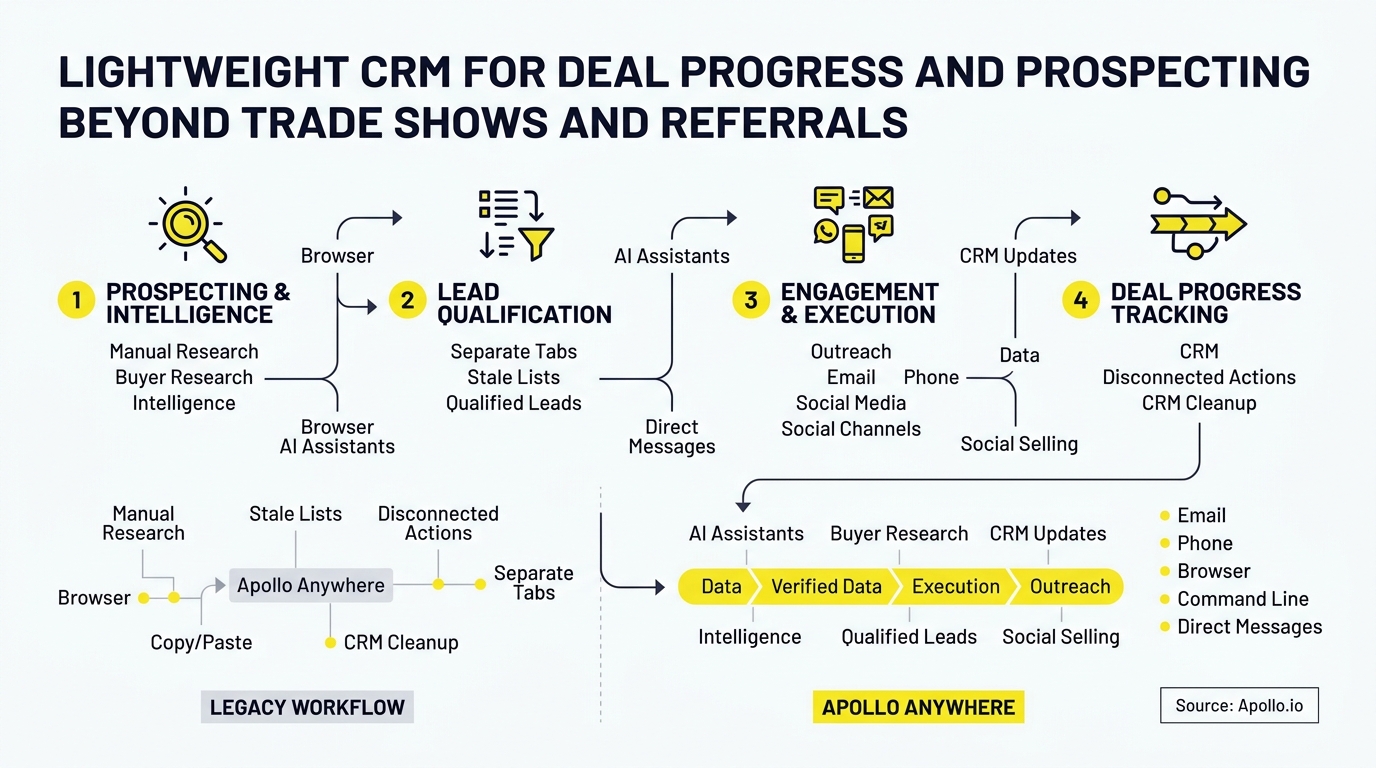

Skip The Research, Apollo Verifies Instantly
Spending hours manually researching leads and chasing bad contact info? Apollo hands your reps verified emails and numbers instantly, so selling time doesn't get eaten by data entry. 98% email accuracy means fewer bounces, more conversations.
Start Free with Apollo →Key Takeaways
- Trade shows and referrals alone can't keep pace with 1,000+ new CPG brands launching every six months.
- A lightweight CRM should auto-capture activity, not add data-entry work reps resent.
- Source attribution (trade show vs. referral vs. outbound vs. signal-based) reveals which prospecting channel actually converts.
- Pairing a simple CRM with a prospecting tool beats buying one bloated, all-in-one suite.
- SDRs, AEs, and RevOps leaders each need different views of the same pipeline data.
What Is A Lightweight CRM For CPG Sales?
A lightweight CRM for CPG sales is a simplified deal-tracking system that logs pipeline stages, contacts, and activity without the configuration overhead of enterprise platforms. It's built to answer one question fast: where does each brand-account relationship stand right now?
Unlike heavyweight platforms designed for complex approval chains, a lightweight CRM prioritizes speed of entry and clarity of view. This matters because Pipedrive's 2026 survey found 42% of sales and marketing professionals spend at least 40% of their day on non-revenue work, and 62% say fragmented systems cause a missed deal or action every week.
For CPG teams specifically, "lightweight" doesn't mean feature-poor. It means the system captures distributor relationships, retail channel data, and buyer contacts without forcing reps to manually update five different fields after every call.
How Do You Track Deal Progress Without Manual Data Entry?
You track deal progress by automating activity capture: emails, calls, and meetings should log themselves, with reps only updating stage and next-step fields. Passive capture is the single biggest lever for adoption, since Pipedrive's research found only 11% of reps listed closing deals among their most frequent weekly activities, versus 38% who spend most of their time logging calls, emails, and meetings.
A minimum viable CPG deal-tracking model needs:
- Stage exits: Defined criteria to move a brand account from "Discovered" to "Qualified" to "Sampling" to "Proposal Sent" to "Closed-Won."
- Source taxonomy: Trade show, referral, outbound, inbound content, or signal-triggered.
- Stale-deal rules: Auto-flag any deal with no activity in 14-21 days.
- Contact roles: Category buyer, distributor, broker, and decision-maker tagged separately.
Tired of dirty pipeline data slowing down deal reviews? Get complete pipeline visibility with Apollo's deal management tools built for fast-moving GTM teams.

How Can Sales Teams Find New CPG Brand Customers Beyond Trade Shows?
Sales teams find new CPG brand customers by monitoring launch data, retail expansion signals, and firmographic filters instead of waiting for annual events. NielsenIQ reported that established niche brands gained 1.5 percentage points of U.S. market share from 2022-2025 while large national brands lost share, meaning the highest-growth accounts are often small, fast-moving, and invisible to traditional referral networks.
A practical Beyond Trade Shows workflow looks like this:
- Detect a signal: New product launch, funding round, distributor appointment, or retail expansion.
- Qualify against your ICP: Category, price point, distribution channel, and company size.
- Identify decision-makers: Category manager, founder, or head of sales.
- Create the CRM opportunity: Tag source as "signal-based" for attribution.
- Trigger personalized outreach: Reference the specific signal, not a generic pitch.
Struggling to find qualified CPG leads outside your referral network? search Apollo's 240M+ contacts with 65+ filters to build a continuous CPG target-account feed. Apollo's sales prospecting tools help teams find and close the right accounts faster than manual list-building ever could.
How Do SDRs And AEs Use A CRM Differently For CPG Deals?
SDRs and AEs need different views of the same pipeline: SDRs focus on volume and qualification speed, while AEs focus on deal depth and stakeholder mapping. For SDRs, the CRM should surface daily activity targets and flag which signal-sourced accounts haven't been touched in 48 hours.
For Account Executives managing later-stage CPG deals, the CRM needs to track multiple buying-committee members: the category buyer, the distributor rep, and sometimes a co-manufacturing contact. Gartner's 2026 research found 69% of B2B buyers still turn to sales reps to validate AI-generated insights, which means AEs need CRM data that supports credible, informed conversations, not just contact info.
RevOps leaders benefit from a source-attribution dashboard that rolls both views into one report, showing which channel (trade show, referral, outbound, or signal) produces the highest win rate by rep type.
See Deal Stages Before Forecasts Fall Apart
Marketing leads stall before they ever become real opportunities, and nobody can say why? Apollo shows exactly where each deal sits so reps act before it goes cold. Built-In improved win rates using Apollo's scoring and signals.
Start Free with Apollo →What Should A CRM Selection Scorecard Include For CPG Teams?
A CRM selection scorecard for CPG teams should weigh setup speed, activity automation, source tracking, and integration depth over feature count. Use this comparison framework when evaluating options:
| Criteria | Why It Matters For CPG Sales | Minimum Bar |
|---|---|---|
| Setup time | Reps abandon tools that take weeks to configure | Live pipeline in under a day |
| Activity auto-logging | Reduces the non-revenue work reps resent | Email, call, and meeting capture without manual entry |
| Source/channel tagging | Reveals which prospecting method actually converts | Custom field for trade show, referral, outbound, signal |
| Prospecting integration | Connects deal tracking to new-account discovery | Native or API-based data enrichment |
| Stale-deal alerts | Prevents deals from silently dying | Automated flags after 14+ days of inactivity |
Return on a properly implemented CRM is significant:SellersCommerce reports that well-implemented CRM systems yield an average return of $8.71 for every $1 spent. A CRM integration strategy that actually works starts with this scorecard, not a feature checklist.
How Do You Build A Source-Attribution Dashboard For CPG Prospecting?
You build a source-attribution dashboard by tagging every deal with its origin channel at creation, then reporting win rate and deal velocity by source over time. This single dashboard answers the question every revenue leader asks: is our trade show budget outperforming outbound, or is it the other way around?
Structure the dashboard around four columns: source channel, deals created, win rate, and average days-to-close. Update it monthly, not quarterly, since CPG buying cycles move fast when a brand is actively expanding distribution.
This is also where Ideal Customer Profile criteria pay off. If signal-based accounts convert at a higher rate than referrals, that's a signal to invest more in continuous prospecting and less in event budgets.
What Does A 30-Day Implementation Checklist Look Like?
A 30-day implementation checklist moves a CPG sales team from scattered spreadsheets to a working lightweight CRM and prospecting motion in four weekly phases:
- Week 1: Configure pipeline stages, source taxonomy, and stale-deal rules. Import existing contacts and connect email/calendar for auto-logging.
- Week 2: Connect a prospecting data source and build your first signal-based target list (new launches, retail expansions, funding events).
- Week 3: Launch outreach sequences referencing specific signals. Train SDRs and AEs on stage-exit criteria.
- Week 4: Build the source-attribution dashboard and review first-month data with RevOps.
Spending hours a week on manual outreach instead of selling? automate your sequences with Apollo's multi-channel sales engagement platform and free up time for the conversations that actually close deals.
Teams that consolidate their stack see the impact directly. Collin Stewart of Predictable Revenue put it simply: "We reduced the complexity of three tools into one." That's the model CPG teams need: one lightweight CRM, one prospecting engine, connected instead of stitched together.
What Is The Best CRM And Prospecting Setup For A Growing CPG Sales Team?
The best setup for a growing CPG sales team pairs simple, automated deal tracking with continuous account discovery rather than relying on one all-in-one suite or one seasonal event. Apollo brings B2B data, sales engagement, and AI-powered execution together in one connected go-to-market system, so CPG sales teams don't have to stitch together separate vendors for research, outreach, and deal tracking.
Apollo is trusted by companies including Anthropic, Smartling, Redis, Spotdraft, and Superside, spanning industries from AI research to legal technology to global creative services. For a CPG team choosing between a bloated platform like the one referenced in HubSpot's CRM product page and a focused, lightweight stack, the deciding factor is usually speed to value: how fast can reps get a working pipeline and a live prospecting feed without a lengthy implementation.
Explore Apollo's CRM integration options to connect your existing system, or check out how contact enrichment tools keep buyer data current as brands scale distribution.
Frequently Asked Questions
Do CPG Sales Teams Really Need A CRM If They Already Track Deals In A Spreadsheet?
Yes, because spreadsheets can't auto-capture activity, flag stale deals, or tie source data to win rates. According to SchedulingKit, 74% of small businesses have already implemented a CRM as of 2025, with 91% of companies with 11+ employees now using one.
How Do You Prospect For CPG Brands Beyond Referrals And Trade Shows?
Monitor product-launch trackers, retail expansion news, and funding announcements to build a continuous target-account list instead of waiting for the next event or warm intro. Combine this with filtered search on a sales intelligence platform to identify decision-makers at each newly discovered brand.
What's The Difference Between A Lightweight CRM And A Full GTM Platform?
A lightweight CRM focuses narrowly on deal-stage tracking and contact records, while a full GTM platform adds prospecting, enrichment, and engagement in one workspace. Growing teams often start lightweight, then consolidate as pipeline complexity increases.

Ready To Replace Guesswork With A Connected CPG Sales Motion?
Trade shows and referrals will always play a role in CPG sales, but they can't be the whole strategy when over a thousand new brands launch every six months. Pairing simple deal tracking with continuous, signal-based prospecting is how growing teams keep pace without adding headcount or complexity.
To see why Apollo stands alone as the only fully agentic GTM platform, combining sales intelligence, outbound execution, and enrichment in one workspace, start free with Apollo today. Schedule a Demo to see how your CPG sales team can turn continuous discovery into predictable pipeline.
Scale Outreach Without Adding Headcount
Struggling to justify tool spend without hard numbers on time saved or pipeline built? Apollo replaces manual busywork with automated prospecting your whole team can scale. GTM Ops drove 4x more meetings without hiring a single rep.
Start Free with Apollo →Don't miss these
Sales
Inbound vs Outbound Marketing: Which Strategy Wins?
Sales
What Is a Sales Funnel? The Non-Linear Revenue Framework for 2026
Sales
What Is a Go-to-Market Strategy? The 2026 GTM Playbook
See Apollo in action
We'd love to show how Apollo can help you sell better.
By submitting this form, you will receive information, tips, and promotions from Apollo. To learn more, see our Privacy Statement.
4.7/5 based on 9,690 reviews
