
Lead Generation for SaaS Companies: Why You Need to Sell to CTOs Before They Ever Fill Out a Form
Most SaaS lead generation is built for a buyer who no longer exists: someone who clicks an ad, fills out a form, and waits for a rep to explain the product.
Today's CTOs and VP-level buyers pick their preferred vendor in private, long before they talk to sales, and they do it using signals your form never captures.
The SaaS companies winning in 2026 aren't the ones with the most forms. They're the ones who show up inside the right account's tech stack, with the right message, before a competitor even knows the deal exists.
That starts with Apollo's B2B lead generation tools, which let teams build and work these lists in one workspace instead of stitching together a database, a sequencer, and a CRM sync.

Apollo Ends Hours Of Contact Research
Reps burning hours hunting down the right contacts before they can even send an email? Apollo surfaces verified prospects instantly with 98% email accuracy, so outreach starts same-day, not next week.
Start Free with Apollo →Key Takeaways
- SaaS buyers pick a preferred vendor before talking to sales, so targeting has to happen earlier, not after a form fill.
- Technographic filtering (who uses a competitor's tool) is the highest-signal way to find SaaS buyers ready to switch.
- Selling to CTOs means reaching both the economic buyer and the technical champion in the same motion.
- Inbound trial signups need instant, rules-based routing to the right AE, not a queue.
- Apollo lets SaaS teams build the list, run the sequence, and route the trial inside one connected system.
Why Can't SaaS Companies Wait for the Form Fill Anymore?
The buyer has already decided before they talk to you. That is the uncomfortable truth behind modern SaaS sales cycles, and it is backed by buyer behavior data across the category.
SaaS and fintech buying committees research quietly, compare vendors against their current stack, and arrive at sales conversations with a shortlist already formed. By the time a CTO requests a demo, they have usually already ruled out two or three alternatives.
This changes what "lead generation" has to mean for a SaaS company. It is no longer only about generating form fills.
It is about identifying the accounts most likely to be mid-evaluation right now, based on what tools they run, who they just hired, and what their engineering team is searching for, and reaching the economic buyer and technical champion before they've committed to someone else.
How Do SaaS Companies Sell to CTOs Without Getting Ignored?
Selling to CTOs fails when it looks like every other cold email a CTO gets: generic, feature-first, and addressed to "Director of Engineering" instead of a real person's actual stack.
CTOs and CIOs respond to specificity. They want to know you understand what they're already running, what's breaking, and why now is the moment to look at something new.
That means the message has to reference their current tooling, their team's likely pain point, and a department head who will actually use the product day to day, not just the executive who signs the contract.
Relevance beats personalization here. Sending "Hi {{first_name}}" to a thousand CTOs is table stakes and gets deleted.
Sending one CTO a message that reflects the exact tool they're paying for, the exact team size that's straining it, and the exact moment they're likely frustrated is what gets a reply.
Apollo's AI-powered lead scoring helps SaaS teams prioritize which CTOs to approach first, based on company website signals, CRM history, and prospecting activity, so reps spend their limited outreach windows on the accounts most likely to convert.
What Makes a Technographic List Different From a Regular Prospect List?
A technographic list is a prospect list filtered by the specific software a company already has installed, not just by industry or headcount. For SaaS companies selling a replacement or complementary product, this is the single highest-signal targeting method available.
A generic list says "mid-market fintech companies with 50-200 employees." A technographic list says "mid-market fintech companies currently running Competitor X's platform, with a CTO hired in the last 18 months."
The second list converts better because it tells you two things a generic list cannot: the prospect has budget allocated to this problem already, and they have a reason to be unhappy or curious about alternatives.
Apollo's database includes technologies-used as one of its 65+ filters, alongside headcount, funding, hiring activity, and job changes, so SaaS teams can build this exact list without guessing.
How Does This Work Step by Step Inside Apollo?
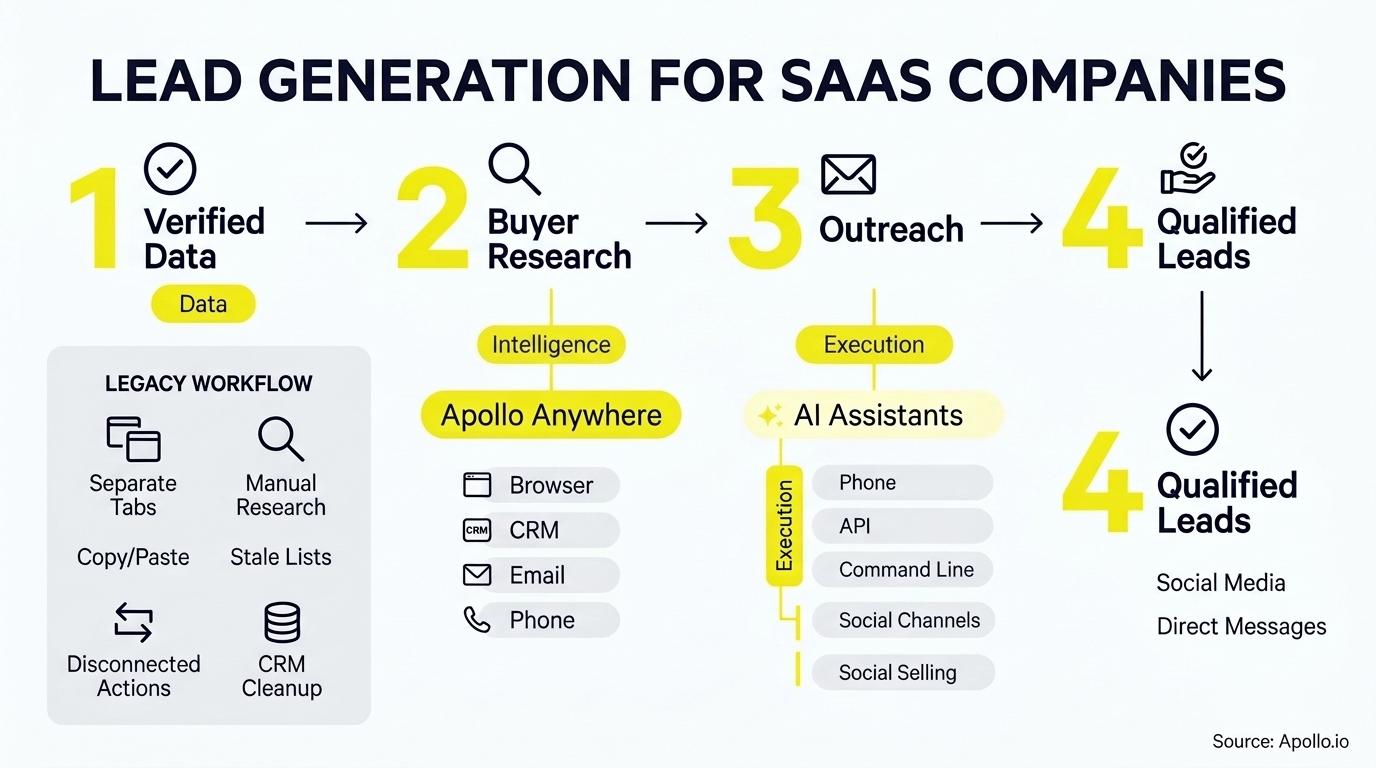
Here's the prototypical workflow a B2B SaaS team runs inside Apollo, start to finish.
| Step | Action | Where It Happens |
|---|---|---|
| 1. Build the list | Filter Apollo's database for companies currently on a competitor's tech stack, in target industries (SaaS, fintech, mid-market), at the right headcount | Apollo Search |
| 2. Pull the contacts | Identify the CTO (economic buyer) and the relevant department head (technical champion) at each account | Apollo database, or the Chrome extension while browsing a prospect's site or professional networks-adjacent profile |
| 3. Score and prioritize | Apply AI-powered lead scoring using firmographic fit, website activity, and intent signals to rank which accounts to contact first | Apollo Scores |
| 4. Run the sequence | Launch a multi-step sequence blending email, phone, and social touchpoints, personalized to the specific tech stack each account runs | Apollo Sequences |
| 5. Route inbound trials | When a CTO or team member from a targeted account signs up for a trial, route them instantly to the AE who owns that account or territory | Apollo Inbound |
| 6. Keep the CRM current | Sync enriched contact data, sequence activity, and trial status automatically | Apollo synced to Salesforce |
For example, a B2B SaaS company selling a data warehouse tool can filter Apollo for companies running a competitor's product, pull the CTO and the head of data engineering at each account, and launch a sequence referencing a known limitation of that competitor's platform. When one of those accounts signs up for a trial, Inbound routes it instantly to the AE who already has context on that account, instead of sitting in a shared queue.
This is the kind of outcome Collin Stewart's team saw when they consolidated their stack. Census, a SaaS data company, said simply: "We cut our costs in half."
Struggling to find which accounts are actually running your competitor's stack right now? Search Apollo's 240M+ contacts with 65+ filters, including technologies used.

Apollo Scores And Routes Leads Instantly
Reps fighting over which leads are actually hot while good ones go cold waiting for follow-up? Apollo's scoring ranks prospects by fit and intent, then routes them to the right rep automatically. Stop guessing, start closing.
Start Free with Apollo →Who Should SaaS Companies Actually Be Targeting?
Apollo's recommendation for B2B SaaS teams is to target CTOs, CIOs, and VP-level buyers at SaaS, fintech, and mid-market companies, not a broad "all software buyers" list.
These titles control or heavily influence the technical buying decision, and they are the people most likely to be evaluating a stack change when a competitor's tool is underperforming, a contract is renewing, or a new hire is pushing for change.
Pairing the CTO with a department head (the technical champion who will use the product daily) matters just as much as reaching the executive. Deals stall when only the economic buyer is engaged and no one on the ground is pulling for the switch internally.
Mid-market companies are a particularly strong fit for this motion. They move faster than enterprise and have more budget flexibility than early-stage startups, which means a well-timed, well-targeted outbound sequence can shorten what would otherwise be a long evaluation cycle.
What Does the Rest of the Market Get Wrong About SaaS Lead Gen?
Most SaaS marketing teams are still measuring success by MQL volume, even though buying committees now involve multiple stakeholders and far more research before any form gets filled out. According to Content Marketing Institute, 56% of B2B marketers struggle to attribute content ROI and an equal share struggle to track the customer journey, which means most teams genuinely don't know which pre-form activity is driving their pipeline.
At the same time, the content being produced for that journey still isn't translating into trust with buyers. A study by TrustRadius found that 78% of technology buyers shortlist products they already knew before they started researching, which means brand familiarity built before outreach even starts is doing more work than the outreach itself.
This is why technographic targeting and CTO-specific messaging outperform generic outbound. It meets a buyer who already has budget and intent, instead of trying to create demand from zero.
Spending hours manually building sequences for each account segment? Automate multi-step sequences across email, phone, and social with Apollo.
How Should SaaS Teams Measure This Differently?
Lead-timing and ownership need to be explicit, not assumed. A simple scorecard keeps marketing, sales, and product aligned on who owns each stage and what "ready" actually means.
| Signal Stage | What It Looks Like | Owner |
|---|---|---|
| Fit signal | Account matches technographic + firmographic criteria (right stack, right size, right industry) | Marketing / RevOps |
| Intent signal | Website visits, content engagement, or hiring activity suggesting active evaluation | Marketing |
| Engagement signal | Replies to sequence, opens from multiple stakeholders at the account | Sales (SDR/AE) |
| Product signal | Trial signup, feature usage, or in-app activity from a targeted account | Product / AE |
| Routing | Instant assignment to the AE who owns that account or segment | RevOps |
What Does a 90-Day Rollout Look Like?
Teams don't need to rebuild their entire GTM motion overnight. A focused 90-day plan gets the technographic, CTO-first motion running without disrupting existing pipeline.
| Phase | Timeframe | Focus |
|---|---|---|
| Audit | Days 1-30 | Identify gaps in current targeting, pull technographic lists for top 2-3 competitor stacks, map CTO + department head pairs |
| Launch | Days 31-60 | Build and launch two enablement assets (a stack-switch sequence and a trial-routing workflow), instrument scoring signals |
| Review | Days 61-90 | Review pipeline sourced from technographic lists, adjust scoring weights, expand to additional competitor stacks |
Frequently Asked Questions
What Is Technographic Lead Generation for SaaS Companies?
Technographic lead generation means building prospect lists filtered by the specific software a target company already uses, rather than relying only on industry or employee count. For SaaS companies, this surfaces accounts that already have budget for the problem category and a specific reason to consider switching.
How Do SaaS Companies Convert Inbound Trial Signups Faster?
Instant, rules-based routing matters more than response speed alone. When a trial signup matches a previously targeted account, the system should route it directly to the AE who already has context, instead of placing it in a general queue.
Is Technographic Targeting the Same as Firmographic Targeting?
No. Firmographic targeting filters by company attributes like industry, revenue, and headcount.
Technographic targeting filters specifically by the tools and platforms a company has installed, which is a stronger intent signal for SaaS replacement or add-on sales.

Get Leads Now
SaaS buyers are picking vendors before they ever talk to sales, which means the companies that win are the ones reaching the right CTO, with the right message, at the moment their current stack starts to strain.
Apollo brings the technographic list, the CTO-level targeting, the multi-step sequence, and the inbound trial routing into one workspace, so SaaS teams stop losing deals to timing and start winning them with relevance. Get Leads Now and start building your first technographic list today.
Scale Outreach Without Adding Headcount
Can't scale outreach without hiring more reps? Apollo automates prospecting so your team sends more personalized without burning through credits or budget. One agency drove 4x more meetings and matched 3 SDRs with just one.
Start Free with Apollo →Don't miss these
Sales
Inbound vs Outbound Marketing: Which Strategy Wins?
Sales
What Is a Sales Funnel? The Non-Linear Revenue Framework for 2026
Sales
What Is a Go-to-Market Strategy? The 2026 GTM Playbook
See Apollo in action
We'd love to show how Apollo can help you sell better.
By submitting this form, you will receive information, tips, and promotions from Apollo. To learn more, see our Privacy Statement.
4.7/5 based on 9,690 reviews
