Most fintech and payments companies chase leads by blasting "revenue growth" messages to anyone with a business email. The better motion starts with the buyer: the owner or CFO at an ecommerce, retail, or SaaS business who is already paying processing fees every month.
This guide covers B2B lead generation for fintech and payments companies selling to businesses, not consumer fintech marketing. You will leave with a target list to build, a message angle, and a 90-day plan, all runnable in Apollo's B2B lead generation tools.
The first list to build is an ecommerce business owner list, followed by a CFO email list for the same accounts.

Skip Manual Research, Fill Pipeline With Apollo
Tired of spending hours researching leads and verifying contact info instead of selling? Apollo finds business contacts with 98% email accuracy, so your reps spend their day in conversations, not spreadsheets. Start free and see how fast your pipeline moves.
Start Free with Apollo →Key Takeaways
- Target the owner and the CFO at the same business, not one or the other.
- Segment ecommerce and retail accounts by revenue band before you write a single message.
- Lead outreach with a specific cost problem, like processing fees, and offer a rate comparison.
- Add partner and integration channels so you are not relying on cold outreach alone.
- Score accounts for readiness before handing them to sales.
Who Should Fintech Companies Target First?
Start with owners and CFOs at ecommerce, retail, and SaaS businesses that process payments. These are the people who feel processing costs, reconciliation delays, and failed payments directly.
Our data shows that payments and fintech sellers reach the owner and the CFO in nearly equal measure. Treat that as a signal to build both lists for every account, because one person often feels the pain and the other approves the spend.
Cross-industry research shows how crowded these decisions are. Forrester's 2024 research found an average of 13 internal participants in B2B purchasing decisions, with 89% of purchases involving at least two departments.
Build this first list today:
- Filter for ecommerce, retail, and SaaS companies in Apollo.
- Split them into two revenue bands: SMB and mid-market.
- Pull the owner or founder and the CFO or head of finance at each account.
How Do You Build an Ecommerce Business Owner List?
An ecommerce business owner list works best when it is built around a payment problem, not a generic industry label. Owners respond to messages about margin and checkout, so segment before you write.
Follow these steps:
- Search ecommerce and retail companies with Apollo's B2B database (240M+ people, 30M+ companies, 65+ filters), then narrow by revenue band and headcount.
- Filter titles for founder, owner, and CEO, which is typically who controls the merchant account at smaller companies.
- Add technology and hiring filters to find stores that recently added payment methods or finance staff.
- Save the list and tag it by revenue band so each band gets its own message.
Struggling to find qualified leads? Search Apollo's 240M+ contacts with 65+ filters and save your first owner list in minutes.
How Do You Build a CFO Email List?
A CFO email list is a targeted set of finance leaders at the accounts you already chose, not a bulk purchase. CFOs care about fees, cash flow, and reconciliation, so your list should keep them attached to the same businesses as the owners.
Across financial services sellers broadly, the C-suite and finance department dominate who teams search for, with CFOs searched nearly as often as owners. Expect competition for a CFO's inbox and plan for relevance over volume.
Run this workflow:

- Use the same account list from the owner search.
- Filter by seniority and department to pull the CFO, VP of Finance, or controller.
- Fill gaps with Waterfall Enrichment so records are complete before you sequence.
- Keep owner and CFO in separate sequences with different openers.
How Can Fintech Companies Generate Leads Without Cold Outreach?
Cold outreach is one channel, not the whole system. Partnerships often carry more weight in fintech than in other industries.
The World Economic Forum and Cambridge 2025 study found that 84% of surveyed fintechs collaborate with incumbent financial institutions, and 52% report API integrations. The sample covers retail-facing fintechs, so treat it as direction on partnership behavior rather than a B2B conversion benchmark.
Test these low-cost channels this quarter:
- Publish an integration guide for each ecommerce platform or accounting tool you connect with.
- Ask accountants and fractional CFOs who serve merchants for referrals.
- Host a joint webinar with a platform partner on payment costs or reconciliation.
- Keep pricing, security, and implementation pages ungated so buyers can evaluate before they talk to sales.
Track partner-sourced opportunities separately from direct inbound so you can see which channel earns its keep.
How Do You Earn Trust and Handle the Fintech Sales Cycle?
Fintech buyers want proof before a meeting, and the cycle often involves security and finance review. Cost reflects that: LeadSpot reports that fintech ranks among the most expensive customer acquisition verticals due to regulatory friction, security vetting, and multi-stakeholder procurement.
Build a buyer evidence kit before you scale outreach:
| Stakeholder | What They Ask For | What To Send |
|---|---|---|
| Owner | Will this cut my costs? | Rate comparison and a short case example |
| CFO | What is the true all-in cost? | Fee schedule and reconciliation walkthrough |
| Technical lead | How hard is the integration? | API documentation and implementation outline |
| Risk or procurement | Is it secure and compliant? | Security overview and compliance documentation |
Before passing an account to sales, score it on stakeholder coverage (owner and CFO identified), fit (revenue band and payment volume), and trigger (new funding, expansion, or a platform change). Hand off only accounts that clear your bar on all three.
Turn Forecast Guesswork Into Real Pipeline
Marketing leads that never become real opportunities? Forecasts built on stale deal data. Apollo brings prospecting, engagement, and deal tracking into one connected system, so you see where every deal stands. Teams actively using Apollo's AI Assistant are up 2,156% since December 2025.
Start Free with Apollo →How Does Apollo Help Fintech and Payments Companies Sign More Merchants?
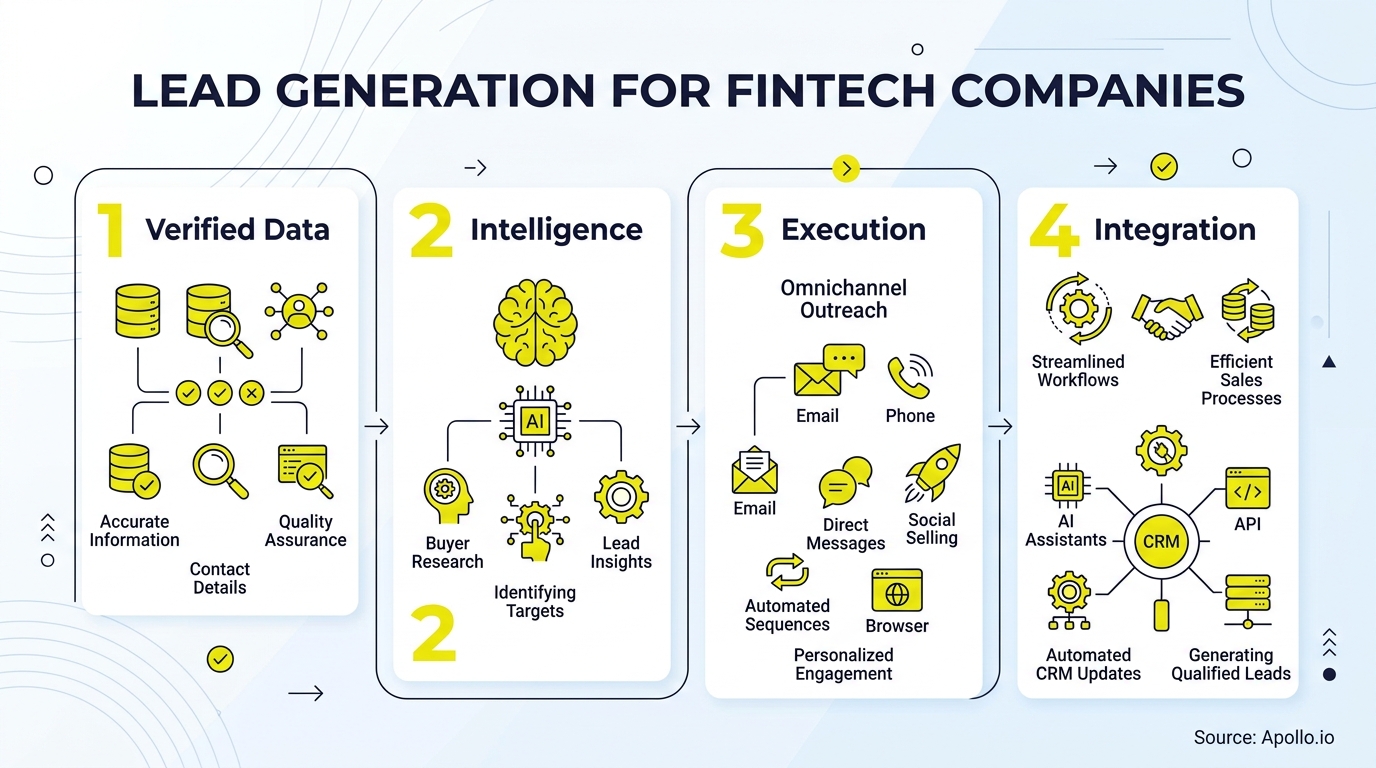
If you're in fintech or payments, Apollo helps you solve three problems: finding the right businesses, reaching both the owner and the CFO, and sending a message tied to a real cost. The data, intelligence, and execution live in one connected system, so you are not stitching together separate vendors.
For example, a payments company can run this workflow:
- Filter for ecommerce and retail businesses by revenue band in Apollo.
- Pull the owner and the CFO at each account.
- Use the AI Assistant to research accounts and draft a message around processing-fee savings.
- Launch sequences that offer a rate comparison as the call to action.
- Sync results to your CRM so reps see activity without manual entry.
Apollo meets you where you already work. With Apollo MCP, Apollo's Model Context Protocol, you can prospect and enrich from inside ChatGPT or Claude, and the Chrome extension surfaces contacts as you browse a prospect's website.
Relevance beats personalization at scale. Putting a first name on a generic pitch is table stakes, while a message tied to a merchant's revenue band and payment problem earns attention.
Spending hours on manual outreach? Automate your sequences with Apollo and keep owner and CFO tracks running side by side.
How Do You Sell to Other Fintech Companies?
If you sell into fintech rather than from it, the buyers are product, engineering, risk, and finance leaders. Use Apollo's industry, title, and seniority filters to find them, and tailor the message to the workflow they own.
Start with company-type and headcount filters, then layer in titles like head of payments or VP of risk. Pull the technical and finance contacts together, since both usually weigh in.
What Does a 90-Day Fintech Lead Generation Pilot Look Like?
Run a 90-day pilot before committing to a full program, and track cost against the pipeline you create. Fintech acquisition is not cheap: DataAlly reports an average customer acquisition cost of about $1,450 per won customer for SMB-focused fintech firms.
| Phase | Timeframe | Focus |
|---|---|---|
| Foundation | Days 1-30 | Build owner and CFO lists, write the evidence kit, set scoring criteria |
| Launch | Days 31-60 | Run sequences by revenue band and start one partner channel |
| Measure | Days 61-90 | Compare cost per accepted opportunity by channel and refine the list |
Measure accepted opportunities and pipeline value, not raw lead counts. Keep one dashboard that shows both channels and both segments.

Frequently Asked Questions About Fintech Lead Generation
How Do Fintech Companies Find Merchants To Sell To?
Filter for ecommerce, retail, and SaaS companies by revenue band, then add the owner and CFO at each account. Start with one band, test a message, and expand from there.
Should I Target The Owner Or The CFO?
Target both. Our data shows payments sellers reach each in nearly equal measure, so run separate sequences with an owner-focused and a CFO-focused opener.
What Message Works For A Payments Offer?
Lead with a specific cost problem, such as processing fees, and make the call to action a rate comparison. Avoid generic growth claims, since buyers avoid irrelevant outreach: Gartner found that 73% of B2B buyers actively avoid suppliers sending irrelevant outreach.
How Do I Know An Account Is Ready For Sales?
Score it on stakeholder coverage, fit, and a trigger such as funding or expansion. Pass it to sales only when all three are in place.
Ready to build your first merchant list? Start Your Free Trial with Apollo and run data, intelligence, and execution from one connected workspace.
Prove Apollo's ROI Before Your Budget Review
Budget approval stuck on unclear time savings and pipeline impact? Apollo brings prospecting, engagement, and deal tracking into one workspace, so wins show up fast. Teams actively using Apollo's AI Assistant are up 2,156% since December 2025.
Start Free with Apollo →Don't miss these
Sales
Inbound vs Outbound Marketing: Which Strategy Wins?
Sales
What Is a Sales Funnel? The Non-Linear Revenue Framework for 2026
Sales
What Is a Go-to-Market Strategy? The 2026 GTM Playbook
See Apollo in action
We'd love to show how Apollo can help you sell better.
By submitting this form, you will receive information, tips, and promotions from Apollo. To learn more, see our Privacy Statement.
4.7/5 based on 9,690 reviews
