
Most analytics vendors chase the technical champion. The better motion is to reach the executive who feels the reporting pain first, usually before an analytics leader exists.
This guide shows you who to target, what to build first, and how to run it, starting with B2B lead generation tools and a head of analytics list that tells you where the gap is.
Here, "lead generation for data analytics companies" means winning customers for your analytics, BI, or data consulting business. It does not mean using analytics to generate leads.

Skip Manual Research, Get Verified Contacts
Tired of hours lost researching leads and verifying contact info while quota clock keeps ticking? Apollo finds business contacts for you with 98% email accuracy. Start spending your day selling, not hunting.
Start Free with Apollo →Key Takeaways
- Sell to the finance and operations executive first. Mid-market companies often feel the reporting pain before they hire an analytics leader.
- Build a "no analytics head" list. It finds companies where your dashboards solve a hire they have not made.
- Offer something useful before a sales call, like a sample dashboard or a data-readiness checklist.
- Target the buying group, not one contact. Finance, operations, and IT all weigh in.
- Run a 90-day pilot with clear tracking before you scale any channel.
Who Should Data Analytics Companies Target For Lead Generation?
Target CFOs, COOs, and heads of analytics at mid-market companies. Which of the three you contact first depends on whether the company already has a data leader.
Our data shows BI and analytics sellers often reach the COO and CFO, not an analytics leader, because many mid-market companies have not hired one yet. Act on that: lead with a business problem like slow month-end reporting or disconnected operations data, not a feature list.
Match the target to your offer, since the buyer changes with what you sell:
| Your Offer | First Contact | Business Problem to Lead With | Buying Trigger |
|---|---|---|---|
| BI or dashboard software | CFO or COO | Manual reporting, no single source of truth | Missed forecast, new board reporting demands |
| Analytics consulting | COO or head of analytics | Data scattered across systems, stalled AI plans | New data initiative, platform migration |
| Data platform or integration | Head of analytics or IT | Unreliable pipelines, ungoverned data | Tool consolidation, compliance review |
Next step: pick one row, then build a list of 50 companies that match it.
How Do You Build A Head Of Analytics List?
A head of analytics list names the companies that already have a data leader, and just as usefully, the ones that do not. Both groups are prospects, with different pitches.
Companies with a head of analytics need integration, scale, or better tooling. Companies without one need an outcome delivered, which is where dashboards as "the first hire they don't have to make" lands.
- Filter for mid-market companies, roughly 200 to 1,000 employees, in your best-fit industries.
- Search for titles like Head of Analytics, Director of Data, and VP of BI.
- Save two lists: companies that return a data leader, and companies in the same filter that return none.
- Send the first list a tooling or scale message, and the second a business-outcome message.
For example, Apollo's B2B database covers 240M+ people and 30M+ companies with 65+ filters, so you can search by title, headcount, and industry in one pass.
Struggling to find qualified leads? Search Apollo's 240M+ contacts with 65+ filters.
Next step: build both lists this week and compare their size.

How Do You Build CFO And COO Lists That Convert To Conversations?
Build CFO and COO lists around the company's pain, then segment by what each executive owns. A CFO cares about close speed and forecast accuracy, and a COO cares about throughput and cost visibility.
Across IT services and software sellers, owners, CEOs, and founders are searched for more than any technical title, with CTOs and CIOs close behind. The pattern points the same way for analytics: the economic buyer usually gets the first touch, not IT.
- Filter by title (CFO, COO, VP Finance, VP Operations) and mid-market headcount.
- Exclude companies with a head of analytics if you are running the "first hire" pitch.
- Write one message per persona. Give the CFO a reporting problem and the COO an operations-visibility problem.
- Offer a sample dashboard built on a public or sample dataset, not a demo request.
Relevance beats personalization. A first name merge is table stakes; naming the right problem at the right moment is what earns a reply.
Next step: draft two short messages, one per persona, and test them on 25 contacts each.
How Can Analytics Companies Generate Leads Without Outbound?
Lead with self-service proof so buyers can evaluate you before they talk to a rep. Gartner's 2025 buyer survey found that 61% of B2B buyers preferred a rep-free buying experience. That is cross-industry evidence, not an analytics benchmark, so treat it as a reason to test.
Build these assets first:
- A data-readiness diagnostic that scores a company on data quality, ownership, and tooling.
- Sample dashboards by function (finance, operations, sales) buyers can explore without a form.
- An implementation guide that shows realistic timelines and who is involved.
- A benchmark or research piece with its methodology shown, since buyers trust evidence they can verify.
Cloud marketplaces and partner referrals are a second channel to test. Treat marketplace-sourced opportunities separately from deals that merely transact there, so you can see what generated the lead.
Next step: ship one diagnostic, then route every completion into your CRM with its score.
How Do You Earn Trust And Handle The Analytics Sales Cycle?
Earn trust by making your claims easy to check. Research on enterprise analytics buying links the premium on cost to complex technical buying committees, data governance reviews, and 6–18 month enterprise sales cycles, so expect several stakeholders and a slow start.
Plan for these buyer needs:
- Proof: publish customer outcomes with specifics, and send buyers to reviews they can verify. Many buyers fact-check AI-generated answers, so claims need evidence behind them.
- Objections: prepare answers on security, integration with their existing stack, and who maintains the dashboards after launch.
- Evaluation: offer a bounded pilot with agreed success criteria, such as reporting time saved, rather than an open-ended trial.
- Timing triggers: watch for a new CFO or COO, a funding round, a platform migration, or a failed forecast.
Next step: write down the three objections you hear most and publish a plain answer to each.
How Does Apollo Help Data Analytics Companies Win Customers?
If you're a data, analytics, or BI vendor, Apollo solves three problems: finding mid-market buyers with no analytics head, reaching finance and operations executives with a relevant message, and keeping your CRM current as accounts change.
For example, a BI vendor can run this workflow:
- Find the accounts. Filter for companies with 200 to 1,000 employees in your target industries, then search for CFO, COO, and VP Operations titles.
- Spot the gap. Check which accounts return no head of analytics or data lead. Those are your "first hire they don't have to make" prospects.
- Prioritize. Use scoring and prioritization to rank accounts by fit, and layer buying signals like hiring and funding.
- Prospect where you work. With the Chrome extension, pull a verified contact from a company's website or Gmail. With Apollo MCP, Apollo's Model Context Protocol, ask for the same list inside ChatGPT or Claude without opening another tab.
- Run outreach. Launch a multichannel sequence through sales engagement that offers your sample dashboard, and route replies to the right owner.
- Keep the CRM clean. Sync contacts and activity so your pipeline reflects who actually engaged.
Spending hours on manual outreach? Automate your sequences with Apollo.
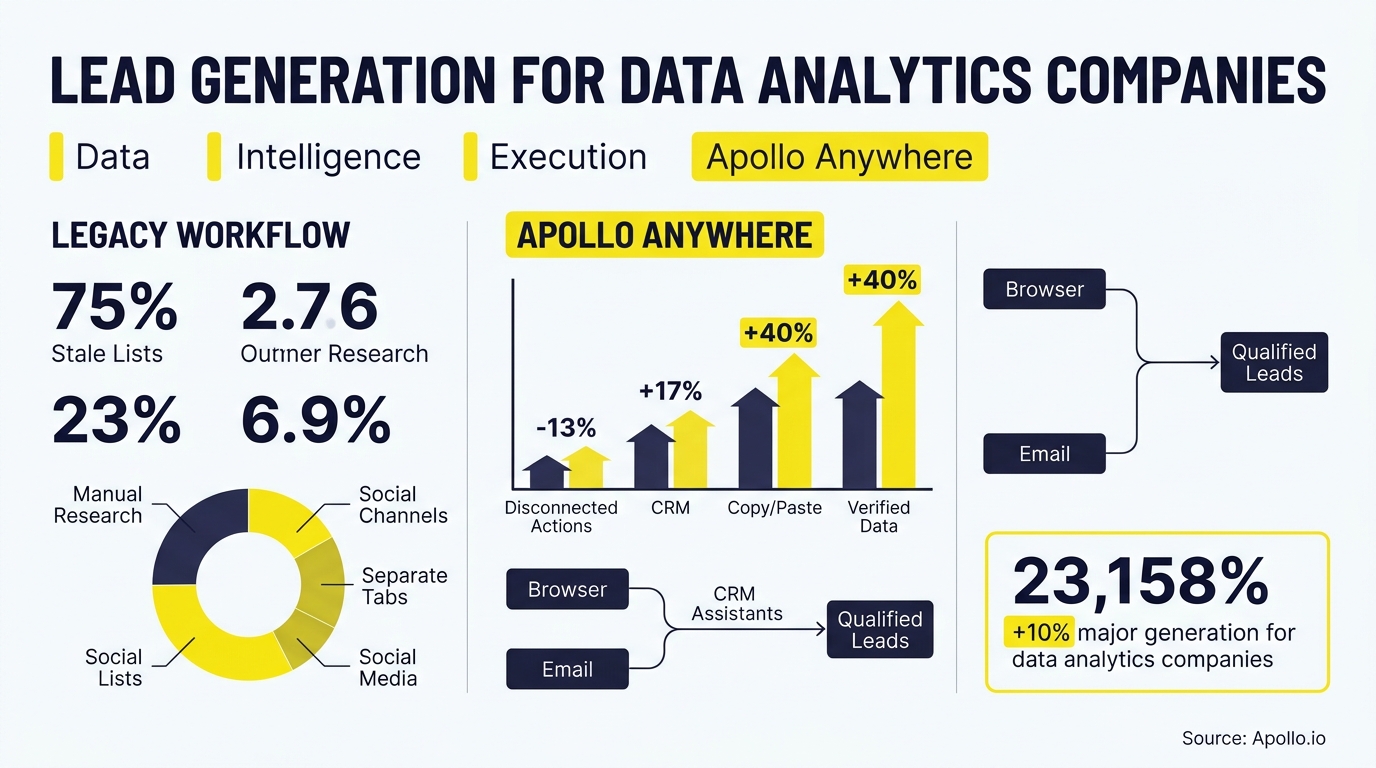
Apollo brings data, intelligence, and execution into one connected system, so your team does not stitch together separate tools for research, outreach, and tracking.
Next step: build the "no analytics head" list in Apollo and send the first 25 messages.
Reach Buyers Before Your Forecast Slips
Struggling to fill the funnel with leads that actually turn into opportunities? Apollo surfaces the right business contacts at right moment, so your outreach lands while buyers are still in motion. Teams actively using Apollo's AI Assistant are up 2,156% since December 2025.
Start Free with Apollo →How Do You Qualify Analytics Leads By Data Readiness?
Score leads on business ownership, data readiness, and fit before they reach a rep. Gartner found that 63% of organizations lacked, or were unsure they had, appropriate data-management practices for AI. Readiness is uneven, so qualify before you pitch.
Treat the thresholds below as hypotheses to test, not benchmarks:
| Signal | Points (Hypothesis) | Why It Matters |
|---|---|---|
| Executive sponsor identified (CFO or COO) | 3 | A business owner can approve budget |
| Diagnostic completed | 2 | Shows active interest and gives you data |
| Data scattered across 3+ systems | 2 | Strong fit for integration or BI |
| Named trigger (new hire, migration, funding) | 2 | Creates a reason to act now |
| No data owner at all | -1 | Needs education before a sales conversation |
Two routing examples show how it works. A 400-person manufacturer with a COO sponsor, data in four systems, and a pending migration scores high and goes to a consultation.
A 250-person company with a completed diagnostic but no owner scores low and goes to a nurture sequence with an implementation guide.
Next step: add a score field to your CRM and log it for every new lead.
What Should A 90-Day Lead Generation Pilot Look Like?
Run one pilot with a baseline, two test cohorts, and fields you can audit. Buyers use many channels (McKinsey's 2024 research found an average of 10), so measure the whole path, not one touchpoint.
| Phase | Timeframe | What To Do |
|---|---|---|
| Baseline | Days 1-14 | Record current lead sources, response rates, and meeting-to-opportunity conversion |
| Launch | Days 15-45 | Split targets into two cohorts: outbound plus diagnostic versus diagnostic only |
| Optimize | Days 46-75 | Compare cohorts by persona, message, and score; adjust the weakest step |
| Review | Days 76-90 | Calculate cost per qualified opportunity; set a date to revisit wins as the cycle matures |
Track these fields on every record: source, persona, readiness score, offer used, stage, and cost. Cost per lead varies widely, and First Page Sage reports a $310 paid CPL in one benchmark. The research for this guide did not establish analytics-specific CPL norms, so set your own baseline instead of borrowing one.
Next step: pick your two cohorts and write the tracking fields before you send a single message.
How Do You Sell To Analytics Companies?
If you are prospecting data, analytics, and BI vendors rather than winning their customers, target founders, CEOs, and heads of sales and marketing. These companies buy partner programs, data, tooling, and services.
Use Apollo's industry, title, and seniority filters to build the list, then add headcount and technology filters. Lead with the vendor's own growth problem, such as pipeline or partner reach.
Next step: build a 50-account list of analytics vendors and filter by seniority.
Frequently Asked Questions
What Is A Qualified Lead For An Analytics Company?
A qualified lead has a business owner, a defined problem, and a reason to act now. Score on those three, and review your thresholds after your first closed deals.
Which Channels Work Best For Analytics Lead Generation?
The channels worth testing are outbound to finance and operations executives, self-service assets like diagnostics and sample dashboards, partner referrals, and cloud marketplaces. Run them against a baseline instead of assuming any one wins.
How Much Does An Analytics Lead Cost?
Costs vary by channel, deal size, and sales cycle, and no analytics-specific CPL norm was established in the research behind this guide. Track your cost per qualified opportunity across the 90-day pilot and use it as your benchmark.
Should I Target The CFO Or The Head Of Analytics?
Target the CFO or COO if the company has no data leader, and the head of analytics if it does. Build both lists and test one message for each.

Ready To Win More Analytics And BI Customers?
The best prospects are often the finance and operations leaders who need analytics but have not hired for it yet. Find them early, offer proof before a sales call, and measure what the pilot produces.
Ready
to build your first CFO, COO, and head of analytics lists? Start a Trial with Apollo to find the right buyers, prioritize them, and run outreach from one connected workspace.
Prove Pipeline ROI Fast With Apollo
Budget approval stuck on unclear ROI? Apollo shows what your outreach delivers, so you can defend every dollar. Customer. io drove +50% YoY growth, and Leadium tripled annual revenue by speeding up follow-up. Start free and see results before renewal talks.
Start Free with Apollo →Don't miss these
Sales
Inbound vs Outbound Marketing: Which Strategy Wins?
Sales
What Is a Sales Funnel? The Non-Linear Revenue Framework for 2026
Sales
What Is a Go-to-Market Strategy? The 2026 GTM Playbook
See Apollo in action
We'd love to show how Apollo can help you sell better.
By submitting this form, you will receive information, tips, and promotions from Apollo. To learn more, see our Privacy Statement.
4.7/5 based on 9,690 reviews
