
Most agencies still wait for the next referral, then wonder why the pipeline feels fragile. The better motion is to pick the brand-side buyer first, reach them before the review cycle starts, and show up with a relevant idea instead of a generic credentials deck.
This guide is about generating clients for your agency, not leads for your clients. You will leave with a target list to build, a message angle, a qualification rule, and a 30-day plan, all runnable with Apollo's B2B lead generation tools.
If you are building a CMO email list or a marketing director list, the list matters less than the signal behind it: who is planning, who is hiring, and who is about to reconsider their media mix.

Skip Manual Research, Reach Verified Buyers
Tired of burning hours researching leads and double-checking contact info? Apollo finds prospects and delivers business contact info with 98% email accuracy. More time selling, less time hunting, so your pipeline stops stalling. Start today.
Start Free with Apollo →Key Takeaways
- Target marketing directors first, then CMOs and brand managers, at mid-market and enterprise consumer brands.
- Reach brands before planning season with a short media plan teaser, not a credentials deck.
- Use referrals as one channel, not your whole pipeline.
- Qualify every opportunity with a bid/no-bid check before you spend on a pitch.
- Keep your CRM current so every new brand-side contact is tracked to a win.
Who Should Advertising Agencies Target To Win More Brand Accounts?
Target consumer brands in the mid-market and enterprise bands, especially apparel, retail, and CPG. The buyers are marketing directors, CMOs, and brand managers.
Our data shows that media and advertising agencies target marketing directors slightly more than CMOs, especially at apparel and retail brands. The takeaway: the marketing director often owns the agency brief day to day, so start there and bring the CMO in as a second thread.
Many agencies also see that the founder or owner is the most common target across agencies and marketing companies broadly, because small buyers are owner-led. For mid-market and enterprise brand work, that pattern flips toward marketing titles.
The market context supports being deliberate. RSW/US reports that 75% of advertising and marketing agency executives say new business has become harder, primarily because it is difficult to break through to prospects.
Build this list first:
- Apparel, retail, and CPG brands in your revenue band.
- Marketing directors and brand managers at those brands.
- CMOs at the same accounts as your second contact.
Struggling to find qualified leads? Search Apollo's 240M+ contacts with 65+ filters.
How Do You Build A CMO Email List That Actually Fits Your Agency?
A useful CMO email list is narrow, not large. Filter by industry, headcount, revenue, location, and seniority, then keep only brands where your category experience is a real fit.
Set these steps this week:
- Filter by consumer apparel, retail, and CPG industries and your target headcount range.
- Filter by title: CMO, Chief Marketing Officer, and VP Marketing.
- Cut accounts where you have a conflict or no relevant case study.
- Verify emails before any outreach goes out.
Keep it to a list you can personalize, roughly one theme per batch. A CMO list of 50 well-matched brands will do more for you than 5,000 names.
How Do You Build A Marketing Director List For Brand-Side Outreach?
The marketing director list is your primary working list. These buyers run channel plans, manage agency relationships, and feel pain first when results slip.
Build it in four moves:
- Start from the same account list you built for CMOs.
- Add titles: Marketing Director, Director of Brand, Head of Media, and Brand Manager.
- Group contacts by brand so one agency voice reaches the whole marketing team.
- Enrich missing fields so no brand sits half-complete.
Relevance beats personalization here. Mentioning a first name at volume is table stakes, so lead with the right signal, such as a new product line, a seasonal launch, or a hiring change on the brand team.
How Do You Generate Agency Leads Without A Big Tool Budget?
Referrals matter, but they should not be your only source. RSW/US found that 93% of surveyed marketing and professional services firms said their growth engine was not strong enough to meet revenue targets.
Run these low-cost motions alongside outbound:
| Channel | What To Do | Next Step |
|---|---|---|
| Referrals | Ask past clients for two named brand introductions | Send a short intro note they can forward |
| Networking | Attend retail and CPG marketing events | Book three follow-up calls per event |
| Expert content | Publish one teardown of a brand campaign | Send it to the brand's marketing director |
| Direct outreach | Email brand-side contacts with a plan teaser | Track replies in your CRM |
Pick two channels and run them for 30 days before adding a third. Spreading thin is how agencies end up with activity and no pipeline.
How Do You Earn Trust And Handle A Long Agency Sales Cycle?
Expect a slow cycle. RSW/US reports that 78% of marketing and professional service agencies say it can take up to six months to close new business.
Buyers expect proof before a first call. Prepare three things: one case study tied to revenue, a short point of view on their category, and a clear first step such as a media audit or a planning workshop.
Handle common objections directly:
- "We already have an agency": offer a no-switch audit of one channel.
- "Our budget is tight": propose a scoped pilot with a clear success measure.
- "Send us a deck": offer a one-page plan teaser instead.
Time your outreach around triggers: Q4 planning, a new CMO or marketing director, a funding event, or a seasonal launch. Add each trigger as a field in your CRM so reps know why they are reaching out now.
Run a bid/no-bid check before any formal pitch. Use your own numbers, not industry averages:

| Input | Your Number | Decision Rule |
|---|---|---|
| Estimated pitch cost | Hours times loaded rate | Compare to expected gross profit |
| Win probability | Your historical win rate | Pass if expected value is below pitch cost |
| Delivery capacity | Team hours available | Pass if you cannot staff it |
| Expected gross profit | Fees minus delivery cost | Bid only if it clears your margin floor |
Turn Forecast Guesswork Into Pipeline Clarity
Forecasts feel unreliable because deal data is stale and the top of your funnel is thin? Apollo connects prospecting, outreach, and deal tracking in one workspace, so you see where every deal stands. Teams like Built-In saw a 10% lift in win rate.
Start Free with Apollo →How Does Apollo Help Advertising Agencies Win More Brand Accounts?
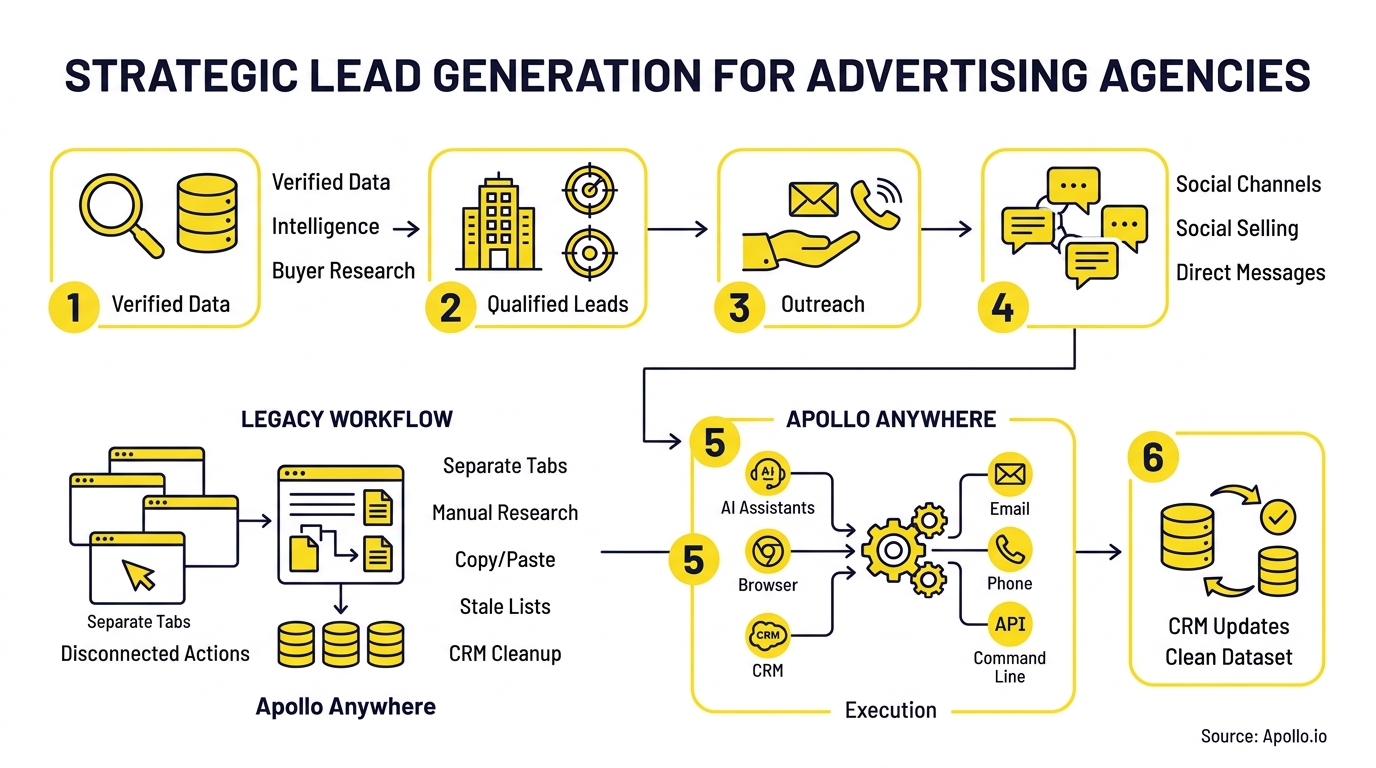
If you are an advertising or media buying agency, Apollo solves three problems: finding the right brand-side contacts, reaching them with a relevant message at the right time, and keeping your CRM clean as accounts move.
For example, a media agency can run this motion ahead of Q4 planning:
- Find: Filter Apollo for marketing directors at apparel and CPG brands by headcount, revenue, and location, using Apollo Data.
- Research: Use the AI Assistant to summarize each brand's recent campaigns and pick one angle per account.
- Reach: Build a sequence in Sales Engagement that opens with a short media plan teaser and follows with a call and a social touch.
- Prospect where you work: Use the Chrome extension to pull verified contacts straight from a brand's website or your inbox.
- Keep the CRM current: Enrich your client CRM with the new brand-side contacts so every account stays accurate.
Apollo meets you in the tools you already use, so research and outreach do not require another tab. Teams that want AI-native workflows can also work through Apollo MCP inside ChatGPT or Claude.
Spending hours on manual outreach? Automate your sequences with Apollo.
Track every stage in your CRM, from first reply to a won account and gross profit, so you learn which brands and angles actually pay off.
How Do You Sell To Advertising Agencies Themselves?
If you are a vendor prospecting agency leaders, the same logic applies in reverse. Use Apollo's industry, title, and seniority filters to find agency owners, new business directors, and heads of strategy.
Filter by agency size and specialty, then lead with a message about their new business pipeline. Start with a list of 50 agencies in one specialty and test one angle before widening.
Frequently Asked Questions About Lead Generation For Advertising Agencies
How Many Brand Accounts Should An Agency Prospect At Once?
Start with a batch you can personalize, usually 30 to 50 accounts per rep. Run it for 30 days, review replies, and refine before adding more.
Should Agencies Rely On Referrals Or Outbound?
Use both. Referrals build trust, and outbound gives you a repeatable pipeline, so set a weekly outreach target alongside your referral asks.
What Should A First Outreach Message Include?
Include one signal about the brand, one relevant idea, and one small ask such as a 15-minute call. Keep it under 100 words and attach no deck.
How Do I Know Which Opportunities To Pitch?
Run the bid/no-bid check with your own pitch cost, win rate, capacity, and margin. Pitch only when expected gross profit clears your floor.

Your 30-Day Rollout
| Week | Focus | Output |
|---|---|---|
| Week 1 | Define ICP and build lists | Account list plus marketing director and CMO lists |
| Week 2 | Write the plan teaser and sequence | One sequence live for one brand batch |
| Week 3 | Run outreach and book calls | Replies tracked by stage in your CRM |
| Week 4 | Review and qualify | Bid/no-bid decisions and next-batch plan |
Ready to win more brand accounts? Start Prospecting with Apollo's connected platform and bring prospecting, engagement, and CRM enrichment into one workflow.
Prove Pipeline ROI With Apollo
Budget review coming and no clear numbers to defend your sales tools? Apollo puts prospecting, outreach, and deal tracking in one workspace, so impact is easy to show. Leadium tripled annual revenue by automating follow-up. Start free and see results fast.
Start Free with Apollo →Don't miss these
Sales
Inbound vs Outbound Marketing: Which Strategy Wins?
Sales
What Is a Sales Funnel? The Non-Linear Revenue Framework for 2026
Sales
What Is a Go-to-Market Strategy? The 2026 GTM Playbook
See Apollo in action
We'd love to show how Apollo can help you sell better.
By submitting this form, you will receive information, tips, and promotions from Apollo. To learn more, see our Privacy Statement.
4.7/5 based on 9,690 reviews
