
How to Coordinate Data Updates Among Sales and Marketing Teams in 2026
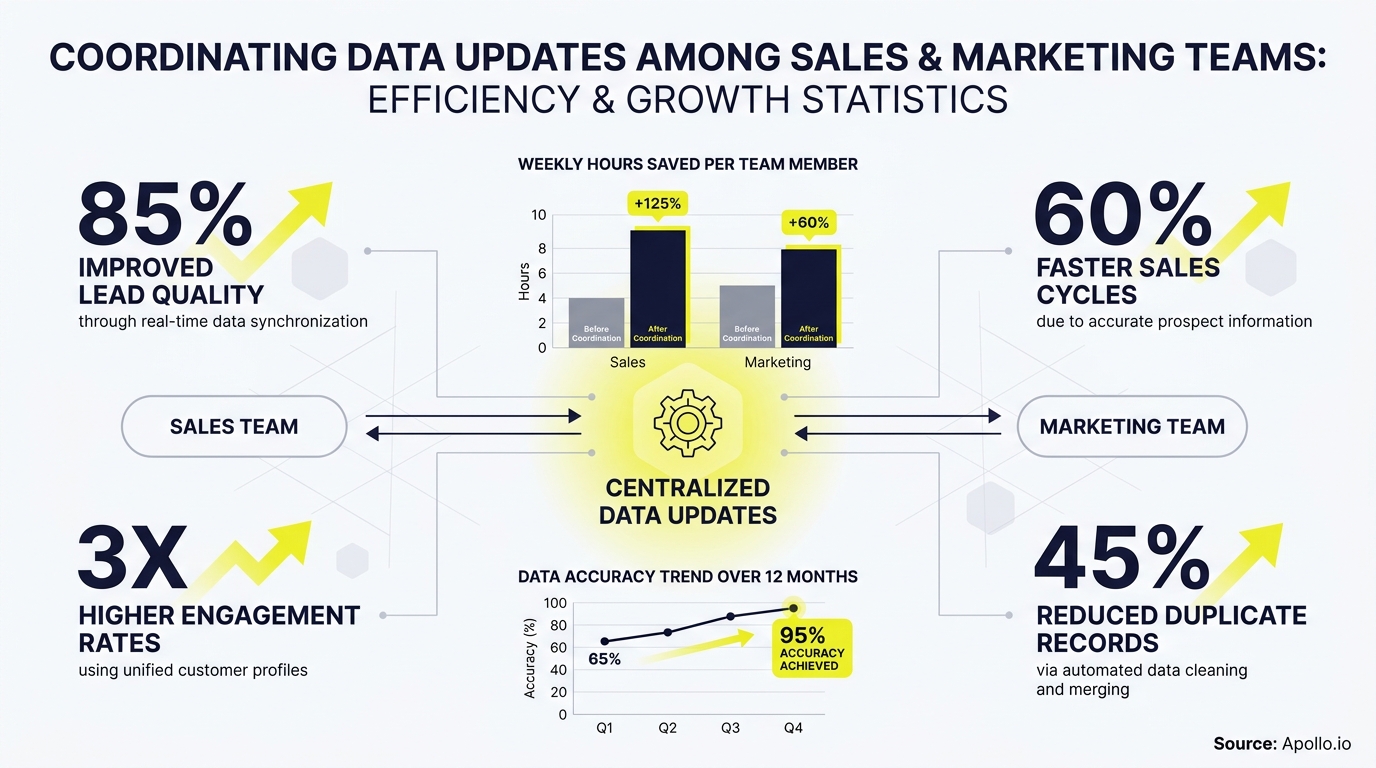
Sales and marketing teams share the same revenue goal but often operate from different, conflicting versions of the same data. According to Semrush, 45% of B2B marketers find alignment between sales and marketing teams difficult. The result: leads get misrouted, campaigns target the wrong accounts, and pipeline visibility breaks down. Understanding the difference between sales and marketing functions is the first step. The second is building a system that keeps both teams working from the same trusted data.

Research Less, Pipeline More With Apollo
Tired of burning hours verifying contact info instead of selling? Apollo delivers 230M+ accurate business contacts so your team spends time closing, not searching. Start building real pipeline today.
Start Free with Apollo →Key Takeaways
- Process misalignment and outdated CRM data are the primary reasons sales and marketing operate from conflicting information.
- A Data Update Operating System (DUS) with RACI ownership and SLA-backed freshness cadences is the most effective coordination framework.
- Data defects fall into three categories: missing, incomplete, and incorrect. Each has different downstream consequences for routing and personalization.
- RevOps leaders who treat data governance as an operational discipline are measurably more likely to exceed revenue goals.
- Enriching and verifying contact data automatically reduces manual update cycles and keeps both teams aligned without friction.
Why Is Coordinating Data Updates So Difficult?
Coordinating data updates is difficult because sales and marketing systems are built independently, creating conflicting field definitions, update timestamps, and ownership gaps. Data from Landbase shows 70% of CRM data is outdated or inaccurate, costing sales teams an estimated 500 hours annually in lost productivity. Compounding the problem: Integrate.io reports that organizations average 897 applications but only 29% are integrated, creating data silos that block unified analytics and automation.
Common friction points include:
- Differing lead definitions: According to Khilon, 62% of organizations report their sales and marketing functions define qualified leads differently.
- No single system of record: CRM, marketing automation platforms (MAP), and data warehouses each maintain separate field values that drift over time.
- Manual handoffs: Spreadsheet-based updates introduce lag, human error, and version conflicts.
- AI readiness risk: Agents and automated workflows now write to CRM fields, making governance more urgent, not less.
Tired of stale contact records slowing down your GTM motion? Keep your CRM clean with Apollo's automated data enrichment across 230M+ verified contacts.
What Is a Data Update Operating System (DUS)?
A Data Update Operating System (DUS) is a governance framework that defines who owns each data field, how frequently it must be refreshed, and what happens when a record falls below quality thresholds. It replaces ad-hoc updates with structured accountability. As TechTarget's coverage of ServiceNow's Autonomous CRM highlights, early automation projects that skipped governance, permissions, and auditability created data leakage problems that compounded at scale.
A DUS has four components:
| Component | What It Defines | Who Owns It |
|---|---|---|
| RACI Matrix | Responsible, Accountable, Consulted, Informed for each field type | RevOps |
| SLA Cadences | Freshness thresholds: firmographics (quarterly), contacts (monthly), intent (weekly) | RevOps + Marketing Ops |
| Defect Taxonomy | Missing, incomplete, incorrect — prioritized by routing impact | RevOps + Sales Ops |
| Change Control | Approval workflow for bulk field edits; audit log for agent-driven writes | RevOps |
Learning more about how Revenue Operations drives growth can help your team decide where to anchor DUS ownership.
How Do You Classify and Prioritize Data Defects?
Data defects fall into three categories, each with different consequences for downstream execution. Prioritize remediation by revenue impact, not data volume.
| Defect Type | Example | Primary Impact | Remediation Priority |
|---|---|---|---|
| Missing | No phone number, no industry tag | Routing failure, sequence gap | High |
| Incomplete | Company name present but no size or revenue | ICP scoring error, wrong segment | High |
| Incorrect | Wrong job title, outdated email domain | Personalization failure, bounce | Medium (fix at enrichment cycle) |
For RevOps leaders, the most actionable step is mapping each defect type to a specific workflow failure. A missing industry tag breaks account-based marketing segmentation. An incorrect email domain causes bounce spikes that damage sender reputation. Connecting defects to outcomes makes remediation a revenue conversation, not an IT ticket.
A solid data enrichment strategy ensures missing and incomplete records get populated automatically rather than waiting for manual correction cycles.
Turn Funnel Gaps Into Predictable Pipeline
Pipeline forecasting a guessing game because quality leads never convert? Apollo surfaces in-market buyers with precision targeting so every rep focuses on opportunities that close. Join 600K+ companies building pipeline that actually moves.
Start Free with Apollo →How Should RevOps Teams Structure Cross-System Data Flows?
RevOps teams should designate one authoritative system of record for each data domain and sync downstream from there, not the reverse. The trend toward reverse ETL, accelerated by Fivetran's acquisition of Censusand Hightouch's 2026 funding round, reflects exactly this model: define golden fields in the warehouse, then activate them into CRM and MAP rather than letting those systems drift independently.
Recommended ownership model:
- Data Warehouse / CDP: Source of truth for firmographics, intent scores, and account health.
- CRM: Source of truth for deal stage, opportunity owner, and sales activity.
- MAP: Source of truth for engagement history, lead score, and campaign membership.
- Sync direction: Warehouse pushes enriched firmographics to CRM and MAP. CRM pushes deal stage changes back to warehouse. MAP pushes engagement events to CRM.
This prevents the most common conflict: marketing updating a job title in the MAP while sales has a different value in the CRM. Both teams see the same record because both read from the same upstream source. For more on how data sync improves B2B sales and marketing ROI, the principles apply directly here.

How Do SDRs and Marketing Teams Handle Buying-Group Data Updates?
SDRs and marketing teams handle buying-group data by tracking multiple contacts per account rather than a single lead record. B2B buying involves groups, and data governance must reflect that reality. For SDRs and AEsworking target accounts, this means maintaining contact records for every known stakeholder: economic buyer, champion, technical evaluator, and procurement.
Buying-group data coordination requires:
- Account-level deduplication: Merge duplicate contact records before syncing to MAP segments.
- Role tagging: Assign buying-role fields (Champion, Blocker, Economic Buyer) so marketing sends role-appropriate content.
- Engagement stitching: When a champion opens a marketing email, that signal should update the account record visible to the AE in the CRM.
- Intent at account level:Intent data should roll up to the account, not sit on a single contact, so both sales and marketing can act on it simultaneously.
Research from ResearchGate indicates that companies with integrated data systems and collaborative data sharing practices see improved performance metrics, including higher conversion rates and increased customer satisfaction.
What KPIs Measure Data Coordination Health?
Data coordination health is measured by tracking field completeness, record freshness, duplication rate, and handoff latency across your GTM systems. These four metrics give RevOps a clear signal before data quality problems reach quota-carrying reps.
| KPI | What to Measure | Target Benchmark |
|---|---|---|
| Field Completeness Rate | % of records with all required fields populated | 95%+ |
| Record Freshness | % of accounts enriched within SLA window | 90%+ within cadence |
| Duplication Rate | % of duplicate contacts or accounts in CRM | Below 2% |
| Handoff Latency | Time from MQL to sales assignment | Under 4 hours |
Marketing leaders should tie completeness and freshness metrics to campaign performance. When data quality drops, segment targeting degrades before pipeline does. Catching the upstream signal prevents the downstream miss. For a broader look at how sales analytics drive revenue growth, these data health KPIs are a natural extension of pipeline reporting.
According to Trykondo, organizations using RevOps were 1.4 times more likely to exceed revenue goals. Formalizing data coordination as a RevOps function is one of the highest-leverage moves a GTM team can make.
Working from fragmented contact data across multiple tools? Apollo's CRM enrichment tool automatically fills gaps across 65+ data attributes, so your sales and marketing teams always work from the same verified record.

How Do You Build a Coordinated Data Update System That Lasts?
Coordinating data updates at scale requires treating data governance as an operational discipline, not a one-time cleanup project. The teams that succeed make three structural investments: they appoint a data owner (usually within RevOps), automate enrichment so updates happen without manual triggers, and create a shared data contract between sales and marketing that defines field ownership and escalation paths.
As high-performing marketing teams are structured around shared data accountability, sales teams need the same alignment. Deploying data cleansing and enrichment processes in parallel ensures your system of record stays accurate between governance reviews.
Apollo consolidates prospecting, enrichment, engagement, and pipeline data into one workspace, eliminating the multi-tool drift that causes sales and marketing data to diverge. As Census put it: "We cut our costs in half."And Cyera noted:"Having everything in one system was a game changer."
Start coordinating your GTM data without adding another tool to your stack. Get Leads Now and see how Apollo keeps sales and marketing working from the same verified source of truth.
Prove Pipeline ROI With Apollo
ROI pressure making every tool renewal a battle? Apollo delivers measurable pipeline impact from day one — so you walk into budget reviews with numbers, not guesses. Leadium 3x'd their revenue. You're next.
Start Free with Apollo →Don't miss these
Sales
Inbound vs Outbound Marketing: Which Strategy Wins?
Sales
What Is a Sales Funnel? The Non-Linear Revenue Framework for 2026
Sales
What Is a Go-to-Market Strategy? The 2026 GTM Playbook
See Apollo in action
We'd love to show how Apollo can help you sell better.
By submitting this form, you will receive information, tips, and promotions from Apollo. To learn more, see our Privacy Statement.
4.7/5 based on 9,690 reviews
