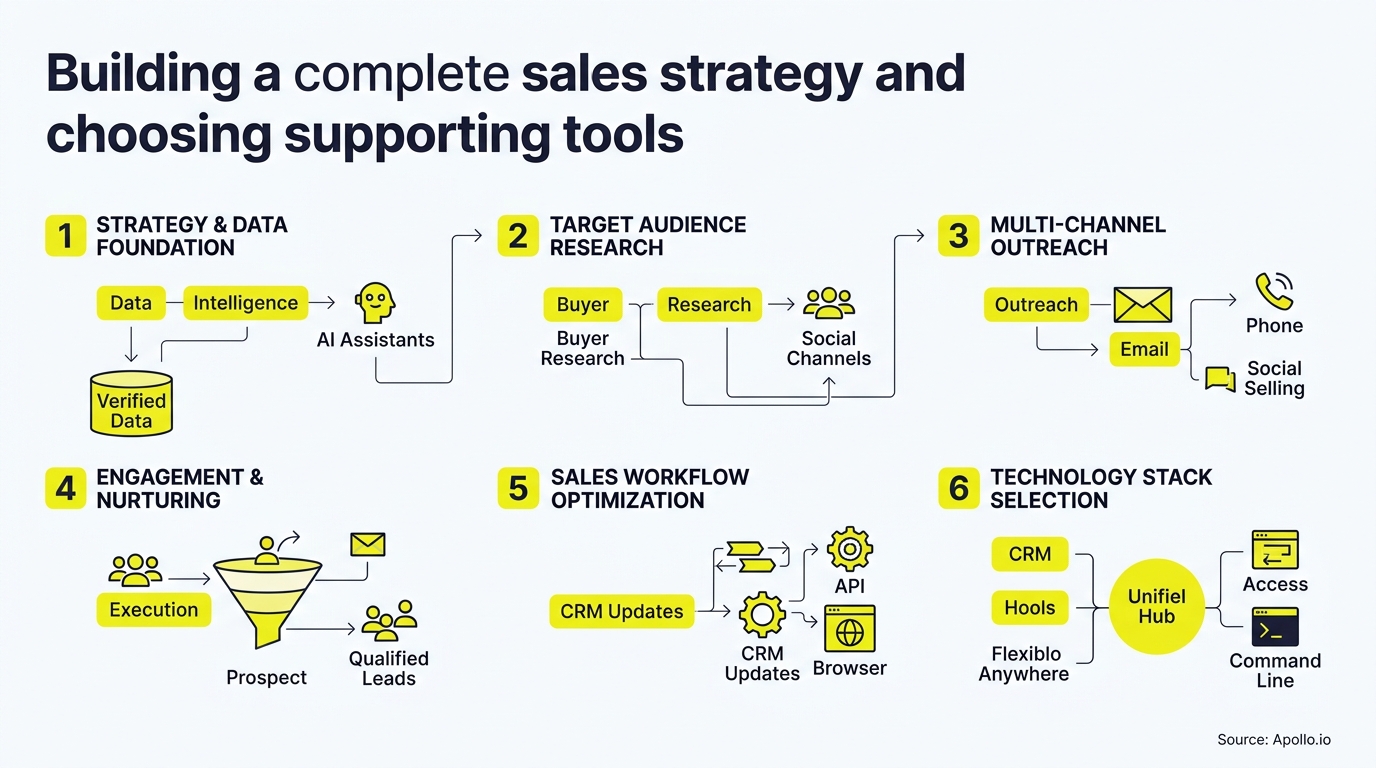
A complete B2B sales strategy starts with your revenue target and buyer journey, then picks tools only for the workflows that journey requires. Teams that reverse that order end up with bloated stacks and low adoption. Use this sequence to build the strategy first, then build a sales tech stack that scales revenue around it.

Skip Manual Research. Apollo Finds Contacts.
Tired of burning hours researching leads and double-checking contact info? Apollo puts verified business contact info at your fingertips, with 98% email accuracy. Your reps spend less time hunting and more time selling.
Start Free with Apollo →Key Takeaways
- Strategy comes first: lock in revenue target, ICP, sales motion, and owners before you compare any software.
- Buyers want self-service plus human validation, so design handoffs, not just outreach volume.
- Score every tool against a workflow, an owner, and a success metric, then decide to buy, reuse, or retire.
- Use Apollo MCP when you need to prospect, enrich contacts, and queue outreach inside ChatGPT, Claude, Perplexity, or Codex without switching tabs.
- Run a 90-day pilot with leading indicators before committing to a full rollout.
How Should You Build a Complete Sales Strategy and Choose Tools?
Build the strategy in four steps: define a one-page canvas, map the buyer journey, score tools against workflows, and pilot for 90 days. Each step feeds the next, so tool decisions stay tied to revenue outcomes.
- Canvas: revenue target, pipeline math, ICP, value proposition, sales motion, capacity, owners.
- Journey map: buying stages, exit criteria, channel handoffs, KPIs.
- Tool scorecard: weighted criteria and a buy, reuse, or retire call.
- Pilot: 90-day rollout with leading indicators.
What Goes Into a One-Page Sales Strategy Canvas?
A one-page canvas captures the decisions every tool must later support: who you sell to, how you sell, and who owns each outcome. Keep it to one page so it stays usable.
| Canvas Element | Question to Answer |
|---|---|
| Revenue target | How much new and expansion revenue, by when? |
| Pipeline math | How many opportunities, at what win rate and deal size? |
| ICP | Which segments, titles, and triggers qualify an account? |
| Value proposition | Why do buyers pick you over the status quo? |
| Sales motion | Self-service, inside sales, field, or a hybrid? |
| Capacity and owners | Who runs each stage, and how many deals can they carry? |
Gartner's 2026 research is a useful cue for the motion row. Gartner reports that 69% of B2B buyers seek sales reps to validate AI-generated insights and complex purchase decisions, which argues for a hybrid motion over a purely automated one.

How Do You Map the Buyer Journey Before Picking Software?
Map each buying stage from first awareness through onboarding, and for every stage define exit criteria, the owning channel, and the handoff. This tells you which capabilities you actually need.
Buyers rarely follow a straight line. Research cited by WaveCNCT notes that B2B buyers interact through 10+ distinct channels across a typical purchase, so channel ownership and handoffs matter as much as the channels themselves.
- Stage name and exit criteria: what must be true to advance?
- Stakeholders: who is in the buying group at this stage?
- Handoff: who owns the next step, and by when?
- KPI: conversion, velocity, or stall rate for the stage.
Include a stall-recovery step. Forrester's December 2024 research found that 86% of B2B purchases stalled during the buying process, so qualification, stakeholder alignment, and a business case belong in the strategy itself.
How Do SDRs and AEs Fit Into the Strategy?
SDRs own early-stage coverage and meeting creation, while AEs own validation, business case, and close. Writing those roles into the journey map prevents duplicate work and dropped handoffs.
SDRs need fast prospecting and sequencing. AEs need account context before every call. RevOps owns data quality and routing. For sellers spending time on research and admin, the stakes are real: Salesforce's 2024 survey found reps spent 70% of their time on non-selling tasks, so each tool should remove a measurable chunk of that load.
Struggling to find qualified leads for your SDRs? Search Apollo's 240M+ contacts with 65+ filters and keep prospecting tied to your ICP.
Fill Your Funnel With Buyers Who Convert
Struggling to fill the top of your funnel with leads that actually turn into opportunities? Apollo pairs 98% email accuracy with buying signals, so your reps reach the right people while they're ready to talk. Evaluating tools. Start free and see for yourself.
Start Free with Apollo →How Should You Choose Sales Tools: A Weighted Scorecard?
Choose tools with a weighted scorecard that ties each product to a workflow, an owner, and a success metric. Then make an explicit buy, reuse, or retire decision for every candidate.
| Criterion | Suggested Weight | What to Check |
|---|---|---|
| Workflow fit | 25% | Does it cover a stage on your journey map? |
| Integration | 20% | Clean CRM sync, APIs, native connectors |
| Adoption | 20% | Named owner, training plan, usage target |
| Data quality controls | 15% | Verification, permissions, human approvals |
| Security and compliance | 10% | Access controls, admin governance |
| Total cost | 10% | Licenses, implementation, overlap with existing tools |
Adopt weights that fit your team; these are a starting point. The goal is to stop buying on demo quality alone. As JohnnyGrow notes, point-solution accumulation harms seller productivity, so audit overlap before adding anything new.
Fewer, connected tools also tend to perform better. Salesforce reports that high-performing sales teams are 1.3x more likely to operate on a unified platform than on disparate point solutions.
What Is a Minimum Viable Sales Stack?
A minimum viable sales stack covers only the workflows your journey map demands: a system of record, a data source, an engagement layer, and reporting. Start there and add tools only when a gap is proven.
- System of record: CRM with clean routing and ownership.
- Data and enrichment: verified contacts and account intelligence.
- Engagement: sequences across email, phone, and social.
- Meetings and conversations: scheduling and call capture.
- Reporting: pipeline and conversion visibility by stage.
For RevOps leaders and founders watching costs, consolidation is the lever. One Predictable Revenue user put it plainly: "We reduced the complexity of three tools into one." Read the full story at Predictable Revenue.
Spending hours on manual outreach? Automate your sequences with Apollo's multi-channel platform instead of stitching together separate vendors.
How Can You Run Prospecting Inside Your AI Tools?
You can run the prospecting and enrichment steps of your strategy from inside ChatGPT, Claude, Perplexity, or Codex using Apollo MCP. Connect Apollo through the AI tool's connectors with OAuth, on any plan including free, and Apollo's data and action limits mirror your account.
From one conversation, you can search for people and companies that match your ICP, enrich contacts with verified emails and phone numbers, add prospects to sequences, and ask about campaign performance. Your best prospecting session shouldn't require opening a new tab.
This fits the hybrid-motion lesson. Buyers still want expert help, so freeing SDRs and AEs from research and admin gives them more time for the conversations where humans add value. Teams that need an auditable data layer can pair this with Apollo's data enrichment for clean CRM records.
What Does a 90-Day Rollout Look Like?
A 90-day rollout moves from baseline to pilot to expansion, using leading indicators because most sales cycles run longer than the pilot. Measure time saved and conversion by stage, not adoption alone.
| Phase | Days | Focus |
|---|---|---|
| Baseline | 1-15 | Measure time on non-selling tasks, stage conversion, and stall rate. |
| Pilot | 16-60 | Roll tools to one team; track meetings booked, response rate, and research time. |
| Expand | 61-90 | Retire overlapping tools, standardize templates, extend to more teams. |
Be honest about what the numbers prove. Salesforce's February 2026 survey found 87% of sales organizations use AI, but respondents' time-saving figures are expectations, not demonstrated savings.
A controlled pilot is what separates real ROI from adoption hype.

Conclusion: Where Should You Start?
Start with the one-page canvas this week, then map the buyer journey, score your current stack, and pilot for 90 days. Add retention and expansion goals so the strategy covers the customer lifecycle past closed-won, not just new logos.
Want one workspace for prospecting data, engagement, and pipeline instead of a bloated stack? Try Apollo Free and build your first sequence today.
Prove Pipeline ROI Fast With Apollo
Ramping new reps slowly while leadership asks for proof the stack is paying off? Apollo puts data, outreach, and AI in one workspace, so teams get productive quickly. Built-In saw +10% win rate and +10% ACV.
Start Free with Apollo →Don't miss these
Sales
Inbound vs Outbound Marketing: Which Strategy Wins?
Sales
What Is a Sales Funnel? The Non-Linear Revenue Framework for 2026
Sales
What Is a Go-to-Market Strategy? The 2026 GTM Playbook
See Apollo in action
We'd love to show how Apollo can help you sell better.
By submitting this form, you will receive information, tips, and promotions from Apollo. To learn more, see our Privacy Statement.
4.7/5 based on 9,690 reviews
