

Turn Funnel Guesswork Into Pipeline Wins
Pipeline forecasting a guessing game because leads stall before they ever become opportunities? Apollo surfaces in-market buyers with precision so your funnel fills with prospects that actually convert. Join 600K+ companies forecasting with confidence.
Start Free with Apollo →How Does RevOps Manage and Optimize Outbound Sequence Performance Across an SDR Team?
Most SDR teams measure outbound sequence performance by opens, replies, and touches. RevOps teams that win in 2026 measure something different: whether sequences move buyers toward a decision. Understanding what revenue operations is and how it drives growth is the foundation for building a sequence system that actually converts pipeline.
According to the State of RevOps 2025 report, companies with a formal RevOps function report 19% faster revenue growth and 15% higher profitability compared to those without. That advantage is built, in large part, on sequence governance.
Get Verified Contacts That Actually Convert
Tired of hours lost chasing bad emails and dead-end numbers? Apollo delivers 97% email accuracy so your team spends time selling, not searching. Join 600K+ companies building pipeline that actually moves.
Start Free with Apollo →Key Takeaways
- RevOps should own outbound sequences as a production system: inputs (data), process (cadence design), QA (audits), and outputs (pipeline).
- Customization rate is a more predictive sequence KPI than touch count or open rate.
- Cross-functional governance (a cadence council) aligns ICP definitions, messaging, and content across Marketing and Sales.
- Deliverability is now a RevOps competency: authentication, list hygiene, and suppression rules determine whether sequences reach inboxes.
- Signal-based enrollment (intent, hiring, funding triggers) lets RevOps route high-personalization capacity to the accounts most likely to convert.
What Is RevOps' Role in Outbound Sequence Management?
RevOps owns outbound sequence performance as an operational system, not a rep-level responsibility.
This means designing the infrastructure SDRs execute within: sequence templates, enrollment criteria, suppression rules, SLA definitions, and the KPI framework that connects activity to pipeline.
Research from JohnnyGrow shows organizations that deployed revenue operations grew revenue nearly three times faster than those that didn't. The mechanism is standardization: when RevOps governs sequences centrally, reps spend less time on admin and more time on high-quality follow-up. Learn more about how sales operations functions within organizations to understand where RevOps fits in the broader structure.
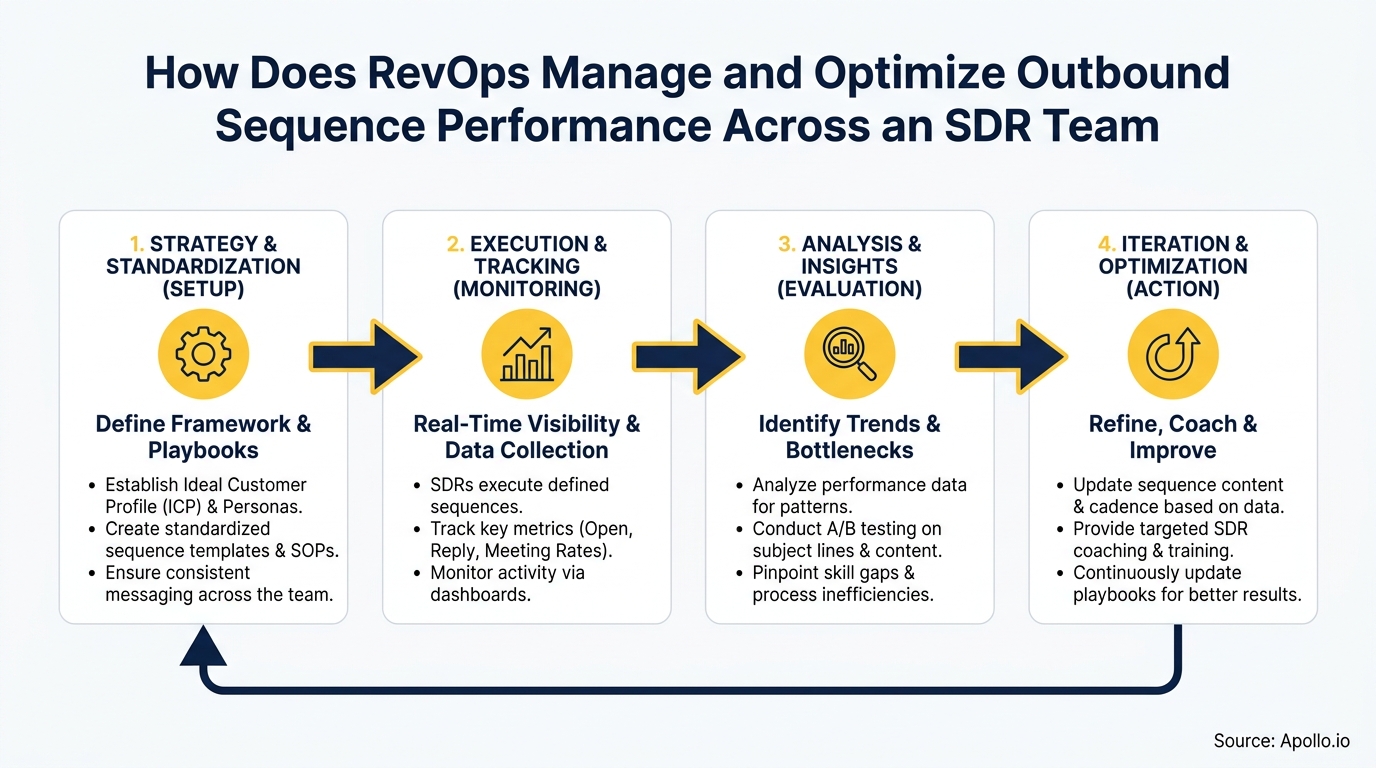
The RevOps sequence performance system has four layers:
- Inputs: Verified contact data, ICP definitions, intent signals, firmographic filters
- Process: Centralized sequence templates, persona-based libraries, channel mix rules
- QA: Call/email audits, customization rate checks, deliverability monitoring
- Outputs: Pipeline created, meetings held, opportunity conversion rate
What KPIs Should RevOps Track Beyond Open Rate?
RevOps should replace vanity metrics with a KPI chain that links sequence steps to revenue outcomes. Open rate tells you nothing about pipeline. The modern scoreboard runs from delivery to dollars.
| KPI Layer | Metric | Why It Matters |
|---|---|---|
| Delivery | Deliverability rate, bounce rate | Sequences that don't land can't convert |
| Engagement | Reply rate, positive reply rate | Signals message-market fit |
| Conversion | Reply → qualified meeting rate | Measures SDR qualification quality |
| Pipeline | Meetings held, opp created per sequence | Connects sequence to revenue |
| Customization | % of steps personalized per segment | First-class predictor of buyer acceptance |
Data from Optif.ai shows top-quartile SDRs generate 12–15 qualified meetings per month, while the median is 8–10. The gap between median and top-quartile performers is largely a governance and personalization problem, not a rep effort problem.
Spending hours on manual outreach when you should be analyzing what's working? Automate your sequences with Apollo's multi-channel engagement platform and free up RevOps to focus on optimization instead of execution.
How Do SDRs Benefit from RevOps-Governed Sequence Templates?
SDRs perform better when RevOps removes the guesswork from sequence design.
Centralized templates built around buyer personas, use cases, and intent signals mean reps start every sequence from a proven foundation rather than a blank page.
The key shift in 2026 is from "more touches" to value-led orchestration. RevOps governs the channel mix (email, phone, social outreach), timing windows, and message value at each step. SDRs customize within guardrails rather than freestyle. This is how you build winning outbound sequences at scale without sacrificing personalization quality.
Practical template governance includes:
- Persona libraries: Separate sequences for each ICP persona (e.g., VP Sales vs. RevOps Director)
- Signal-based variants: Enrollment triggers tied to intent, hiring signals, or funding events
- Content-to-step mapping: Which asset (case study, ROI tool, proof point) appears at which sequence step
- Customization QA checklist: RevOps audits a sample of sent messages weekly to verify personalization rate
Turn Funnel Guesswork Into Pipeline Wins
Pipeline forecasting a guessing game because leads stall before they ever become opportunities? Apollo surfaces in-market buyers with precision so your funnel fills with prospects that actually convert. Join 600K+ companies forecasting with confidence.
Start Free with Apollo →What Is Cross-Functional Sequence Governance (and Why Does RevOps Own It)?
Cross-functional sequence governance is the operating model that aligns Marketing, Sales, and RevOps on shared ICP definitions, messaging standards, and content usage in cadences. RevOps owns it because sequences sit at the intersection of all three functions.
A cadence council is the recurring ritual that makes this work. It typically meets monthly and includes RevOps, SDR leadership, and a Marketing representative. Decisions made in this forum include:
- Which personas enter which sequences
- What defines a qualified meeting (shared definition across CRM and sequencing tool)
- Which marketing content is approved for sequence use and at which step
- Suppression rules (who never gets enrolled, when to pause active contacts)
- A/B test decisions and what experiments are running this quarter
For RevOps leaders building this structure, sales analytics and data sync between platforms are the technical prerequisites for making cross-functional decisions with reliable data.

How Does Deliverability Governance Affect SDR Sequence Performance?
Deliverability is now the number-one technical constraint on outbound sequence performance. If emails don't reach inboxes, every other optimization is irrelevant.
RevOps must own sending infrastructure as a competency, not delegate it to individual reps.
Email authentication enforcement has tightened significantly in 2025–2026, with bulk-sender requirements actively enforced by major providers. RevOps deliverability governance covers:
- Authentication: SPF, DKIM, and DMARC alignment on all sending domains
- Domain strategy: Separate sending domains for high-volume SDR outreach to protect the primary domain
- Volume controls: Daily send limits per mailbox to avoid spam triggers
- Bounce management: Hard bounces removed immediately; soft bounce thresholds defined
- List hygiene: Contact verification before enrollment, not after delivery failure
Struggling with contact quality before sequences even start? Start with Apollo's 230M+ verified business contacts to reduce bounce rates and protect sender reputation from day one.
How Does Signal-Based Enrollment Improve Outbound Sequence Results?
Signal-based enrollment improves outbound sequence results by routing the right contacts into the right sequences at the moment they are most likely to engage. Static ICP-only targeting (job title + firmographics) misses the timing dimension that separates good sequences from great ones.
RevOps defines the signals and owns the routing rules. Common enrollment triggers include:
- Intent data spike on a relevant topic
- Hiring signal for a role the product solves for
- Funding announcement (new budget, new priorities)
- Technology change (added or removed a competing tool)
- Engagement with inbound content (visited pricing page, downloaded asset)
Signal-based routing also determines personalization capacity allocation. High-intent accounts get the highest-effort, most customized sequence steps. Lower-intent accounts enter lighter-touch nurture sequences. This is how RevOps scales outbound prospectingwithout sacrificing the quality buyers respond to. See also:sales performance management for connecting signal-based outbound to broader revenue targets.
How Should RevOps Run Sequence Experimentation Across an SDR Team?
RevOps should run governed A/B experiments at the sequence level, not leave testing to individual reps. When every SDR freelances their sequences, the results are too noisy to learn from.
Centralized experimentation produces comparable data.
A structured experimentation framework covers:
- One variable per test: Change subject line, first-touch channel, or timing window — never all at once
- Holdout groups: A control sequence runs alongside the variant to isolate the effect
- Minimum sample size: Define statistically meaningful thresholds before reading results
- Attribution hygiene: CRM sync must log which sequence variant each contact experienced
- Promotion criteria: Winning variants become the new standard template in the library
This connects directly to sales transformation: RevOps-led experimentation is how organizations shift from gut-feel sequencing to a repeatable, measurable outbound production system.

How Can RevOps and SDR Teams Get Started with Apollo?
RevOps manages and optimizes outbound sequence performance by owning the full system: verified data inputs, governed templates, signal-based enrollment, deliverability infrastructure, cross-functional alignment, and a KPI chain tied to pipeline.
Open rates and touch counts are lagging indicators.
The leading indicators are customization rate, reply-to-meeting conversion, and deliverability health.
Apollo gives RevOps and SDR teams a single platform to run this entire system. From a 230M+ contact database with 65+ filters to multi-step sales sequences, AI-powered personalization, and built-in analytics, Apollo consolidates the tools most teams run separately. As Cyera put it: "Having everything in one system was a game changer."
Schedule a Demo to see how Apollo's unified GTM platform helps RevOps teams govern, measure, and scale outbound sequence performance across their entire SDR org.
Prove Pipeline ROI From Day One
ROI pressure killing your next tool renewal? Apollo surfaces measurable pipeline impact fast, so budget approvals become easy wins. Leadium 3x'd their annual revenue — your CFO conversation just got easier.
Start Free with Apollo →Don't miss these
Sales
Inbound vs Outbound Marketing: Which Strategy Wins?
Sales
What Is a Sales Funnel? The Non-Linear Revenue Framework for 2026
Sales
What Is a Go-to-Market Strategy? The 2026 GTM Playbook
See Apollo in action
We'd love to show how Apollo can help you sell better.
By submitting this form, you will receive information, tips, and promotions from Apollo. To learn more, see our Privacy Statement.
4.7/5 based on 9,690 reviews
