
How Automation Powers Multi-Step Campaigns and Timely Follow-Ups
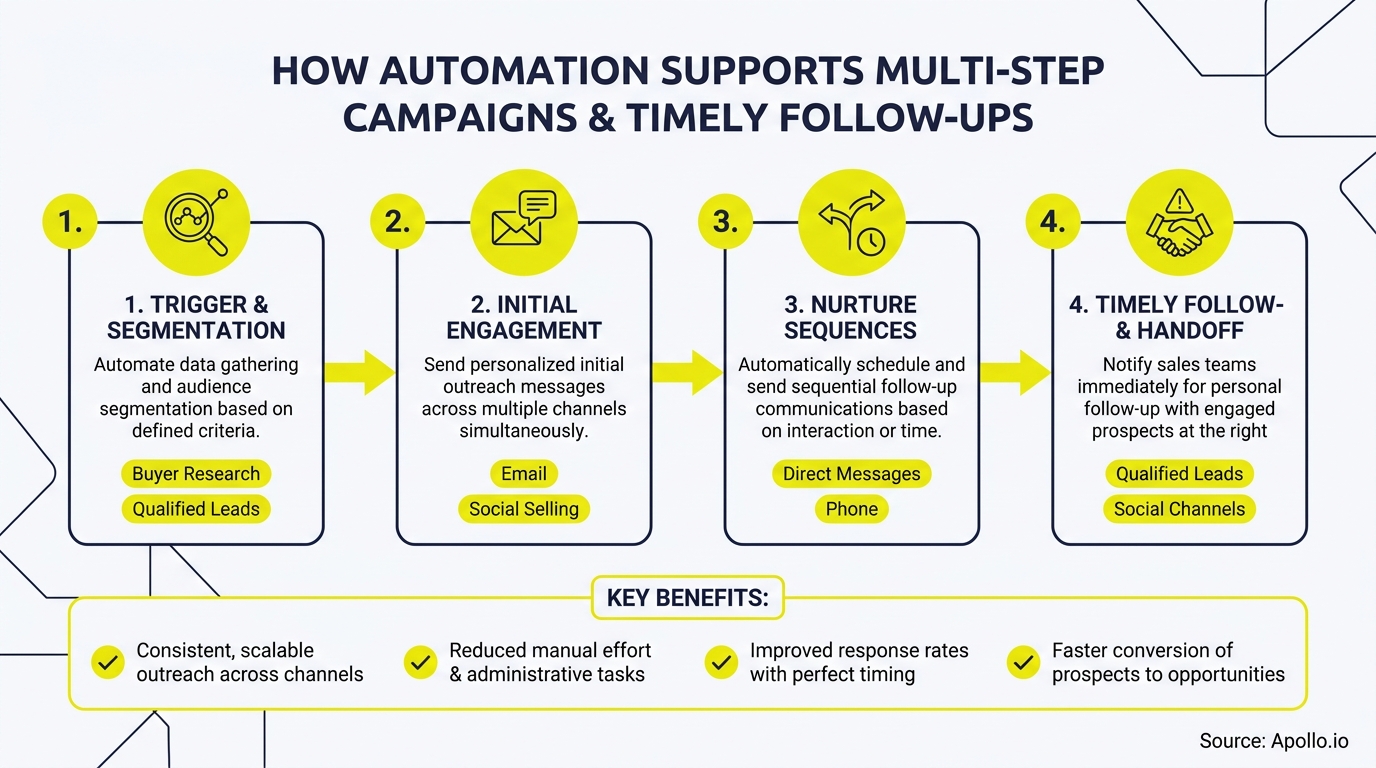
Most B2B buyers are already moving through their purchase journey before your team even knows they exist. By the time a prospect fills out a form or replies to an email, they have likely already shortlisted vendors. Automation supports multi-step campaigns and timely follow-ups by detecting buyer signals early, routing the right message to the right person at the right moment, and keeping sequences consistent without manual intervention.
The challenge is not sending more touchpoints. It is orchestrating them intelligently, with suppression rules, role-aware branching, and clean data underneath.
This guide explains how to build that system.

Scale Your Team Without the Chaos
Tired of inconsistent processes slowing your team down? Apollo standardizes your outreach playbooks so every rep hits the ground running. Nearly 100K paying customers build predictable pipeline at scale.
Start Free with Apollo →Key Takeaways
- Effective automation connects buyer signals to the next best action, not just the next scheduled email.
- Timely follow-ups require a unified data foundation: fragmented CRM, intent, and engagement data cause mistimed outreach and missed opportunities.
- Multi-step campaigns should branch by stakeholder role, not just contact stage, to address buying committees effectively.
- Suppression rules are as important as trigger rules: knowing when NOT to follow up protects sender reputation and buyer trust.
- SDRs, RevOps leaders, and marketing teams all benefit from automation differently; the platform must support all three in one workspace.
What Does Automation Actually Do in Multi-Step Campaigns?
Automation in multi-step campaigns executes a coordinated sequence of actions across channels based on buyer behavior, time delays, or data conditions, rather than requiring manual intervention at each step. According to inBeat Agency, 98% of B2B marketers consider marketing automation critical to their organization's success. That near-unanimous view reflects a practical reality: no human team can consistently monitor every lead, personalize every follow-up, and hit every timing window at scale.
A typical automated multi-step campaign includes:
- Trigger: Prospect views a pricing page or downloads a whitepaper
- Step 1 (immediate): Personalized email referencing the specific content viewed
- Step 2 (Day 3): SDR task created for a phone call if email is opened
- Step 3 (Day 7): Social touch or case study follow-up if no reply
- Suppression: Sequence pauses if prospect books a meeting or replies
Spending too much time building sequences manually? Automate your multi-channel sequences with Apollo's sales engagement platform and keep every touchpoint on schedule.
How Do Timely Follow-Ups Actually Affect Pipeline?
Timely follow-ups directly influence which vendor wins a deal, making speed-to-context the new speed-to-lead. Gartner reported in March 2026 that 67% of B2B buyers prefer a rep-free experience, while 45% used AI during a recent purchase. Buyers do not wait for your team to notice their engagement. Automation must act the moment a signal appears.
A Reddit user shared a firsthand perspectiveon exactly this dynamic: by automating follow-ups for webinar attendees to trigger personalized demos based on their polling answers, their team boosted demo booking rates by about 20% compared to generic post-webinar emails. The difference was not speed alone. It was relevance triggered by behavior.
Research from Amra & Elma shows over 76% of companies worldwide now use marketing automation tools, which means buyers are increasingly accustomed to fast, relevant follow-up and will notice when it is absent.
What Is the Signal-to-Action Framework for Timely Follow-Ups?
A signal-to-action framework maps specific buyer behaviors to the appropriate next step, wait window, content type, and suppression condition. This prevents both delayed responses and irrelevant outreach.
| Buyer Signal | Wait Window | Next Best Action | Suppression Rule |
|---|---|---|---|
| Pricing page visit (2+ times) | Within 1 hour | SDR call task + personalized email | Pause if already in active deal |
| Email opened (no click) | Day 3 | Follow-up email with case study | Skip if reply received |
| Demo form submitted | Immediate | Meeting confirmation + AE notification | Remove from nurture sequence |
| Content download (mid-funnel) | Within 4 hours | Email with related use case | Pause if DNC listed |
| No engagement in 14 days | Day 14 | Re-engagement email or archive | Remove from active sequence |
Suppression rules are not optional. Without them, automation floods buyers with irrelevant touches, damaging sender reputation and buyer trust. Forrester has warned that ungoverned AI-driven outreach poses significant financial and reputational risk for B2B organizations.
How Do SDRs and RevOps Teams Benefit from Automated Sequences?
SDRs benefit from automation by eliminating the manual tracking burden of multi-touch follow-ups, freeing time for personalization and live conversations.
A sales professional wrote on Reddit that manually personalizing 50 leads per week at 5 minutes each burns over 20 hours a month just on follow-ups.
Semi-automated templates that require only a first-line tweak cut that to roughly 3 hours saved per week.
For RevOps leaders, the value is different: automation creates a single, auditable record of every touchpoint, making pipeline attribution reliable. Revenue operations teams use workflow automation to enforce consistent routing logic, prevent leads from falling through cracks, and maintain CRM hygiene automatically.
Key benefits by role:

- SDRs/BDRs: Automated task creation, sequence enrollment, and follow-up reminders based on prospect behavior
- Account Executives: Pre-meeting intelligence surfaced automatically; deal stage triggers relevant content delivery
- RevOps: Consistent data entry, lead-to-account matching, and routing rules enforced without manual review
- Marketing Leaders: Behavior-triggered nurture campaigns that adapt to engagement rather than running on fixed schedules
Turn Funnel Guesswork Into Pipeline Wins
Pipeline forecasting a guessing game because leads stall before they ever reach your AEs? Apollo surfaces high-intent prospects and moves them forward automatically. Nearly 100K paying customers run on predictable pipeline.
Start Free with Apollo →What Data Architecture Do You Need for Reliable Automated Follow-Ups?
Reliable automated follow-ups require a connected data layer where CRM records, intent signals, email engagement, and web activity sync in near real time. Adobe's May 2026 B2B Journey Orchestration report found that only 41% of B2B organizations have a unified customer data foundation to support AI-driven automation at scale.
That gap is why campaigns misfire: suppression rules cannot run on stale data, and triggers cannot fire on signals that live in disconnected systems.
The minimum required data connections for timely follow-ups:
- CRM sync: Deal stage, owner assignment, and contact status must update in real time
- Intent data:Intent signals should feed directly into enrollment and suppression logic
- Email engagement: Opens, clicks, and replies must trigger or pause sequence steps immediately
- Enrichment:Contact data enrichment keeps records accurate so routing logic fires on correct account and role data
Struggling with data gaps that cause mistimed outreach? Apollo's data enrichment keeps your contact records verified and current so your automation triggers on accurate signals every time.
How Do You Branch Nurture Flows for Buying Committees?
Committee-aware nurture branches sequences by stakeholder role, ensuring each member of the buying group receives content matched to their specific concerns rather than a generic drip. The average B2B buying group includes multiple stakeholders, each evaluating your solution from a different angle.
A single-thread sequence cannot address all of them.
A sample multi-step flow for a 3-role buying committee:
- Economic Buyer (VP/C-suite): ROI-focused case studies, competitive differentiation, executive summary emails
- Technical Evaluator (IT/RevOps): Integration documentation, CRM connection guides, security overview
- End User (SDR/AE): Product walkthroughs, workflow examples, peer testimonials
Branching logic should also respond to account-level signals, not just individual behavior. If the economic buyer opens a pricing email while the technical evaluator downloads an integration guide, the account should escalate to a higher-priority tier, triggering an AE outreach task. This is how modern sales automation software drives coordinated revenue outcomes rather than isolated contact touches.
How Do You Measure Whether Your Automated Campaigns Are Working?
Measure automated campaign performance at both the lead level and account level to distinguish between individual engagement and genuine buying-group momentum. Lead-level metrics tell you what is resonating; account-level metrics tell you whether pipeline is actually moving.
| Metric | Level | What It Validates |
|---|---|---|
| Email open and reply rate by sequence step | Lead | Message relevance and timing |
| Time from trigger to first touch | Lead | Follow-up speed |
| Sequence completion rate | Lead | Suppression rule accuracy |
| Meetings booked per enrolled account | Account | Campaign-to-pipeline conversion |
| Multi-stakeholder engagement rate | Account | Buying committee coverage |
| Pipeline velocity by campaign source | Account | Revenue impact of automation |
Sales analytics tied directly to your sequence data makes this measurement reliable. When engagement data, CRM records, and campaign performance live in the same platform, attribution is clear and optimization cycles are faster.

Start Automating Multi-Step Campaigns That Actually Convert
Automation supports multi-step campaigns and timely follow-ups when it is built on three foundations: accurate data, role-aware branching logic, and governed suppression rules. Without all three, sequences either misfire on stale triggers or flood buyers with irrelevant touches.
Apollo consolidates prospecting, sequencing, enrichment, and CRM sync into one platform, so your automation runs on verified data without stitching together five separate tools. As Cyera put it: "Having everything in one system was a game changer." Apollo's workflow engine gives SDRs, RevOps teams, and marketing leaders a single workspace to build, trigger, and measure every campaign step from first signal to closed deal.
Request a Demo to see how Apollo automates multi-step campaigns with the data accuracy and workflow control your GTM team needs in 2026.
Prove Pipeline ROI Before Next Review
ROI approval stuck because you can't quantify pipeline impact? Apollo delivers measurable results fast — teams like Leadium 3x'd annual revenue. Start your free trial and show leadership real numbers.
Start Free with Apollo →Don't miss these
Sales
Inbound vs Outbound Marketing: Which Strategy Wins?
Sales
What Is a Sales Funnel? The Non-Linear Revenue Framework for 2026
Sales
What Is a Go-to-Market Strategy? The 2026 GTM Playbook
See Apollo in action
We'd love to show how Apollo can help you sell better.
By submitting this form, you will receive information, tips, and promotions from Apollo. To learn more, see our Privacy Statement.
4.7/5 based on 9,690 reviews
