
How Does an AI Tool Learn from Historical Deal Outcomes in 2026?
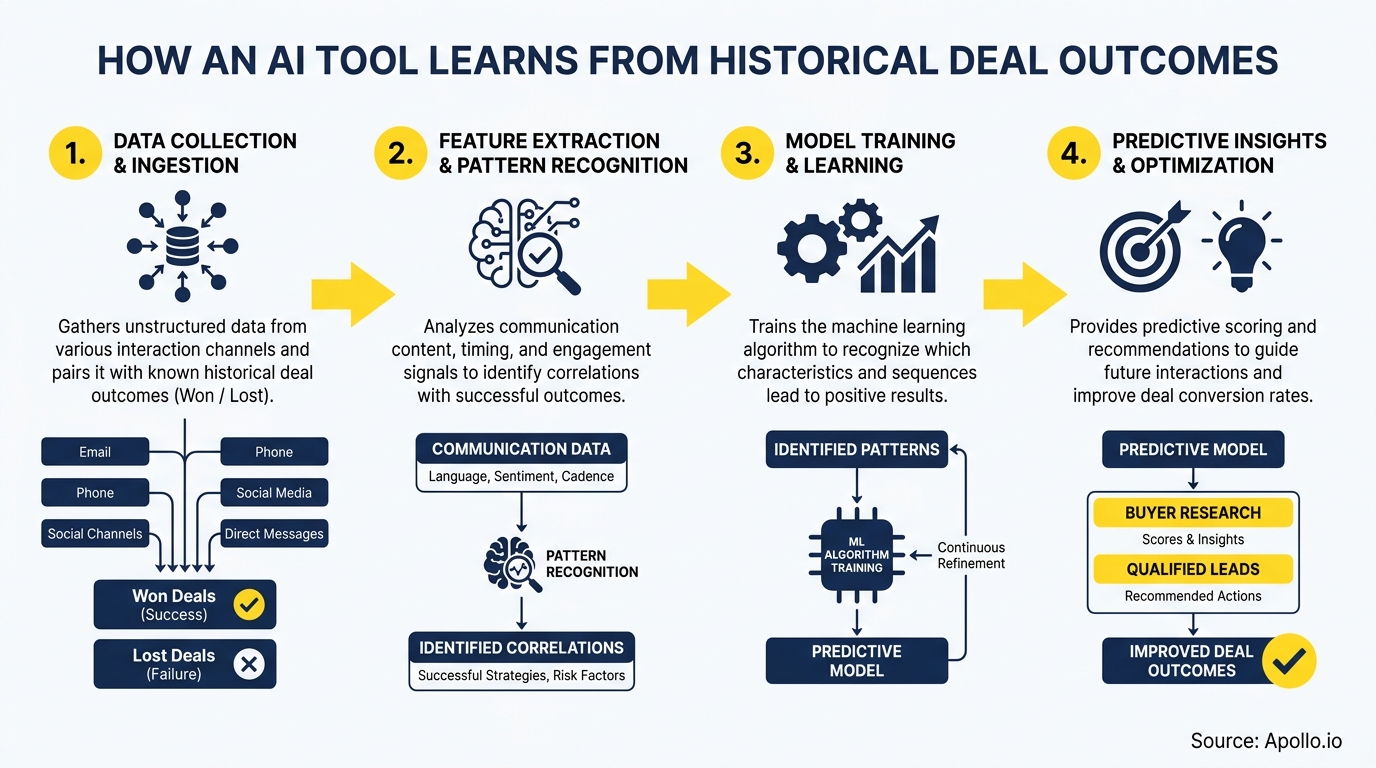
Your closed-lost deals are your most underused AI dataset. Understanding how an AI tool learns from historical deal outcomes is the difference between a sales team that guesses and one that allocates resources based on evidence. This process, often called win/loss modeling or CRM outcome learning, converts past opportunities into a probabilistic engine that scores, ranks, and prioritizes current deals. If you want to know which AI sales tools actually close more deals, the answer starts with how they process historical data.

Research Less, Close More With Apollo
Tired of your reps burning hours hunting down contact info that bounces? Apollo delivers verified business contacts so your team spends time selling, not searching. Join 600K+ companies building pipeline faster.
Start Free with Apollo →Key Takeaways
- AI learns from historical deal outcomes by converting closed-won and closed-lost opportunities into labeled training data, then extracting patterns across deal attributes, relationship signals, and buyer context.
- The most valuable output is not just a win probability score, but a prescriptive signal: which deals to pursue, deprioritize, or abandon entirely.
- Relationship and context variables matter as much as CRM stage and deal size. Stronger buyer-seller relationships correlate with higher win likelihood.
- CRM data quality is the hard ceiling on AI accuracy. Low data trust limits what can be safely automated.
- Feedback loops must be auditable. Without human oversight, AI models amplify past bias rather than correcting it.
What Does "Learning from Historical Deal Outcomes" Actually Mean?
AI learns from historical deal outcomes by treating every closed opportunity as a labeled data point. The label is the outcome (won, lost, or stalled), and the features are the deal's attributes at the time of close.
The model finds which combinations of features most reliably predict each label, then applies those patterns to open opportunities.
Three core concepts define this process:
- Labels: Won, lost, stalled, or no-decision. Each closed deal gets one.
- Features: Deal size, industry, sales stage duration, activity count, stakeholder count, buyer-seller relationship strength, competitive mentions, and contract value.
- Model output: A win probability score (0–100%) and, in prescriptive systems, a recommended action or bid/no-bid signal.
According to Superlayer, AI can analyze historical win/loss patterns, deal velocity, and deal size, along with current pipeline data and customer interaction data, to identify critical patterns, risk signals, and buying commitments. This is the foundation of modern sales analytics and deal scoring.
How Does the Closed-Won/Closed-Lost Learning Loop Work?
The AI learning loop follows six sequential steps, each building on the last.
- Ingest: Pull historical opportunities from your CRM, including all associated fields, activity logs, and contact records.
- Label: Tag each opportunity as won, lost, or stalled. Stalled (no-decision) is often treated as a separate class rather than a loss.
- Feature engineering: Transform raw CRM fields into model-ready inputs. Stage duration becomes a numeric variable. Relationship strength becomes a score. Competitive mentions become a binary flag.
- Train and validate: Split historical data into training and holdout sets. Train the model on the larger set, validate accuracy on the holdout. A 2026 B2B opportunity-management study published in a peer-reviewed journal used 4,574 historical opportunities and stacked five model types, improving predictive accuracy by 11% over the best single model.
- Score: Apply the validated model to current open opportunities to generate win probability scores.
- Learn from feedback: When a scored opportunity closes, that outcome becomes new labeled data. The model updates over time as deal patterns shift.
A Reddit user shared a firsthand perspectiveon AI agent memory that maps directly to this loop: "Most 'memory' implementations are basically a notes app rather than storing decision traces like: context, options considered, action, outcome, regret/success signal. If you want it to actually improve, log a lightweight 'why' schema per decision, add an evaluator step that scores outcome a day later, and periodically distill into rules so you are not just stuffing raw history back into context." This is precisely what best-in-class deal scoring systems do.
Struggling to track deal activity in a unified view? Get complete pipeline visibility with Apollo's deal management so your AI always has clean, structured input data.
How Does AI Move from Win Probability to Prescriptive Deal Prioritization?
Prescriptive deal prioritization goes beyond forecasting by using win probability scores to make resource-allocation decisions, not just predictions. This is the shift from "this deal is likely to close" to "here is the next action most correlated with similar deals that won."
The same 2026 study found that a predict-and-optimize framework, applied retrospectively, could have increased total sales by 21% while bidding on 38% fewer opportunities. The implication for sales leaders: AI-driven prioritization is not just about accuracy, it is about focus.
Prescriptive outputs include:
- Deal ranking: Sort open pipeline by win probability to guide rep attention.
- Bid/no-bid signals: Flag deals below a win-probability threshold as candidates for deprioritization.
- Next best action: Surface the activity pattern most correlated with wins in similar historical deals (e.g., "Add a second stakeholder," "Schedule executive call within 5 days").
- Risk alerts: Flag deals that are stalling based on stage duration benchmarks from historical closed-lost data.
This is what the December 2025 Clari and Salesloft merger was designed to deliver: a combined platform providing "Revenue Context" for pattern-based deal risk detection and automated deal health monitoring. The market is clearly moving toward AI that acts, not just predicts. For RevOps leaders, this connects directly to how revenue operations drives growth through better resource allocation.

How Do RevOps Teams and AEs Use Deal-Scoring AI in Practice?
RevOps leaders use deal-scoring AI to create a shared, objective pipeline view that removes rep-level forecast bias. Account Executives use it to prioritize their book of business and identify which deals need immediate attention versus which can be nurtured.
Practical applications by role:
| Role | How They Use Historical Deal Learning |
|---|---|
| RevOps | Validates forecast accuracy, monitors model drift, sets scoring thresholds |
| Account Executives | Prioritizes high-score deals, uses next-best-action prompts to move stalled opportunities |
| Sales Leaders | Identifies coaching needs by comparing rep win rates against model benchmarks |
| SDRs/BDRs | Focuses outreach on accounts that match the ICP profile of historical wins |
According to Optif.ai, 89% of revenue organizations are currently employing AI-powered tools, a substantial jump from 34% in 2023. For SDRs building outbound sequences, pairing deal-scoring insights with a well-defined ideal customer profile ensures that the accounts entering the pipeline already resemble historical wins. Spending hours on manual outreach to low-fit accounts? Automate your outreach with Apollo's AI sales automation and focus rep time on deals the model scores highest.
Turn Blind Forecasts Into Pipeline Clarity
Pipeline forecasting a guessing game because deal stages shift by the rep? Apollo surfaces real-time buyer signals so your team acts on facts, not gut feel. Join 600K+ companies building predictable revenue.
Schedule a Demo →What CRM Data Readiness Is Required for Accurate Deal Scoring?
AI deal scoring is only as accurate as the CRM data feeding it. Incomplete, inconsistently entered, or biased historical data produces unreliable model outputs.
Required CRM fields for reliable win/loss modeling:
- Close date (actual, not estimated)
- Deal value at time of close
- Sales stage history with timestamps
- Number of contacts engaged and their seniority
- Activity log (calls, emails, meetings)
- Closed-lost reason (standardized picklist, not free text)
- Competitive mentions or displacement flags
- Buyer-seller relationship tenure
The data quality problem is real. Salesforce's 2024 State of Sales research reported that only 35% of sales professionals completely trust their organization's data.
Bain's 2025 survey found more than half of commercial organizations lack adequate data foundations due to incomplete datasets and misconfigured technology.
A commenter added in a Reddit discussiona critical governance point: "Learning from past decisions only matters if those decision traces are reviewable and challengeable by humans. Otherwise you just encode bias and drift more efficiently." For sales teams, this means model outputs need human review checkpoints, especially when scoring logic influences large deal commitments. This connects to broader concerns about what sales automation software should and should not handle automatically.
Data enrichment directly improves model accuracy. Gaps in contact seniority, firmographic data, or activity history can be filled before training. Contact data enrichment ensures the features your model trains on are complete and consistent.
What Are the Limits of AI Deal Learning and What Cannot Be Safely Automated?
AI deal scoring has measurable limits. Several high-stakes decisions should remain with human judgment even when models are well-calibrated.
What AI cannot safely automate in deal learning:
- Executive relationship assessment: Champion strength and stakeholder politics are poorly captured in CRM fields.
- Novel market conditions: Models built on 2019–2023 data may not reflect post-2024 buying behavior shifts.
- Pricing exception decisions: Discount authority and deal structuring require human judgment and approval chains.
- Final forecast commits: AI scores inform forecasts; they should not replace rep and manager judgment for board-level commits.
Data from Martal projects that by 2027, 95% of sellers' research workflows will begin with AI, moving sales forecasting from guesswork to data-driven strategy. That still leaves final judgment with humans. Building a sales tech stack that scales means knowing which decisions AI accelerates and which it should inform but not own.

How Does Apollo Help GTM Teams Apply Deal Intelligence in 2026?
Apollo brings deal intelligence, pipeline management, and sales engagement into one platform, eliminating the fragmented stack that undermines consistent CRM data entry. When data quality improves, model accuracy improves with it. "Having everything in one system was a game changer" (Cyera).
Apollo serves B2B GTM teams from startups through enterprise, including SDRs, AEs, RevOps, and revenue leaders who need a single source of truth for pipeline decisions.
Apollo's platform combines verified contact and account data with sales analytics and engagement automation so the signals feeding deal scoring are clean and complete. For teams building or refining their AI sales approach, Apollo consolidates the inputs that make win/loss modeling work: enriched contact records, activity tracking, and pipeline visibility in one workspace. As noted in how to use sales automation the right way, the goal is not to automate every step, but to automate the inputs that humans struggle to keep consistent.
Ready to put cleaner data behind your deal scoring? Start a Trial with Apollo and give your AI the data foundation it needs to learn from every deal you close.
Prove Pipeline ROI Before Next QBR
Budget approval stuck on unclear metrics? Apollo delivers measurable pipeline impact from day one — so you walk into every QBR with numbers, not narratives. Leadium 3x'd revenue. You're next.
Start Free with Apollo →Don't miss these
Revenue Operations
Top Market Intelligence Tools for B2B Teams in 2026
Revenue Operations
Sales Operations Analyst Salary: 2026 Compensation Guide and Benchmarks
Revenue Operations
Sales Compensation Software: How to Automate Commission Management
See Apollo in action
We'd love to show how Apollo can help you sell better.
By submitting this form, you will receive information, tips, and promotions from Apollo. To learn more, see our Privacy Statement.
4.7/5 based on 9,690 reviews
