
How Do Revenue Leaders Calculate Expected Pipeline from an AI SDR Deployment in 2026
Most AI SDR business cases fail before they start because leaders forecast activity instead of pipeline. The right model converts AI-driven time savings and capacity gains into stage-by-stage pipeline dollars using your own historical conversion rates. Tools like Apollo's AI Sales Assistant help revenue teams run these end-to-end workflows from a single platform, making it easier to instrument the data your model needs. For broader context on building a measurement-ready GTM operation, see What Is Revenue Operations and How Does It Drive Growth?

Scale Smarter With Apollo's AI Engine
Tired of your reps burning hours on manual research instead of selling? Apollo surfaces verified contacts and automates outreach so your team scales without the chaos. Join 600K+ companies building predictable pipeline.
Start Free with Apollo →Key Takeaways
- Expected pipeline from an AI SDR deployment is a funnel math problem: capacity lift converts to meetings, meetings to SQLs, SQLs to opportunities, opportunities to pipeline dollars.
- Apply a quality discount to AI-sourced pipeline during the first 60-90 days to avoid overforecasting early-stage output.
- Segment your forecast by AI maturity tier: copy assistance, automation, and predictive intelligence each produce different uplift ranges.
- Downstream metrics (win rate, stage velocity) multiply top-of-funnel gains into bookings impact and belong in every CFO-ready model.
- Governance design (control groups, attribution rules, review cadence) determines whether your pipeline forecast is credible or just a vendor claim.
What Is the Core Formula for Expected Pipeline from an AI SDR?
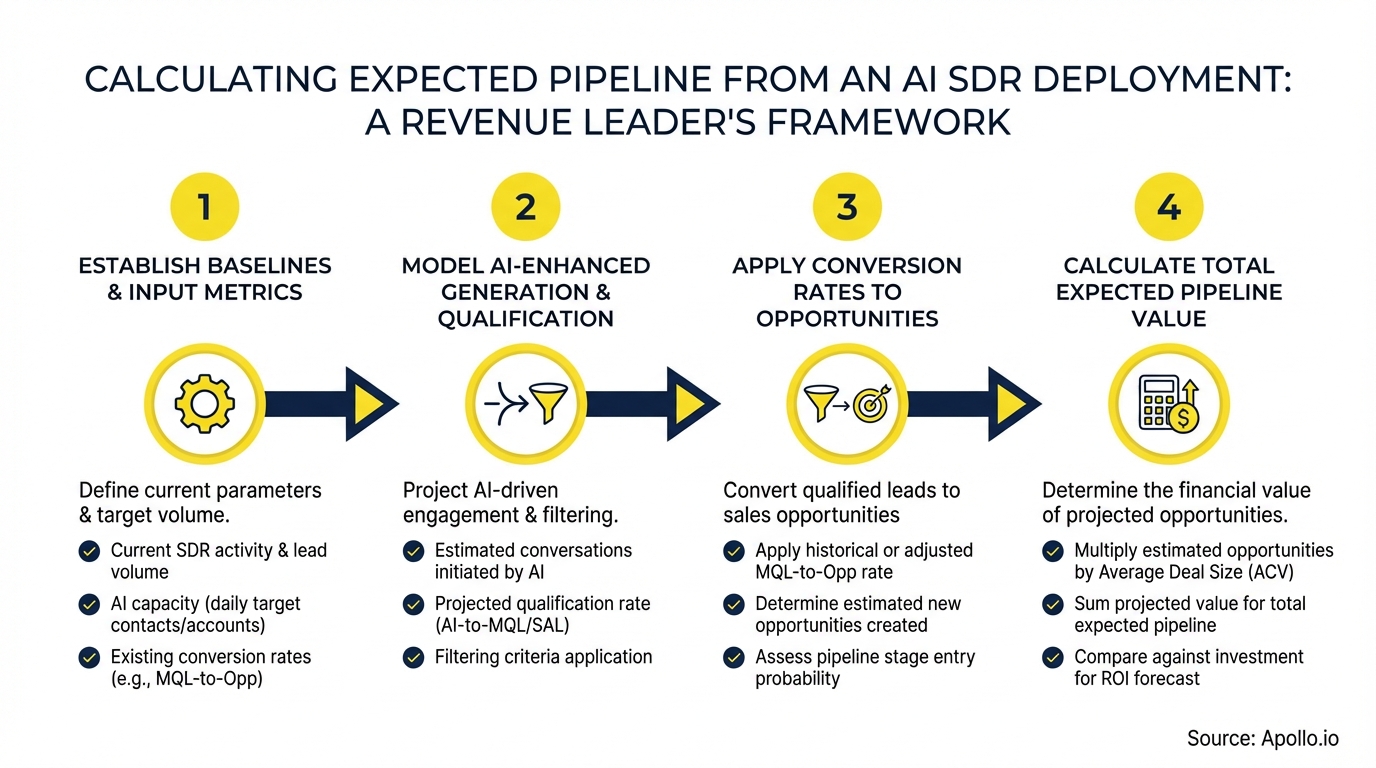
Expected pipeline equals incremental meetings generated multiplied by opportunity conversion rate, multiplied by average contract value, multiplied by a quality discount factor. Written out: Expected Pipeline = (Incremental Meetings) × (Meeting → Opp Rate) × (ACV) × (Quality Discount). Each variable comes from your own CRM history except the quality discount, which accounts for ICP drift and deliverability issues that reduce AI-sourced meeting quality in early ramp periods. This framing aligns with how return on sales calculations work: downstream revenue impact, not top-of-funnel volume.
Research from Medium shows organizations deploying AI in their sales pipelines observe a 20% increase in pipeline volume. Early adopters, per additional Medium reporting, are reporting a 2-3x increase in pipeline generation. These ranges reflect why a single headline number is insufficient: your model needs your funnel rates, not industry averages.
How Do RevOps Leaders Build the Inputs for This Model?
RevOps leaders build the model inputs by pulling three to four quarters of baseline SDR performance from their CRM: touches per week per rep, meeting-to-SQL rate, SQL-to-opportunity rate, and average opportunity value. AI capacity lift is then estimated from time saved per user. The sales analytics framework your team already uses for quota planning is the right starting point.
| Input Variable | Where to Find It | Notes |
|---|---|---|
| Baseline meetings/SDR/month | CRM activity reports | Use trailing 90-day average |
| Meeting → SQL rate | Pipeline stage conversion report | Segment by inbound vs outbound |
| SQL → Opportunity rate | Pipeline stage conversion report | Filter for AI-sourced leads post-launch |
| Average contract value (ACV) | Closed-won deals | Use ICP-segment ACV, not blended |
| Quality discount | Pilot cohort analysis | Apply 0.7–0.9x during first 90 days |
| Ramp curve | Tool adoption logs | Model usage intensity growth, not day-one full utilization |
Struggling to find qualified leads at scale to feed this model? Search Apollo's 230M+ contacts with 65+ filters to build ICP-matched prospect lists your AI SDR can act on immediately.
How Does AI Maturity Level Change the Forecast?
AI maturity determines how much uplift to model because different capability tiers produce different capacity gains. A team using only generative AI for email copy gets a smaller lift than one running full automation and predictive scoring.
Segment your forecast into three scenarios.
| AI Maturity Tier | Capabilities | Expected Capacity Lift | Quality Discount (Days 1-90) |
|---|---|---|---|
| Tier 1: Copy Assist | AI-written emails and subject lines | Low | 0.85x |
| Tier 2: Automation | Sequencing, list building, follow-up | Moderate | 0.80x |
| Tier 3: Predictive + Automation | Intent scoring, ICP matching, full workflow | High | 0.75x (ramp-in period) |
Apollo's Outbound Copilot operates at Tier 3: it automatically finds ICP-matched prospects, adds them to sequences, and runs multi-channel workflows without manual list building. Teams using Apollo's AI Research Agent have seen 46% more meetings booked, which feeds directly into the capacity-lift input in your model.

How Do Downstream Metrics Multiply Pipeline Impact?
Downstream metrics multiply pipeline impact because win rate and stage velocity improvements convert the same pipeline dollars into more closed revenue. A forecast that stops at opportunity creation undervalues the deployment.
Model close-rate lift separately and apply it as a multiplier on expected pipeline to arrive at expected bookings impact.
- Win rate lift: AI-grounded messaging and pre-meeting research improve rep preparedness, which can improve close rates over time. Track this as a separate metric against your pre-deployment baseline.
- Stage velocity: Gartner predicts sales orgs with AI-driven enablement will achieve 40% faster sales stage velocity than those using traditional methods by 2029, making velocity a forward-looking multiplier worth modeling.
- Revenue credit: Attribute AI-sourced pipeline using a CRM field (e.g., "AI SDR sourced") so you can calculate pipeline-to-bookings conversion rates for AI vs. human-sourced opportunities separately.
For SDRs and AEs, accurate pre-meeting intelligence directly supports this downstream lift. Apollo's meeting preparation feature surfaces company priorities, decision-maker context, and past objections before every call, reducing the time reps spend on manual research and improving meeting quality scores.
Turn Funnel Guesswork Into Closed Deals
Pipeline forecasting a guessing game because leads stall before they ever reach your AEs? Apollo surfaces high-intent prospects and delivers verified contacts so your funnel actually converts. Top revenue teams trust Apollo to call their numbers with confidence.
Schedule a Demo →How Should Revenue Leaders Set Up Governance for AI SDR Pipeline Measurement?
Revenue leaders should set up governance by defining attribution rules, control groups, and review cadence before launch, not after. Without these, pipeline credit disputes and data quality gaps will undermine the entire forecast.
The Salesforce "State of Sales 2026" report reinforces this: revenue leaders are increasingly being asked to quantify AI impact in pipeline and forecast terms, not just productivity metrics.
- Attribution rule: Define "AI SDR sourced" as the first meaningful touch being AI-generated. Stamp this on the opportunity at creation.
- Control group: Run a holdout cohort of accounts receiving only human SDR outreach for the first 60 days. Compare meeting rates and pipeline conversion.
- Review cadence: Measure weekly for activity metrics (touches, replies), monthly for pipeline creation, quarterly for pipeline-to-bookings conversion.
- Ramp curve assumption: Model usage intensity growing over 90 days, not at full utilization from day one. This prevents overforecasting in board decks.
Solid revenue operations frameworks build these instrumentation requirements into the deployment plan from the start. Teams that skip this step routinely discover their AI SDR pipeline numbers are unauditable six months later.
Need to track AI SDR pipeline alongside your full funnel without stitching together multiple tools? Manage your pipeline end-to-end in Apollo so every AI-sourced opportunity is visible, attributed, and forecastable in one place.
What Benchmarks Should Revenue Leaders Use to Sanity-Check Their Forecast?
Revenue leaders should sanity-check their forecast against published benchmarks at each funnel stage, then adjust for their specific segment, ACV, and AI maturity tier. Use external benchmarks as ceilings, not targets.
- According to Aviso, teams using AI SDR agents have achieved a 24% increase in qualified pipeline, a useful mid-range benchmark for Tier 2-3 deployments.
- SuperAGI reports that some companies have experienced 300% pipeline growth after implementing AI-powered SDR systems, though outlier results like this reflect full-stack deployments with strong ICP fit and data hygiene.
- For inbound qualification specifically, the uplift ceiling is higher: SalesMotion reports AI SDR agents can boost inbound conversions by up to 70%.
Apply a conservative estimate for your first 90-day forecast and revise upward as your control group data matures. The SDR sales benchmarking guide provides baseline human SDR conversion rates you can use as your pre-AI denominator.
How Do Revenue Leaders Present This Model to the CFO?
Revenue leaders present the AI SDR pipeline model to the CFO by framing it as incremental qualified pipeline per dollar invested, with a defined payback period. CFOs are increasingly receptive to AI investment narratives when they include clear payback logic, as ITPro reported in 2026 noting a marked shift in CFO attitude since the arrival of agentic AI tools.
Structure the one-pager as follows:
- Baseline: Current pipeline generated per SDR per quarter (from CRM)
- Uplift scenario: Conservative, base, and optimistic cases using your funnel inputs and maturity-tier multipliers
- Cost input: AI SDR licensing cost plus RevOps instrumentation time
- Payback metric: Incremental pipeline divided by incremental cost
- Confidence qualifier: State the quality discount applied and the ramp curve assumption
Predictable Revenue consolidated its outbound stack and reduced costs significantly: "We reduced the complexity of three tools into one," per their published Apollo case study. That kind of tool consolidation also simplifies the CFO conversation by reducing the number of line items in the ROI model.

Start Forecasting AI SDR Pipeline with Confidence
The formula is straightforward: capacity lift converts to meetings, meetings convert to opportunities at your historical rates, and opportunities convert to pipeline dollars after applying a maturity-appropriate quality discount. The hard part is instrumentation: clean CRM attribution, a real control group, and a governance cadence that updates assumptions as ramp-period data matures.
Apollo's AI Sales Assistant gives revenue teams the data, sequences, scoring, and workflow automation to feed this model with real activity, not estimates. As Ian Kistner, Head of Sales Development at Crusoe, put it: "We're using Apollo's AI Assistant to score and tier accounts, which makes it much easier to prioritize outbound in a quickly expanding market." Learn more in the AI Assistant usage guide.
Ready to build a pipeline forecast you can stand behind in your next board meeting? Start Free with Apollo and give your AI SDR deployment the data foundation it needs to generate forecastable, attributable pipeline from day one.
Prove Pipeline ROI With Apollo
ROI pressure killing your tool budget before renewal? Apollo delivers measurable pipeline impact your leadership can actually see. Leadium 3x'd annual revenue — your board wants numbers like that.
Start Free with Apollo →Don't miss these
Sales
Inbound vs Outbound Marketing: Which Strategy Wins?
Sales
What Is a Sales Funnel? The Non-Linear Revenue Framework for 2026
Sales
What Is a Go-to-Market Strategy? The 2026 GTM Playbook
See Apollo in action
We'd love to show how Apollo can help you sell better.
By submitting this form, you will receive information, tips, and promotions from Apollo. To learn more, see our Privacy Statement.
4.7/5 based on 9,690 reviews
