
How to Track and Measure Outbound Sales Performance Across Your Team in 2026
Most outbound dashboards are lying to you. They show dials, emails, and meetings booked — but hide whether any of it is actually building pipeline. According to Gradient Works, only 28% of reps met quota in 2023, yet most sales leaders still manage by activity counts rather than conversion quality. The result: busy teams with shrinking pipelines.
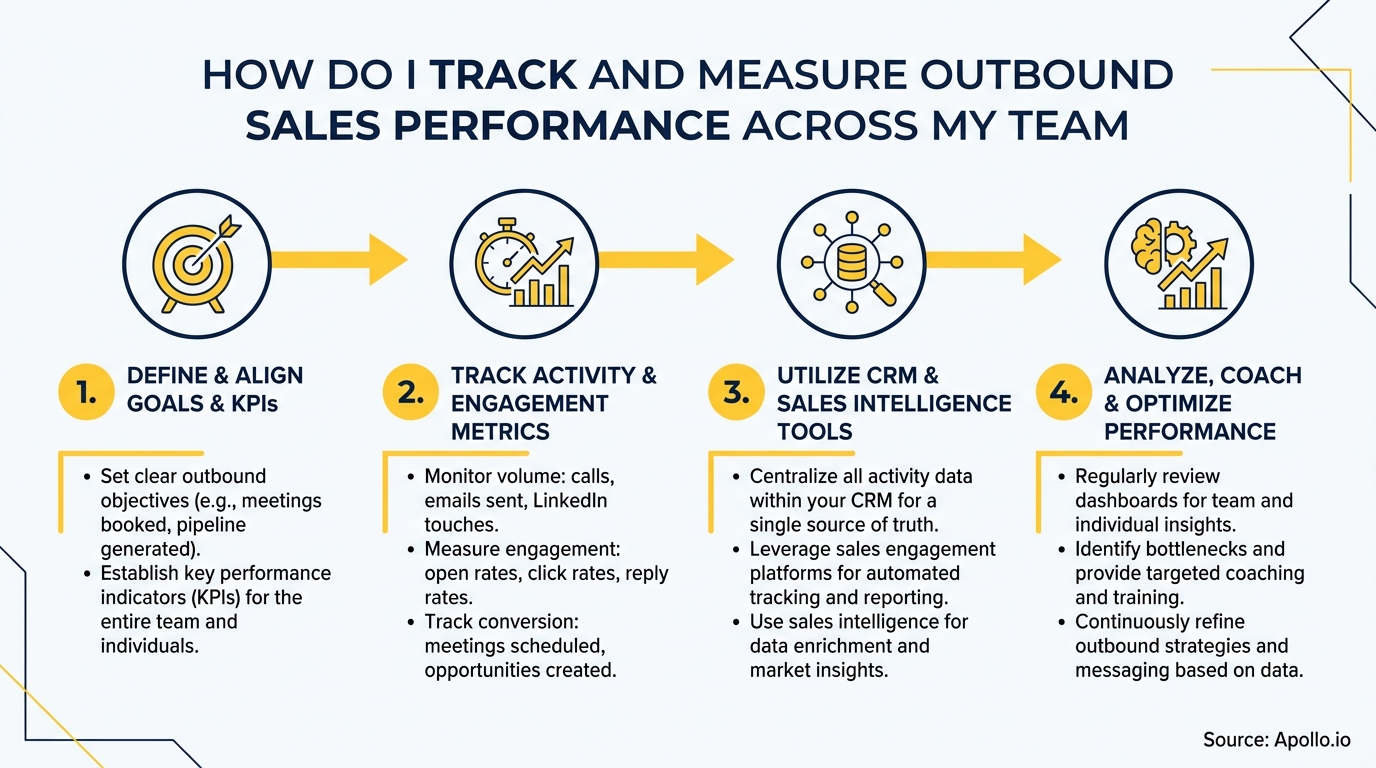
Tracking outbound performance correctly means connecting activities to pipeline outcomes — and knowing which leading indicators predict revenue before the quarter ends. This guide gives you a practical sales performance management framework built for 2026's harder selling environment.

Scale Smarter With Apollo's AI Engine
Tired of your reps burning hours on manual research instead of closing deals? Apollo surfaces verified contacts and automates outreach so your team scales without the chaos. Join 600K+ companies building predictable pipeline.
Start Free with Apollo →Key Takeaways
- Activity volume (dials, emails) is a weak predictor — conversion rates between funnel stages are what matter.
- Quota attainment as a single number masks who's struggling; track attainment distribution by cohort.
- Leading indicators (conversation rate, meeting show rate, pipeline coverage) give you time to coach before the quarter is lost.
- Data governance — CRM hygiene, field completion, stage adherence — determines whether your analytics are trustworthy.
- AI-aware KPIs are now essential: measure AI adoption rates alongside traditional funnel metrics.
What Are the Right Outbound Sales KPIs to Track?
The right outbound KPIs fall into two layers:leading indicators that predict pipeline health, and lagging indicators that confirm revenue outcomes. Most teams over-index on lagging metrics and discover problems too late to fix them.
| Metric Type | KPI | What It Tells You |
|---|---|---|
| Leading | Conversation rate (touches → live conversations) | Is your targeting and messaging connecting? |
| Leading | Meeting show rate | Are booked meetings actually happening? |
| Leading | Pipeline coverage ratio | Do you have enough pipeline to hit quota? |
| Leading | Touches per meeting booked | Sequence efficiency across channels |
| Lagging | Quota attainment (by rep) | Who hit target — and by how much? |
| Lagging | Win rate | Quality of pipeline entering the funnel |
| Lagging | Average deal size | Outbound sourced vs. inbound deal value |
Data from Kondo shows the average B2B win rate sits around 20-21%, making pipeline coverage and conversion rates upstream the most actionable levers sales leaders can pull. For a deeper look at how sales analytics drives revenue growth, the methodology matters as much as the metrics themselves.
Turn Funnel Guesswork Into Real Pipeline
Pipeline forecasting a guessing game because leads stall before they ever become opportunities? Apollo surfaces verified, in-market contacts so your funnel fills with prospects that actually convert. Top GTM teams trust Apollo to make revenue predictable.
Schedule a Demo →How Do You Build a Measurement Stack That Actually Works?
A measurement stack works when your data is clean, your fields are standardized, and your team logs activity consistently. Without governance, dashboards show noise, not signal.
Four governance requirements for reliable outbound measurement:
- CRM field hygiene: Define mandatory fields at each pipeline stage (lead source, contact role, next step date). Audit completion rates weekly.
- Activity taxonomy: Standardize what counts as a "touch" — a call attempt vs. a connected conversation are different data points.
- Stage adherence rules: Define clear criteria for stage advancement so pipeline aging data is comparable across reps.
- Ownership: Assign a RevOps owner to maintain the measurement framework. Ungoverned dashboards decay fast.
This governance-first approach directly addresses a finding from Gartner: 84% of sales leaders agreed sales analytics has had less influence on performance than expected — not because data is scarce, but because instrumentation quality is poor. Strong revenue operations discipline is the foundation, not an afterthought.
Struggling to keep your outbound pipeline clean and measurable? Apollo's pipeline management tools give RevOps a single source of truth for outbound performance.

How Do SDRs and Sales Leaders Diagnose Quota Attainment Gaps?
Quota attainment distribution — not the average — is the diagnostic every sales leader needs. A team averaging 85% attainment can hide the fact that two reps are at 140% while six are below 50%.
Track attainment in four bands:
- Below 50% of quota
- 50% to 80% (struggling)
- 80% to 100% (close but missing)
- 100%+ (exceeding)
Then segment by cohort: ramping reps (under 6 months) vs. tenured reps, and SMB vs. mid-market vs. enterprise territory. Different problems appear in each segment and require different coaching responses. SDRs in ramp phases, for example, need coaching on conversation rate before you address pipeline volume. For strategies on managing team performance by segment, see Apollo for Sales Leaders.
Also worth noting:Glen Coco's State of Outbound Sales found 54% of sales professionals reported an increase in customer acquisition costs over the past 12 months — which means attainment gaps are increasingly expensive to ignore.
What Channel Attribution Metrics Should You Measure for Outbound?
Channel attribution for outbound means tracking which combination of touches (calls, emails, social outreach) generates conversations and pipeline — not just which channel sent the last message before a meeting booked.
Key channel metrics to track per sequence:
- Time-to-first-conversation: How many days and touches before a live exchange?
- Touches-per-meeting by channel mix: Email-only vs. call-first vs. social-first sequences
- Reply rate by touch number: Research from Belkins found the highest email reply rate (8.4%) comes from just one email, with performance declining with each follow-up
- Connect rate by channel: Calls via parallel dialer vs. standard sequential dialing
Modern outbound teams treat measurement as omnichannel by default. Buyers split their time across channels, so your attribution model needs to reflect multi-touch influence rather than last-touch credit. This connects directly to outbound sales software that captures activity across every channel in one place.
Spending hours logging activity across disconnected tools? Apollo's multi-channel sales engagement platform tracks every touch automatically so your attribution data is always accurate.
How Do AI-Enabled KPIs Change Outbound Performance Measurement?
AI-aware KPIs measure whether your team is using AI tools effectively, and whether those tools are improving conversion outcomes. This is a new measurement layer most teams haven't built yet.
AI KPIs to add to your measurement stack:
- AI adoption rate: % of reps using AI-assisted research or personalization per week
- AI-assisted sequence conversion vs. manual: Are AI-written messages converting at higher rates?
- Research accuracy rate: Are AI-generated prospect summaries reducing pre-call prep errors?
- Rep time reclaimed: Hours per week shifted from admin/research to live selling time
Teams using Apollo's AI Research Agent have reported 46% more meetings booked — making AI adoption itself a measurable performance driver, not just a productivity convenience. As the broader market shifts toward AI-assisted outbound, teams that don't measure AI adoption risk falling behind without knowing why. This aligns with the broader shift in sales performance management strategy toward real-time, AI-augmented analytics.
What Does a 90-Day Outbound Measurement Implementation Look Like?
A 90-day rollout gives you enough time to establish governance, baseline your metrics, and run your first coaching cycle from real data.
| Phase | Timeline | Actions |
|---|---|---|
| Foundation | Days 1-30 | Audit CRM fields, define activity taxonomy, assign RevOps owner, set baseline metrics |
| Instrumentation | Days 31-60 | Build attainment distribution report, launch channel attribution tracking, add meeting show rate to weekly review |
| Optimization | Days 61-90 | Run first cohort-based coaching session from data, add AI KPIs, set benchmarks for next quarter |
The most important step in days 1-30 is establishing your baseline. You cannot improve what you haven't measured. Most teams discover in this phase that their existing CRM data is too incomplete to trust — which makes governance the first fix, not the last. Reference how to build a sales tech stack that scales to ensure your tooling supports clean data capture from day one.

How Do You Turn Outbound Measurement Into Revenue?
Tracking outbound performance is only valuable when it changes behavior. The measurement system should feed a weekly coaching loop: review conversion rates by rep, identify the stage where pipeline stalls, and run targeted coaching on that specific gap.
Research from Martal projects that by 2026, 65% of B2B sales organizations will transition from intuition-based to data-driven decision-making. Teams that build this infrastructure now will have a measurable advantage over those still managing by gut feel. The connection between measurement and revenue is direct: better data means better coaching, which means faster ramp times, higher attainment rates, and more predictable pipeline.
Apollo brings prospecting, engagement, pipeline tracking, and AI automation into one platform — eliminating the data fragmentation that makes measurement unreliable. As Cyera noted, "Having everything in one system was a game changer." For sales leaders ready to build a measurement system that actually drives revenue, understanding what factors affect sales performance is the right next step.
Ready to measure outbound performance with a unified GTM platform? Get Leads Now
Prove Pipeline ROI With Apollo
ROI pressure killing your tool budget approval? Apollo delivers measurable pipeline impact from day one — so you walk into every budget review with numbers, not guesses. Leadium 3x'd their annual revenue. You're next.
Start Free with Apollo →Don't miss these
Sales
Inbound vs Outbound Marketing: Which Strategy Wins?
Sales
What Is a Sales Funnel? The Non-Linear Revenue Framework for 2026
Sales
What Is a Go-to-Market Strategy? The 2026 GTM Playbook
See Apollo in action
We'd love to show how Apollo can help you sell better.
By submitting this form, you will receive information, tips, and promotions from Apollo. To learn more, see our Privacy Statement.
4.7/5 based on 9,690 reviews
