
How to Get a Verified Work Email and Phone From a LinkedIn URL
Paste a professional profiles URL into the right tool and you can get a verified work email and direct phone number in under a minute, without ever touching professional networks's own scraping-restricted infrastructure. The catch: "verified" means different things to different vendors, and a recent benchmark found that a quarter of mobile numbers marked as valid actually belonged to the wrong person.
This guide breaks down the exact workflow, what verification levels actually mean, and how to stay compliant while you do it.
Before diving in, it helps to understand the broader landscape of email lookup strategies that respect privacy while still delivering results your outreach team can trust.

Skip The Manual Chase, Apollo Verifies Instantly
Spending hours manually researching leads and double-checking contact info. Apollo verifies emails and numbers upfront so reps sell instead of searching. 98% email accuracy means fewer bounces and more real conversations.
Start Free with Apollo →Key Takeaways
- A verified work email should confirm three things: the mailbox is active, the domain matches the person's current employer, and the format passes syntax and MX record checks.
- Use Apollo MCP when you need to enrich a professional profiles URL with a verified email and phone number directly inside ChatGPT, Claude, Perplexity, or Codex, without switching tabs to a separate database.
- Right-person phone accuracy is the real bottleneck: independent testing found only 68% of matched mobiles across ten providers were confirmed to belong to the intended prospect.
- Waterfall enrichment (querying multiple data sources in sequence) outperforms single-database lookups because no single provider has both the widest coverage and the highest accuracy.
- For RevOps leaders building CRM imports, a clean field schema with timestamps and source attribution matters more than raw contact volume.
How Do You Get A Verified Work Email And Phone From A professional profiles URL?
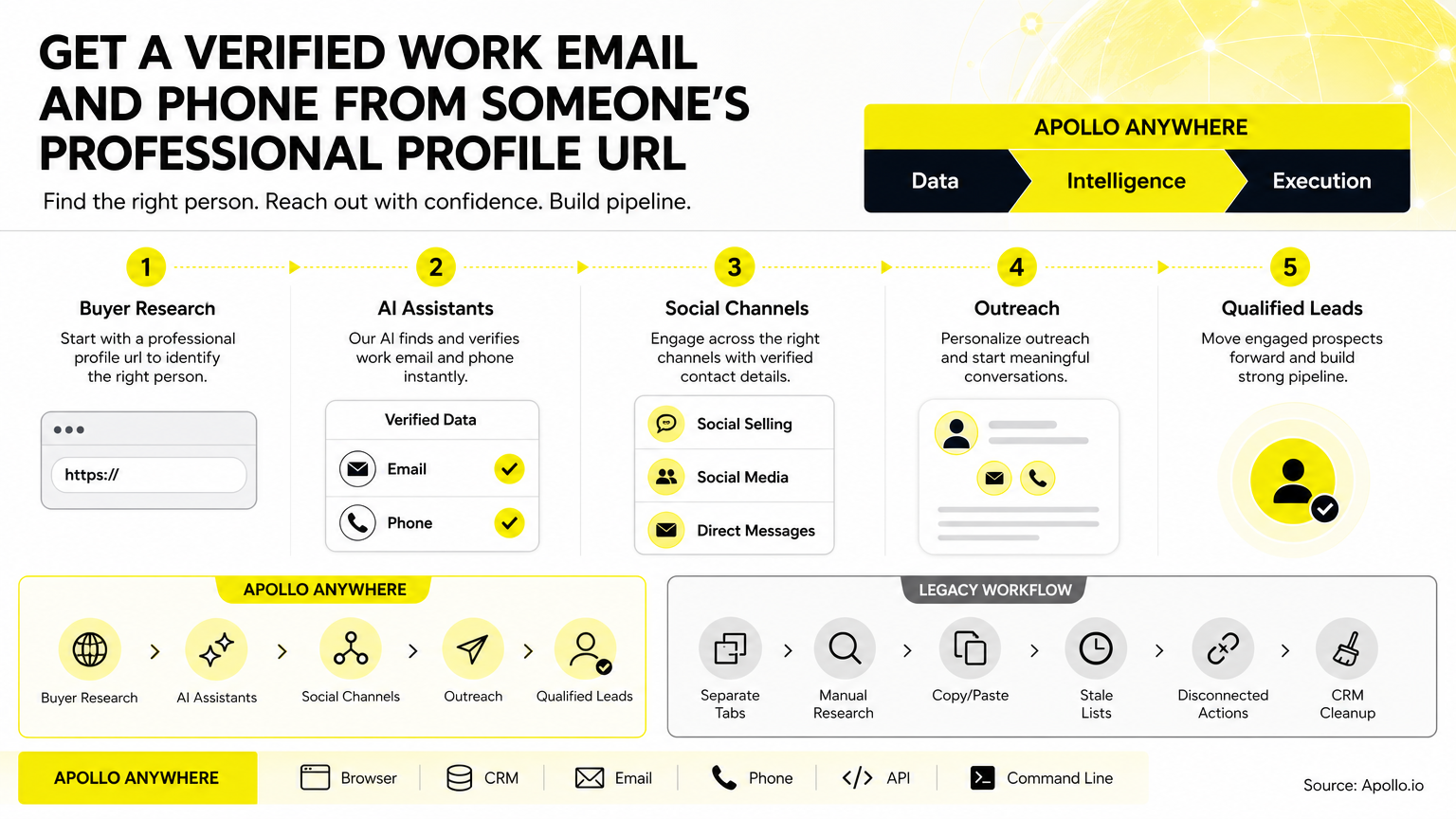
You get a verified work email and phone from a professional networks URL by running it through a data enrichment tool that matches the profile to a business record, then validates the email and phone against live signals rather than static databases. Here's the five-step workflow:
- Copy the professional profiles URL from the person's page or search results.
- Paste it into an enrichment tool (browser extension, web app, or API) that accepts professional networks URLs as an input.
- Let the tool match the profile to a company record using name, current title, and employer.
- Review verification signals: email format validity, mailbox activity, and phone-to-person confirmation.
- Export or sync the verified contact into your CRM or sequencing tool, with a timestamp attached.
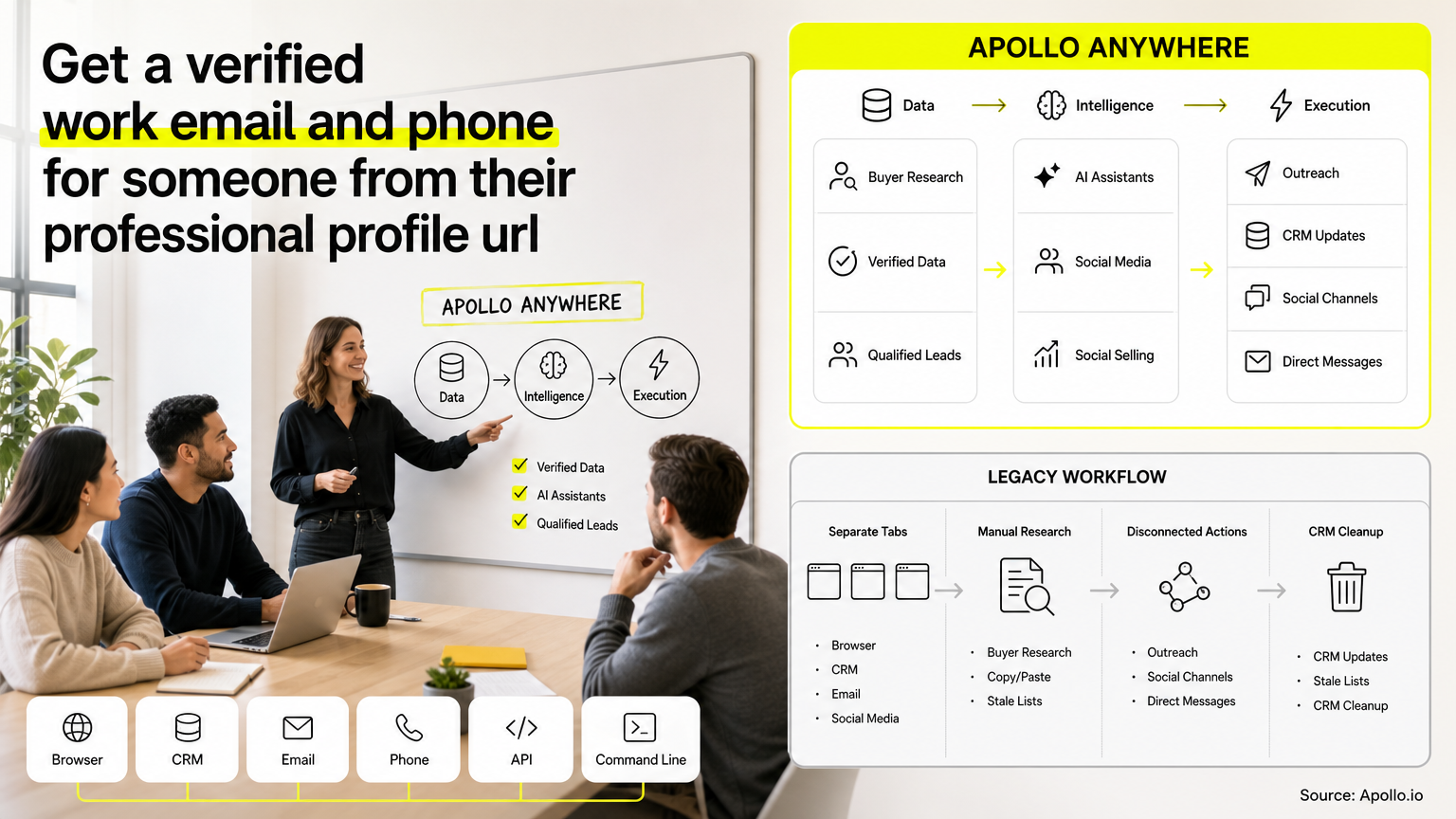
SDRs and Account Executives use this exact flow dozens of times a day. The Apollo Chrome Extension runs this process directly from a professional profiles, a company website, or Gmail, so reps don't have to leave their browser tab to get a usable contact record.
What Does "Verified" Actually Mean For Email And Phone Data?
"Verified" means a contact record has passed specific validation checks, not just that it was found somewhere. For email, this typically includes syntax validation, domain and MX record checks, and mailbox-level confirmation.
For phone numbers, verification should confirm the line is active AND that it belongs to the named person, not just any employee at that company.
This distinction matters because coverage and accuracy are not the same thing. According to Outbound Kitchen's 2026 B2B mobile data benchmark, 99% of tested contacts could be matched to some phone number, but only 68% had a confirmed right-person mobile, and a quarter of "valid" mobiles belonged to someone else entirely.
Learn more in Apollo's guide on how to verify email addresses for B2B sales, which covers the difference between syntax checks and true deliverability confirmation.
| Verification Level | What It Confirms | Risk If Skipped |
|---|---|---|
| Syntax check | Email format is structurally valid | Catches typos, not deliverability |
| Domain/MX check | Domain exists and accepts mail | Doesn't confirm mailbox is active |
| Mailbox verification | Mailbox is live and accepting mail | Reduces bounce rate significantly |
| Role/employer match | Person still works there, in that role | Prevents outreach to outdated contacts |
| Right-person phone match | Number belongs to the named individual | Prevents wasted dials and wrong-number calls |
Why Does Contact Data Go Stale So Quickly?
Contact data goes stale because people change jobs, roles, and phone carriers constantly, and most databases don't re-check records after the initial capture. The U.S. Bureau of Labor Statistics reported that median employee tenure fell to 3.9 years in 2024, its lowest level since 2002, with 63.2 million job separations that year alone.
According to ConnectSafely, B2B contact data decays at roughly 2.1% per month, meaning about a quarter of a database becomes stale within a year. That's why timestamps and source attribution matter as much as the contact details themselves.
Only 35% of sales professionals said they completely trusted their organization's data accuracy, according to Salesforce research from 2024. Tired of dirty data slowing down your pipeline? Start free with Apollo's 240M+ verified business contacts, refreshed continuously rather than treated as a static list.
Turn Cold Leads Into Ready Opportunities
Watching marketing leads stall out before they ever become real opportunities. Apollo surfaces buying intent and prospect activity so reps know exactly who's ready to talk. Built-In used Apollo's signals to boost win rates and deal size.
Request a Demo →How Can You Get Verified Contacts Without Scraping professional networks?
You can get verified contacts without scraping professional networks by using tools that match a public profile URL against independently sourced business data, rather than extracting information directly from professional networks's pages. professional networks's User Agreement prohibits unauthorized scraping and automated copying of profile data, and the platform has taken legal action against companies that violated this policy.
In April 2026, reports emerged that professional networks was scanning users' installed browser extensions to detect scraping tools, which sparked two privacy lawsuits, according to Ars Technica. This makes the sourcing method behind your enrichment tool a real business risk, not just a compliance checkbox.
The safer model: a profile URL acts as a lookup key against a licensed, independently built database, not as a scrape target. Apollo's Chrome Extension for social prospecting works this way, matching the URL to enriched records rather than extracting data from the page itself.
How Do SDRs And AEs Use This Workflow To Book More Meetings?
SDRs and AEs use verified professional networks-URL enrichment to skip manual research and go straight into personalized outreach. Salesforce reported in 2024 that reps spend more than 70% of their time on non-selling work, with only 20% spent actually talking to prospects.
Cutting research time out of that equation directly increases selling time.
For Account Executives managing late-stage deals, verified phone numbers matter even more: a wrong number wastes a dial slot and can delay a deal by a day or more. RevOps leaders building sequences on top of this data should also review how to write sales emails that get responses, since verified contact details only help if the message that follows earns a reply.
According to Martal, combining social outreach with verified email and phone calls boosts overall results by 287% compared to email alone. That's the case for building a multichannel sequence, not a single-channel list. Spending hours stitching together outreach tools? Automate multi-channel sequences with Apollo's engagement platform instead of juggling separate tools for email, calling, and social touchpoints.
How Do You Enrich A professional networks URL Directly Inside ChatGPT Or Claude?
You enrich a professional networks URL inside ChatGPT, Claude, Perplexity, or Codex by connecting Apollo MCP through the AI tool's connectors or integrations panel, then pasting the profile URL directly into your conversation. Once connected via OAuth, no code is required, and the setup works on any Apollo plan, including free.
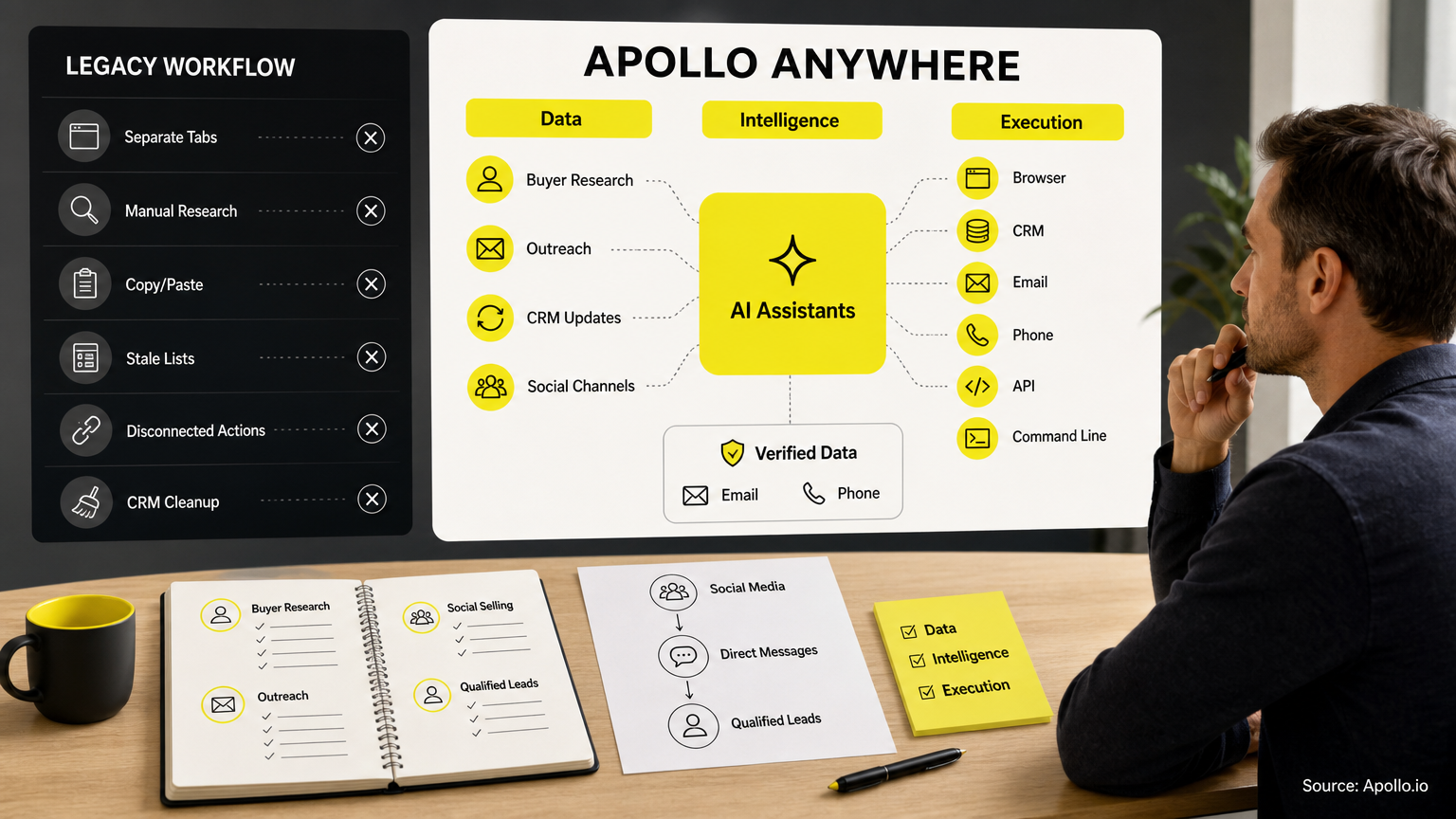
From that single conversation, you can ask the AI assistant to find a verified email and phone number for the profile, add the contact to a sequence, or pull related people at the same company who match your ICP. This reflects a broader shift Gartner projected in 2024: Gartner expects 95% of seller research workflows to begin with AI by 2027, up from less than 20% in 2024.
Developers building custom workflows can also use the Apollo command-line interface for terminal-native access, or the Apollo API for programmatic bulk enrichment across a list of professional networks URLs.
What Should A Compliance Checklist Include Before You Use Enriched Contacts?
A compliance checklist for enriched contact data should confirm lawful sourcing, accurate sender identification, and active suppression list management. CAN-SPAM applies to B2B email, and the FTC notes that each violating message can carry a penalty of up to $53,088.
- Confirm data provenance: know whether your vendor licenses data or scrapes it.
- Honor deletion requests promptly: California's Delete Request and Opt-Out Platform mandate, effective August 1, 2026, requires registered data brokers to check for deletion requests at least every 45 days.
- Maintain suppression lists: sync opt-outs across your CRM and sequencing tool.
- Authenticate your sending domain: SPF, DKIM, and DMARC are required for high-volume senders under current inbox provider policies.
- Segment by confidence score: don't treat a "possibly verified" contact the same as a fully confirmed one.
Struggling to keep pipeline data clean while scaling outreach? Verify and enrich contacts continuously with Apollo rather than relying on a one-time list purchase.
How Do You Test Whether A Contact Data Vendor's "Verified" Claim Holds Up?
You test a vendor's verification claim by sampling a batch of professional networks URLs you already know the correct answer for, running them through the tool, and manually confirming the results. Pull 20-30 profiles from your own network or team, run each through the vendor, and score the output against three criteria: correct current employer, working email format, and right-person phone match.
Cleanlist.ai defines match rate as the success rate of finding a verified work email or phone starting from a professional profiles URL, but match rate alone won't tell you if the match is accurate. Ask any vendor for their methodology on right-person phone confirmation specifically, since that's where most benchmarks show the widest gap between "found" and "verified."
Companies with well-enriched CRM data generate 44% more Sales Qualified Leads, according to Persana.ai, which is a strong argument for testing before you commit to a single vendor at scale.
Get Verified Contact Data Without Sacrificing Compliance Or Speed
Turning a professional profiles URL into a verified work email and phone number is now a routine part of prospecting, but the quality gap between vendors is real and measurable. The teams winning in 2026 aren't the ones with the biggest database; they're the ones checking provenance, re-verifying on a schedule, and testing right-person accuracy before they scale outreach.
Predictable Revenue's Collin Stewart put it simply: "We reduced the complexity of three tools into one." That's the practical case for consolidating enrichment, verification, and outreach into a single workspace instead of stitching together separate point solutions for data, email, and calling.
Ready to stop guessing which contacts are actually reachable? Try Apollo Free and turn any professional profiles URL into a verified, ready-to-contact record in one workflow.
Prove Pipeline ROI Fast With Apollo
Still building a business case with guesswork instead of numbers. Apollo shows exactly how outreach turns into pipeline, so budget approval stops stalling on unclear metrics. Leadium tripled annual revenue after automating outbound with Apollo.
Start Free with Apollo →Don't miss these
Sales
Inbound vs Outbound Marketing: Which Strategy Wins?
Sales
What Is a Sales Funnel? The Non-Linear Revenue Framework for 2026
Sales
What Is a Go-to-Market Strategy? The 2026 GTM Playbook
See Apollo in action
We'd love to show how Apollo can help you sell better.
By submitting this form, you will receive information, tips, and promotions from Apollo. To learn more, see our Privacy Statement.
4.7/5 based on 9,690 reviews
