
How to Find the Right Contacts for Your ABM Campaign
Most ABM campaigns fail before the first email sends. Marketing builds a target account list, hands it to sales, and sales finds one VP contact per account instead of the full buying group.
By the time that single contact responds (or doesn't), the account has often already picked a vendor.
Research from The Starr Conspiracy puts the median enterprise B2B buying group for technology and SaaS purchases at 11 stakeholders. If your ABM contact list has 1-2 names per account, you're not running account-based marketing. You're running contact-based marketing with an account label on it. This guide walks through how to find, verify, and prioritize the right contacts across every account on your list, using a role matrix, a coverage scorecard, and a signal-to-contact decision tree.

Skip The Research, Apollo Verifies Contacts
Spending hours manually researching leads and chasing dead-end emails. Apollo verifies business contact data instantly with 98% email accuracy, so your team spends less time hunting and more time selling. Join 600K+ companies building pipeline faster.
Start Free with Apollo →Key Takeaways
- ABM contact discovery means mapping the full buying group (typically 8-11+ stakeholders) per account, not finding one decision-maker.
- Use Apollo MCP when you need to pull verified contacts and org charts for target accounts directly inside ChatGPT, Claude, or Perplexity, without switching tabs to run the search.
- Nearly half of purchasing influence sits with "hidden buyers" in finance, procurement, and legal, roles most ABM lists skip entirely.
- Track contact coverage (verified, multi-threaded, role-mapped) as an account-level KPI, not just total contacts uploaded.
- Use Apollo MCP when you need to enrich a stale CRM list with current titles and verified emails before launching a new ABM sequence.
What Is A Buying Group In ABM Contact Discovery?
A buying group is the full set of stakeholders inside a target account who influence, evaluate, or approve a purchase decision. It is not the same as your target account list, and it is not the same as a single champion or decision-maker.
According to Intentsify, modern B2B deals no longer have a single decision-maker. Buying groups typically include:
- Champions: internal advocates who push the initiative forward
- Evaluators: technical or functional users who test the product
- Economic buyers: budget owners who approve spend
- Blockers: procurement, legal, and security reviewers who can stall or kill a deal
- End users: the people who use the product daily
Missing any of these roles creates risk later in the deal cycle, not just a smaller contact list.
Who Are The Hidden Buyers You're Probably Missing?
Hidden buyers are stakeholders outside the obvious target persona, typically in finance, procurement, and legal, who hold outsized influence over deal approval. Nearly half of purchasing influence in B2B deals belongs to these functions, yet most ABM contact lists skip them entirely because they don't fit the "ideal customer profile" persona used for outbound.
This matters because economic buyers and legal reviewers often surface late, after a champion has already built internal consensus. If you haven't identified and warmed these contacts earlier, procurement or security can add weeks to a deal that was otherwise ready to close. Building your target account list with role coverage in mind, not just firmographic fit, prevents this bottleneck.
How Many Contacts Do You Need Per Target Account?
Most ABM programs need 6-11 verified contacts per target account to cover the full buying group, based on committee size benchmarks from The Starr Conspiracy. A single contact per account is not a campaign; it's a guess.
Use this role matrix as a starting checklist for each account:
| Role | Function Examples | Why They Matter |
|---|---|---|
| Champion | Director/Manager in the buying department | Drives internal momentum |
| Evaluator | Ops, RevOps, IT | Tests functionality and fit |
| Economic Buyer | VP/CFO/Budget Owner | Approves spend |
| Blocker/Reviewer | Legal, Procurement, Security | Can delay or veto |
| End User | Individual contributor | Daily product usage |
Struggling to find qualified contacts across every role on this list? Search Apollo's 240M+ contacts with 65+ filters to map every role in the matrix above, not just the top of the org chart.

Why Does Early Contact Discovery Matter For ABM Timing?
Early contact discovery matters because most buying decisions are made before a seller ever gets involved. Research from Omnibound found that 95% of winning vendors are chosen from a shortlist the buying group creates before ever making first contact with a salesperson, and 80% of deals are won by the vendor favored during that anonymous research phase.
If your ABM contact discovery only starts after a form fill or demo request, you're mapping the buying group after the shortlist is already set. Teams that identify and lightly engage the extended buying committee (not just the loudest inbound lead) earlier in the cycle have more influence when the actual evaluation begins. This is also why market intelligence tools that surface intent signals ahead of hand-raising are becoming standard in ABM stacks.
How Do You Turn Intent Signals Into A Prioritized Contact List?
You turn intent signals into a prioritized contact list by layering behavioral data (website visits, content downloads, hiring changes) on top of your role matrix, then ranking accounts and contacts by combined fit and engagement. This is the signal-to-contact decision tree:
- Anonymous intent detected → Match the account to your target list → Pull the full org chart
- CRM has partial contact data → Enrich stale records with current titles and emails
- No existing contacts → Run a fresh search against the role matrix
- Contacts identified but unverified → Run email and phone verification before outreach
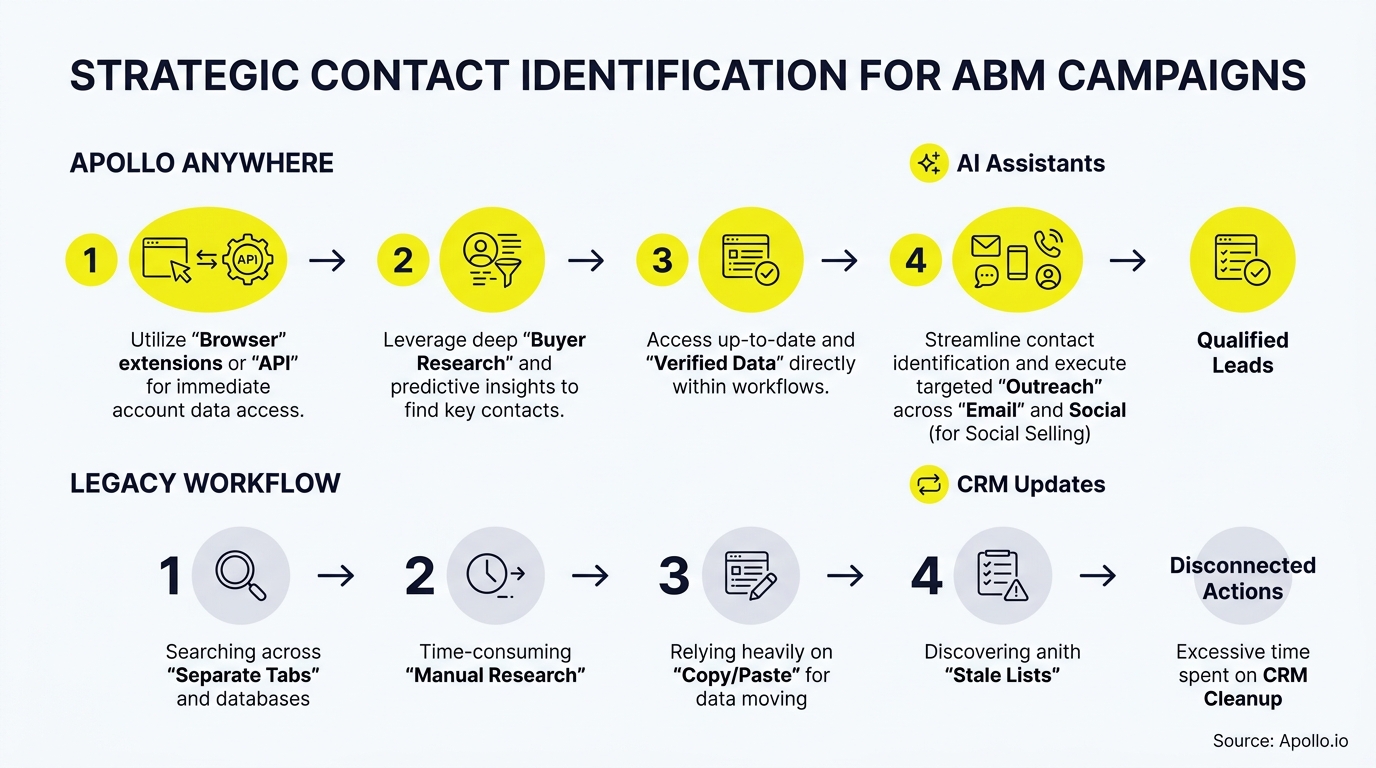
This is also where AI-assisted workflows are changing the operational reality. If you're already working inside ChatGPT, Claude, or Perplexity, Apollo MCP lets you search for people and companies matching an ICP, enrich contacts with verified emails and phone numbers, and add prospects to sequences, all from the same conversation where you're analyzing account signals. You don't have to open a separate tab to run the search and a third tool to load the sequence.
Spot Sales-Ready Buyers Before They Cool Off
Marketing hands off leads that stall before they ever become real opportunities. Apollo surfaces buying signals and intent data so reps engage prospects at the exact moment they're ready to talk. Built-In improved win rates using Apollo's scoring.
Start Free with Apollo →How Do You Verify Contact Data Before Launching Outreach?
You verify contact data by checking email deliverability, confirming current title and department against a live source, and flagging records older than your enrichment cadence before any contact enters an active sequence. Skipping this step is expensive: IndustrySelect reports that inaccurate contact data costs U.S. businesses an estimated $3.1 trillion annually.
A basic verification checklist for every ABM contact list:
- Email format and deliverability confirmed (not just syntax-valid)
- Job title and department match current company structure
- Phone number validated against a business record, not just a pattern-matched guess
- Record last updated within your acceptable freshness window
- Role tagged against the buying-group matrix (champion, evaluator, blocker, etc.)
For teams building lists manually, our guide on how to verify email addresses for B2B sales covers the mechanics in more depth. Tired of chasing stale records that bounce on send? Start free with Apollo's verified business contact data to skip the manual cleanup step entirely.
How Do RevOps Teams Track Contact Coverage As An ABM Metric?
RevOps teams track contact coverage by measuring the percentage of required buying-group roles identified, verified, and multi-threaded per account, then reviewing that number alongside pipeline stage. This turns "we uploaded 500 contacts" into "we have verified coverage on 4 of 6 roles at 70% of Tier 1 accounts," which is a far more useful signal for forecasting.
A simple account-level dashboard should track:
| Metric | What It Tells You |
|---|---|
| % roles identified per account | Committee mapping completeness |
| % contacts verified (email/phone) | Data quality and deliverability risk |
| Multi-threading depth | Number of active contacts engaged, not just listed |
| Stale record % | Contacts needing re-enrichment |
Vector found that 41% of marketers cite the inability to track the right data inside target accounts as their single biggest ABM challenge. Coverage metrics like these close that visibility gap. RevOps leaders who centralize this tracking also cut down on the tool-switching that causes CRM drift; see our notes on solving data synchronization headaches for related workflow fixes.
How Do SDRs And AEs Multi-Thread A Target Account?
SDRs and AEs multi-thread an account by engaging at least three to four contacts across different roles (champion, evaluator, economic buyer) in parallel, rather than waiting for one contact to respond before finding the next. This shortens the research-to-outreach gap that eats SDR selling time.
Research from MarketBetter found that SDRs currently spend just 2 hours per day actively selling, with the rest consumed by research and admin work. For AEs managing active deals, multi-threading isn't optional. A single-threaded deal that loses its champion (to a job change, reorg, or simple silence) resets the entire sales cycle.
Practical multi-threading steps:
- Identify the champion first, then work outward to their manager and adjacent evaluators
- Add procurement and legal contacts to a nurture track earlier, even before they're active
- Use sequences that vary messaging by role, not one generic template for every contact
Spending hours stitching together contact lists from your CRM, a spreadsheet, and a data vendor? Automate multi-threaded sequences across roles with Apollo's sales engagement platform instead of building outreach for one contact at a time. Teams also lean on our Apollo Email Finder when a specific buying-group contact is missing a verified address.

Getting Started: From Target Account List To Full Buying-Group Coverage
Finding the right contacts across your target accounts isn't a one-time export. It's an ongoing process of role mapping, verification, and re-enrichment as accounts move through the buying cycle and people change jobs.
Start by auditing your current ABM list against the role matrix above. If most accounts show one or two contacts, that's your coverage gap, not your target account list's fault.
From there, layer in verification and intent signals so your team engages the full committee, not just the person who filled out a form.
Predictable Revenue described the shift plainly: "We reduced the complexity of three tools into one." That's the practical outcome of consolidating contact discovery, enrichment, and outreach into a single workspace instead of stitching together a data vendor, a verification tool, and a separate sequencer.
Ready to build full buying-group coverage across your target accounts? Start Your Free Trial and search, verify, and sequence every contact your ABM campaign actually needs, in one platform.
Justify Spend With Apollo's Fast Payback
Struggling to prove ROI before the next budget review? Apollo replaces scattered tools with one platform, so pipeline impact shows up in weeks, not quarters. Leadium tripled revenue after consolidating on Apollo.
Start Free with Apollo →Don't miss these
Sales
Inbound vs Outbound Marketing: Which Strategy Wins?
Sales
What Is a Sales Funnel? The Non-Linear Revenue Framework for 2026
Sales
What Is a Go-to-Market Strategy? The 2026 GTM Playbook
See Apollo in action
We'd love to show how Apollo can help you sell better.
By submitting this form, you will receive information, tips, and promotions from Apollo. To learn more, see our Privacy Statement.
4.7/5 based on 9,690 reviews
