
How to Find Senior IT and Clinical Decision-Makers at Hospitals
Hospital technology deals don't close because one CIO said yes. They close when a system-level executive, a clinical champion, a security leader, and a finance stakeholder all stop blocking the deal at the same time.
If you're still building lists around a single "IT Decision Maker" title, you're missing most of the committee that actually approves the purchase.
This guide maps the real buying committee at hospitals and health systems, shows you how to research and prioritize accounts, and gives you a workflow for finding named contacts fast. For the broader prospecting motion this fits into, see Outbound Prospecting: How to Find, Reach, and Win B2B Leads.

Skip The Research, Apollo Finds Buyers Fast
Spending hours manually researching leads and chasing bad contact info. Apollo hands you verified emails and numbers instantly, no more guessing games. 98% email accuracy means your outreach actually connects.
Start Free with Apollo →Key Takeaways
- Target the health system first, not individual hospitals. System-level executives often influence technology decisions across every affiliated facility.
- Hospital technology purchases involve multiple stakeholders, so build multi-threaded outreach plans that reach IT, clinical, security, and finance leaders at once.
- Use Apollo MCP when you need to pull verified CIO, CMIO, and CISO contacts directly inside ChatGPT, Claude, or Perplexity without switching tabs.
- Monitor leadership changes continuously. Healthcare executive turnover is high, so static contact lists go stale fast.
- Score accounts on operational readiness signals (governance committees, AI hires, EHR modernization), not just general AI interest.
Who Are The Senior IT And Clinical Decision-Makers At Hospitals?
Senior IT and clinical decision-makers at hospitals are the executives and committee members who evaluate, approve, and fund technology purchases, and they span far beyond the CIO title. The core group includes the Chief Information Officer (CIO), Chief Medical Information Officer (CMIO), Chief Information Security Officer (CISO), VP of Clinical Informatics, and increasingly, dedicated AI leadership roles.
Titles have shifted quickly. An August 2026 review found dedicated AI leaders at more than 20 major health systems, with titles like chief health AI officer, chief medical information and AI officer, and chief data and AI officer becoming common.
A prospecting list built only on "CIO" and "CMIO" search strings will miss these newer, often highly influential, buyers.
How Do You Map A Hospital Buying Committee?
You map a hospital buying committee by identifying five functional roles: sponsor, technical evaluator, clinical validator, security reviewer, and finance approver. Hospital technology evaluations rarely sit with one department.
| Role | Typical Titles | What They Care About |
|---|---|---|
| Executive Sponsor | CIO, Chief Digital Officer, COO | Strategic fit, enterprise risk, budget ownership |
| Clinical Validator | CMIO, VP Clinical Informatics, Chief Nursing Informatics Officer | Workflow impact, patient safety, clinician adoption |
| Security Reviewer | CISO, VP Information Security | Data protection, compliance, vendor risk assessment |
| AI/Data Governance | Chief AI Officer, Chief Data Officer | Model validation, governance policy, monitoring |
| Finance Approver | CFO, VP Finance, Procurement Director | ROI, total cost of ownership, contract terms |
Federal data on hospital predictive-AI adoption found that most evaluations involve more than one party, with specialized committees and department leaders playing a significant role alongside IT staff. Treat every deal as a five-thread outreach plan, not a single contact.
Should You Target The Health System Or The Individual Hospital?
Target the health system first. Most U.S. hospitals are system-affiliated, and system-level executives frequently set technology strategy for every facility under their umbrella.
Chasing individual hospital administrators when a parent system already owns the vendor decision wastes outreach cycles.
This matters even more during M&A activity. When hospitals get acquired, they're often moved onto the parent system's EHR platform, and purchasing authority shifts from local hospital leaders to system-level CIO and procurement teams.
Before you prioritize an account, confirm:
- Is this facility part of a larger health system, or independently operated?
- Has it been acquired or merged in the past 18 months?
- Does the parent system have a centralized IT/clinical governance structure?
Independent hospitals move slower on technology adoption and typically need more education-heavy outreach, while system-affiliated facilities respond better to enterprise-level ROI and integration messaging.
What Search Strings And Triggers Help You Find Named Contacts?
The fastest way to find named contacts is combining title-based search strings with recent trigger events, then verifying with a sales intelligence platform. Start with these title variants, since traditional CIO/CMIO searches increasingly miss newer roles:
- "Chief Information Officer" OR "Chief Digital and Information Officer" OR "VP Information Technology"
- "Chief Medical Information Officer" OR "VP Clinical Informatics" OR "Chief Nursing Informatics Officer"
- "Chief AI Officer" OR "Chief Health AI Officer" OR "Chief Data and AI Officer"
- "Chief Information Security Officer" OR "VP Information Security" (hospital or health system)
Layer in trigger events that signal active buying windows:
- New executive appointment or promotion in the past 90 days
- Announced EHR migration or system consolidation
- New AI governance committee or AI leadership hire
- Recent M&A activity involving the facility or parent system
Healthcare executive turnover is unusually high right now, with more than half of healthcare CIOs having been in their current role for three years or less as of a recent Becker's Hospital Review tracking report. That means the contact you found six months ago may already report to someone new. Struggling to keep contact data current? Search Apollo's 240M+ contacts with 65+ filters to surface verified, current titles instead of working from a stale list.
Turn Buying Committee Chaos Into Pipeline
Marketing hands you leads that stall before they ever become real opportunities. Apollo maps every stakeholder in the deal and shows you exactly where each one stands, so forecasts stop being a guessing game. Build pipeline you can actually trust.
Start Free with Apollo →How Can RevOps Teams Keep Hospital Contact Data Clean?
RevOps teams keep hospital contact data clean by running continuous enrichment against CRM records instead of relying on annual list purchases. Healthcare leadership changes fast enough that a quarterly refresh cycle isn't sufficient.
For RevOps leaders managing healthcare territories, the practical workflow is: enrich existing CRM records monthly, flag any contact without a title update in 90+ days, and route re-verification tasks automatically when a trigger event fires (executive move, funding announcement, M&A news). The Data Health Center approach to CRM hygiene applies directly here: instantly enrich and clean records so your reps aren't emailing someone who left the health system four months ago.
Account-based targeting also reduces wasted effort. Since AHA reporting shows most hospitals and hospital beds are system-affiliated, RevOps can concentrate enrichment resources on a smaller number of system-level accounts rather than spreading thin across every individual facility.

How Do SDRs Multithread A Hospital Buying Committee?
SDRs multithread a hospital buying committee by running parallel outreach sequences to at least three of the five buyer roles simultaneously, rather than waiting for one contact to respond before reaching the next. Hospital deals stall when reps single-thread a CIO and hope for an internal introduction.
A practical sequence for SDRs and BDRs working health system accounts:
- Week 1: Email + call the CIO or VP IT with an executive-level ROI angle.
- Week 1 (parallel): Email the CMIO or VP Clinical Informatics with a workflow/clinical-safety angle.
- Week 2: Reach the CISO with a security/compliance-framed message referencing your governance documentation.
- Week 3: If no response, escalate to a finance or procurement contact with a cost-comparison one-pager.
Buying committees across B2B, not just healthcare, have grown large. The Starr Conspiracy cites research putting average B2B buying committee size at 18-22 stakeholders, reinforcing why single-threaded outreach fails in complex sales like hospital technology. Spending hours manually building these sequences? Automate multi-channel sequences with Apollo so your team can run parallel threads to IT, clinical, and security contacts from one workspace.
How Do You Use AI Tools To Research Hospital Decision-Makers Faster?
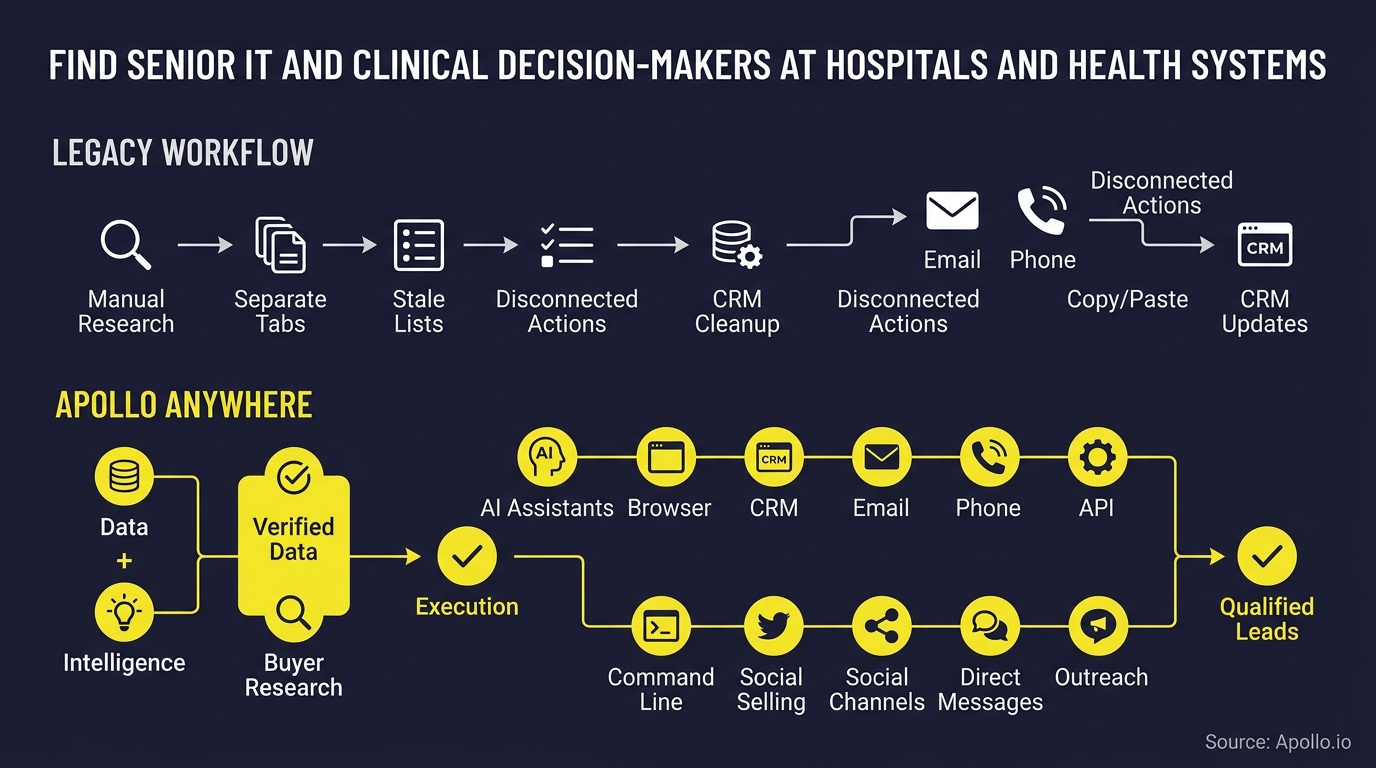
You use AI tools to research hospital decision-makers faster by connecting a sales intelligence platform directly inside the AI assistant you already work in, so you can ask for a target list and get verified contacts without switching tabs. Apollo MCP connects to ChatGPT, Claude, Perplexity, and Codex, letting you type a request like "find CMIOs and CISOs at health systems with 500+ beds in the Midwest" and get enriched results with verified emails and phone numbers in the same conversation.
Setup is no-code: connect Apollo through the AI tool's connectors or integrations menu via OAuth, on any Apollo plan including free. From there you can search for people and companies matching your ICP, enrich records, and even queue prospects into a sequence without leaving the chat.
For developer-oriented teams building custom workflows, the Apollo CLI offers the same access from the terminal.
Your best prospecting session shouldn't require opening a new tab.
How Do You Build Consensus Once You've Found The Committee?
You build consensus by giving each stakeholder role a document tailored to what they evaluate, not one generic pitch deck sent to everyone. Since ONC/HealthIT.gov data shows most hospitals assign predictive-AI evaluation to multiple entities including specialized committees and department leaders, sellers need distinct materials for each reviewer.
Build three lightweight templates before your first multithreaded outreach wave:
- ROI summary for CFOs and finance approvers, framed around cost avoidance and operational efficiency.
- Security and compliance checklist for CISOs, covering data handling, access controls, and audit trail capability.
- Clinical validation brief for CMIOs and clinical informatics leaders, focused on workflow disruption and patient safety.
Account executives closing hospital deals report that having these ready before the first committee meeting shortens the internal debate cycle significantly, since each stakeholder gets the specific proof they need instead of hunting through one long deck.
What Should You Watch For As Deals Progress?
Watch for readiness signals, not just interest signals, when deciding which accounts to prioritize. Many health systems are exploring AI initiatives but aren't operationally ready to deploy them, which means a hospital discussing AI publicly isn't automatically a fast-moving deal.
Practical account-scoring signals to track:
- Recent appointment of a dedicated AI or data governance executive
- Formation of an AI governance or model-oversight committee
- Announced EHR modernization or cloud migration project
- Job postings for informatics, implementation, or integration roles
- Whether the organization has publicly stated an "Epic-first" purchasing posture, which affects how you position integration and interoperability
Account executives should weight these signals more heavily than generic press mentions of "AI interest," since readiness (not enthusiasm) predicts how fast a deal actually moves through committee.
Frequently Asked Questions
Who Approves Hospital Technology Purchases?
Hospital technology purchases are typically approved by a combination of the CIO, a specialized evaluation committee, department or division leaders, and finance/procurement, rather than one individual. CHIME Central notes that half of healthcare organizations name the CIO as the primary executive determining IT budgets, but that leaves the other half distributing that authority across other roles or committees.
How Do You Find A CMIO's Contact Information?
You find a CMIO's contact information by searching sales intelligence databases filtered by title variants (CMIO, VP Clinical Informatics, Chief Health AI Officer) and healthcare industry, then verifying the email and phone number before outreach. A B2B phone number and email finder browser extension can also pull verified contact details while you're researching a hospital's leadership page or a professional network profile.
What Is The Difference Between A CIO And A CMIO?
A CIO oversees enterprise IT infrastructure, security, and technology strategy across the health system, while a CMIO focuses specifically on clinical technology adoption, EHR workflow design, and physician engagement with digital tools. Both roles typically weigh in on major technology purchases, but they evaluate different aspects: the CIO cares about integration and enterprise risk, the CMIO cares about clinical safety and adoption.

Start Building Your Hospital Buying Committee List Today
Finding senior IT and clinical decision-makers at hospitals and health systems isn't about locating one CIO. It's about mapping the full committee, IT, clinical, security, AI governance, and finance, then running coordinated outreach to all of them at once.
Static lists and single-threaded outreach lose to reps who multithread and keep their data current.
Apollo brings verified contact data, multi-channel sequences, and AI-powered research together in one workspace, so your team isn't stitching together a data vendor, an outreach tool, and a spreadsheet just to reach a single health system account. As Collin Stewart of Predictable Revenue put it, "We reduced the complexity of three tools into one."
Try Apollo Free and start mapping IT, clinical, security, and finance stakeholders across your target health systems today.
Prove ROI Fast, Scale Outreach With Apollo
Struggling to justify tool spend when leadership wants numbers now? Apollo turns one rep into a full outbound team with automated multi-channel sequences and verified contacts. Leadium 3x'd annual revenue by automating outbound and follow-up.
Start Free with Apollo →Don't miss these
Sales
Inbound vs Outbound Marketing: Which Strategy Wins?
Sales
What Is a Sales Funnel? The Non-Linear Revenue Framework for 2026
Sales
What Is a Go-to-Market Strategy? The 2026 GTM Playbook
See Apollo in action
We'd love to show how Apollo can help you sell better.
By submitting this form, you will receive information, tips, and promotions from Apollo. To learn more, see our Privacy Statement.
4.7/5 based on 9,690 reviews
