
How to Find Nonprofit Leadership Contacts for Partnership Outreach
Nonprofit staffing has gotten leaner, and titles change faster than most CRMs can keep up. The Center for Effective Philanthropy found that roughly 30% of surveyed nonprofits reduced staff since January 2025, which means the program director you found six months ago may no longer own that initiative.
Finding the right nonprofit contact for partnership or sponsorship outreach now requires a role-based map, not a one-time list.
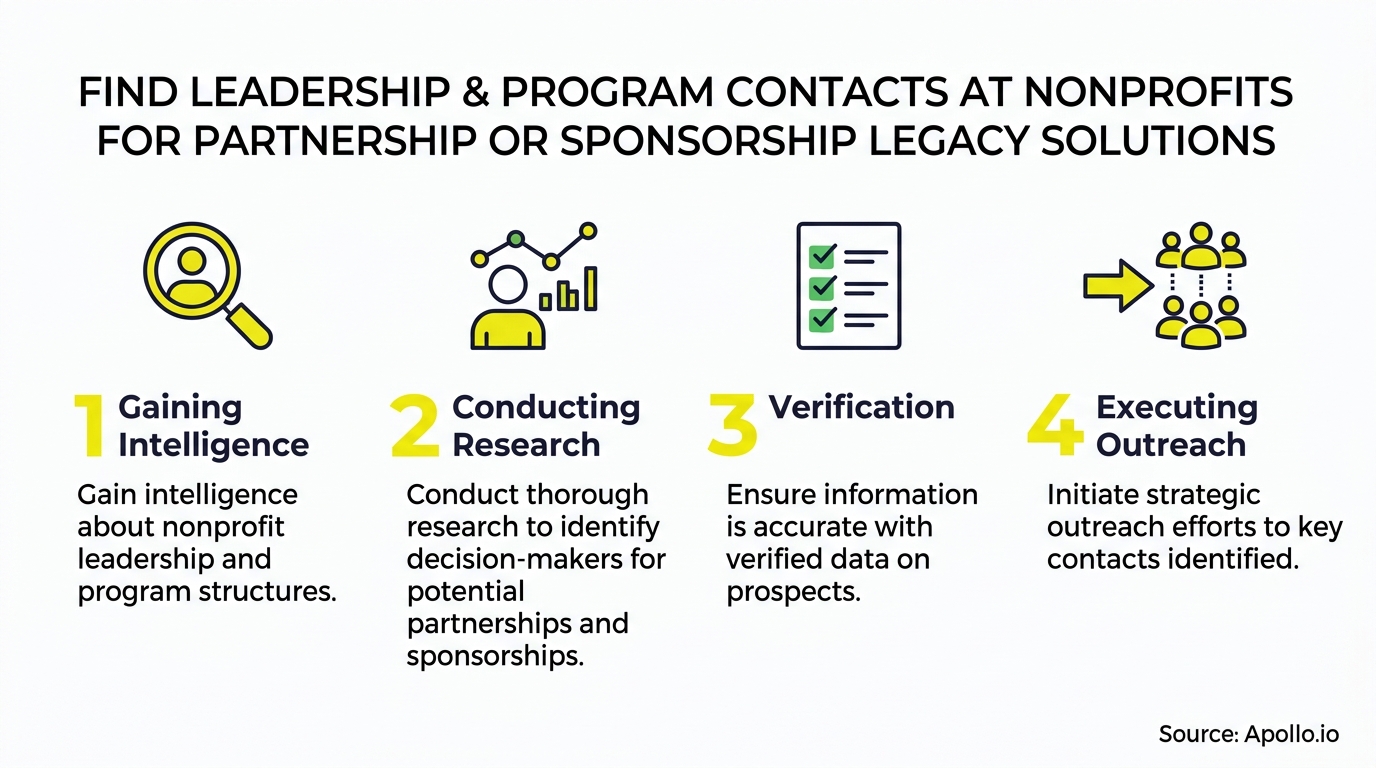
This guide gives you a decision tree by organization size, a verification checklist, a sponsor-fit scorecard, and a 30-day cadence, so your outreach lands with the person who actually owns the decision. If you'd rather automate the research and verification steps, Apollo's prospecting tools can shortcut most of this manual work.

Skip The Research, Apollo Verifies Contacts
Spending hours manually researching leads and double-checking contact info. Apollo verifies emails and numbers instantly with 98% accuracy, so your team spends less time hunting and more time selling.
Start Free with Apollo →Key Takeaways
- Match your outreach contact to nonprofit staff size first: small and volunteer-run organizations route through the executive director, while larger organizations have dedicated development or partnerships staff.
- Verify every contact within 30 days of outreach since staffing volatility at nonprofits means titles and program ownership shift quickly.
- Use Apollo MCP when you need to research nonprofit leadership, enrich contact records, and draft outreach without leaving ChatGPT, Claude, Perplexity, or Codex.
- Score partnership fit before you reach out. Corporate partners increasingly evaluate alignment across brand, mission, and community impact rather than just budget.
- Multi-thread your outreach. Partnership decisions on the corporate side involve several departments, so nonprofits with development, marketing, and program staff need more than one point of contact too.
How Do You Find the Right Nonprofit Contact By Organization Size?
The right nonprofit contact depends on staff size: smaller organizations concentrate partnership decisions with the executive director, while larger organizations have dedicated development or corporate-partnerships staff. According to Candid, 70% of nonprofits operate with 10 or fewer staff, and a large share of that group runs entirely on volunteers. Title-only searches fail here because one person often owns fundraising, programming, and partnerships simultaneously.
| Staff Size | Primary Contact | Backup Contact |
|---|---|---|
| 1-10 staff (often volunteer-run) | Executive Director / Founder | Board Chair or Treasurer |
| 11-50 staff | Development Director | Program Director |
| 51-200 staff | Corporate Partnerships / Community Engagement Lead | Development Director |
| 200+ staff | VP of Partnerships or Institutional Giving | Marketing/Communications Director |
For sponsorship-specific asks, always add a program-level contact to your map. Companies increasingly want to fund a specific initiative rather than general operations, and the program owner can speak to measurable outcomes the executive director may not track day to day.
What Sources Should You Use to Verify Nonprofit Contacts?
Verify nonprofit contacts by layering public filings, organizational websites, and enrichment tools rather than trusting a single source. No single database reliably confirms both current employment and a deliverable email address, so each source fills a different gap.
- IRS Form 990 filings: List officers, directors, and sometimes highest-compensated employees. Useful for confirming legal leadership but often 12-18 months out of date.
- Nonprofit websites and annual reports: Best for current program names and staff bios, though small organizations rarely update these often.
- Candid's search platform: Consolidated nonprofit profiles, funding history, and leadership data as of its January 2026 relaunch, giving researchers a faster starting point before individual verification.
- Professional network profiles: Good for confirming a current title change, especially after the staffing reductions reported across the sector in 2026.
- Contact enrichment platforms: Confirm a verified business email and phone number tied to the current role.
Score each contact on a simple confidence scale: 1 point per source that confirms the same name, title, and organization. A score of 3 or higher (matched across three independent sources) is safe to add to an active sequence.
A score of 1 needs manual verification before you send anything.
Struggling to find qualified nonprofit leadership and program contacts? Apollo's data enrichment tools cross-check contact records so you're not relying on a single stale filing.
See Every Deal Stage With Apollo
Forecasting off because reps update stages whenever they feel like it. Apollo gives you a live, unified view of every deal so you're never guessing where pipeline actually stands. Stop presenting forecasts you don't trust.
Start Free with Apollo →How Do You Score Partnership Fit Before Reaching Out?
Score partnership fit by weighing mission alignment, program relevance, and budget compatibility before you send a single email. Corporate partnership research from For Momentum found that 91% of companies rank brand-and-mission alignment as an important selection factor, while 85% prioritize community or CSR alignment and immediate, tangible program impact.
| Fit Criteria | Strong Signal | Disqualifier |
|---|---|---|
| Mission alignment | Overlaps directly with your CSR or brand pillars | No thematic connection to your company's focus areas |
| Program relevance | Active initiative with a specific audience, geography, or event | Only general operating support requested |
| Budget compatibility | Sponsorship tiers match your available budget range | Minimum ask exceeds your approved range with no flexible tiers |
| Measurable outcomes | Publishes impact metrics or reporting cadence | No tracking or reporting infrastructure in place |
Skip organizations that fail two or more criteria. Blackbaud Giving Fund notes that the most successful outreach prioritizes alignment over list size, meaning a shorter, well-scored list consistently outperforms a broad, unfiltered one.
What Should Your Outreach Email Say to Each Contact Role?
Your outreach email should reference a specific program or initiative and match its tone to the recipient's role, since executive directors and program managers care about different details. Generic "support our cause" messaging underperforms because it ignores what each contact actually owns.
- Executive Director (small/volunteer-run org): Lead with mission fit and a specific, low-lift partnership ask (in-kind donation, event sponsorship, employee volunteer day).
- Development Director: Lead with budget range, sponsorship tiers, and multi-year partnership potential.
- Program Director: Lead with the specific program, audience served, and how your company's resources support a measurable outcome.
- Corporate Partnerships Lead: Lead with co-branding opportunities, employee engagement options, and reporting/impact measurement.
Keep it to 3-4 sentences and one clear ask. According to Kondo, modern B2B outreach typically requires 5 to 12 touchpoints to close, with up to 50% of opportunities going to whoever responds first, so plan for a sequence, not a single email.

How Can RevOps Leaders Keep Nonprofit Contact Data From Going Stale?
RevOps leaders keep nonprofit contact data current by building a 30-day re-verification cycle into their CRM instead of doing an annual list refresh. Staffing volatility makes this non-negotiable: nonprofit downsizing in 2026 means titles and program ownership can change mid-quarter.
General B2B contact decay compounds the problem. Landbase reports that B2B contact data decays between 22.5% and 70.3% annually, and Salesmotion found that 91% of CRM data is incomplete, stale, or duplicated. Nonprofit records are more exposed to this decay given the sector's current staffing pressure.
For RevOps teams managing this manually across spreadsheets, tool consolidation matters. Collin Stewart of Predictable Revenue noted, "We reduced the complexity of three tools into one," which is the same problem RevOps leaders face when juggling a filings database, an enrichment tool, and a separate sequencing platform for nonprofit outreach.
How Do SDRs and AEs Research Nonprofit Contacts Without Switching Tabs?
SDRs and AEs can research and enrich nonprofit contacts directly inside the AI tools they already use by connecting Apollo MCP to ChatGPT, Claude, Perplexity, or Codex. Instead of bouncing between a filings search, a company website, and a separate enrichment tool, you ask your AI assistant to find people at a given nonprofit that match a role (program director, development lead), and Apollo returns verified contact records in the same conversation.
Setup takes minutes: connect Apollo through the AI tool's connectors or integrations panel using OAuth, on any Apollo plan including free. From there, an SDR can search for nonprofit organizations matching a cause category, enrich the resulting contacts with verified emails and phone numbers, and push qualified prospects straight into a sequence, all without opening a new tab.
Your best prospecting session shouldn't require opening a new tab.
For Account Executives managing a live sponsorship conversation, the same workflow answers a different question: who else at this nonprofit should be looped in before a decision gets made. Given that corporate partnership decisions involve an average of eight departments on the buying side, nonprofits deserve the same multi-threaded diligence in return.
How Do You Multi-Thread Outreach Across a Nonprofit Organization?
Multi-thread nonprofit outreach by identifying at least two or three relevant contacts (executive sponsor, program owner, and development or marketing lead) before sending your first message. Relying on a single named contact is risky given current staffing volatility, and it also mirrors how corporate partners already operate on their side of the table.
Sequence your outreach so each contact receives a role-relevant message, not a copy-pasted pitch. Start with the program owner if you're proposing a specific initiative, then loop in development or the executive director once there's programmatic interest.
This respects everyone's time and avoids the appearance of a mass blast, which matters more now that inbox providers are getting better at separating authenticated bulk email from priority messages.
Teams managing this across dozens of nonprofit prospects benefit from a single system that handles research, enrichment, and sequencing together. Cyera's team put it simply: "Having everything in one system was a game changer." Spending hours manually cross-referencing filings and websites? Apollo's sales engagement platform lets you build and send role-specific sequences to your entire nonprofit contact map from one workspace.
What Are Common Questions About Finding Nonprofit Contacts?
How Do You Find a Nonprofit Program Director's Email?
Find a nonprofit program director's email by first confirming their current title on the organization's website or professional network profile, then verifying the email through a contact enrichment tool. Program director titles change often at smaller organizations, so cross-check against at least two sources before adding the contact to an active sequence.
How Do You Find Decision-Makers at Small or Volunteer-Run Nonprofits?
Find decision-makers at small or volunteer-run nonprofits by starting with the executive director or founder, since one person typically owns partnerships, programming, and fundraising in organizations with 10 or fewer staff. Check the board chair as a backup contact, since board members often have direct input on sponsorship decisions at this scale.
What Information Does a Form 990 Provide for Contact Research?
A Form 990 provides the names and titles of officers, directors, and sometimes highest-compensated employees at a tax-exempt organization. It confirms legal leadership structure but is typically 12-18 months out of date, so pair it with a current website check or enrichment tool before outreach.
How Many Touchpoints Does Nonprofit Partnership Outreach Typically Require?
Nonprofit partnership outreach typically requires the same multi-touch cadence as standard B2B outreach. Kondo's research on B2B benchmarks found that modern outreach generally requires 5 to 12 touchpoints to close, and roughly half of opportunities go to the first vendor or partner to respond.
What Does a 30-Day Nonprofit Outreach Cadence Look Like?
A 30-day nonprofit outreach cadence combines contact verification, staged multi-channel touchpoints, and a built-in re-verification checkpoint. Treat this as an always-on process rather than a seasonal campaign, since 68% of companies now evaluate new nonprofit partnerships as opportunities arise rather than on a fixed calendar, according to the For Momentum research cited above.
- Days 1-3: Build your contact map by size and role, then verify each contact against two or more sources.
- Days 4-7: Score partnership fit using the scorecard above and disqualify weak matches.
- Days 8-14: Send the first role-specific email to your primary contact, referencing a specific program.
- Days 15-21: Follow up with the primary contact and introduce a second contact (multi-threading).
- Days 22-28: Try a different channel. professional networks DMs achieve an average response rate of 10.3% compared to 5.1% for cold email, according to Expandi's 2026 outreach benchmarks.
- Days 29-30: Re-verify any contact who hasn't responded before deciding whether to continue the sequence or move to a backup contact.
Repeat this cycle continuously for active prospects rather than treating it as a one-time project. For more on building sustain structured multi-channel sequences, Apollo's sales engagement platform lets you build the entire 30-day cadence once and let it run across email and phone touchpoints automatically.
How Can AI Tools Help Find Nonprofit Leadership Contacts Faster?
AI tools speed up nonprofit contact research by letting you search, enrich, and verify leadership and program contacts directly from the AI assistant you already use, without switching tabs or exporting spreadsheets. Instead of manually cross-referencing a nonprofit's staff page, tax filings, and a data provider, you can ask your AI tool to pull verified contact records in seconds.
Apollo MCP connects Apollo's database directly into Claude, ChatGPT, Perplexity, and Codex, so you can type a prompt like "find the Director of Development and Program Manager at [nonprofit name]" and get enriched contact records with verified emails back in the same conversation. From there, you can ask the AI to draft an outreach sequence, add the contacts to a list, or enrich a spreadsheet of 50 nonprofits at once. Setup takes minutes: connect Apollo through your AI tool's integrations menu with OAuth, and your search and enrichment limits follow whatever Apollo plan you're already on, including the free tier.
For teams doing high-volume prospecting across many organizations, this approach removes the toggle tax of researching one nonprofit at a time across multiple browser tabs.
What Common Mistakes Should You Avoid When Contacting Nonprofit Leaders?
The most common mistake is sending a generic partnership pitch to the Executive Director when a Development Director or Program Manager is the actual decision-maker for sponsorship-level asks. Nonprofit org charts are flatter than corporate ones, so misrouting a message often means it never gets forwarded internally.
- Ignoring program-level contacts: Program Managers often have more influence over partnership fit than fundraising staff, especially for in-kind or skills-based sponsorships.
- Using corporate sponsorship language: Nonprofits respond better to mission-aligned framing than to generic "brand awareness" pitches.
- Single-threading: Reaching only one contact at a small nonprofit risks losing the entire opportunity if that person leaves or is unresponsive, which is common given documented turnover rates in the sector.
- Skipping re-verification: Sending outreach to a stale email address wastes a touchpoint and can hurt sender reputation over time.
Struggling to keep contact records current across dozens of nonprofit prospects? Apollo's waterfall enrichment cross-checks multiple data sources automatically so you're not manually verifying each contact one by one.

Conclusion
Finding the right leadership and program contacts at nonprofits comes down to mapping the org by size, verifying contacts before you reach out, and running a structured multi-channel cadence instead of a single cold email. Nonprofits move fast on partnership decisions when the message reaches the right person with mission-aligned framing, and it stalls indefinitely when it lands with the wrong title or a bounced address.
Apollo brings contact search, verification, and multi-channel outreach into one workspace, so your team can move from finding a Development Director's name to sending a personalized sequence without stitching together separate tools. Start free with Apollo today to build your nonprofit contact list and launch outreach in the same platform.
Justify Spend With Apollo's Quota Wins
Can't quantify pipeline impact fast enough to justify the tool budget? Apollo turns outreach into measurable revenue from week one, so leadership sees results before renewal talks start. Teams report 3x revenue growth and higher win rates using Apollo.
Start Free with Apollo →Don't miss these
Sales
Inbound vs Outbound Marketing: Which Strategy Wins?
Sales
What Is a Sales Funnel? The Non-Linear Revenue Framework for 2026
Sales
What Is a Go-to-Market Strategy? The 2026 GTM Playbook
See Apollo in action
We'd love to show how Apollo can help you sell better.
By submitting this form, you will receive information, tips, and promotions from Apollo. To learn more, see our Privacy Statement.
4.7/5 based on 9,690 reviews
