
How to Find Companies Using a Competitor's Tool for Switch Campaigns
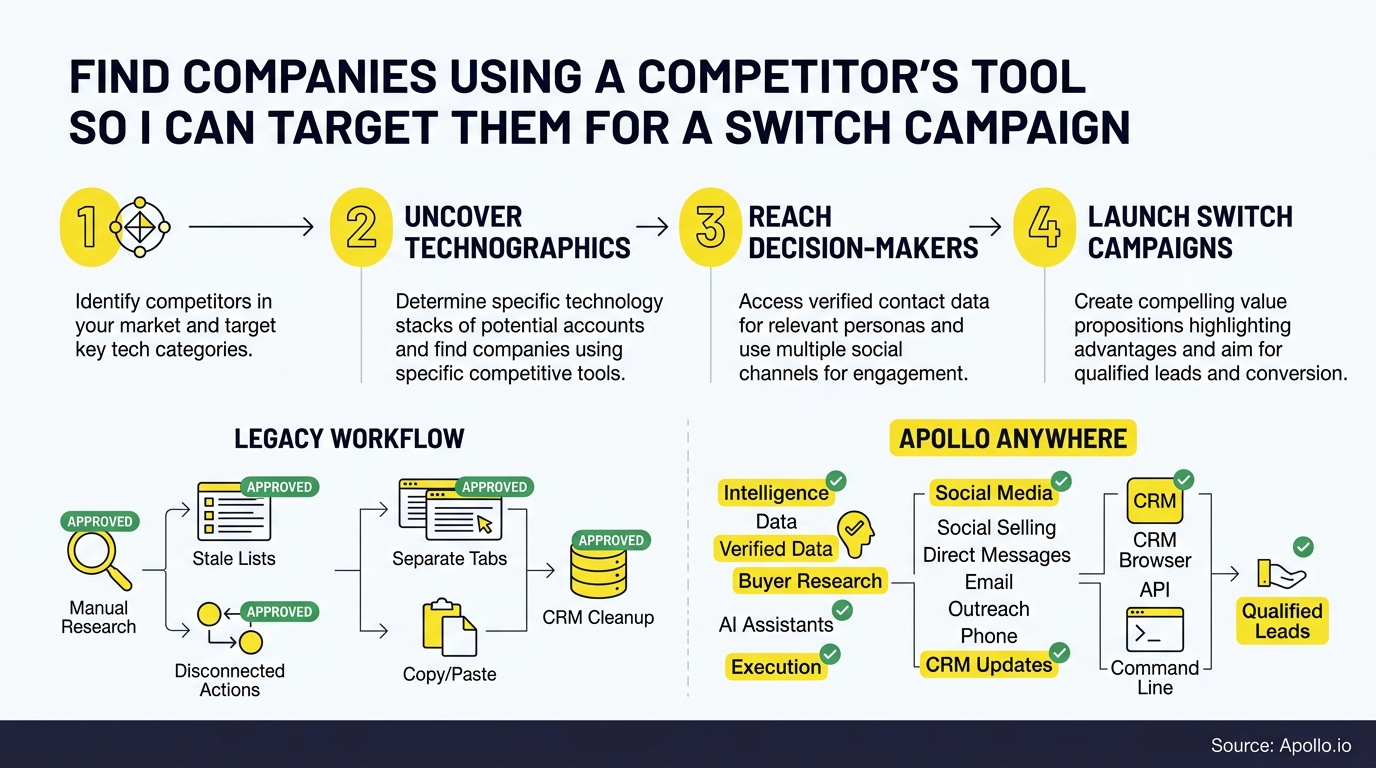
Finding companies that use a competitor's tool is the easy part. Building a switch campaign that actually converts requires layering that technographic signal with dissatisfaction indicators, buying-group mapping, and a compliant outreach process.
This guide breaks down the exact scoring model, workflow, and messaging framework to turn a raw list of competitor users into a pipeline of switch-ready accounts.

Skip The Research, Apollo Verifies Contacts
Spending hours manually researching leads and chasing bad emails. Apollo verifies contact data instantly with 98% email accuracy, so reps sell instead of digging. Access 240M+ business contacts in one search.
Start Free with Apollo →Key Takeaways
- A confirmed competitor install is a qualification signal, not switching intent. Layer it with comparison-page activity and a business trigger before you reach out.
- Use Apollo MCP when you need to research a competitor's customer base, enrich contacts, and launch a sequence without leaving ChatGPT, Claude, Perplexity, or Codex.
- Renewal timing matters: decisions are typically locked in well before the contract deadline, according to ORM Tech, so timing your outreach months ahead of expiration matters more than the install date itself.
- Map the full buying group before you send anything. The average B2B deal involves multiple stakeholders, per Gradient Works, and most switch campaigns fail by only pitching the tool's day-to-day user.
- Apollo consolidates prospecting, enrichment, and outreach into one workspace, so switch campaigns don't require stitching together a technographic vendor, a data enrichment tool, and a separate sequencing platform.
What Is A Competitor Switch Campaign?
A competitor switch campaign is a targeted outbound motion aimed at companies currently using a rival product, built around evidence that they might be dissatisfied, under-using the tool, or approaching a renewal decision.
It's not just cold outbound with a competitor's name inserted into a template.
The distinction matters because a confirmed install alone doesn't tell you if an account is happy. Gartner found that just 49% of martech tools were actively used despite representing nearly 22% of marketing spend, and only 15% of organizations qualified as high performers achieving ROI from their stack (Gartner). That underutilization gap is exactly where switch campaigns find opportunity, but you need more than a technographic flag to find it.
How Do You Find Companies Using A Competitor's Tool?
You find companies using a competitor's tool by combining technographic detection (job postings, integration marketplaces, website tags, case studies) with independent corroborating sources, since any single method can be outdated or wrong.
Vendor-run testing from Demandbase found AI-assisted research could reliably verify roughly 2,000 companies, with a practical ceiling near 5,000, compared to well over 100,000 accounts in a corresponding technographic dataset. That's a useful reminder: an LLM prompt to "find companies using [competitor]" is a good starting point for account research, not a scalable list-building method on its own.
Reliable detection methods include:
- Job postings mentioning the competitor tool as a required skill
- Integration marketplaces where the competitor lists customer-facing connectors
- Case studies and customer logos published by the competitor
- Review platforms where companies leave verified reviews tied to their account
- Website technology tags detected through crawlers
Struggling to turn scattered signals into a clean account list? Search Apollo's 240M+ contacts with 65+ filters to cross-reference technographic and firmographic data in one place.
How Do You Score Which Competitor Accounts Are Switch-Ready?
You score switch-ready accounts by weighting three signal categories: confirmed tool use, active comparison intent, and a business trigger event. No single signal should qualify an account for outreach on its own.
| Signal Category | Example Evidence | Suggested Weight |
|---|---|---|
| Confirmed competitor use | Job posting, integration listing, case study | 30% |
| Active comparison intent | Comparison-page visits, pricing-page research, review reads | 35% |
| Business trigger | New leadership hire, renewal window, negative review, funding event | 25% |
| ICP fit | Company size, industry, tech stack maturity | 10% |
Comparison-related research carries outsized weight for good reason. An analysis of mutual customers conducted by Factors.ai and reported by G2 found that alternatives-page activity generated 13x as many signals as visits to a vendor's own profile, and competitor-pricing research generated 6x as many. If an account is reading pricing pages and comparison content, they're closer to a decision than a company that merely has the tool installed.
Disqualification rules: Drop any account with zero comparison intent in the last 90 days, no confirmed decision-maker contact, or an active contract that just renewed. These accounts waste sequence capacity that should go to higher-confidence targets.
How Do You Verify A Company's Tech Stack Before Outreach?
You verify a tech stack by corroborating at least two independent sources before treating a competitor-use signal as confirmed. Relying on one data point, especially an AI-generated summary, risks messaging a company about a tool they stopped using a year ago.
A practical verification sequence:
- Check the competitor's own published case studies or customer logo page
- Cross-reference with a job posting or integration marketplace listing
- Confirm recency by looking at the posting or listing date (aim for signals under 6-12 months old)
- Log the source and date in a signal-tracking sheet for audit purposes
This is where Apollo MCP earns its place in the workflow. Instead of tab-switching between a technographic tool, a spreadsheet, and your CRM, you can ask directly inside ChatGPT, Claude, Perplexity, or Codex to search for companies matching an ICP, pull verified contact details, and log findings, all from one conversation. Apollo MCP connects through the AI tool's integrations panel via OAuth on any Apollo plan, including free, so GTM teams can run this research without engineering support.
How Do You Map The Buying Group For A Switch Campaign?
You map the buying group by identifying every role affected by the switch, not just the person who uses the tool day-to-day. Skipping this step is the most common reason switch campaigns stall after an initial reply.
Research from Gradient Works found the average B2B deal now involves 6-10 stakeholders, and most of those buyers are taking longer to decide than they were a few years ago. A switch campaign aimed only at the tool's primary user misses finance, IT, procurement, and the executive who signs off on the contract.
| Role | Migration Concern | Message Angle |
|---|---|---|
| Day-to-day user | Learning curve, workflow disruption | Feature parity, faster onboarding |
| IT/Security | Data migration, integration risk | API compatibility, migration support |
| Finance/Procurement | Contract terms, total cost | Consolidated pricing, renewal timing |
| Executive sponsor | ROI, team adoption | Business outcomes, case studies |
Integration capability is a top concern across this buying group. Research from Corporate Visions found that 77% of buyers prioritize integration capabilities when evaluating a switch, which is a strong message angle for the IT and RevOps stakeholders in the group.
Know Which Leads Are Actually Sales-Ready
Marketing leads that stall before opportunity. Apollo scores and prioritizes prospects by buying intent, so reps chase deals that are ready to move, not dead-end leads. Built-In grew win rates using Apollo's scoring and signals.
Start Free with Apollo →How Should SDRs And AEs Personalize Switch Campaign Messaging?
SDRs and AEs should personalize switch messaging around the specific migration trigger they've identified for that account, not a generic "we're better than [competitor]" pitch. professional networks and Ipsos research found that 78% of B2B buyers strongly want outreach to be personalized, yet 69% of B2B marketers said reaching the right audience remained a persistent challenge (professional networks).
For SDRs and BDRs working top-of-funnel outreach, lead with the trigger event: a negative review, a leadership change, or a renewal window. For Account Executives running the second half of the cycle, focus messaging on migration mechanics and total cost of ownership once a prospect engages, since that's where finance and IT concerns surface.
Since B2B buyers now use an average of 10 interaction channels during a purchase decision, according to McKinsey, a single-channel email sequence isn't enough. Pair email with calls, social touches, and relevant content to reach the buying group across channels.
Spending hours manually building these sequences one contact at a time? Automate multi-channel sequences with Apollo's sales engagement platform so reps can focus on personalization instead of manual list-building. For more tactical prospecting approaches, see this breakdown of sales prospecting techniques that find and close the right leads faster.
How Do You Stay Compliant When Running Competitor Switch Campaigns?
You stay compliant by keeping a documented source record for every technographic and intent signal, respecting suppression lists, and giving recipients clear opt-out mechanisms in every message. Competitive intelligence is public-domain research; how you act on it needs a paper trail.
A basic compliance checklist for switch campaigns:
- Log the source and date for every "confirmed competitor use" signal
- Maintain a do-not-contact suppression list synced across sequences
- Include unsubscribe options on every email touch
- Avoid disparaging competitor claims that can't be sourced publicly
- Route data-subject requests to a documented process
RevOps leaders building this into a repeatable, auditable motion often find that consolidating tools reduces the compliance burden. Predictable Revenue's Collin Stewart noted, "We reduced the complexity of three tools into one," describing how Predictable Revenue simplified its stack. Fewer systems tracking prospect data means fewer places compliance can break down.

How Do You Measure ROI On A Switch Campaign?
You measure switch campaign ROI by tracking conversion rate against intent-triggered benchmarks and comparing pipeline generated to the cost of running the campaign. Intent-triggered outreach, which includes monitoring competitor switching signals, converts at a 10%-14% rate compared to just 2%-5% for purely cold approaches, according to Lunas Consulting.
Track these core metrics per campaign wave:
- Reply rate segmented by signal confidence tier (high/medium/low)
- Meeting-booked rate by buying-group role contacted
- Time from first touch to opportunity creation
- Win rate against the specific competitor named in the signal
For RevOps leaders reporting on this, tying campaign performance back to a deal management workspace makes it easier to see which signal combinations actually convert instead of guessing after the fact.
Frequently Asked Questions
What Is The Difference Between Technographic Data And Buying Intent Data?
Technographic data confirms which tools a company currently uses, while buying intent data shows whether that company is actively researching alternatives. You need both: technographic data tells you who to target, intent data tells you when they're ready to listen.
How Often Should You Refresh A Competitor-Install Account List?
Refresh competitor-install lists on a recurring cadence, since technology stacks change and stale signals waste outreach capacity. Prioritize re-verification for any account approaching its renewal window, since that's when switching consideration peaks.
Can Small Sales Teams Run Switch Campaigns Without A Big Data Team?
Yes. Small teams can run switch campaigns using a consolidated platform that combines search, enrichment, and sequencing instead of stitching together separate technographic, data, and outreach vendors. Cyera's team found that "having everything in one system was a game changer" after consolidating onto Apollo, which points to the value of fewer tools for smaller teams running this motion.
What Should A Switch Campaign Message Actually Say?
A switch campaign message should focus on the buyer's specific pain points and your product's documented strengths, not on disparaging the incumbent tool by name. Lead with a business trigger you've verified (a funding round, a leadership change, a public complaint about cost or support) and connect it to a concrete outcome your product delivers.
Avoid vague claims like "better data" or "easier to use." Instead, reference specific capabilities: multi-channel sequencing, waterfall enrichment, or a workflow your product automates that the competitor's tool doesn't include. If you have a customer quote from a team that switched, use it verbatim with a link to the case study rather than paraphrasing their experience as a general benchmark.
Keep the ask small in the first touch. Request a 15-minute conversation about a specific pain point, not an immediate demo of your full platform.
This respects the reality that most target accounts are mid-contract and not actively shopping.
How Do You Avoid Compliance Risk When Naming A Competitor In Outreach?
You avoid compliance risk by keeping outbound messaging factual, sourced, and focused on your own product rather than unverifiable claims about the competitor. Only reference technographic detections, public reviews, or firmographic triggers you can point to; never claim a prospect is "unhappy" with their current tool unless you have a direct quote or public complaint to cite.
Legal and marketing teams should approve any competitor-comparison collateral before it goes into a sequence, and reps should be trained to redirect conversations toward the prospect's own goals rather than disparaging remarks. This keeps the campaign focused on value and reduces the chance of a competitor dispute over your claims.
How Can RevOps Keep A Switch Campaign List Clean Over Time?
RevOps keeps a switch campaign list clean by scheduling recurring enrichment passes and syncing verified fields directly into the CRM, so reps always work from current job titles, emails, and technographic status. Manual list-building degrades quickly as prospects change roles or companies adopt new tools, which is why a recurring enrichment cadence matters more than a one-time export.
Route re-verification around renewal windows and org-chart changes at target accounts, since those two triggers are the strongest predictors of switching intent. Centralizing this workflow in one platform, rather than passing spreadsheets between a technographic tool, an enrichment vendor, and a sequencing platform, reduces the operational overhead of maintaining the list. Struggling to keep your target account data current? Automate multi-source verification with Apollo's waterfall enrichment.

Turn Competitor Signals Into A Compliant, Multi-Signal Switch Campaign
Finding companies using a competitor's tool is just the first filter. Winning switch campaigns in 2026 combine that install signal with comparison intent, a business trigger, and full buying-group coverage, then execute across channels with a documented compliance trail.
Apollo brings B2B data, sales intelligence, and outreach execution together in one workspace, so your team isn't managing a technographic vendor, a separate enrichment tool, and a standalone sequencing platform just to run one switch campaign. For related research on identifying accounts already showing purchase signals, see this guide to building a qualified sales pipeline.
Apollo serves B2B GTM teams, GTM Engineers, and AI Builders building headless GTM workflows with the Apollo API, CLI, and MCP, alongside Sales Professionals, SDRs/BDRs, AEs, RevOps, Marketing, and Revenue Leaders who need to move from signal to sequence without switching tools. Ready to build your own switch campaign list? Start Your Free Trial and turn verified technographic signals into a compliant, multi-channel campaign today.
Apollo Turns Rep Hours Into Provable Pipeline
Struggling to prove ROI before your budget review? Apollo's automation gives reps back hours to sell instead of prospect, turning tool spend into measurable pipeline fast. Leadium tripled annual revenue automating outbound with Apollo.
Start Free with Apollo →Don't miss these
Sales
Inbound vs Outbound Marketing: Which Strategy Wins?
Sales
What Is a Sales Funnel? The Non-Linear Revenue Framework for 2026
Sales
What Is a Go-to-Market Strategy? The 2026 GTM Playbook
See Apollo in action
We'd love to show how Apollo can help you sell better.
By submitting this form, you will receive information, tips, and promotions from Apollo. To learn more, see our Privacy Statement.
4.7/5 based on 9,690 reviews
