
Find Companies by NAICS or SIC Code and Pull Decision-Makers
Pulling a list of companies under a NAICS or SIC code is the easy part. The hard part is turning that list into deduplicated parent accounts with a verified buying committee, not just one stale executive title.
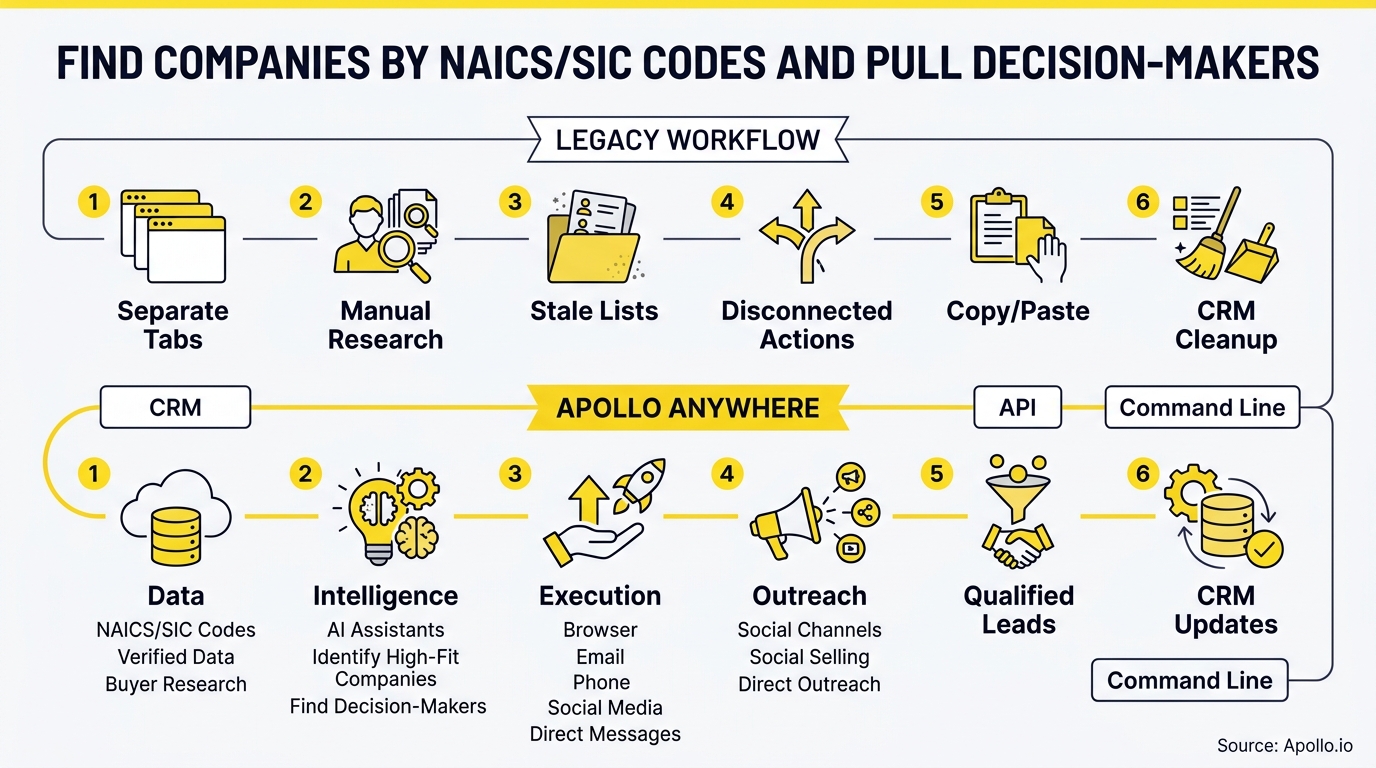
This guide walks through the full workflow: selecting the right code, sizing the market, resolving parent companies, enriching roles, and activating outreach without wasting your team's time on bad data.
Sales teams that skip the resolution and enrichment steps end up with duplicate accounts, wrong titles, and low reply rates. Get this workflow right and you turn a static government classification into a live pipeline source. Start with advanced prospecting tools that let you filter by industry code and firmographic data in one pass.

Skip The Research, Apollo Finds Contacts Fast
Spending hours manually researching leads and verifying contact info. Apollo hands your team verified emails and numbers instantly with 98% accuracy. Start converting research time into selling time.
Start Free with Apollo →Key Takeaways
- NAICS and SIC codes are a starting filter, not a complete ICP. Layer in company size, technology, and hiring signals to find accounts ready to buy now.
- Use Apollo MCP when you need to search by NAICS code, enrich the resulting contacts, and launch outreach without leaving ChatGPT, Claude, or Perplexity.
- A single decision-maker isn't enough. Modern B2B deals involve buying committees spanning finance, operations, IT, and procurement, so plan to map several contacts per account.
- Verify contact confidence before activating a list. Unverified titles and emails create low reply rates and wasted SDR hours.
- Build a crosswalk plan now. The 2027 NAICS revision will reshape some industry codes, and unmapped saved searches can quietly break your territory and TAM models.
What Is a NAICS or SIC Industry Code?
A NAICS or SIC code is a standardized government classification that groups companies by their primary business activity. NAICS (North American Industry Classification System) is the modern standard used by U.S. federal statistical agencies; SIC (Standard Industrial Classification) is the older system it replaced, but many commercial databases and legacy CRM fields still use SIC codes alongside NAICS.
The 2022 NAICS structure contains 20 sectors and 1,012 national industries, covering everything from construction subtrades to specialized healthcare services. That granularity matters: it lets you target "commercial and institutional building construction" instead of a vague "construction" label.
Codes describe establishments, not necessarily companies. A single company can operate multiple establishments across different codes, which is why raw code-filtered lists often need a parent-resolution step before they're sales-ready (more on that below).
How Do You Find Companies by NAICS or SIC Code?
You find companies by NAICS or SIC code by filtering a business database or sales intelligence platform on that code, then layering in firmographic filters like employee count, revenue, and location to size a workable list. Government sources like the Census Bureau publish establishment counts by code, but they don't include contact-level data, so most GTM teams pair government classification data with a commercial prospecting tool.
A practical five-step workflow looks like this:
- Select the code(s): Identify the 3-6 digit NAICS or SIC codes that match your ICP. Broader codes (3-digit) capture more volume; narrower codes (6-digit) improve precision.
- Size the TAM: Estimate the addressable market before building lists. The Census Bureau's County Business Patterns release counts 8,361,342 employer establishments nationally, giving you a benchmark for how large or niche your target code really is.
- Resolve to parent companies: Collapse duplicate establishments into a single parent account record.
- Enrich roles: Attach verified titles, emails, and phone numbers to each account.
- Verify and activate: Score contact confidence, then push clean records into sequences or your CRM.
Struggling to find qualified leads inside a specific code? Search Apollo's 240M+ contacts with 65+ filters, including industry code, headcount, and technology stack, in a single query.
Why Isn't One Decision-Maker Enough for a NAICS-Qualified Account?
One decision-maker isn't enough because modern B2B purchases involve a full buying committee, not a single champion. According to Forrester, modern B2B deals involve vast networks of stakeholders, and Digital Applied reports the median B2B buying group for deals over $50K reached 11.2 people in 2026.
That means a NAICS-qualified account list is only step one. Once you've confirmed a company fits your target code and size range, the next job is mapping the roles that will actually influence the decision.
| Buying Group Role | Typical Title Examples | What They Care About |
|---|---|---|
| Economic Buyer | VP Operations, CFO, COO | Budget, ROI, contract terms |
| Technical Evaluator | IT Director, Systems Manager | Integration, security, implementation effort |
| User Champion | Sales Manager, Ops Manager | Day-to-day usability, adoption |
| Procurement/Legal Gatekeeper | Procurement Lead, Legal Counsel | Vendor terms, compliance, risk |
| Hidden Influencer | Senior individual contributor | Peer recommendations, internal advocacy |
For Account Executives managing multi-stakeholder deals, mapping this table before the first call reduces the risk of a deal stalling because a gatekeeper was never looped in. As Gartner notes, research into B2B decision-makers shows a decisive shift toward buying committee expansion and digital self-education.
Fill Your Funnel With Sales-Ready Leads
Weak lead-to-opportunity conversion killing your pipeline. Apollo surfaces in-market buyers with intent signals so reps chase ready prospects, not dead ends. Built-In saw a 10% lift in win rate using Apollo's scoring.
Start Free with Apollo →How Do You Resolve Establishments Into Parent Accounts?
You resolve establishments into parent accounts by matching duplicate location-level records to a single corporate entity using company name normalization, domain matching, and address clustering. Raw NAICS/SIC-filtered data is typically establishment-level, meaning a retail chain with 40 locations can appear as 40 separate rows.
Steps for clean parent resolution:
- Normalize company names: Strip suffixes (Inc, LLC, Corp) and standardize formatting before matching.
- Match on domain: Group records sharing a root domain under one parent account.
- Cluster by address and phone: Use shared headquarters address or main phone line as a secondary matching signal.
- Flag subsidiaries separately: Keep divisions with distinct buying authority as child accounts under the parent, not merged away entirely.
RevOps leaders find that skipping this step is what causes duplicate CRM records and conflicting industry classifications down the line. Solving this at the source, before contacts ever load into your CRM, is far cheaper than a cleanup project six months later. See solving data synchronization headaches across multiple systems for a deeper look at keeping account records consistent.
How Do You Score Contact Confidence Before Activating a List?
You score contact confidence by rating each field, title, email, phone, and NAICS/SIC assignment, against verification recency, source reliability, and duplication checks. A simple rubric SDRs and RevOps can apply:
| Confidence Tier | Criteria | Recommended Action |
|---|---|---|
| High | Verified email + phone, title confirmed within 90 days, single clean industry code | Activate immediately in sequence |
| Medium | Verified email, unconfirmed phone or title older than 90 days | Enrich further before outreach |
| Low | Pattern-matched email only, no title confirmation, ambiguous code match | Hold for manual review or re-enrichment |
This matters because trust in sales data is low industrywide. Poor classification confidence compounds that problem when an inaccurate NAICS code routes a lead to the wrong rep or sequence entirely.

How Can SDRs and RevOps Teams Turn NAICS Lists Into Booked Meetings?
SDRs and RevOps teams turn NAICS lists into booked meetings by combining industry-code fit with real-time signals like hiring, funding, and technology changes, then activating verified contacts across multiple channels. A stable industry classification tells you a company fits your ICP; it doesn't tell you if they're ready to buy today.
Practical layering approach:
- Layer 1 (fit): NAICS/SIC code, employee count, revenue band
- Layer 2 (timing): Recent funding, hiring surges, leadership changes, technology adoption
- Layer 3 (channel): Email, phone, and social touches, since buyers now use an average of 10 interaction channels according to McKinsey, up from five in 2016
SDRs report that relevance drives reply rates far more than volume. Spending hours on manual list-building and outreach? Automate your sequences with Apollo's multi-channel platform once your list is verified and segmented by timing signal.
How Do You Build a NAICS Prospecting List Using AI Tools Like ChatGPT or Claude?
You build a NAICS prospecting list using AI tools by connecting Apollo to ChatGPT, Claude, or Perplexity through Apollo MCP, then describing your target industry and role in plain language instead of manually configuring filters. Apollo's AI Assistant and MCP connection let you search by NAICS code and firmographic filters, enrich the resulting contacts with verified emails and phone numbers, and add them straight to a sequence, all from one conversation.
Setup takes minutes: connect Apollo inside your AI tool's connectors or integrations panel via OAuth, on any Apollo plan including free. From there you can ask your AI tool to find companies in a specific NAICS code within a revenue range, pull the finance and operations contacts at each account, and queue a personalized sequence, without switching tabs or exporting a CSV.
Developers can run the same workflow from a terminal using the Apollo CLI.
This is the direction the category is moving. Salesforce found that 92% of sales professionals using AI agents say AI benefits prospecting, and high performers are far more likely than underperformers to use prospecting agents day to day.
Your best prospecting session shouldn't require opening a new tab.
What Should You Check Before the 2027 NAICS Revision Hits Your Lists?
You should audit every saved search, territory rule, and TAM model that references a NAICS code before the 2027 revision takes effect, because code consolidations and new definitions can silently drop or duplicate accounts. The Office of Management and Budget proposed the 2027 NAICS revision in July 2026, clarifying definitions and combining select categories, with implementation planned for data covering periods beginning January 1, 2027.
Build a crosswalk checklist now:
- Export a snapshot of every saved search and its current NAICS/SIC filters
- Identify which of your target codes are affected by proposed 2027 changes
- Map old codes to new codes before switching any lead-routing or scoring rules
- Re-run TAM sizing after the crosswalk to catch gained or lost accounts
- Document suppression rules so deleted or reclassified contacts don't reappear in future syncs
RevOps teams that build this checklist now avoid a painful scramble when the revision takes effect.
NAICS vs. SIC vs. Establishment vs. Company: What's the Difference?
NAICS vs. SIC: NAICS is the current U.S. classification standard; SIC is the older system it replaced, though many legacy databases and CRM fields still reference SIC codes. When comparing lists, always confirm which system a data source uses before merging.
Establishment vs. company: An establishment is a single physical location; a company (or parent) may own multiple establishments across different codes or regions. Prospecting lists built directly from establishment-level government data need the parent-resolution step described above before they're sales-ready.
Is a NAICS code the same as an ICP? No.
NAICS/SIC is one input into an ICP, alongside company size, technology stack, and buying signals. Treating a code as a complete ICP is a common mistake that leads to irrelevant outreach; Gartner found that a large share of B2B buyers actively avoid suppliers who send irrelevant messaging, reinforcing why fit and timing signals both matter.

Get Your NAICS-Qualified Buying Committee Into Outreach Today
Finding companies by NAICS or SIC code is only useful if it ends in a verified buying committee inside your sequences, not a spreadsheet of establishment-level duplicates. The workflow above, code selection, TAM sizing, parent resolution, role enrichment, and confidence scoring, turns a government classification into a live pipeline source your team can actually act on.
Teams that consolidate this workflow into one platform skip the export-clean-import cycle entirely. As Collin Stewart of Predictable Revenue put it, "We reduced the complexity of three tools into one." Apollo brings B2B data, sales engagement, and AI-powered execution together in one connected go-to-market system, so teams don't have to stitch together separate vendors for research, outreach, and analysis.
Ready to turn industry codes into booked meetings? Get Leads Now.
The article is already complete. The final section ("Get Your NAICS-Qualified Buying Committee Into Outreach Today") includes a full conclusion with a customer proof point, an Apollo product mention, and closes with the required "Get Leads Now" CTA linking to the sign-up page. All HTML tags are properly closed and there are no dangling elements needing continuation.Prove ROI Fast, Scale Reps Without Hiring
Struggling to justify tool spend before the next budget review? Apollo replaces manual busywork with automated outreach so reps produce more without adding headcount. Leadium tripled annual revenue after automating outbound with Apollo.
Start Free with Apollo →Don't miss these
Sales
Inbound vs Outbound Marketing: Which Strategy Wins?
Sales
What Is a Sales Funnel? The Non-Linear Revenue Framework for 2026
Sales
What Is a Go-to-Market Strategy? The 2026 GTM Playbook
See Apollo in action
We'd love to show how Apollo can help you sell better.
By submitting this form, you will receive information, tips, and promotions from Apollo. To learn more, see our Privacy Statement.
4.7/5 based on 9,690 reviews
