
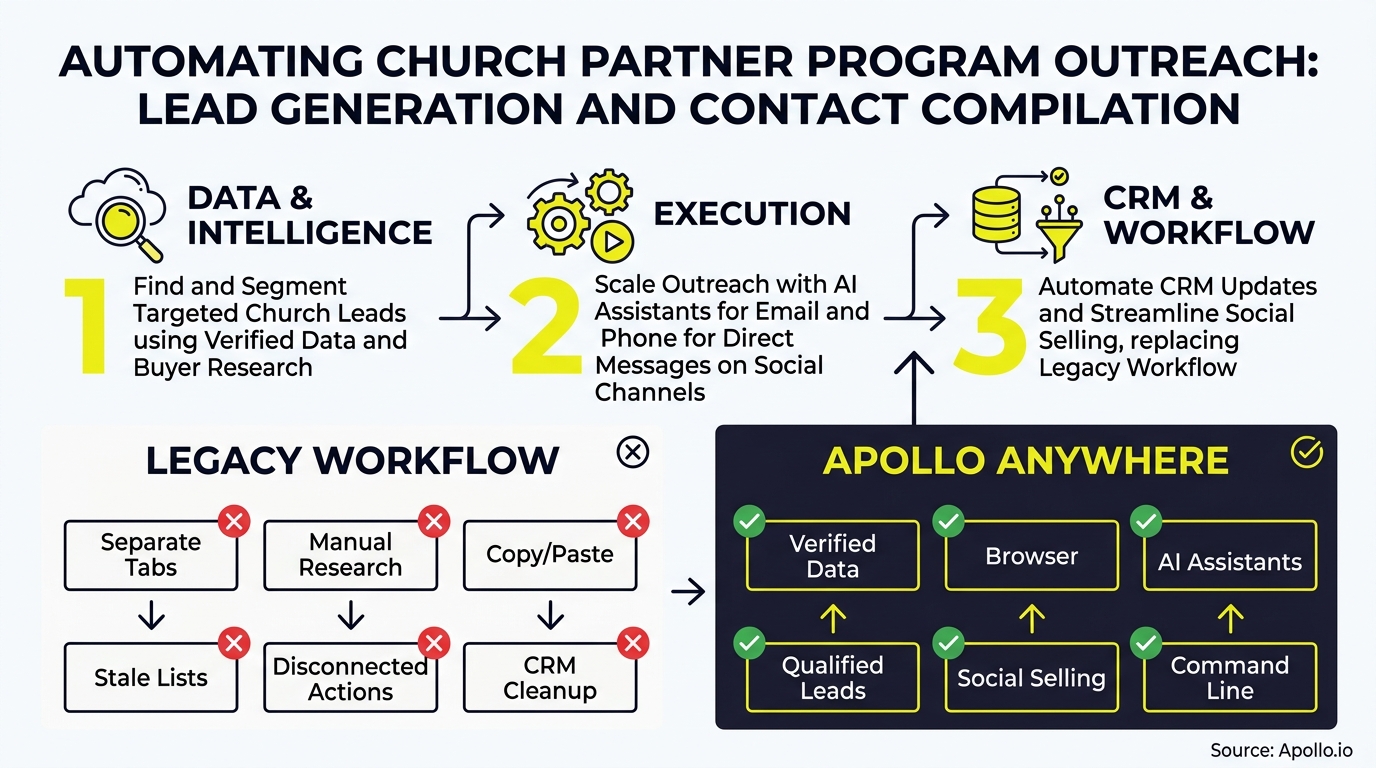
Building a church partner program starts with a verified, organization-first contact list and an outreach workflow that automates the admin, not the relationship. This playbook walks sales prospecting teams, SDRs, and partner managers through discovering churches, verifying decision-makers, and scaling email and phone outreach responsibly.
Barna's June 2026 research found only 13% of surveyed pastors don't use AI at all, but pastors tend to prefer it behind the scenes, for research and preparation, rather than as a replacement for personal ministry. Your outreach should follow the same principle.

Skip Manual Research, Let Apollo Find Leads
Tired of spending hours researching leads and double-checking contact info before you can sell? Apollo hands you verified business contacts with 98% email accuracy. Your reps get their selling time back. Start filling your pipeline today.
Start Free with Apollo →Key Takeaways
- Qualify churches by eligibility, decision authority, and onboarding capacity before you build a single list.
- Build lists from verified sources, then record the source and verification date on every contact.
- Automate research, deduplication, and reminders. Keep humans on first-touch messages and phone calls.
- Sender reputation and instant opt-outs matter more than database size.
- Start with a small pilot and scale only when the dashboard says so.
What Is a Church Partner Lead List?
A church partner lead list is a structured set of church organizations and the specific people who can approve or champion a partnership, each with a documented source, verification date, and reason for fit. It is organization-first: the church is the account, and staff roles are the contacts.
It is not a bulk export of pastor emails. Pew Research Center's 2023-2024 Religious Landscape Study found 62% of U.S. adults identify as Christian, including 40% Protestant and 19% Catholic.
Those are population shares, not church counts or addressable leads, so segment by denomination, geography, ministry priorities, and decision structure.
The same ideas apply to any lead list that actually converts: tight definition, clean data, clear next step.
How Do You Qualify Churches Before Outreach?
Qualify churches with a short readiness scorecard that checks program eligibility, decision authority, and onboarding capacity before any contact enters a sequence.
| Criterion | Question to Answer | Pass Signal |
|---|---|---|
| Eligibility | Does the church meet your program's requirements? | Matches denomination, size, or ministry type you serve |
| Decision authority | Who owns the relevant ministry function? | Named role (e.g., executive pastor, operations lead) |
| Onboarding capacity | Can staff implement this? | Staff or volunteer owner identified |
| Active presence | Is the church operating? | Current website, recent events |
Capacity matters. Hartford's 2023-2024 research surveyed about 1,700 religious leaders; nearly half had considered leaving their congregation.
Build a low-effort partnership brief: one page, clear implementation requirements, and a named contact for questions.
Should You Buy or Build Church Contact Lists?
Build a core list from verifiable sources and use purchased or enriched data only to fill gaps, because provenance and freshness decide whether outreach lands.
| Source | Best For | Watch-Outs |
|---|---|---|
| Denominational directories | Verified church identity and location | Staff roles often outdated |
| Church websites | Active ministries, staff pages, contact routes | Online presence is not outreach consent |
| Purchased lists | Fast coverage | Unknown provenance, duplicates, decay |
| B2B data platforms | Role-based contacts at scale | Needs church-specific filtering and checks |
Hartford's March 2025 synthesis reported 75% of congregations offered online worship in 2023, so websites are a reliable way to confirm a church is active. Treat that as verification, never as permission to automate marketing.
Data also ages. Landbase reports annual contact decay can reach up to 70% in high-turnover sectors, so stamp every record with a verification date.
Struggling to find qualified leads? Search Apollo's 240M+ contacts with 65+ filters to build a first-pass list, then verify against church sources.
Fill Your Funnel And See Every Deal With Apollo
Forecasts feel like guesswork when the top of your funnel is thin and deal data is stale? Apollo puts business contact info for your target accounts and every sequence in one connected workspace. Teams actively using Apollo's AI Assistant are up 2,156% since December 2025.
Start Free with Apollo →What Should a Church Contact List Schema Include?
A sound schema has separate church and contact records, linked by ID, with provenance fields and a deduplication key.
- Church record: legal name, campus name, denomination, city/state, website, parent organization, ministry focus.
- Contact record: name, role, work email, phone, source URL, verification date, verification method.
- Compliance fields: suppression status, opt-out date, outreach channel permitted.
- Dedup key: normalized website domain plus campus identifier.
Multi-campus churches are the usual duplicate trap. Decide up front whether a campus or the parent church is the account, then merge on the domain key so one organization never receives parallel sequences.
Need a faster way to find verified business contacts? Enrichment fills gaps, but always confirm the role against the church's own site.

How Do SDRs Automate Church Outreach Without Losing the Personal Touch?
SDRs automate the administrative work, including research, enrollment gating, reply routing, suppression, and task creation, while a human reviews first-touch messages and handles calls.
Map your CRM workflow in four gates:
- Enrollment gate: contact enters a sequence only if the scorecard passes and verification is under your freshness limit.
- Review gate: a human approves the first-touch draft.
- Reply routing: positive replies create a task for the partner manager; negatives and unsubscribes trigger suppression.
- Call task: the system schedules a call task for a person, rather than dialing by itself.
Research on multichannel outreach from Outplay reports multichannel sequences outperform single-channel ones. Pair email and phone, but keep both human-led.
Spending hours on manual outreach? Automate your sequences with Apollo and keep review steps in place.
What Are the Email and Phone Compliance Basics?
Commercial email needs a working opt-out honored within 10 business days, and phone automation using artificial voices needs separate consent review.
The FTC states CAN-SPAM has no business-to-business exception, and the opt-out mechanism must stay functional for at least 30 days after sending. Sync your suppression list across every tool so an unsubscribe in one place stops all sequences.
For phone, the FCC's February 2024 ruling classified AI-generated voices as artificial voices under the TCPA. That is not a blanket ban on AI-assisted calling, but it means automated voice campaigns need consent and exemption review.
Human calling with administrative automation is a different category. Since December 15, 2025, providers must block calls using a reasonable do-not-originate list, so use legitimate caller numbers and monitor for blocked calls.
This is general information, not legal advice. Confirm your use case with counsel.
How Do You Scale Email Without Hurting Deliverability?
Scale in measured steps after authentication, list hygiene, and suppression are working, because sender reputation limits reach more than list size does.
- Authenticate: set up SPF, DKIM, and DMARC. Microsoft began enforcing these for domains sending more than 5,000 messages daily to Outlook.com consumer addresses in May 2025.
- Watch spam rates: Google recommends user-reported spam rates below 0.1% and avoiding 0.3% or higher for bulk Gmail senders.
- Suppress fast: remove bounces and unsubscribes immediately.
- Follow up: CopyCrest cites Belkins reporting that follow-up touches account for 42% of all received replies, so build a short, relevant follow-up step.
These thresholds apply to Gmail and Outlook consumer addresses, not every church mailbox, but the discipline carries over.
How Do RevOps Teams Measure a Church Partner Pilot?
RevOps measures a pilot by activation and cost per active partner, not by emails sent.
| Metric | What It Tells You |
|---|---|
| Verified-contact rate | List quality |
| Bounce and spam-complaint rate | Deliverability health |
| Positive reply rate | Message fit |
| Partners activated | Actual program outcome |
| Cost per active partner | Whether scaling pays off |
Scale when bounces and complaints stay low and activation holds. Pause when complaints rise, replies shift negative, or onboarding capacity backs up. Don't invent conversion benchmarks; record your own and compare pilot to pilot. For team-wide visibility, deal management keeps every partner conversation in one view.

What Should You Do Next?
Run a small pilot: pick one denomination or region, score the churches, verify contacts from church sources, and launch a human-reviewed email and call workflow with immediate suppression.
The teams that win with church partnerships treat automation as support for relationships. Consolidate prospecting, enrichment, and outreach in one place and you cut your tech stack along with the manual work. As Collin Stewart of Predictable Revenue put it: "We reduced the complexity of three tools into one."
Ready to build your first church partner list? Start a Trial.
Prove Pipeline ROI Fast With Apollo
Budget approval stuck because you can't show what your tools actually return? Apollo puts business contact data, sequences, and reporting in one workspace, so wins show up faster. Leadium tripled annual revenue by automating inbound and speeding follow-up.
Start Free with Apollo →Don't miss these
Sales
Inbound vs Outbound Marketing: Which Strategy Wins?
Sales
What Is a Sales Funnel? The Non-Linear Revenue Framework for 2026
Sales
What Is a Go-to-Market Strategy? The 2026 GTM Playbook
See Apollo in action
We'd love to show how Apollo can help you sell better.
By submitting this form, you will receive information, tips, and promotions from Apollo. To learn more, see our Privacy Statement.
4.7/5 based on 9,690 reviews
