
How to Enrich a Company's Firmographics and Tech Stack Before an Onsite Visit
Walking into an onsite meeting without knowing a prospect's headcount, funding stage, or which CRM they run is the fastest way to sound generic. A 15-minute enrichment workflow before you leave the office can turn a courtesy visit into a pipeline-moving conversation.
This guide gives you the exact steps, a five-part visit brief template, and a confidence-scoring model so you walk in prepared, not guessing.

Apollo Ends Hours Of Manual Lead Research
Spending hours hunting down emails and phone numbers that turn out wrong. Apollo hands your reps verified contact data instantly, with 98% email accuracy built in. Skip the busywork and get straight to selling.
Start Free with Apollo →Key Takeaways
- Enrich firmographics (industry, headcount, revenue, location) and technographics (installed tools, integrations, recent stack changes) before every onsite visit to replace generic pitches with company-specific questions.
- Use Apollo MCP when you need to pull a company's firmographic and tech-stack brief directly inside ChatGPT, Claude, or Perplexity without switching tabs before you head out the door.
- Score every data field for source, freshness, and confidence. Old technographic data creates false assumptions since company stacks change constantly.
- Translate each detected tool into a discovery question about integration gaps, contract timing, or migration risk instead of just listing what the prospect uses.
- Use Apollo MCP when you need enrichment, verification, and sequence follow-up handled in one conversation instead of stitching together separate research tools.
How Do You Enrich A Company Before An Onsite Visit?
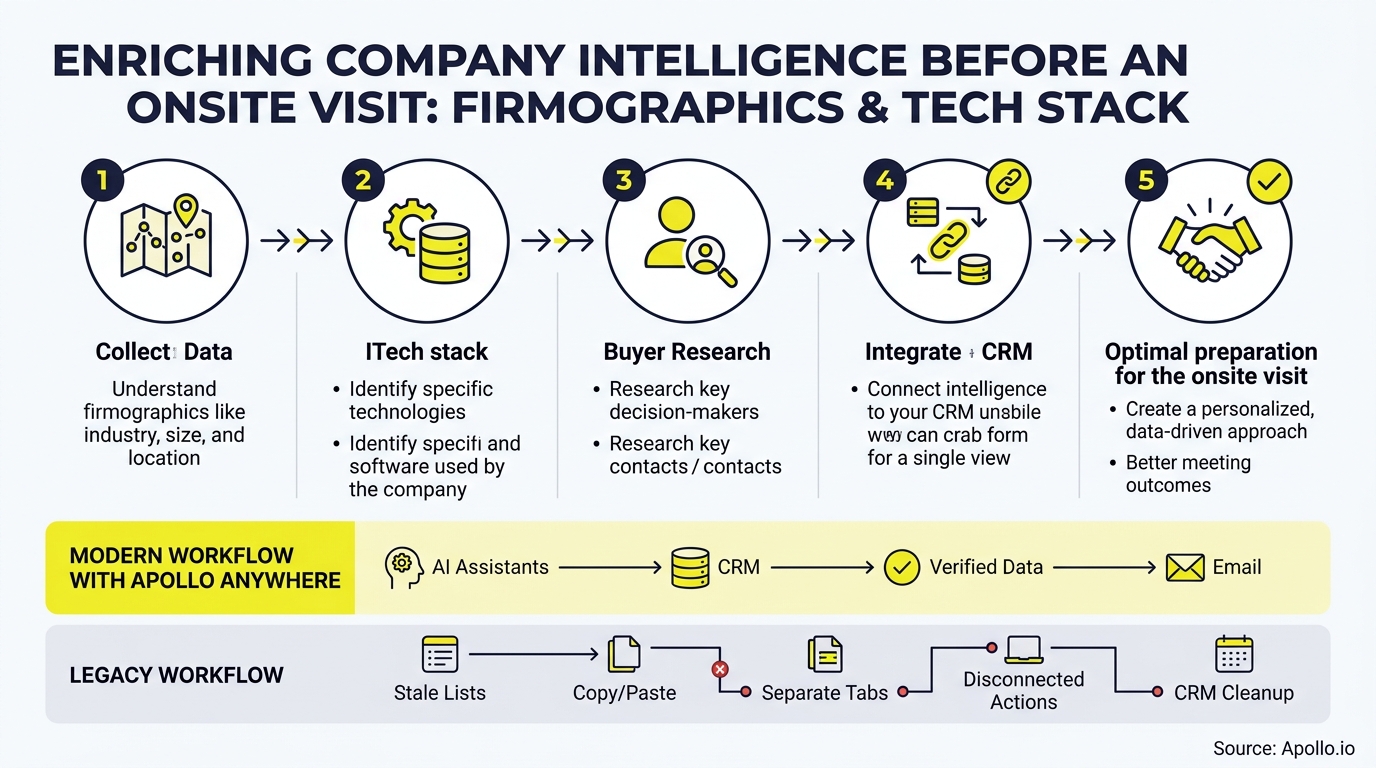
You enrich a company before an onsite visit by pulling firmographic data (industry, size, revenue, locations), technographic data (installed software and recent changes), and recent trigger events, then compressing all three into a one-page brief you can scan in the parking lot.
The workflow takes about 15 minutes when your data sources are connected:
- Minutes 1-5: Pull firmographics: employee count, revenue band, industry, funding stage, HQ and facility location.
- Minutes 6-10: Pull technographics: CRM, marketing automation, support desk, and any tools relevant to your product category.
- Minutes 11-13: Check for trigger events: leadership changes, funding rounds, job postings, or expansion news.
- Minutes 14-15: Convert findings into 3-5 discovery questions tied to what you found.
For SDRs booking the meeting and Account Executives running it, this workflow removes the guesswork that leads to generic pitches. Struggling to find qualified account data fast? search Apollo's 240M+ contacts and company records with 65+ filters to build the account view in one pass.
What Is The Onsite Account Readiness Brief Template?
The Onsite Account Readiness Brief is a five-part, one-page document that compresses firmographic, technographic, and relationship data into a scannable pre-visit reference.
Build it as a repeatable template so every rep produces the same structure.
| Section | What It Contains | Why It Matters Onsite |
|---|---|---|
| 1. Company Snapshot | Industry, headcount, revenue band, HQ/facility address, funding stage | Confirms fit and sets visit context |
| 2. Tech Stack Map | CRM, engagement tools, infrastructure, and category-relevant software | Surfaces integration and displacement angles |
| 3. Recent Changes | New hires, funding, leadership moves, tool swaps in the last 90 days | Gives a timely reason for the visit |
| 4. Stakeholder Map | Names, titles, and roles of known buying-group members | Modern buying committees involve multiple people, so mapping roles avoids talking to the wrong person |
| 5. Discovery Questions | 3-5 questions generated from the tech stack and trigger events | Replaces scripted pitches with account-specific conversation |
According to Numriq, the average B2B buying committee has grown to 11 stakeholders by 2026, up from 6.8 in 2023, which is exactly why the stakeholder map section can't be skipped.
How Do You Score Confidence In Enriched Data?
You score confidence in enriched data by tagging each field with its source, last-verified date, and a confidence level, so reps know which facts to state directly and which to confirm in conversation.
| Confidence Level | Criteria | How To Use It Onsite |
|---|---|---|
| High | Verified within 30 days from a primary source (company site, filing, direct enrichment) | State as fact: "I saw you recently expanded into..." |
| Medium | 30-90 days old or inferred from job postings/social signals | Frame as a question: "Are you still running on...?" |
| Low | Over 90 days old or single-source, unverified | Use only to prompt discovery, never state as confirmed |
This matters because company tech stacks change constantly, not just grow. Treat every technographic field as time-stamped, not permanent.
RevOps leaders maintaining a single source of truth should build this scoring directly into CRM fields so every rep sees the same confidence flags, not just the raw data.
Turn Cold Leads Into Sales-Ready Deals
Marketing leads piling up but never turning into real opportunities. Apollo surfaces buying intent and prioritizes accounts actually ready to talk, so reps stop chasing dead ends. Built-In saw a 10% lift in win rate using Apollo's scoring.
Start Free with Apollo →How Do You Turn Detected Tech Stack Tools Into Discovery Questions?
You turn detected tools into discovery questions by mapping each tool category to a business risk, integration gap, or competitive angle, then phrasing it as a question rather than a statement of fact.
| Detected Tool Category | What It Signals | Discovery Question To Ask Onsite |
|---|---|---|
| Legacy CRM | Possible migration fatigue or contract renewal window | "How is your current CRM handling your growth in headcount?" |
| No dedicated engagement platform | Manual outreach, potential efficiency gap | "How does your team currently manage multi-channel outreach?" |
| Multiple point solutions in one category | Tool sprawl, budget consolidation opportunity | "How many tools does your team juggle for [category] today?" |
| Recently added competitor tool | Active evaluation or recent switch | "What prompted the move to your current [tool]?" |
Companies that fold technographic data into their go-to-market strategy are far more likely to hit revenue targets than teams relying on basic firmographic targeting alone, according to Landbase. The tool-to-question mapping is what makes that data actionable instead of just interesting.
How Can SDRs And AEs Use Apollo MCP To Prep For An Onsite Visit?
SDRs and AEs can use Apollo MCP to pull a full firmographic and technographic brief directly inside ChatGPT, Claude, or Perplexity, without opening a separate research tool. Apollo MCP (Model Context Protocol) connects Apollo's data and workflows into the AI tools reps already have open.
From one conversation, you can ask your AI assistant to search for a company matching your ICP, enrich the account with firmographic and technographic details, verify contact information, and even queue a follow-up sequence for after the visit. Setup is no-code: connect Apollo inside your AI tool's connectors via OAuth on any Apollo plan, including free.
For technical teams, the Apollo API and command-line interface support the same enrichment inside custom workflows or terminal-based tools. Your best prospecting session shouldn't require opening a new tab.
For Account Executives running back-to-back onsite meetings, this means the brief is ready before you leave your last call, not assembled from memory in the parking lot.

What Privacy And Governance Rules Apply To Pre-Visit Enrichment?
Pre-visit enrichment should rely on public, company-level firmographic and technographic sources, not personal or sensitive data, and every field should carry a timestamp and source for auditability. Treat this as a standing checklist, not a one-time review.
- Source transparency: Log where each data point came from (public filing, company website, verified enrichment provider).
- Minimization: Collect only what's relevant to the visit, business contact information and company-level attributes, not personal details unrelated to the deal.
- Freshness timestamps: Tag every firmographic and technographic field with a last-verified date.
- Retention limits: Set expiration or review dates so stale technographic data doesn't get treated as current fact.
This discipline also protects data trust internally. RevOps teams that document sourcing and freshness give reps confidence to actually use the brief instead of double-checking everything manually.
Why Does Pre-Visit Enrichment Matter For Onsite Meetings?
Pre-visit enrichment matters because onsite meetings are high-value, low-frequency interactions where irrelevant pitches cost you the deal. Buyers actively avoid vendors who show up without doing their homework.
Prepared reps who walk in with a company-specific brief convert meetings into pipeline at a meaningfully higher rate than reps who wing it, according to MarketBetter. That gap is the entire business case for spending 15 minutes on enrichment instead of zero.
Founders and revenue leaders under ROI pressure should treat this as a process, not a one-off habit: standardize the sales tech stack that generates these briefs so every rep, not just your best performer, walks in prepared. Predictable Revenue's Collin Stewart put it simply: "We reduced the complexity of three tools into one."
Frequently Asked Questions
How Accurate Is Enriched Firmographic And Technographic Data?
Accuracy depends on source and freshness, which is why every field in your brief needs a confidence score rather than being treated as universally reliable. Apollo maintains 98% email accuracy across its database, but technographic signals like installed tools should always be timestamped since stacks change frequently.
How Do You Verify A Detected Tech Stack Is Still Current?
Cross-check detected tools against job postings, recent press, and direct conversation cues during the meeting itself. Treat any technographic signal older than 90 days as a discovery question, not a confirmed fact, using the confidence table above.
Does Enrichment Data Sync With My CRM?
Yes, most enrichment platforms, including Apollo's enrichment tools, can write firmographic and technographic fields directly back to CRM records so the whole team sees the same account view. This avoids reps rebuilding the same brief from scratch for every visit. Learn more about the difference between data enrichment and data cleansing if you're setting up this sync for the first time.
Is Pre-Visit Enrichment Only About Public Company Data?
Yes. Enrichment for onsite prep should focus on company-level firmographics and technographics, industry, size, revenue, installed software, not personal or sensitive information.
This keeps the brief focused on business context and supports responsible data handling.

Ready To Build Your Onsite Visit Brief?
Manually pulling firmographics from one tool, technographics from another, and stakeholder details from a third is exactly the toggle tax that slows reps down before their most important meetings. Apollo brings company data, tech-stack signals, and contact verification into one workspace, so RevOps teams stop maintaining multiple point tools and reps stop guessing before they walk in the door. Census summed up the shift simply: "We cut our costs in half."
Whether you're an SDR building the first brief or an AE refining it hours before the meeting, the workflow is the same: enrich, verify, score confidence, and convert findings into questions. Start Prospecting with Apollo and build your next onsite brief in minutes, not hours.
Justify Every Dollar With Apollo's Results
Stuck proving ROI before the budget gets pulled. Apollo's automation turns rep hours into measurable pipeline from day one, no long ramp required. Leadium tripled annual revenue after automating outbound with Apollo.
Start Free with Apollo →Don't miss these
Sales
Inbound vs Outbound Marketing: Which Strategy Wins?
Sales
What Is a Sales Funnel? The Non-Linear Revenue Framework for 2026
Sales
What Is a Go-to-Market Strategy? The 2026 GTM Playbook
See Apollo in action
We'd love to show how Apollo can help you sell better.
By submitting this form, you will receive information, tips, and promotions from Apollo. To learn more, see our Privacy Statement.
4.7/5 based on 9,690 reviews
