
How to Drive Sales: Proven Strategies for Modern Sales Teams
Sales teams in 2026 face a paradox: buyers research independently yet expect personalized engagement at every touchpoint. According to BookYourData, 80% of B2B sales interactions between suppliers and buyers are expected to occur through digital channels by 2025. The ability to drive revenue growth through analytics and automation separates winning teams from those stuck in manual workflows.

Stop Manual Research—Apollo Finds Buyers Fast
Tired of spending 4+ hours daily hunting for contact info? Apollo delivers 224M verified contacts with 96% email accuracy. Join 550K+ companies closing more deals.
Start Free with Apollo →Key Takeaways
- Digital channels now dominate B2B sales, requiring content-first strategies that work without sales reps
- Data quality and enrichment directly impact pipeline velocity and deal close rates
- Sales leaders consolidating tools report significant cost savings and faster team ramp times
- AI-powered automation handles repetitive tasks while reps focus on high-value conversations
- Revenue operations alignment connects marketing spend to closed revenue with clear attribution
What Does It Mean to Drive Sales in 2026?
To drive sales means creating predictable revenue growth through systematic processes, technology, and buyer-focused strategies. It combines prospecting, engagement, pipeline management, and deal execution into a repeatable system. Multiple factors affect sales performance, from data accuracy to rep productivity to content quality.
Research from Landbase shows the global B2B eCommerce market is estimated at $32.11 trillion in 2025. Teams that drive sales effectively tap into this market through targeted outreach, personalized messaging, and multi-channel engagement. The shift toward digital channels demands better data, smarter automation, and content that converts without sales rep involvement.
How Do Sales Leaders Drive Revenue Growth?
Sales leaders drive revenue by aligning team processes, setting clear metrics, and removing friction from the buyer journey. They focus on three core areas: pipeline health, rep productivity, and conversion optimization. Modern sales leaders use data to coach at scale and identify bottlenecks before they impact quota attainment.
Key activities include:
- Establishing KPIs that predict revenue rather than lagging indicators
- Building repeatable playbooks for common buyer scenarios
- Implementing technology that consolidates sales workflows into one workspace
- Creating feedback loops between marketing, sales, and customer success
According to Corporate Visions, the average sales cycle length dropped from 11.3 months in 2024 to 10.1 months in 2025. Leaders who compress cycles focus on buyer enablement content, executive alignment, and proactive objection handling.
Turn Forecast Guesswork Into Revenue Certainty
Pipeline forecasting a guessing game? Apollo's real-time deal intelligence gives you accurate visibility across every stage. Built-In boosted win rates 10% with Apollo's scoring and signals.
Start Free with Apollo →What Tools Help SDRs Drive More Pipeline?
SDRs drive pipeline through prospecting tools that provide accurate contact data, engagement platforms that automate outreach sequences, and analytics that show what messaging works. The challenge is tool sprawl: many teams juggle separate systems for data, email, calling, and tracking.
Essential capabilities SDRs need:
- Contact databases with verified emails and direct dials
- Multi-channel sequencing across email, phone, and social outreach
- Real-time data enrichment to personalize messaging
- Activity tracking and performance dashboards
Struggling to find qualified leads? Search Apollo's 224M+ contacts with 65+ filters to build targeted prospect lists.
Teams consolidating their tech stack report faster ramp times and lower costs. "We reduced the complexity of three tools into one," says Collin Stewart at Predictable Revenue. For SDRs, this means less time switching between platforms and more time having conversations.

How Does Sales Automation Drive Revenue?
Sales automation software drives revenue by handling repetitive tasks, ensuring consistent follow-up, and scaling personalized outreach. It eliminates manual data entry, automates email sequences, and triggers actions based on buyer behavior. The result is more pipeline with the same headcount.
Automation use cases that impact revenue:
- Sequenced outreach that adapts based on engagement signals
- Automatic lead routing to the right rep based on territory or account fit
- Meeting scheduling that syncs with calendar availability
- Data enrichment that keeps CRM records accurate and complete
According to Grand View Research, the global revenue operations market size was estimated at $4.39 billion in 2024 and is projected to reach $16.98 billion by 2033. This growth reflects the shift toward revenue operations models where automation connects marketing, sales, and customer success.
What Sales Strategies Drive Consistent Results?
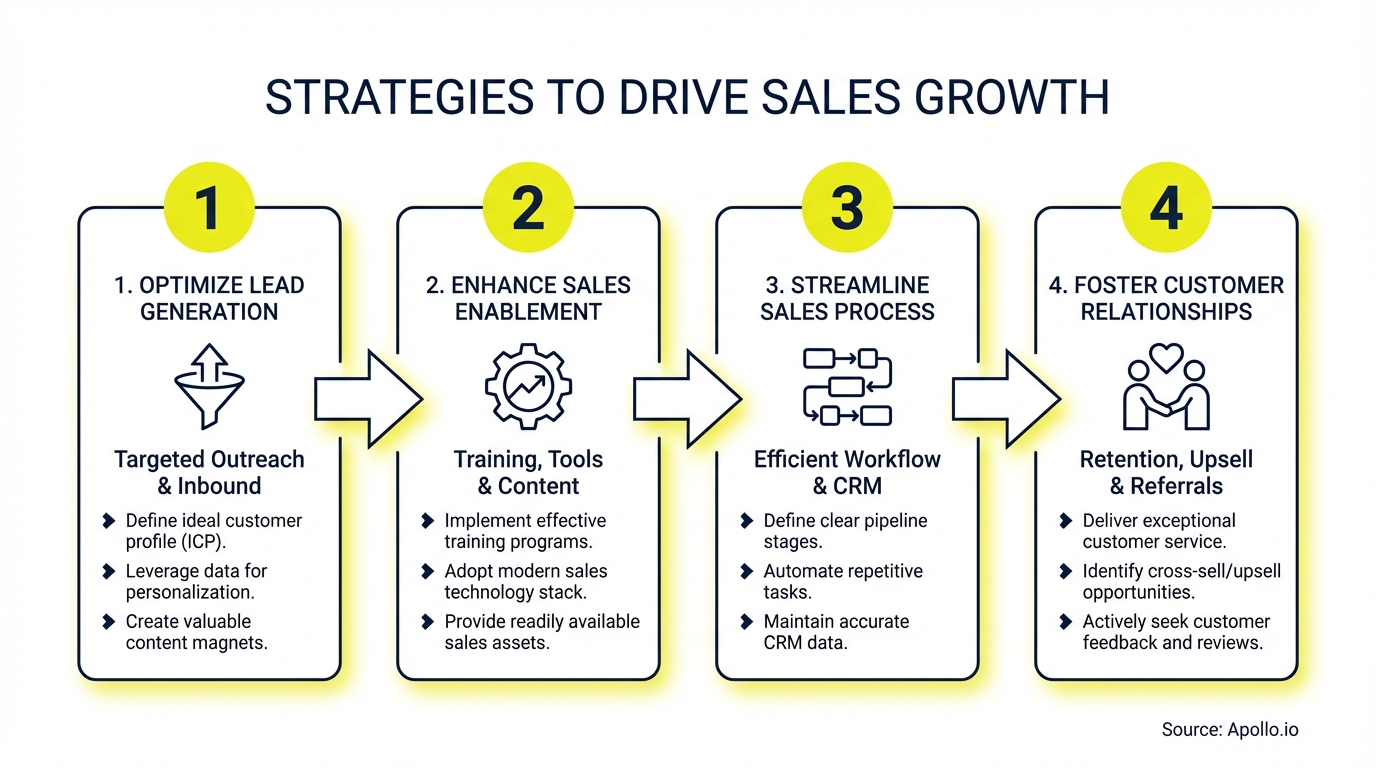
Strategies that drive sales combine process discipline, buyer-focused messaging, and continuous optimization. Account Executives using proven frameworks like the Sales Acceleration Formula create predictable pipelines by focusing on metrics that matter: lead response time, meeting conversion rates, and deal velocity.
| Strategy | Impact Area | Key Metric |
|---|---|---|
| Account-Based Selling | Deal size and win rate | Average contract value |
| Multi-Channel Sequences | Response rates | Reply rate by channel |
| Social Selling | Relationship building | Engagement before outreach |
| Value-Based Messaging | Qualification quality | Discovery call conversion |
Teams executing enterprise sales strategies focus on executive access, business case development, and stakeholder alignment. They use deal management software to track pipeline health and forecast accurately.
How Do Account Executives Drive Deals to Close?
Account Executives drive deals by managing complex buying processes, handling objections, and creating urgency around business outcomes. They focus on discovery, demo effectiveness, and stakeholder management. Objection handling separates top performers from average reps.
Execution tactics that close deals:
- Multi-threaded relationships across buying committee
- Business case development with quantified ROI
- Competitive positioning that highlights differentiation
- Executive sponsorship that accelerates internal approvals
AEs managing multiple deals simultaneously need visibility into pipeline health, next steps, and at-risk opportunities. "Having everything in one system was a game changer," reports the team at Cyera. This consolidation eliminates context switching and ensures nothing falls through the cracks.

Conclusion: Building a Sales System That Scales
To drive sales in 2026 requires a systematic approach combining accurate data, intelligent automation, and buyer-focused content. Teams that consolidate their tech stack, align around revenue operations principles, and invest in enablement consistently outperform competitors stuck in legacy workflows.
The shift toward digital-first buying journeys means content and self-serve experiences carry more persuasion weight than ever. Sales teams need tools that work across the entire revenue cycle, from prospecting to pipeline management to deal execution.
Organizations that embrace this unified approach report faster sales cycles, higher win rates, and lower customer acquisition costs.
Ready to drive more sales? Get Leads Now with Apollo's all-in-one sales platform and join 2M+ users building predictable revenue.
Prove ROI Fast With Apollo's Pipeline Impact
Budget approval stuck on unclear metrics? Apollo tracks every dollar from prospect to close—quantifying time saved and pipeline impact. Built-In boosted win rates 10% and ACV 10% with Apollo's signals.
Start Free with Apollo →Don't miss these
Sales
Inbound vs Outbound Marketing: Which Strategy Wins?
Sales
What Is a Sales Funnel? The Non-Linear Revenue Framework for 2026
Sales
What Is a Go-to-Market Strategy? The 2026 GTM Playbook
See Apollo in action
We'd love to show how Apollo can help you sell better.
By submitting this form, you will receive information, tips, and promotions from Apollo. To learn more, see our Privacy Statement.
4.7/5 based on 9,690 reviews
