
Consultative Sales Approach: Definition, Benefits, and Best Practices
In 2026, buyers demand more than product pitches. According to Gartner, 61% of B2B buyers prefer an overall rep-free buying experience. This shift forces sales teams to adopt a consultative sales approach that prioritizes decision enablement over discovery. Successful AEs and SDRs now focus on reducing buyer friction, aligning stakeholders, and delivering contextual intelligence at high-value decision points.

Research Less. Connect More With Apollo.
Tired of your reps burning hours hunting down contact info that's already outdated? Apollo surfaces verified business contacts instantly, so your team spends time selling — not searching. Join 550K+ companies turning research time into revenue.
Start Free with Apollo →Key Takeaways
- Consultative selling in 2026 means acting as a trusted advisor who helps buyers make confident decisions, not just uncovering needs
- Modern B2B buyers conduct 70% of research before engaging reps, requiring sellers to deliver unique insights and de-risk decisions
- Account Executives using consultative methods close higher-value deals with less discounting by aligning solutions to business outcomes
- Tools like Apollo consolidate your tech stack, giving reps verified contact data and engagement workflows to execute consultative strategies efficiently
- Successful consultative selling requires stakeholder mapping, ROI validation, and internal alignment assets to prevent deal stalls
What Is A Consultative Sales Approach?
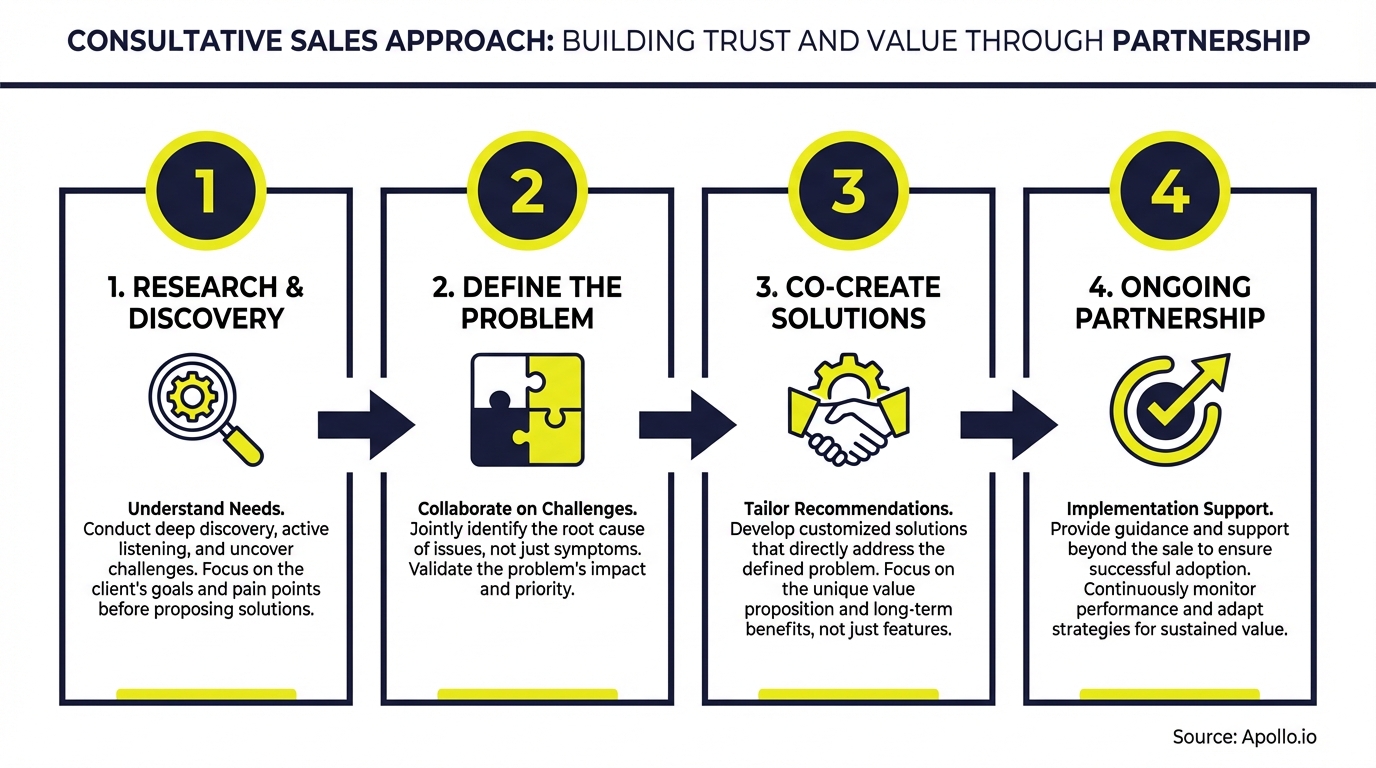
A consultative sales approach is a method where sellers act as trusted advisors, diagnosing buyer challenges and recommending solutions aligned to business outcomes. Rather than leading with product features, consultative reps prioritize understanding buyer context, pain points, and decision criteria. Research from Sales Odyssey shows that 84% of buyers desire salespeople to act as trusted advisors.
This approach shifts the seller's role from information provider to decision enabler. According to Databox, modern B2B buyers are highly informed, conducting approximately 70% of their buying journey research before engaging with a vendor. Consultative selling addresses this by offering insights buyers cannot find through self-research: implementation constraints, competitive tradeoffs, ROI modeling, and stakeholder alignment strategies.
The consultative framework includes four core activities: diagnosis (understanding buyer environment), prescription (recommending fit-for-purpose solutions), validation (proving ROI and de-risking), and enablement (equipping buyers to sell internally). Sales analytics help teams track which consultative behaviors correlate with closed deals.
Why Do Account Executives Need Consultative Selling In 2026?
Account Executives face increasing buyer skepticism and committee-based decision-making. Consultative selling helps AEs navigate complex buying groups by addressing individual stakeholder concerns and building internal consensus. Research from KLA Group indicates that adopting consultative selling and prospecting training can lead to more closed deals, higher-value sales, and reduced reliance on discounts, ultimately improving profitability.
AEs using consultative methods close high-ticket sales by demonstrating business impact rather than feature superiority. This approach reduces price objections because buyers understand the ROI. Sales Leaders report that consultative AEs maintain higher win rates in competitive evaluations by differentiating on insight quality and implementation support, not just product capabilities.
Struggling to track deal progress across multiple stakeholders? Apollo's deal management tools give AEs visibility into buyer engagement and next steps.
Turn Funnel Gaps Into Closed Revenue
Pipeline forecasting a guessing game because quality leads never convert? Apollo surfaces in-market buyers with verified contact data, so your pipeline reflects real opportunities. Join 90K paying customers forecasting with confidence.
Schedule a Demo →How Does Consultative Selling Work In Practice?
Consultative selling follows a structured process that balances buyer autonomy with expert guidance. The framework adapts to where buyers are in their journey, offering self-serve resources early and high-touch consultation at critical decision points.
Here's how top-performing teams execute consultative motions:
| Stage | Consultative Activities | Tools & Assets |
|---|---|---|
| Discovery | Diagnose buyer environment, map stakeholders, identify decision criteria | Diagnostic questionnaires, stakeholder maps, decision frameworks |
| Education | Share insights buyers lack, frame problems differently, challenge assumptions | Thought leadership, comparison guides, ROI calculators |
| Validation | Prove ROI, de-risk implementation, address procurement concerns | Business case templates, risk registries, reference customers |
| Enablement | Equip champions to sell internally, create mutual action plans (MAPs) | Executive briefing decks, internal FAQ docs, implementation roadmaps |
SDRs and BDRs apply consultative principles during prospecting by researching buyer triggers and personalizing outreach around business problems, not product features. HubSpot's sales team demonstrates how consultative prospecting increases response rates and meeting conversion.
Tired of generic outreach that gets ignored? Apollo's multi-channel sequences let you personalize at scale with verified contact data and engagement insights.

What Are The Key Skills For Consultative Selling?
Consultative selling requires a distinct skill set beyond product knowledge. Top performers master business acumen, diagnostic questioning, stakeholder navigation, and evidence-based storytelling.
Here are the critical competencies:
- Business Diagnosis: Understanding buyer financials, operational constraints, competitive positioning, and strategic priorities
- Stakeholder Mapping: Identifying decision-makers, influencers, blockers, and champions across the buying committee
- Insight Generation: Delivering perspectives buyers cannot find through self-research, based on pattern recognition across similar customers
- ROI Quantification: Building credible business cases with measurable impact metrics, implementation costs, and payback periods
- Objection Reframing: Addressing concerns by exploring root causes rather than defending product features
- Internal Selling Enablement: Coaching champions to navigate their organization's approval processes and procurement requirements
Sales Leaders report that consultative skills development requires ongoing coaching, not one-time training. Sales trainers use role-playing, deal reviews, and recorded call analysis to build consultative muscle memory. RevOps teams support skill development by ensuring reps have access to customer success data, competitive intelligence, and ROI benchmarks.
The best consultative sellers leverage sales tech stacks that consolidate data, automate research, and surface insights. According to Predictable Revenue, "We reduced the complexity of three tools into one" when adopting platforms that unify contact data, engagement tracking, and deal management.
How Do Sales Teams Implement Consultative Strategies At Scale?
Scaling consultative selling requires systematic enablement, not just individual rep talent. Successful organizations build content libraries, playbooks, and tools that make consultative motions repeatable.
Here's the implementation framework:
Content-Led Consultative System: Create self-serve diagnostic tools, decision frameworks, and ROI calculators that buyers can access independently. Gate advanced resources (implementation playbooks, procurement guides) to capture intent signals. This accommodates the 61% of buyers who prefer rep-free experiences while providing escalation paths to experts.
Stakeholder-Specific Playbooks: Develop role-based content for finance (TCO models), IT (integration requirements), procurement (contract terms), and operations (change management). Each playbook addresses role-specific objections and value drivers. This reduces the inconsistency problem where 69% of buyers report conflicting information between websites and seller conversations.
Deal-Stall Prevention Assets: Build internal alignment kits including business case templates, mutual action plans (MAPs), risk registries, and executive briefing decks.
These assets help navigate the 13-person buying committees and address the 91% deal stall rate documented in B2B purchases.
Cross-Channel Truth Management: Establish content governance ensuring marketing websites, sales decks, and live conversations deliver consistent messaging. Use a single source of truth for product capabilities, pricing guidance, and competitive positioning. Revenue operations teams typically own this alignment.
What Tools Support Consultative Selling Workflows?
Consultative selling requires tools that unify prospecting, engagement, and deal management. The best platforms reduce context-switching and surface insights reps need for consultative conversations.
Key capabilities include:
- Verified Contact Data: Access to decision-maker contact information, org charts, and job change triggers to identify stakeholders
- Engagement Intelligence: Tracking which prospects open emails, visit pricing pages, and download content to gauge intent
- Conversation Intelligence:AI call assistants that capture action items, surface objections, and recommend next steps
- Multi-Channel Sequences:Sales automation that personalizes outreach across email, phone, and social while maintaining consultative messaging
- Deal Collaboration: Mutual action plans (MAPs), stakeholder tracking, and internal notes that keep teams aligned on consultative strategy
Teams using Apollo consolidate prospecting, engagement, and pipeline management into one workspace. As Census noted, "We cut our costs in half" by replacing separate tools for data enrichment, email sequencing, and CRM enrichment.
Cyera's team found that "Having everything in one system was a game changer" for executing consultative motions efficiently.
Transform Your Sales Approach With Consultative Intelligence
Consultative selling in 2026 means enabling buyer decisions, not controlling them. The most successful Account Executives, SDRs, and Sales Leaders deliver contextual intelligence, de-risk complex purchases, and align stakeholder groups around business outcomes.
This approach drives higher win rates, larger deal sizes, and stronger customer relationships built on trust.
Implementation requires systematic enablement: stakeholder playbooks, ROI validation tools, deal-stall prevention assets, and cross-channel message consistency. Organizations that scale consultative motions invest in AI-powered sales tools that surface insights, automate research, and maintain engagement across complex buying committees.
Apollo's all-in-one platform gives revenue teams the verified contact data, engagement workflows, and deal intelligence needed to execute consultative strategies at scale. From inside sales reps qualifying prospects to enterprise AEs closing mega deals, consultative sellers use Apollo to spend less time on busywork and more time delivering the insights buyers actually value.
Ready to implement consultative selling across your team? Request a Demo to see how Apollo consolidates your sales tech stack and enables consultative workflows that close more deals.
Prove Pipeline ROI With Apollo
Budget approval stuck on unclear metrics? Apollo gives sales teams the pipeline visibility and verified data needed to show measurable impact fast. Join 90K paying customers closing with confidence.
Start Free with Apollo →Don't miss these
Sales
Inbound vs Outbound Marketing: Which Strategy Wins?
Sales
What Is a Sales Funnel? The Non-Linear Revenue Framework for 2026
Sales
What Is a Go-to-Market Strategy? The 2026 GTM Playbook
See Apollo in action
We'd love to show how Apollo can help you sell better.
By submitting this form, you will receive information, tips, and promotions from Apollo. To learn more, see our Privacy Statement.
4.7/5 based on 9,690 reviews
