
Can Apollo Replace ZoomInfo? Data, Outbound, and Integrations Compared
Apollo can replace ZoomInfo for contact data and outbound if your team prioritizes an all-in-one workflow (data, enrichment, sequencing, and dialing) over the deepest possible database. The honest answer is conditional: run a pilot on your actual ICP before you cancel anything.
This guide gives you the scorecard, the migration steps for Salesforce and HubSpot, and a 30-day plan so you can decide with evidence instead of vendor claims.
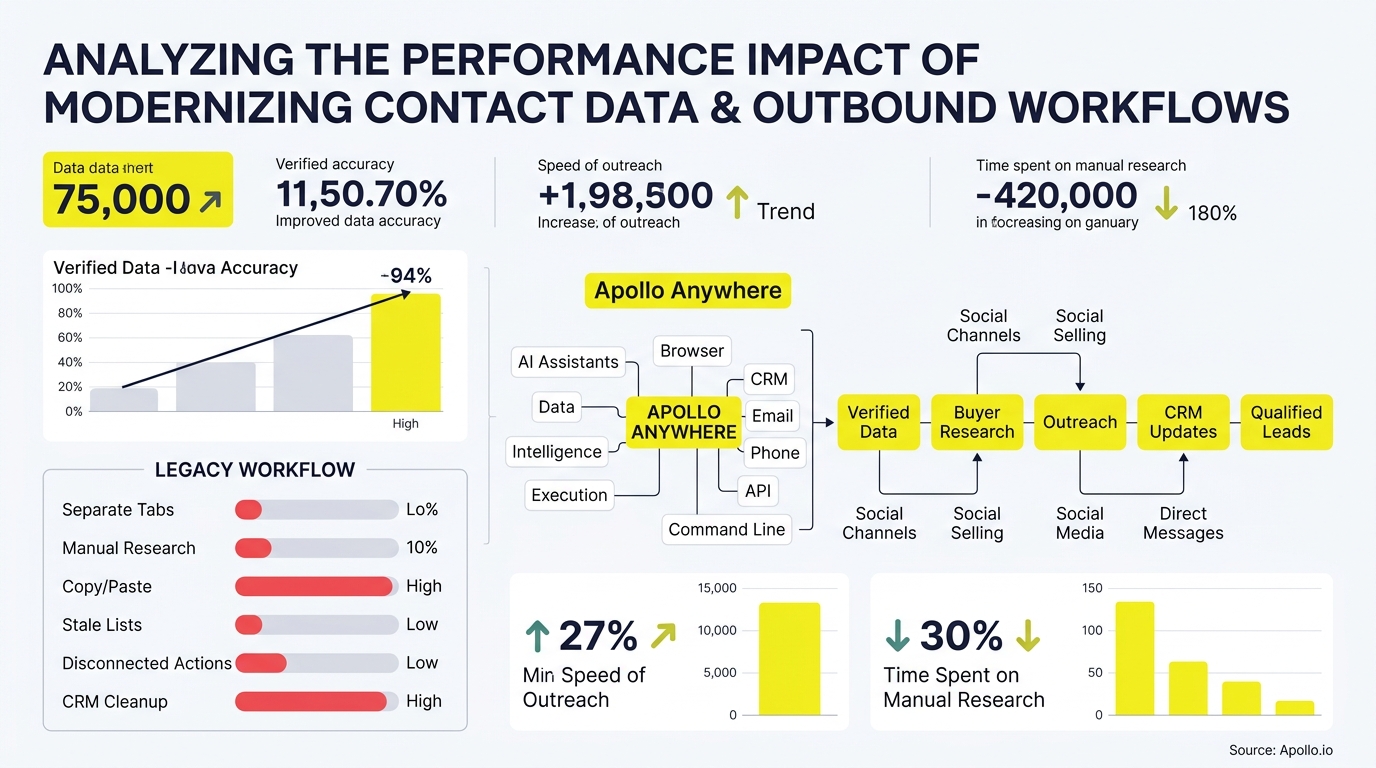

Apollo Ends Manual Contact Hunting
Spending hours a day verifying emails and phone numbers by hand. Apollo hands you 240M+ verified contacts at 98% accuracy so reps spend time selling, not searching. Get your list built in minutes.
Start Free with Apollo →Key Takeaways
- Apollo can replace ZoomInfo for most SMB and mid-market teams that value combined data, enrichment, and outbound execution over pure database size.
- Use Apollo MCP when you need to search contacts, enrich records, and launch sequences directly inside ChatGPT, Claude, or Perplexity without switching tabs.
- Run a 100-500 record pilot on your own ICP before migrating. Vendor-published database stats don't predict fit for your specific industry or geography.
- Map field ownership and overwrite rules in Salesforce or HubSpot before syncing. Apollo's paid-plan integrations start syncing automatically after a six-hour setup window.
- Calculate total cost of ownership, not just license price. Include retired tools, implementation time, and deliverability setup in your comparison.
Can Apollo Replace ZoomInfo For Contact Data And Outbound?
Yes, for many SMB and mid-market teams, but the fit depends on what you value most: unified execution or maximum database depth. Apollo packages contact search, enrichment, sequencing, dialing, and CRM sync into one workspace, which appeals to teams tired of stitching together a data vendor and a separate engagement tool.
On pricing, Apollo's published annual-billing rates are $49/user/month for Basic and $79/user/month for Professional, with Apollo's official pricing page as the source of record for current tiers. Basic already includes unlimited sequences, waterfall enrichment, intent topics, and a US dialer, which can eliminate the need for a separate prospecting subscription.
On data, Apollo's database includes 240M+ People and 30M+ Companies, with 98% email accuracy. ZoomInfo's own comparison page and public materials describe deeper account and signal infrastructure aimed at complex enterprise coverage.
The tradeoff is real: test both against your ICP rather than trusting either vendor's headline numbers.

Which Teams Are the Best Fit for an Apollo Replacement?
Apollo fits best for teams that need combined data and execution in one workspace, while ZoomInfo's account-based infrastructure may still suit complex enterprise signal use cases. Use this table to gauge fit before piloting.
| Team Profile | Apollo Fit | Why |
|---|---|---|
| SDR/BDR teams needing data + sequencing in one tool | Strong | Unlimited sequences and dialer included at the Basic tier |
| RevOps consolidating vendor count | Strong | Native Salesforce/HubSpot sync reduces integration maintenance |
| Founders building outbound from scratch | Strong | Lower entry cost with sales intelligence and outreach in one login |
| Enterprise teams needing deep global account signals | Pilot first | Apollo's Organization tier includes advanced routing, governance, and admin controls, but signal depth should be tested against your specific accounts |
| Marketing teams needing intent + enrichment | Strong | Six intent topics and CSV/API enrichment included |
Apollo serves B2B GTM teams, GTM Engineers, and AI Builders alongside Sales Professionals, SDRs/BDRs, AEs, RevOps, Marketing, and Revenue Leaders, so this isn't an SMB-only decision. Enterprise teams get the same evaluation path, just with more governance requirements to check during the pilot.
How Do You Run a Pilot Before Migrating Off ZoomInfo?
Run a controlled test on 100-500 records that match your actual ICP, then score Apollo against pass/fail thresholds before canceling ZoomInfo. This avoids replacing one unknown with another based on marketing claims.
- Match rate: percentage of your target accounts found in Apollo's database
- Email validity: hard-bounce rate after sending a small test batch
- Phone coverage: percentage of records with a dialable number for your ICP
- Duplicate rate: how many records already exist in your CRM under different formatting
- Outcome metrics: connect rate, positive reply rate, and meetings booked per 100 contacts
Struggling to find qualified leads for your pilot list? search Apollo's database with 65+ filters to build a sample that mirrors your real ICP, not a generic list. For AEs and RevOps leaders reviewing pilot data, compare against your current ZoomInfo results side-by-side for at least two weeks before making the call.
See Which Deals Are Actually Sales-Ready
Guessing which leads are worth chasing while forecasts stay unreliable. Apollo scores and prioritizes prospects so reps chase the right deals at right time. Built-In improved win rates using Apollo's scoring.
Start Free with Apollo →How Do You Connect Apollo to Salesforce or HubSpot Without Corrupting Data?
You connect Apollo by mapping field ownership and overwrite rules before enabling sync, not after. Apollo's paid-plan Salesforce and HubSpot integrations include a six-hour configuration window before automatic synchronization begins, so use that window to lock down rules.
| Pre-Sync Checklist Item | Why It Matters |
|---|---|
| Define field ownership (Apollo vs. CRM as source of truth) | Prevents Apollo from overwriting sales-entered notes or stages |
| Set overwrite rules per field | Stops blank Apollo fields from erasing populated CRM data |
| Transfer suppression/opt-out lists first | Protects compliance and prevents re-contacting unsubscribed leads |
| Run deduplication before first sync | Avoids doubling your CRM record count on day one |
| Document a rollback plan | Lets you revert cleanly if match quality falls short in week one |
This is where connecting Apollo to HubSpot or Salesforce pays off: native sync means fewer manual exports and re-imports, but only if ownership rules are set before you flip the switch. RevOps leaders should treat this checklist as mandatory, not optional, since a bad first sync is expensive to unwind.
How Do You Protect Deliverability During Migration?
You protect deliverability by ramping volume gradually and verifying data before the first send, not after bounces spike. Microsoft's 2025 sender requirements for high-volume Outlook accounts mean unverified batch imports can hurt your domain reputation fast.
- Verify email validity before enrolling any imported list in a sequence
- Warm up sending volume over the first two weeks rather than blasting day one
- Keep suppression lists synced bi-directionally between Apollo and your CRM
- Monitor hard-bounce rate daily during the first send cycle and pause if it spikes
Apollo's contact enrichment and verification tools run before send, which reduces the risk of importing stale ZoomInfo exports directly into live sequences. Spending hours cleaning lists manually? automate verified sequencing with Apollo's engagement platform instead of building a workaround.
How Do You Run Apollo Inside ChatGPT, Claude, or Perplexity?
You run Apollo inside these tools by connecting Apollo MCP through the AI tool's connector settings, no code required. Once connected via OAuth, you can search for people and companies matching your ICP, enrich contacts with verified emails and phone numbers, create or update CRM records, and enroll prospects in sequences, all from one conversation.
For developer-facing workflows, the Apollo command-line interface gives terminal-native access to the same data and actions. This matters because AI agents are becoming a default interface for prospecting: nine in ten sales teams either use agents today or expect to within two years, according to Salesforce's 2026 State of Sales report. Your best prospecting session shouldn't require opening a new tab, and Apollo MCP is built for exactly that shift.

What Does an Apollo Replacement Actually Cost?
The real cost includes license fees plus implementation, verification, and admin time, not just the sticker price. Build a worksheet that captures both sides before comparing totals.
| Cost Category | What to Include |
|---|---|
| Retired tool savings | Cancel fees or contract-end dates for tools Apollo replaces |
| Apollo license cost | Per-seat annual pricing from apollo.io/pricing based on tier and seat count |
| Implementation time | Hours spent on field mapping, dedup, and sync configuration |
| Data verification | Time or tools used to validate the pilot list before go-live |
| Admin overhead | Ongoing time to maintain integrations vs. a single-vendor stack |
Consolidation has a track record here. Collin Stewart of Predictable Revenue said, "We reduced the complexity of three tools into one." According to Visual Sitemaps, Census reduced costs by 50% after switching from a ZoomInfo/Outreach stack to Apollo. Run your own worksheet since results depend on your current stack and contract terms.
What Does a 30-Day Migration Timeline Look Like?
A realistic migration runs in three phases over 30 days: pilot, configure, and cut over. Rushing any phase raises the risk of data loss or deliverability damage.
- Days 1-10 (Pilot): Run the 100-500 record test, score against pass/fail thresholds, get sign-off from RevOps and sales leadership
- Days 11-20 (Configure): Map CRM fields, set overwrite rules, transfer suppression lists, run dedup, document rollback steps
- Days 21-30 (Cut Over): Enable sync, ramp sending volume gradually, monitor bounce and connect rates daily, keep ZoomInfo active in read-only mode until Apollo metrics stabilize
Don't cancel your ZoomInfo contract until day 30 metrics confirm the pilot results held at scale. For Sales Leaders managing this transition, a phased cutover protects pipeline continuity while giving the team time to adjust to a consolidated sales workflow.
Getting Started
Apollo can replace ZoomInfo for contact data and outbound when your team values unified execution over maximum database depth, but the only way to know for certain is to pilot it against your own ICP. Score match rate, email validity, and outcome metrics before you touch your CRM sync settings, then follow the field-ownership checklist to protect the data you've already built.
Whether you're an SDR chasing quota, a RevOps leader tired of maintaining four integrations, or a founder building outbound from zero, the migration path is the same: test, configure carefully, then cut over in phases.
To see why Apollo stands alone as the only fully agentic GTM platform, combining sales intelligence, outbound execution, and enrichment in one workspace, start free with Apollo today.
Justify Spend With Apollo's Fast Payback
Stuck defending tool spend with no hard numbers to show leadership. Apollo consolidates your outreach stack into one platform, cutting costs while your team books more meetings. Leadium 3x'd annual revenue after switching to Apollo.
Start Free with Apollo →Don't miss these
Sales
Inbound vs Outbound Marketing: Which Strategy Wins?
Sales
What Is a Sales Funnel? The Non-Linear Revenue Framework for 2026
Sales
What Is a Go-to-Market Strategy? The 2026 GTM Playbook
See Apollo in action
We'd love to show how Apollo can help you sell better.
By submitting this form, you will receive information, tips, and promotions from Apollo. To learn more, see our Privacy Statement.
4.7/5 based on 9,690 reviews
