
How to Build a Call List Bucketed by Persona and Industry
A generic 500-name call list is why most dials go nowhere. Reps burn hours guessing who to call and what to say, and Speakwise reports that reps currently spend only 30% of their time actually selling, with the remaining 70% consumed by admin, manual list building, and CRM updates. Bucketing your call list by persona and industry fixes the targeting problem before a rep ever picks up the phone.
This playbook shows you how to build queue-ready buckets, sequence them for coverage, and run a 30-day scorecard to keep only what performs. You'll also see where tools like Apollo's advanced prospecting search replace hours of manual list building with filtered, dialer-ready segments.

Skip Manual Research, Apollo Finds Contacts Fast
Hours vanish verifying emails and phone numbers before a single call gets made. Apollo hands your team 240M+ verified contacts with 98% email accuracy, so reps sell instead of searching. Join 600K+ companies that ditched manual research for good.
Start Free with Apollo →Key Takeaways
- Build buckets around industry plus buying-group objective first, then layer persona-level talk tracks underneath, since group-relevant messaging drives stronger consensus than individual-only personalization.
- Use Apollo MCP when you need to pull a fresh, filtered call list by persona and industry directly inside ChatGPT, Claude, or Perplexity without opening a separate tool.
- Map at least 3-5 personas per target account instead of one decision-maker, since most B2B purchases involve multiple people and departments.
- Retire or merge buckets every 30 days based on connect rate and meeting-set data, not gut feel.
- Use Apollo MCP when you need to enrich a stale CRM segment with verified phone numbers and titles before a calling blitz.
What Does It Mean to Build a Call List Bucketed by Persona and Industry?
Bucketing means grouping prospects into small, queue-ready segments defined by industry vertical and buyer persona, so each block of calls shares a common pain point and talk track. Instead of one flat list of 500 names, reps work discrete queues like "VP Finance, Healthcare, 50-200 employees" or "RevOps Manager, SaaS, Series B."
This is not the same as a static export sorted by job title. A true bucket combines industry classification (NAICS code or vertical), company size band, persona/title, and often a trigger event like a recent hire or funding round. Target account list building in Apollo lets RevOps define this logic once and push it to reps as a live, filterable queue rather than a one-time spreadsheet.
How Do You Build a Bucketed Call List Step by Step?
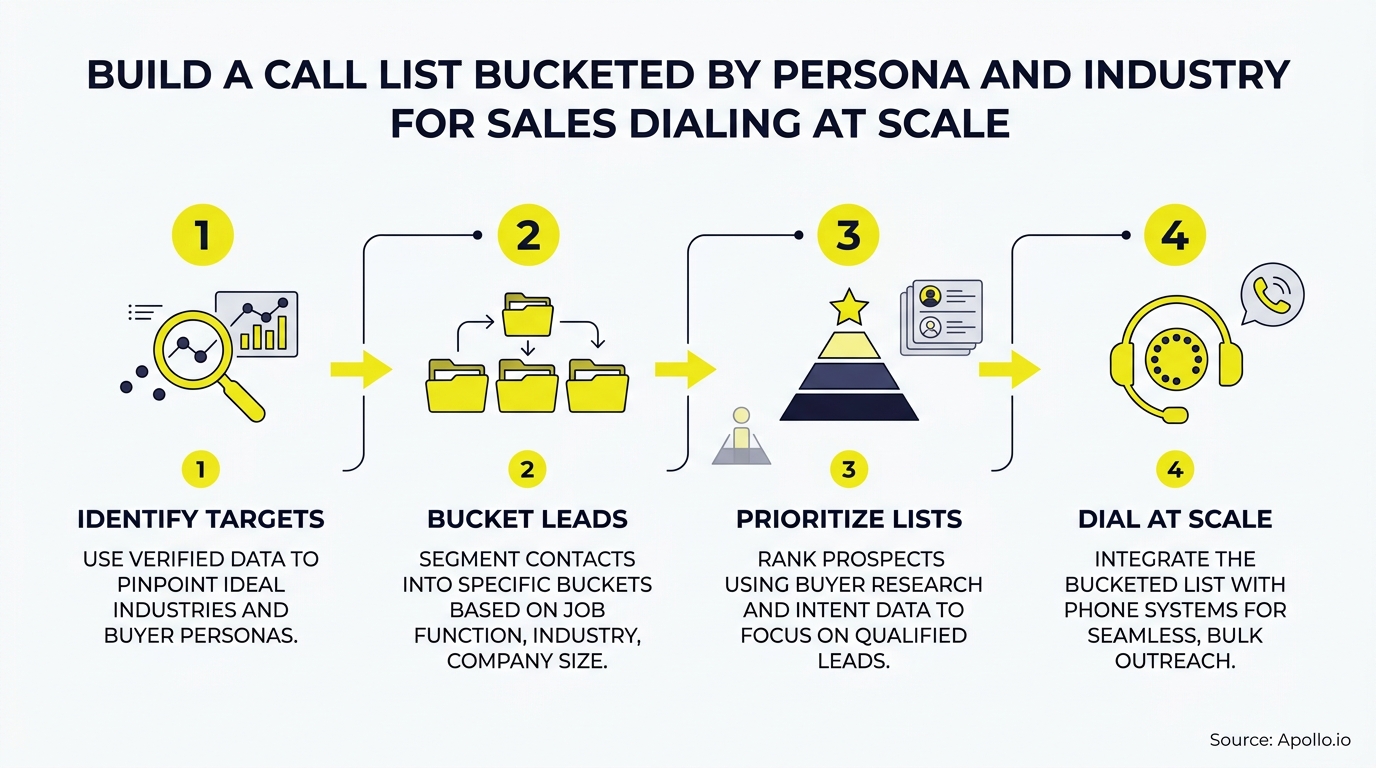
You build a bucketed call list by defining your industry and persona taxonomy first, then layering size, geography, and trigger filters before pulling contacts. Follow this sequence:
- Define industry verticals: Use NAICS codes or a simplified vertical list (SaaS, healthcare, financial services, manufacturing, professional services).
- Set company-size bands: Don't lump everything under "SMB." U.S. Census data shows roughly 73% of U.S. employer establishments have fewer than 10 employees, so a 1-9 band, a 10-49 band, and a 50-plus band behave very differently on a call.
- Map personas per account: Identify 3-5 roles per target account (economic buyer, technical evaluator, end user, influencer) rather than one presumed contact.
- Layer trigger events: Add signals like leadership changes, new funding, or hiring surges to prioritize which buckets get called first.
- Enrich and verify: Pull verified emails and direct dials before loading into the dialer. Apollo's data enrichment pulls current job titles, industry, and phone data before reps ever queue a call.
- Load into the dialer by bucket: Keep each persona/industry combination as its own queue so reps stay in one talk track per session.
Example Queue Matrix
| Bucket ID | Industry | Company Size | Persona | Trigger | Talk Track Focus |
|---|---|---|---|---|---|
| B1 | SaaS | 50-200 | VP Sales | New sales hire in 60 days | Ramp time / rep productivity |
| B2 | Healthcare | 10-49 | Office Manager | Recent compliance audit | Admin time reduction |
| B3 | Financial Services | 200+ | RevOps Lead | CRM migration announced | Data hygiene / integration |
| B4 | Manufacturing | 1-9 | Owner/Founder | Expansion into new region | Cost control at scale |
Why Should You Bucket by Buying Group Instead of a Single Persona?
Bucketing by buying group works better than targeting one presumed decision-maker because most B2B deals involve multiple stakeholders across departments. Forrester found an average of 13 people participate in a purchase and 89% of purchases involve at least two departments.
Overpersonalizing to one individual can actually backfire. Gartner's 2025 research found buying-group-relevant content improves consensus by 20%, while individual-only relevance has a 59% negative impact on consensus, and buyers who receive group-relevant messaging are three times more likely to report a high-quality deal.
The fix: build the bucket around industry plus a shared buying-group objective (e.g., "reduce onboarding time"), then vary the opening line by persona underneath that shared thesis.
This also matches what buyers say they want. According to SalesHive, 73% of B2B buyers actively avoid suppliers who send irrelevant outreach, which makes pre-call bucketing a brand-protection issue, not just a productivity one.
Know Which Leads Are Sales-Ready With Apollo
Pipeline forecasting a guessing game because half your leads never turn into real opportunities? Apollo scores and prioritizes prospects so reps chase buyers who are actually ready to talk. Built-In saw a 10% lift in win rate using Apollo's signals.
Schedule a Demo →How Do SDRs and AEs Use Bucketed Lists to Dial at Scale?
SDRs and AEs use bucketed lists by working one queue at a time so every call in a block shares context, instead of jumping between industries and roles call to call. This keeps the talk track sharp and cuts the mental switching cost that slows down high-volume calling days.
For SDRs, a bucketed queue means less time researching between dials and more time actually talking to prospects. Since Salesforce reports reps spend 70% of their time on nonselling work and only 20% actually on the phone, removing manual list assembly gives that time back directly to dialing.
For Account Executives managing multiple deals, persona buckets help with multithreading: instead of guessing who else to loop in on a stalled deal, the AE pulls the pre-mapped personas for that account's industry vertical and calls the buying-group gap directly. RevOps leaders find this also simplifies reporting, since performance rolls up by bucket instead of by messy individual lists.
Struggling to keep reps in the right queue without manual sorting? Apollo's sales engagement platform lets you build persistent, persona-based queues that stay updated automatically as new contacts match your filters.

How Can You Build a Bucketed Call List Directly Inside ChatGPT or Claude?
You can build a bucketed call list inside ChatGPT, Claude, Perplexity, or Codex by connecting Apollo MCP and asking for contacts that match your industry and persona filters, without switching to a separate tool. Apollo MCP brings live search, enrichment, and sequencing into the AI tool you're already working in.
Setup is no-code: connect Apollo through the AI tool's connectors or integrations panel via OAuth on any Apollo plan, including free. From there, a RevOps leader or founder can type a request like "find VP Finance contacts at healthcare companies with 50-200 employees that hired a new CFO in the last 90 days," and Apollo MCP returns a filtered, enrichable list in the same conversation.
Technical teams can run the same workflow from the terminal using the Apollo CLI.
From that same chat, you can enrich contacts with verified emails and phone numbers, push them into a sequence, or check how a previous bucket is performing, all without opening a new tab. Your best prospecting session shouldn't require opening a new tab.
What Compliance Checks Belong in Your Bucket-Building Workflow?
Compliance checks belong at the point of list creation, not after dialing starts, because DNC and consent rules apply per contact and per region. Build these gates into every bucket before it reaches a rep:
- DNC screening: Scrub every bucket against national and state Do Not Call registries before load-in.
- Time-zone and calling-window rules: Segment buckets by region so reps call within permitted hours automatically.
- Consent and opt-out history: Exclude contacts who previously opted out of any channel, not just phone.
- Rep-controlled dialing: Reps should select which numbers to call within an approved bucket; this keeps the workflow human-directed rather than automated dialing to unscreened numbers.
Building this into your enrichment and list-building step, rather than relying on reps to self-check, keeps every bucket audit-ready as it scales.
How Do You Test, Keep, Merge, or Retire a Call Bucket?
You test a call bucket by running it for 30 days against a small, fixed set of benchmarks, then keep, merge, or retire it based on connect and conversion data, not instinct. This turns list-building into a repeatable operating cadence instead of a one-time project.
| Decision | Trigger Condition | Action |
|---|---|---|
| Keep | Connect rate and meetings-set at or above team benchmark | Continue bucket, refresh contacts monthly |
| Merge | Two buckets show similar talk track performance and overlapping personas | Combine into one queue to simplify rep coverage |
| Retire | Below-benchmark connects after 30 days with no trend improvement | Pull contacts, reassign reps to higher-performing buckets |
For benchmarks, industry averages vary widely. SalesHive/Gong Labs data puts the average connect rate at 5.4% across 300 million calls, while top-quartile reps using tight ICP segments and weekly-refreshed mobile numbers hit 13.3%. Use your own team's historical numbers as the baseline, then track each bucket against it weekly, not just at the 30-day mark.
What Metrics Prove a Bucket Is Worth Scaling?
A bucket is worth scaling when its connect rate, meeting-set rate, and pipeline contribution consistently beat your team's rolling average across at least two review cycles. Track these four metrics per bucket:
- Connect rate: Percentage of dials that reach a live conversation.
- Meeting-set rate: Percentage of connects that convert to a booked meeting.
- Talk-track fit score: Rep-reported qualitative signal on whether the pitch matched the persona's actual pain point.
- Pipeline value per bucket: Revenue influenced, tracked back to the original industry/persona combination.
According to Outsales, top-quartile prospectors convert 52 out of every 100 target buyers into meetings, compared to 19 for average reps, a gap largely explained by tighter targeting rather than higher call volume. Buckets that show this kind of gap over your team average are strong candidates to scale to more reps.
Frequently Asked Questions
How Many Personas Should Be in One Call Bucket?
Map 3-5 personas per target account inside a bucket, reflecting the departments typically involved in that industry's buying process, rather than isolating a single contact.
Can You Build Dialer-Ready Lists Without Manual CSV Exports?
Yes. Platforms like Apollo let you filter by industry, persona, and company size, then push results directly into a dialer queue, removing the export-clean-import cycle entirely. Apollo's dialer software connects directly to filtered lists so reps start calling without a manual handoff.
How Does NAICS Targeting Improve Call List Quality?
NAICS codes classify companies by standardized industry categories, letting you build precise verticals (like "541511 - Custom Computer Programming Services") instead of vague buckets like "tech," which reduces mismatched talk tracks.
What's the Difference Between a Cold Call List and a Bucketed Call List?
A cold call list is typically a flat export sorted by one filter, like title or company size, while a bucketed list combines industry, persona, size, and trigger events so each queue shares a coherent context. See the difference between a hot call and a cold call for how warm signals change queue priority.

Build Your First Bucketed Call List Today
Bucketing by persona and industry turns a flat list into a repeatable system: reps stay in one talk track per session, RevOps gets bucket-level reporting instead of guesswork, and buying groups get relevant messaging instead of one-off pitches. The teams that win in 2026 aren't dialing more, they're dialing smarter segments.
Apollo brings B2B data, sales engagement, and AI-powered execution together in one connected go-to-market system, so teams don't have to stitch together separate vendors for research, outreach, and analysis. As Collin Stewart of Predictable Revenue put it, "We reduced the complexity of three tools into one."
Ready to stop building call lists by hand? Start Your Free Trial and build your first persona-and-industry bucketed call list in Apollo today.
Justify Spend With Apollo's Real Revenue Impact
Struggling to prove ROI before the budget review hits your desk? Apollo turns rep activity into measurable pipeline, so results show up in weeks, not next fiscal year. Leadium tripled annual revenue after automating outbound with Apollo.
Start Free with Apollo →Don't miss these
Sales
Inbound vs Outbound Marketing: Which Strategy Wins?
Sales
What Is a Sales Funnel? The Non-Linear Revenue Framework for 2026
Sales
What Is a Go-to-Market Strategy? The 2026 GTM Playbook
See Apollo in action
We'd love to show how Apollo can help you sell better.
By submitting this form, you will receive information, tips, and promotions from Apollo. To learn more, see our Privacy Statement.
4.7/5 based on 9,690 reviews
