
Why Are Revenue Teams Starting to Adopt AI Agents for Go-to-Market Execution in 2026?
AI agents have crossed from experiment to execution layer. Revenue teams are adopting them because the data is unambiguous: sellers who effectively partner with AI are 3.7 times more likely to meet quota, according to a Gartner survey of 1,026 B2B sellers.
The question is no longer whether to adopt AI agents for GTM execution. It's how fast you can move before your competitors do.
The shift is structural. According to Salesforce research, 83% of sales teams using AI saw revenue growth in the past year, versus 66% of teams not using AI. If you're building or scaling a revenue operations framework, AI agents are now a core component, not a nice-to-have.

Let Apollo Find Contacts Instantly
Tired of your reps burning hours on manual research instead of selling? Apollo surfaces verified contacts automatically, so your team spends time closing — not digging. Join 600K+ companies building pipeline faster.
Start Free with Apollo →Key Takeaways
- Sellers who partner with AI are significantly more likely to hit quota, making agent adoption a competitive performance driver, not just a productivity experiment.
- AI agents differ from copilots: they take autonomous actions (route leads, send sequences, update CRM) rather than just surfacing suggestions.
- SDRs and RevOps leaders see the fastest time-to-value from agents, particularly in prospecting, follow-up coverage, and pipeline hygiene.
- Governance matters more than speed: Gartner warns over 40% of agentic AI projects may be canceled by end of 2027, primarily due to poor governance and unclear ROI.
- The winning pattern is consolidation: agents embedded in unified platforms outperform bolt-on point tools with fragile integrations.
What Are AI Agents for GTM Execution, and How Do They Differ from Copilots?
AI agents for GTM execution are software systems that autonomously complete multi-step tasks across your sales and marketing workflows, without waiting for a human prompt at each step. A copilot suggests the next email.
An agent writes it, sends it, logs the activity in your CRM, and triggers the next step in the sequence based on the prospect's response.
The distinction matters practically. Copilots assist; agents execute.
This is why major platforms are racing to embed agents directly into systems of record. Salesforce's Agentforce turns the CRM into an always-on execution layer.
Microsoft's Sales Development Agent automates lead research and outreach across Dynamics and Salesforce simultaneously. The friction of adoption drops when agents live inside tools your team already uses.
| Capability | Copilot (Assistant) | GTM Execution Agent |
|---|---|---|
| Primary function | Suggest, summarize, draft | Route, sequence, update, follow up |
| Human trigger required? | Yes, every step | No, operates on defined rules |
| CRM write-back | Manual copy-paste | Automated, structured logging |
| Best for | Individual rep productivity | Team-wide pipeline coverage |
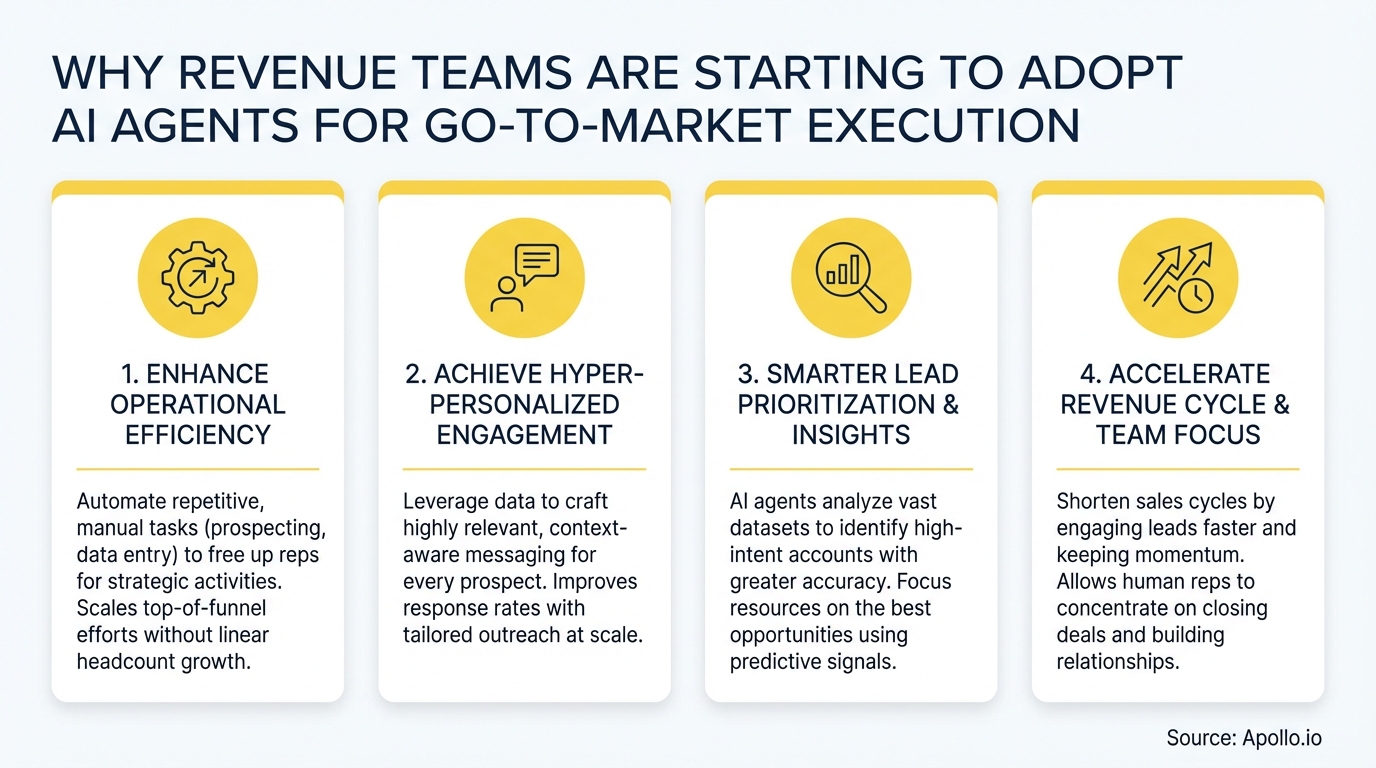
Why Are Revenue Teams Adopting AI Agents Now, Specifically?
Three forces converged in 2025 and 2026 to make AI agent adoption urgent rather than optional.
1. The headcount gap is permanent.
GTM teams are being asked to cover more pipeline with the same or smaller headcount. Always-on follow-up, inbound qualification, and long-tail lead coverage cannot be handled by humans at the required SLA.
Agents fill the gap without adding headcount costs.
2. Adoption is already mainstream. Data from Optif.ai shows 89% of revenue organizations were using AI-powered tools in 2025, up from 34% in 2023. Teams that delay are no longer "cautious"; they're competitively exposed. According to Azumo, 62% of organizations were at least experimenting with AI agents in 2025, with 23% actively scaling agentic AI in at least one business function.
3. The ecosystem is ready.
Gartner projects that task-specific AI agents will be embedded in 40% of enterprise applications by end of 2026, up from less than 5% in 2025. The infrastructure to deploy agents safely, inside your CRM, engagement platform, and data layer, now exists at scale.
Spending hours on manual prospecting and follow-up? Automate your GTM workflows with Apollo's AI sales automation.
How Do SDRs and RevOps Leaders Actually Use AI Agents Day-to-Day?
SDRs see the fastest and most measurable impact from agents in three areas: prospect research, sequence personalization, and follow-up coverage. Agents can research a prospect's business context, draft a tailored first-touch email, and enroll the contact in the right sequence, all before the SDR's first coffee.
This directly addresses the capacity constraint that keeps SDRs from hitting activity targets.
RevOps leaders use agents differently. Their priority is pipeline hygiene, CRM data accuracy, and workflow governance. Agents that automatically log call outcomes, update deal stages based on email engagement, and flag stale opportunities give RevOps a clean, real-time data layer without relying on rep discipline. This supports better forecasting accuracy and removes the manual reconciliation work that consumes RevOps bandwidth.
- SDRs: Automated prospect research, sequence enrollment, meeting scheduling, follow-up at scale
- AEs: Pre-meeting intelligence briefs, deal risk alerts, next-best-action recommendations
- RevOps: CRM write-back, pipeline hygiene, workflow routing, attribution reporting
- Sales Leaders: Coaching signals from call data, quota pacing alerts, team performance dashboards
Struggling to keep your pipeline data clean without manual effort? See how Apollo's pipeline tools give RevOps a single source of truth.
Fill Your Funnel With Buyers Who Convert
Running out of qualified leads while your outreach response rates keep dropping? Apollo surfaces in-market prospects at the right moment, so your pipeline fills with opportunities that actually close. Nearly 100K paying customers have made the switch.
Start Free with Apollo →What Is the GTM Agent Maturity Model?
GTM agent maturity follows a three-stage progression, and most teams in 2026 sit at Stage 1 or early Stage 2. Understanding where you are determines which use cases to prioritize and which governance structures to put in place first.
| Stage | Label | What It Looks Like | Key Metric |
|---|---|---|---|
| 1 | Assisted | AI drafts emails, summarizes calls, reps review before sending | Time saved per rep per week |
| 2 | Task-Specific Agents | Agents enroll contacts in sequences, log CRM updates, qualify inbound leads autonomously | Meetings booked, pipeline created |
| 3 | Orchestrated Agents | Multi-agent workflows span prospecting, engagement, routing, and CRM, with human review at defined checkpoints | Quota attainment, cycle time, win rate |
Most teams should start at Stage 2 with a single, narrow use case: inbound lead qualification or outbound follow-up coverage. Governance structures, audit logs, and human-in-the-loop thresholds should be defined before scaling to Stage 3.
This approach reduces the risk of falling into the category Gartner identifies as likely to cancel agentic AI projects by end of 2027 due to governance failure.
For practical guidance on building the tech stack that supports this progression, see Apollo's playbook for building a sales tech stack that scales revenue.

How Do You Govern AI Agents in GTM Without Slowing Execution?
Governance for GTM AI agents means defining rules for what agents can do autonomously, what requires human approval, and how every agent action is logged and auditable. Without this, agents create compliance risk, data quality problems, and rep distrust.
Four governance principles that work in practice:
- Narrow the first use case. Start with one workflow (e.g., inbound lead response) before expanding to multi-step outbound sequences.
- Define CRM write-back rules explicitly. Specify what fields agents can update, which require human confirmation, and how conflicts are resolved.
- Set human-in-the-loop thresholds. High-value accounts, existing customers, and late-stage deals should always require rep review before agent-initiated contact.
- Build audit logs into the workflow. Every agent action should be timestamped, attributed, and reviewable by RevOps without requiring a technical investigation.
Teams that treat governance as a pre-launch checklist, rather than an afterthought, are the ones that sustain agent adoption at scale. This connects directly to how cross-functional GTM teams maintain alignment when AI takes on execution tasks previously owned by humans.
What Results Are Revenue Teams Seeing from AI Agent Adoption?
The business case for AI agents in GTM is increasingly concrete. Apollo's own AI platform has seen 500% year-over-year growth, with teams using Apollo's AI Research Agent booking 46% more meetings. Customers report consolidation benefits that extend beyond productivity: "Having everything in one system was a game changer," noted the team at Cyera, while Predictable Revenue found they could reduce the complexity of three tools into one.
Broader market data reinforces the pattern. Research from Digital Clarity shows early AI adopters report 30-50% productivity gains in marketing functions. Teams that consolidate their agent capabilities inside a unified GTM platform, rather than stitching together point tools, consistently outperform those managing fragmented agent ecosystems. For a deeper look at how sales automation software drives revenue, the pattern is the same: consolidation beats complexity.
How Do You Start Adopting AI Agents for GTM Execution in 2026?
The fastest path to GTM agent ROI follows a four-step sequence that prioritizes narrow wins over broad transformation.
- Identify one high-volume, repetitive workflow where agent failure is low-risk (e.g., inbound lead acknowledgment, follow-up after no-reply).
- Select a platform with agents embedded in your existing data layer. Agents that operate inside your CRM and engagement platform produce cleaner data and require fewer integrations. Review how top enterprise sales solutions are embedding agentic capabilities in 2026.
- Define your success metric before launch. Meetings booked, response rate, pipeline created per agent-enrolled contact. Measure against a pre-agent baseline.
- Expand based on data, not enthusiasm. Stage 2 to Stage 3 expansion should be triggered by measurable Stage 2 success, not by vendor pressure or internal hype cycles.
Apollo's workflow automation engine lets GTM teams deploy task-specific agents across prospecting, outreach, and pipeline management from a single platform, reducing the integration complexity that causes most agentic AI projects to stall.

Conclusion: The Agent Gap Is Becoming a Revenue Gap
Revenue teams are adopting AI agents for GTM execution because the performance gap between agent-enabled and non-enabled teams is now measurable and growing. The sellers, SDRs, and RevOps leaders who operationalize agents in 2026 will build structural advantages in pipeline coverage, speed-to-lead, and quota attainment that compound over time.
The risk is not moving too fast. It's running fragmented point tools with no governance and calling it an AI strategy.
The teams winning this transition are consolidating: fewer vendors, agents that live inside their data, and clear ROI metrics from day one.
Apollo gives B2B GTM teams a unified platform where AI agents operate across prospecting, engagement, enrichment, and pipeline management in one workspace. "We cut our costs in half," said the team at Census after consolidating onto Apollo. Ready to see what AI-powered GTM execution looks like for your team? Request a Demo.
Prove Pipeline ROI With Apollo
ROI pressure killing your tool budget? Apollo delivers measurable pipeline outcomes your exec team can see — not just promises. Leadium 3x'd their annual revenue after making the switch.
Start Free with Apollo →Don't miss these
Sales
Inbound vs Outbound Marketing: Which Strategy Wins?
Sales
What Is a Sales Funnel? The Non-Linear Revenue Framework for 2026
Sales
What Is a Go-to-Market Strategy? The 2026 GTM Playbook
See Apollo in action
We'd love to show how Apollo can help you sell better.
By submitting this form, you will receive information, tips, and promotions from Apollo. To learn more, see our Privacy Statement.
4.7/5 based on 9,690 reviews
