
Who Owns Outbound Sales Tooling Decisions: Sales Ops or Sales Leadership?
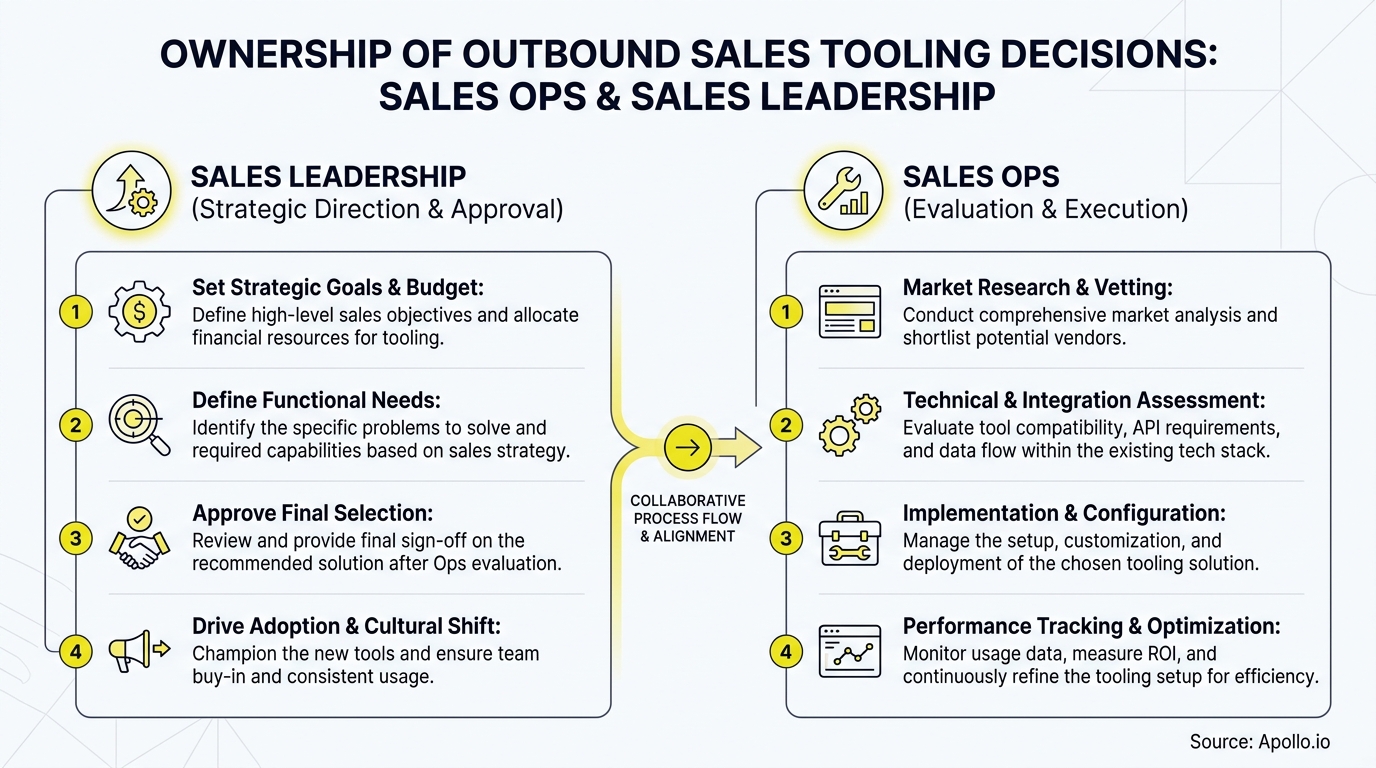
The answer isn't one or the other. Outbound sales tooling decisions work best under a shared model: Sales Ops (or RevOps) owns governance, integration, and measurement, while Sales Leadership owns adoption, targets, and business outcomes. Confusion between these two roles is exactly why so many outbound sales software investments underperform after purchase.
With AI-powered tools reshaping outbound workflows in 2026, the stakes of getting this ownership model right have never been higher. Tool sprawl, misaligned incentives, and shadow IT purchases are costing GTM teams productivity and budget.

Let Apollo Find Your Next Buyer
Tired of burning hours verifying contact info that goes nowhere? Apollo surfaces accurate, ready-to-contact prospects so your team sells instead of searches. Join 600K+ companies building pipeline faster.
Start Free with Apollo →Key Takeaways
- Sales Ops or RevOps should own tooling governance, data standards, CRM integration, and ROI measurement for outbound tools.
- Sales Leadership serves as the business sponsor: setting adoption goals, coaching reps, and validating that tools serve pipeline targets.
- Frontline managers and BDR/SDR managers rarely own tooling decisions — data confirms this is a senior function.
- AI-powered outbound tools increase governance complexity, making the RevOps + IT + Sales Leadership triad essential.
- Platform consolidation — replacing multiple point tools with one unified GTM platform — is the fastest path to both AI readiness and cost reduction.
Why Does Outbound Tooling Ownership Matter in 2026?
Outbound tooling ownership matters because ungoverned purchasing creates tool sprawl, integration debt, and inconsistent rep behavior. According to a State of Sales Development report, only approximately 9% of respondents stated that associates or BDR/SDR managers are responsible for choosing their teams' technology. That means tooling ownership is overwhelmingly a senior function, not a frontline one.
The pressure to consolidate is real. When teams run separate tools for prospecting, sequencing, calling, and analytics, RevOps leaders spend more time managing integrations than improving pipeline. That's a solvable problem — but only when ownership is clearly defined. Explore how building a sales tech stack that scales revenue requires deliberate governance from the start.
What Is the Right RACI for Outbound Sales Tooling Decisions?
The correct RACI assigns Sales Ops or RevOps as the Responsible party for outbound tooling governance, with Sales Leadership as the Accountable executive sponsor. This distinction prevents both shadow IT (reps buying unapproved tools) and top-down mandates that ignore operational feasibility.
| Decision Area | Sales Ops / RevOps | Sales Leadership (CRO/VP) | IT | SDR/BDR Managers |
|---|---|---|---|---|
| Tool evaluation and shortlisting | Responsible | Consulted | Consulted | Informed |
| Budget approval | Consulted | Accountable | Informed | Informed |
| CRM and data integration | Responsible | Informed | Accountable | Informed |
| Adoption targets and coaching | Consulted | Responsible | Informed | Responsible |
| ROI measurement and reporting | Responsible | Accountable | Informed | Informed |
| AI governance and compliance | Responsible | Consulted | Accountable | Informed |
As noted by Revenue.io, Sales Ops teams are increasingly involved in managing CRM systems, refining sales processes, ensuring accurate reporting, and making technology decisions. This aligns directly with the Responsible column above.
Turn Funnel Guesswork Into Pipeline Wins
Tired of watching marketing leads stall before they ever reach your pipeline? Apollo surfaces in-market buyers with the signals your team needs to act first. Nearly 100K paying customers stopped guessing and started closing.
Schedule a Demo →How Do Sales Ops and RevOps Differ in Tooling Ownership?
Sales Ops typically governs tools within the sales function, while RevOps governs tools across marketing, sales, and customer success. For outbound tooling, the practical difference is scope: RevOps-led organizations apply cross-functional data standards and integration requirements that Sales Ops-only teams may miss.
According to Binarystream, RevOps professionals play a crucial role in integrating data, technology, and processes across the entire customer lifecycle, including sales tooling decisions. This makes RevOps the stronger structural owner for outbound tools that touch prospect data, sequences, and pipeline attribution.
For teams building or improving this function, the guide on improving sales efficiency with RevOps outlines the operational levers RevOps controls directly.
How Should RevOps Leaders and Sales Leaders Collaborate on Tool Selection?
RevOps leaders and Sales Leaders should follow a three-gate process: needs validation, technical governance, and adoption planning. Each gate has a clear owner to prevent decision paralysis.
- Gate 1 — Needs Validation (Sales Leadership leads): Define the pipeline problem the tool must solve. Quantify the gap using sales analytics before evaluating any vendor.
- Gate 2 — Technical Governance (RevOps + IT leads): Evaluate CRM compatibility, data hygiene impact, integration overhead, and security requirements. Reject tools that create new integration debt.
- Gate 3 — Adoption Planning (Sales Leadership + SDR/BDR Managers lead): Set rep-level adoption KPIs, build ramp plans, and assign coaching accountability before contract signature.
Sales leaders are expected to evaluate AI tools for automation and ROI integration into workflows, according to Kapable. The three-gate model ensures that expectation is met systematically, not reactively.
Spending too much time evaluating disconnected point tools? See how Apollo's unified sales engagement platform eliminates the integration overhead of managing separate outreach, sequencing, and dialer tools.

What Is the Triad Governance Model for Outbound Tooling?
The triad governance model assigns three distinct roles: RevOps as System Owner, IT as Security and Integration Owner, and Sales Leadership as Business Sponsor. This model is becoming the standard as AI-powered outbound tools introduce compliance, data handling, and auditability requirements that no single team can manage alone.
The triad matters most for AI-native tools. When an AI agent sends outbound sequences, makes calls, or enriches contact records autonomously, accountability for errors, data use, and messaging policy must be explicit.
RevOps owns the configuration and audit trail. IT owns access controls and data security.
Sales Leadership owns whether the outputs serve revenue goals.
This structure also supports sales transformation initiatives where outbound tools are being upgraded or consolidated. Without the triad, transformation projects stall at the integration or adoption stage.
How Does Tool Consolidation Change Who Owns Outbound Tooling?
Platform consolidation shifts ownership decisively toward RevOps, because a single integrated platform requires one governance model rather than multiple vendor relationships. When outbound teams run separate tools for data, sequencing, calling, and reporting, ownership fragments across whoever bought each tool.
Consolidating onto one GTM platform resolves this. As Cyera put it, "Having everything in one system was a game changer." Predictable Revenue reported, "We reduced the complexity of three tools into one." These outcomes are only achievable when RevOps owns the consolidation decision with Sales Leadership's full support.
The sales performance management strategy required to justify consolidation should be driven by RevOps measurement capabilities, not anecdote. RevOps should quantify the current cost of integration maintenance, data inconsistencies, and rep context-switching before presenting a consolidation business case.
Managing too many tools across your outbound stack? Apollo's all-in-one GTM platform gives RevOps a single system to govern and Sales Leaders a single source of truth for outbound performance.
What Should RevOps Leaders Do Next to Own Outbound Tooling Governance?
RevOps leaders should start by auditing their current outbound tech stack, mapping each tool to a business owner, and identifying integration gaps or duplicate capabilities. The goal is a single governed stack with clear accountability at every layer.
Use this checklist to begin:
- List every active outbound tool and its current owner (who bought it, who pays for it, who manages it).
- Map each tool to a specific pipeline metric it is accountable for improving.
- Identify tools with overlapping functionality and flag them for consolidation review.
- Assign formal RACI roles using the framework above before renewing any annual contract.
- Establish a quarterly governance cadence: RevOps reviews adoption data, Sales Leadership reviews pipeline impact, IT reviews integration health.
- Build an AI governance policy before deploying any agentic outbound tool.
For SDRs and BDRs, the practical impact of strong governance is fewer tool switches, cleaner data, and better outbound sequences that actually reach the right prospects. When RevOps owns the stack, frontline reps spend more time selling and less time navigating broken integrations.
Sales Leaders looking to build governance competency can start with the frameworks in essential sales leadership resources and combine them with a structured outbound sales resource kit to align tooling decisions with execution strategy.

Conclusion: Stop Debating Ownership — Assign It
Outbound sales tooling decisions belong to both Sales Ops/RevOps and Sales Leadership, with clearly distinct roles. RevOps governs.
Sales Leadership sponsors. IT secures.
Frontline managers execute. When these roles blur, tooling investments underperform regardless of how good the software is.
The teams winning with outbound in 2026 are not the ones with the most tools. They are the ones with a governed, consolidated stack and explicit accountability at every decision gate.
Apollo gives RevOps leaders a single platform to govern and Sales Leaders a clear view of outbound ROI — from prospecting through pipeline.
Schedule a Demo to see how Apollo consolidates your outbound tech stack into one governed, AI-powered GTM platform.
Prove Pipeline ROI Before Next QBR
ROI pressure killing your tool budget? Apollo delivers measurable pipeline impact fast — 46% more meetings with AI Research Agent. Nearly 100K paying customers justified the spend. Start yours today.
Start Free with Apollo →Don't miss these
Sales
Inbound vs Outbound Marketing: Which Strategy Wins?
Sales
What Is a Sales Funnel? The Non-Linear Revenue Framework for 2026
Sales
What Is a Go-to-Market Strategy? The 2026 GTM Playbook
See Apollo in action
We'd love to show how Apollo can help you sell better.
By submitting this form, you will receive information, tips, and promotions from Apollo. To learn more, see our Privacy Statement.
4.7/5 based on 9,690 reviews
