
What Is the Ideal Team Structure for a Company Running an Agentic GTM Motion?
The ideal agentic GTM team structure combines human strategists, AI governance owners, and agent operators organized into cross-functional revenue pods. Most companies get this wrong by treating AI as a tool layer rather than a structural layer.
The result: agents that drift, content that fails QA, and pipeline that stalls. Before you hire another SDR, consider whether your next GTM hire should be an AgentOps Lead instead.
Understanding how to structure a marketing team for revenue has always mattered, but in 2026 the rules have changed. According to Convince & Convert, while 75% of GTM teams have access to AI, only 29% of GTM leaders report using it to a great extent, revealing a massive execution gap that team design must close.

Clean Data, Real Connections With Apollo
Tired of bounced emails and wrong numbers killing your outreach? Apollo delivers 97% email accuracy so every rep hits real prospects, not dead ends. Join 600K+ companies building pipeline on data that actually works.
Start Free with Apollo →Key Takeaways
- Agentic GTM requires a governance layer built into the org chart, not bolted on later.
- The most effective structure uses human-plus-agent pods, where one operator supervises multiple specialized agents handling research, personalization, and CRM hygiene.
- RevOps owns the agentic OS: data quality, workflow governance, and agent lifecycle management.
- Poor data quality is the top reason AI initiatives fail, making data infrastructure a prerequisite, not a nice-to-have.
- Buying-group content architecture matters more than volume: buyers increasingly prefer self-directed journeys, so content ops must serve them without rep assistance.
Why Does Agentic GTM Require a Governance-First Team Design?
Agentic GTM requires governance-first design because autonomous agents take actions on behalf of your brand, and without oversight structures, errors compound at machine speed. Research from The Spot for Pardot found that 87% of AI project failures point back to poor data quality. That means before agents can execute, your data foundation must be clean and your guardrails must be live.
The emerging function here is AgentOps: a dedicated role (often within RevOps or Marketing Ops) responsible for agent versioning, prompt governance, approval workflows, drift monitoring, and incident response. This mirrors how engineering teams run DevOps. Without an AgentOps owner, agents run unsupervised, brand voice erodes, and compliance risk grows. Governance is not overhead. It is the operating system for the entire motion.
What Are the Three Maturity Stages for an Agentic GTM Team?
Agentic GTM teams evolve through three stages: Pilot, Production, and Platform. Each stage requires different headcount, governance depth, and tooling integration.
| Stage | Focus | Core Roles | Governance Depth |
|---|---|---|---|
| Pilot | Prove value in one workflow | AgentOps Lead, 1–2 SDRs/AEs, RevOps analyst | Manual QA, lightweight SLAs |
| Production | Scale proven agents across GTM | AgentOps Lead, Content Ops Manager, Data Engineer, Sales Pod Leads | Automated QA gates, SME review lanes |
| Platform | Company-wide agentic operating model | Head of GTM AI, AgentOps team, cross-functional pod leads, Security/IT partner | Full audit trails, access controls, citation standards |
Magnify notes that by 2026, the most successful companies will scale revenue through AI-powered systems rather than increasing headcount alone. That insight defines the Platform stage: the org shrinks in raw headcount but expands in output through agent leverage.
What Does the Ideal Agentic GTM Team Structure Look Like?
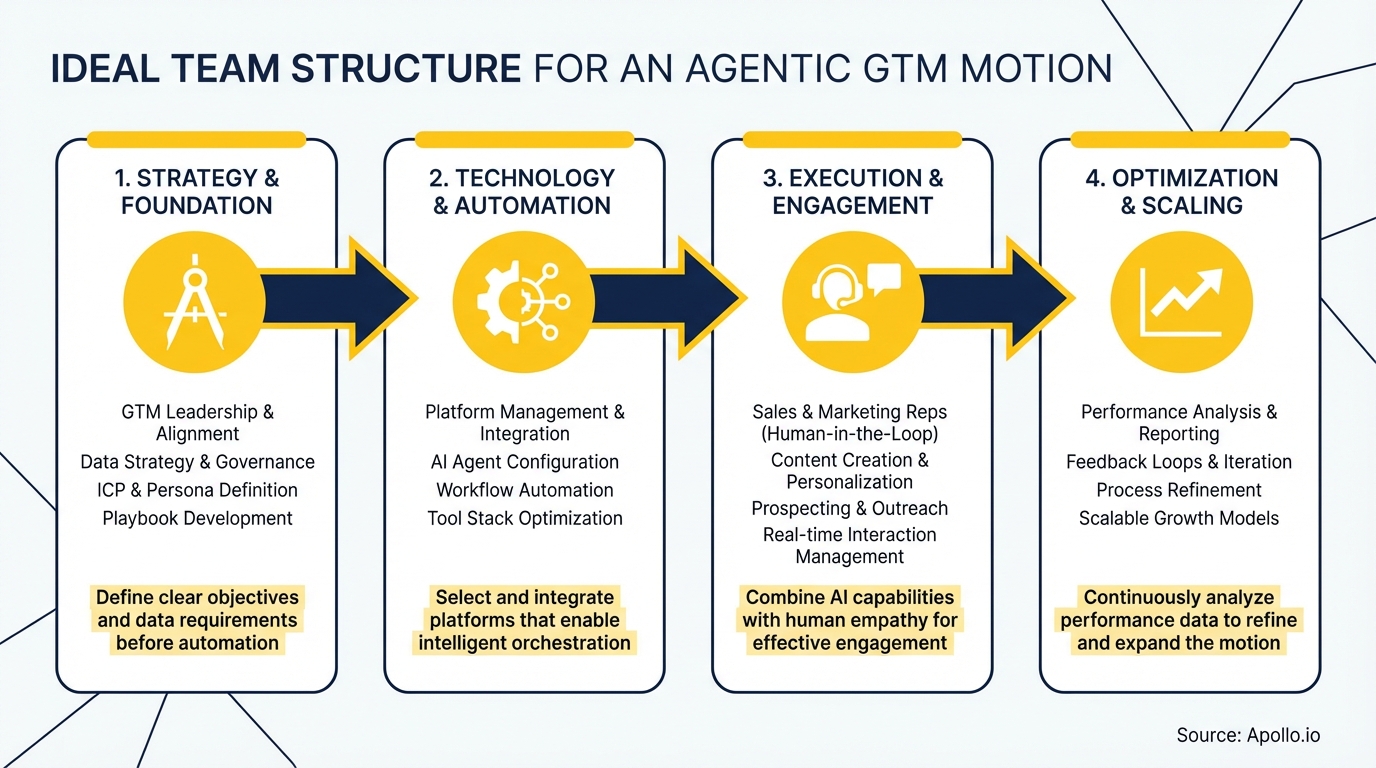
The ideal structure organizes GTM around human-plus-agent revenue pods, with RevOps as the central nervous system. Each pod contains a human operator who supervises specialized agents covering research, personalization, follow-up sequencing, and CRM hygiene.
Struggling to keep your pipeline healthy while agents handle outreach? Build and qualify pipeline with Apollo's unified GTM platform.
Key roles in a Production-stage agentic GTM team:
- AgentOps Lead (RevOps): Owns agent lifecycle, prompt versioning, QA SLAs, and incident response.
- Revenue Pod Leads (AEs/SDRs): Supervise agent clusters handling research and outreach; focus human time on discovery, multi-threading, and negotiation.
- Content Ops Manager: Manages intake-to-distribution workflow, brand voice enforcement, and knowledge-base updates.
- Data Engineer: Builds and maintains data pipelines feeding agents with clean, verified contact and account data.
- Buyer Enablement Specialist: Creates stakeholder packs, objection modules, and ROI proof assets for rep-free buying journeys.
Research from Deloitte confirms that teams reporting the strongest AI outcomes are not the smallest: they are highly connected and cognitively diverse. Cognitive diversity across Sales, Marketing, RevOps, and IT is not optional in this model.
For a deeper look at how cross-functional design enables this, see how to build and lead cross-functional teams for results.

How Do SDRs and AEs Operate Inside an Agentic GTM Motion?
SDRs and AEs in an agentic GTM motion shift from execution roles to operator roles: they direct agents, review outputs, and own the high-judgment moments that agents cannot handle. Research, initial personalization, follow-up cadences, and CRM updates move to agents.
SDRs own first discovery calls, qualification judgment, and escalation decisions. AEs own multi-stakeholder navigation, negotiation, and deal strategy.
This changes what RevOps leaders must measure. Pipeline quality, agent accuracy rates, and human-touch conversion ratios replace raw activity metrics. For AEs, forecasting accuracy becomes more achievable because agents produce cleaner, more consistent data inputs.
Spending hours on manual outreach while competitors run automated sequences? Automate your GTM workflows with Apollo's AI sales automation.
Turn Funnel Guesswork Into Closed Deals
Pipeline forecasting a guessing game because quality leads never make it past the top of the funnel? Apollo surfaces in-market buyers with precision targeting so every rep works pipeline that actually converts. Join 600K+ companies forecasting with confidence.
Start Free with Apollo →What Content Operations Workflow Supports an Agentic GTM Team?
A content ops workflow for agentic GTM runs from intake through distribution with explicit QA gates and a shared knowledge base that agents query in real time. The workflow has five stages: Brief, Produce, QA, Approve, Distribute.
- Brief: ICP signal or campaign trigger initiates a structured content request with buyer context and ICP parameters.
- Produce: AI agent drafts against brand voice guidelines and pulls verified data from the knowledge base.
- QA: Automated checks for hallucinations, citation accuracy, and compliance triggers; flagged content routes to SME review.
- Approve: AgentOps Lead or Content Ops Manager signs off before distribution.
- Distribute: Content routes to the correct channel (email sequence, sales asset, web page) with tracking tags active.
This structure directly addresses the trust gap. The Landbase data showing 96% of organizations plan to expand agentic AI usage in 2026 signals that the volume of agent-produced content will grow significantly, making QA gates non-negotiable rather than optional.
How Should the Team Architect Content for Rep-Free Buying Journeys?
Content for rep-free buying journeys must be organized by buying group role, not by funnel stage. Each stakeholder in a buying committee needs a self-contained information pack that answers their specific concerns without requiring a sales rep to bridge gaps. See what has changed in the B2B buyer journey in 2026 for context on how buyer behavior has shifted.
A practical buying-group content architecture includes:
- Champion Pack: Technical specs, integration evidence, implementation timelines.
- Economic Buyer Pack: ROI models, total cost of ownership, competitive differentiation.
- End User Pack: Workflow impact, ease-of-adoption materials, quick-start guides.
- Objection Modules: Pre-built responses to the top objections by role, enabling agents to surface relevant answers dynamically. See sales objection handling frameworks for templates.
The Buyer Enablement Specialist owns this architecture. Their output feeds both human reps and agents, ensuring consistent messaging regardless of how a prospect chooses to engage.
How Do RevOps Leaders Measure an Agentic GTM Team's Performance?
RevOps leaders measure agentic GTM performance across three dimensions: agent output quality, pipeline velocity, and human-to-agent handoff efficiency. Raw activity volume is no longer a primary metric.
| Dimension | Key Metrics | Owner |
|---|---|---|
| Agent Output Quality | QA pass rate, hallucination rate, brand voice score | AgentOps Lead |
| Pipeline Velocity | Stage conversion rate, cycle time, CAC | Revenue Pod Leads |
| Handoff Efficiency | Agent-to-human escalation rate, response latency, meeting-set rate | RevOps |
Data quality underpins all three dimensions. Per Infuse, 42% of GTM teams cite data quality and technology gaps as barriers to executing marketing strategies. Investing in a scalable sales tech stack with verified data at its core is what separates teams that measure outcomes from those still measuring inputs.

How Should You Build Your Agentic GTM Team in 2026?
The agentic GTM team structure that wins in 2026 is governance-first, pod-organized, and data-grounded. Start by appointing an AgentOps Lead before you deploy your first agent.
Move from Pilot to Production by proving a single workflow, then expand horizontally across pods. Prioritize data quality as a prerequisite, not an afterthought.
Apollo's all-in-one GTM platform consolidates the prospecting, engagement, enrichment, and pipeline tools your agentic team needs into a single workspace. "Having everything in one system was a game changer," noted the team at Cyera. When your agents, reps, and RevOps leaders share one system of record, governance becomes faster and pipeline becomes more predictable.
Ready to build your agentic GTM motion on a unified platform? Start prospecting with Apollo for free and see how 600K+ companies run their go-to-market from one place.
Apollo Turns Pipeline Into Proof
ROI pressure killing your next tool renewal? Apollo delivers measurable pipeline impact from day one — no guesswork, no waiting. Leadium 3x'd annual revenue. Start yours today.
Start Free with Apollo →Don't miss these
Sales
Inbound vs Outbound Marketing: Which Strategy Wins?
Sales
What Is a Sales Funnel? The Non-Linear Revenue Framework for 2026
Sales
What Is a Go-to-Market Strategy? The 2026 GTM Playbook
See Apollo in action
We'd love to show how Apollo can help you sell better.
By submitting this form, you will receive information, tips, and promotions from Apollo. To learn more, see our Privacy Statement.
4.7/5 based on 9,690 reviews
