
What Is an AI Agent in Sales and Revenue Operations?
AI agents are reshaping how B2B GTM teams operate, moving well beyond chatbots and copilots into systems that take action across your entire revenue stack. If you're building or refining your revenue operations strategy in 2026, understanding what AI agents actually do, and how they differ from simpler automation, is now a baseline requirement.
According to Salesforce, an AI agent in sales is an AI-powered tool designed to automate and enhance sales-related tasks in real-time, often with little to no human input. That definition matters: agents don't just generate content, they execute decisions across systems.

Let Apollo Do The Research For You
Tired of your reps burning hours on manual data entry instead of selling? Apollo surfaces verified contacts instantly so your team spends time closing, not digging. Join 600K+ companies building pipeline on autopilot.
Start Free with Apollo →Key Takeaways
- AI agents in sales execute multi-step workflows autonomously, unlike copilots that only assist with single tasks.
- The biggest RevOps ROI from agents comes from automating CRM updates, routing, follow-ups, and approval workflows, not just email personalization.
- Governance, audit trails, and data quality are prerequisites before deploying agents on revenue-critical systems like pipeline and pricing.
- SDRs, AEs, and RevOps leaders each unlock distinct value from agents when mapped to their specific workflow bottlenecks.
- Apollo's unified platform gives GTM teams a single workspace where AI automation, prospecting, engagement, and deal management connect without added tools.
What Is an AI Agent in Sales and Revenue Operations?
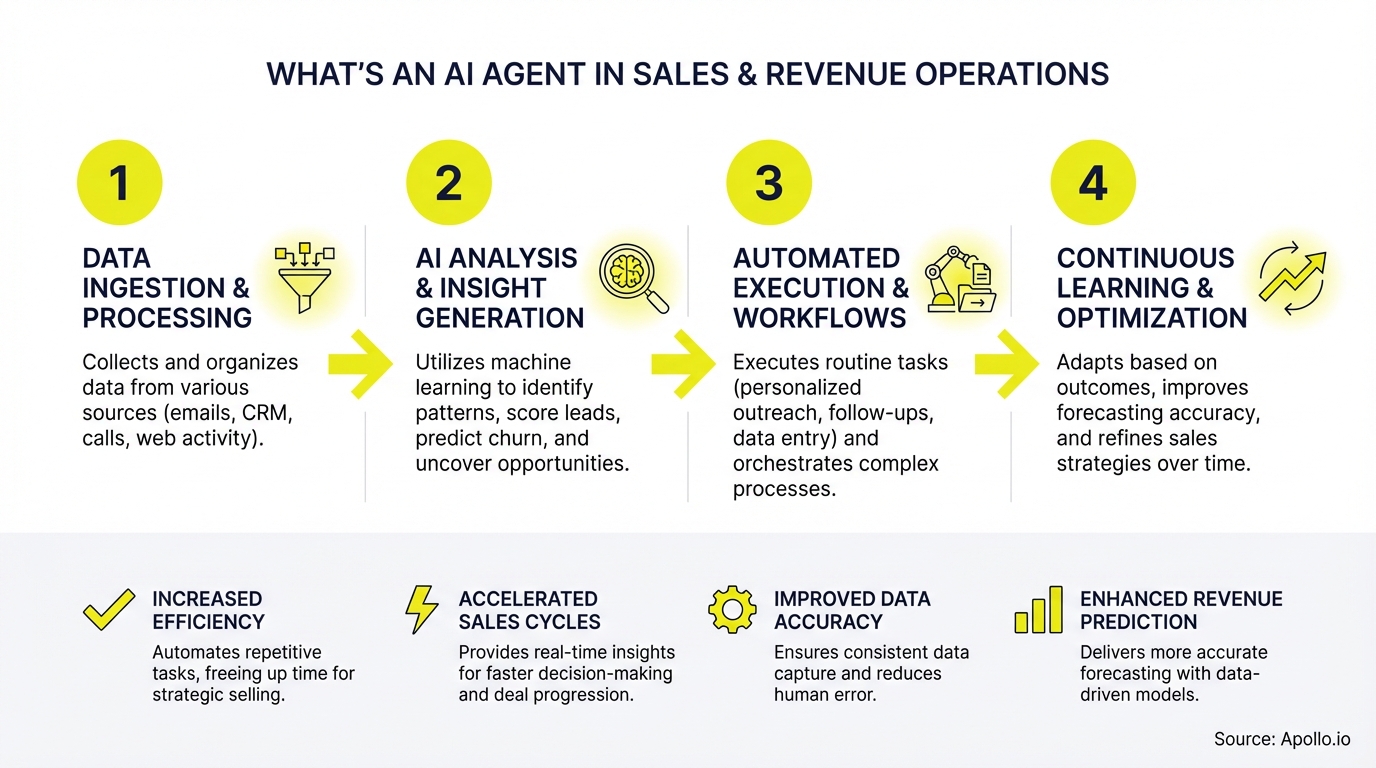
An AI agent in sales and revenue operations is an autonomous software system that perceives context, makes decisions, and executes multi-step actions across connected tools, with or without a human approving each step. It is not a chatbot (reactive, single-turn) and not a copilot (suggests, but waits for a human to act).
An agent closes the loop by acting.
Practical examples of agent actions in a RevOps context:
- Enriching and routing a new inbound lead in the CRM within seconds of form submission
- Triggering a personalized outreach sequence when a prospect hits a behavioral signal
- Updating opportunity fields, next steps, and forecast categories after a call ends
- Flagging stalled deals and surfacing recommended actions to the owning AE
- Generating a draft quote and routing it for approval when deal stage advances
Research from Autobound found that in 2024, 81% of sales teams were either experimenting with or had fully implemented AI, making agent-readiness a competitive baseline, not a differentiator.
How Do AI Agents Differ from Automation and Copilots?
AI agents differ from traditional automation and copilots in their ability to reason, adapt, and act across multiple systems without predefined rigid rules. The distinction matters when scoping what to build or buy.
| Capability | Traditional Automation | AI Copilot | AI Agent |
|---|---|---|---|
| Trigger type | Rule-based (if/then) | Human prompt | Context-aware (signal + goal) |
| Decision-making | None | Recommends to human | Decides and executes |
| Multi-step execution | Limited | No | Yes |
| Cross-system action | Single system | No | Yes (CRM, MAP, email, calendar) |
| Human approval required | No | Always | Configurable (gated or autonomous) |
The market is shifting rapidly from copilots to agents that execute. According to NewMedia, roughly 38% of mid-size and large companies now use at least one AI agent in daily operations, a figure that reflects how quickly this shift is moving from experimentation to production.
How Do RevOps Leaders Use AI Agents Across the Revenue Stack?
RevOps leaders use AI agents to automate the workflow layer connecting marketing, sales, and customer success systems, eliminating the manual handoffs that slow revenue cycles. This is where the compounding value of agents appears: not in any single task, but in the orchestration across your full revenue operations framework.
High-impact RevOps agent workflows by function:
| Revenue Stage | Agent Workflow | Systems Involved |
|---|---|---|
| Inbound routing | Enrich lead, score, assign, trigger sequence | CRM, MAP, Engagement platform |
| Outbound prospecting | Build ICP list, personalize, launch sequence | Data platform, Sequencer |
| Pipeline management | Update deal fields post-call, flag stalled opps | CRM, Conversation intelligence |
| Quote and approval | Generate draft quote, route for sign-off | CPQ, CRM, Slack/email |
| Renewal and expansion | Trigger renewal workflow at contract milestone | CRM, CS platform, Billing |
Spending hours on manual outreach and CRM updates? Automate your entire GTM workflow with Apollo's AI sales automation and reclaim time for revenue-generating work.
Turn Empty Funnels Into Pipeline Fast
Running out of fresh leads before the quarter ends? Apollo surfaces 230M+ verified contacts matched to your ICP so your reps stop guessing and start booking. Nearly 100K paying customers never run dry.
Start Free with Apollo →How Do SDRs and AEs Benefit from AI Agents in 2026?
SDRs and AEs benefit from AI agents in different but complementary ways: SDRs gain speed and coverage in prospecting, while AEs gain depth and deal intelligence at every stage of the cycle.
For SDRs and BDRs:
- Agents auto-build targeted prospect lists based on ICP filters, reducing research time
- Personalized multi-channel sequences launch automatically when a signal triggers (job change, funding, web visit)
- Meeting-booked confirmations and reminders handled without manual follow-up
For AEs and Account Executives:
- Post-call CRM updates (notes, next steps, stage changes) generated and synced automatically
- Deal health scores surface at-risk opportunities before they slip from forecast
- Pre-meeting research briefs compiled from CRM history, intent data, and recent news
Apollo's AI Research Agent, for example, delivers 46% more meetings for teams using it, connecting prospect intelligence directly to outreach execution in one unified workspace. As Cyera noted: "Having everything in one system was a game changer."
For sales analytics to reflect agent-driven activity accurately, your CRM data quality must be maintained. Agents are only as reliable as the data they act on.

What Governance Do AI Agents in Sales Require?
AI agents in sales require governance controls covering permissions, audit trails, human-in-the-loop gates, and data access boundaries before they touch revenue-critical systems. Governance is now the primary buying criterion for enterprise GTM teams evaluating agents, not feature demos.
A minimum governance checklist for production agent deployment:
- Audit trail: Every agent action logged with timestamp, trigger, and outcome
- Permission scoping: Agents operate only within defined data and system boundaries
- Human-in-the-loop gates: High-stakes actions (pricing changes, large quote approvals) require human sign-off
- Rollback capability: Ability to reverse agent actions if errors occur
- Data quality contracts: CRM field standards enforced before agents read or write records
- Monitoring and alerting: Anomaly detection when agent behavior deviates from expected patterns
Agents fail for the same reason dashboards fail: dirty CRM data and unclear process ownership. Before deploying agents on pipeline or pricing workflows, validate your data foundation.
This is the RevOps prerequisite that most teams skip, and the reason adoption stalls.
Struggling to keep your pipeline data clean and actionable? Apollo's deal management tools give RevOps teams complete pipeline visibility and control as a foundation for AI agent workflows.
How Do You Measure the ROI of AI Agents in Revenue Operations?
The ROI of AI agents in RevOps is best measured through a KPI tree that connects agent activity to pipeline value, win rate, and cycle time, not just time saved. The narrative has shifted from productivity metrics to revenue impact.
| Agent Workflow | Leading KPI | Revenue KPI |
|---|---|---|
| Automated prospecting | Sequences launched per SDR | Meetings booked, pipeline created |
| CRM auto-update | Data completeness rate | Forecast accuracy, deal velocity |
| Deal health scoring | At-risk deals flagged | Win rate, churn prevention |
| Quote automation | Time from verbal to sent quote | Cycle time reduction, deal size |
| Renewal workflow | Renewals initiated on time | Net revenue retention |
When building your pilot business case, tie each agent workflow to at least one pipeline or revenue metric. Teams that connect agents to revenue outcomes, rather than generic productivity claims, are better positioned to scale beyond the pilot phase. For context on aligning your sales tech stack to these outcomes, map each tool's data output to the KPI it feeds.
How Do You Get Started with AI Agents in Sales and RevOps?
Start with one high-volume, low-risk workflow where the data is clean, the process is documented, and the success metric is clear. Expanding from a single pilot to a production-ready agent layer requires a maturity model with explicit gating criteria at each stage.
A four-stage pilot-to-production model:
- Identify: Select one workflow with measurable before/after KPIs and clean data inputs
- Pilot: Run the agent in shadow mode (logs actions, but humans execute) for two to four weeks
- Gate: Review accuracy, data quality issues, and edge cases before enabling autonomous execution
- Scale: Expand to adjacent workflows only after the first agent meets its KPI targets for 30+ days
Apollo consolidates the prospecting, engagement, enrichment, and pipeline data layers that agents need to operate, giving GTM teams from SDRs through enterprise RevOps leaders a unified foundation without assembling multiple vendor integrations. As Predictable Revenue put it: "We reduced the complexity of three tools into one." Explore how Apollo's sales automation capabilities connect to your existing workflows as a starting point for your first agent deployment.

Start Building Your AI Agent Strategy with Apollo
AI agents in sales and revenue operations are no longer experimental. They are the workflow layer that separates high-performing GTM teams from those still spending most of their week on non-selling work.
The teams winning in 2026 are the ones that moved from pilot to production with clear governance, clean data, and revenue-tied KPIs.
Apollo's all-in-one GTM platform gives SDRs, AEs, RevOps leaders, and revenue executives the unified data, AI automation, and engagement tools to deploy agents without stitching together a fragmented tech stack. Whether you're just starting to explore what revenue operations can do or ready to operationalize agents at scale, Apollo provides the foundation.
Start Free with Apollo and see how AI-powered automation, 230M+ verified business contacts, and unified deal management work together in one workspace.
Prove Pipeline ROI Before Q Ends
ROI pressure killing your next tool approval? Apollo delivers measurable pipeline outcomes your exec team can see — fast. Leadium 3x'd annual revenue. Your CFO wants proof, not promises.
Start Free with Apollo →Don't miss these
Sales
Inbound vs Outbound Marketing: Which Strategy Wins?
Sales
What Is a Sales Funnel? The Non-Linear Revenue Framework for 2026
Sales
What Is a Go-to-Market Strategy? The 2026 GTM Playbook
See Apollo in action
We'd love to show how Apollo can help you sell better.
By submitting this form, you will receive information, tips, and promotions from Apollo. To learn more, see our Privacy Statement.
4.7/5 based on 9,690 reviews
