
What Role Does LinkedIn Play in a Modern Multi-Channel Outbound Sequence
professional networks plays a specific, non-negotiable role in modern multi-channel outbound sequences: it is the trust and credibility layer that makes every other channel work harder. When a prospect receives your email, the first thing many do is look you up on professional networks.
Your profile, recent posts, and mutual connections either validate the outreach or kill it. That is why treating professional networks as an optional add-on is one of the most common mistakes SDRs and AEs make in 2026.
The data backs this up. According to Martal, multi-channel sequences combining email, and phone can boost conversion rates by up to 250% compared to single-channel outreach. Building a winning outbound sequence now means designing social touches as first-class steps, not afterthoughts.

Research Less, Close More With Apollo
Tired of your reps burning hours on manual lead research instead of selling? Apollo surfaces verified contacts instantly so your team spends time closing, not digging. Join 600K+ companies building pipeline faster.
Start Free with Apollo →Key Takeaways
- professional networks's primary job in a sequence is to build trust and credibility, not to generate meeting bookings at scale.
- Personalized professional networks connection requests significantly outperform blank requests in reply rates.
- Multi-channel sequences using three or more coordinated channels dramatically outperform single-channel approaches.
- professional networks's messaging limits mean it must be treated as a high-signal, selective channel, not a volume play.
- SDRs and AEs who integrate professional networks content and engagement into cadences see measurably higher reply and meeting rates.
What Role Does professional networks Play in a Multi-Channel Outbound Sequence?
professional networks serves three distinct jobs inside a modern outbound sequence: demand activation, trust-building, and omnichannel consistency. Demand activation means using professional networks content and engagement to create awareness before a cold email ever lands.
Trust-building means your profile and activity validate your credibility when prospects vet you. Omnichannel consistency means social touches reinforce the same message your prospect sees in email and hears on the phone.
professional networks is also where buyers audit sellers. Even when the primary outbound channel is email, prospects commonly verify the sender on professional networks before replying. This makes profile positioning, recent thought leadership, and visible mutual connections conversion levers inside every sequence, not just professional networks-specific outreach. Learn more about how social selling on professional networks builds trust and closes deals.
| professional networks Job in Sequence | Actions | KPI to Track |
|---|---|---|
| Demand Activation | Publish POV posts, comment on prospect content | Content impressions, connection acceptance rate |
| Trust-Building | Profile view, personalized connect request, follow | Reply rate lift vs. non-professional networks sequences |
| Omnichannel Consistency | DM referencing email sent, share relevant resource | Stakeholder expansion rate, influenced pipeline |
Why Does professional networks Outperform Email as a Solo Channel?
professional networks messages achieve a 10.3% response rate, which is double email's 5.1%, according to OneAway. However's messaging limits mean you cannot use it at email-level volumes. This is the core tension: professional networks converts better per message, but email scales further. The answer is not to choose one, it is to sequence them so each channel amplifies the other.
Research from Belkins found that personalized connection requests significantly boost reply rates to 9.36% compared to 5.44% for requests with no message. That gap underscores why generic, automated professional networks activity loses most of its value. Every professional networks touch should be intentional and personalized, which is exactly what messaging limits enforce.

How Do SDRs Structure social touches Inside a Cadence?
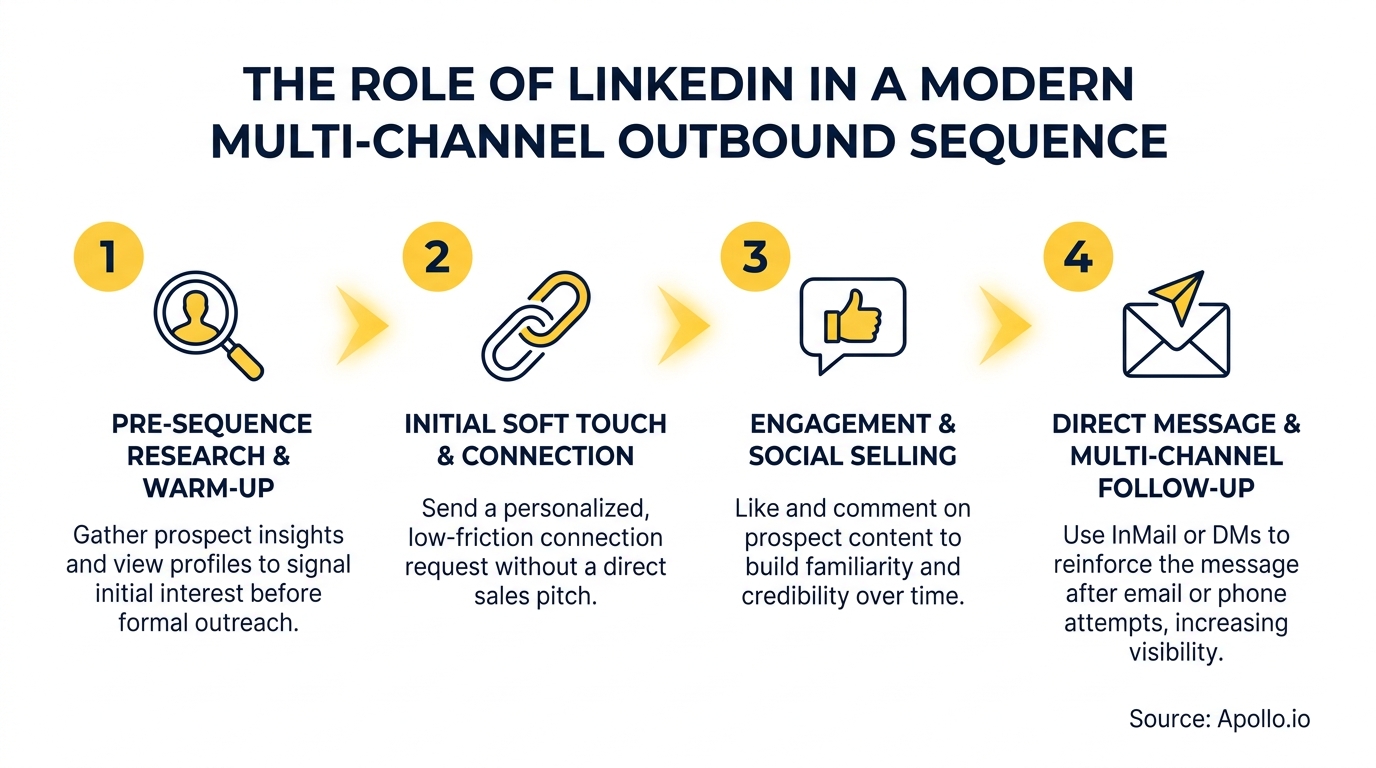
SDRs get the most from professional networks by positioning it as the warm-up layer before email asks and the re-engagement layer between phone attempts. A practical cadence pattern looks like this:
- Day 1: Follow the prospect and view their profile (creates a visible signal)
- Day 2: Send a personalized connection request referencing a shared interest or mutual connection
- Day 3: Send the first cold email (now with professional networks context supporting credibility)
- Day 5: Leave a thoughtful comment on a prospect post or share a relevant resource via DM if connected
- Day 7: Phone call, referencing the professional networks connection in the opening
- Day 10: Follow-up email with a specific proof point or case study
This pattern treats professional networks as the trust and signal layer, not the primary ask channel. AEs managing enterprise accounts can extend this motion by mapping multiple stakeholders and using professional networks to engage champions while email and calls target the economic buyer. Explore top sales sequence examples to see how high-performing teams structure these cadences.
Struggling to keep your multi-channel sequences organized across email, phone, and social? Automate your sequences with Apollo's multi-channel engagement platform and manage every touch from one workspace.
Turn Funnel Gaps Into Pipeline Gold
Tired of watching marketing leads stall before they ever reach your pipeline? Apollo surfaces high-intent prospects ready to buy — so your team stops guessing and starts closing. Nearly 100K paying customers trust Apollo to fill their funnel with quality.
Start Free with Apollo →How Does professional networks Fit Into the Broader Channel Mix?
professional networks is not a replacement for email or phone. It is the identity and credibility layer that makes the other channels land better. Data from Landbase shows multi-channel campaigns using three or more channels achieve 287% higher purchase rates compared to single-channel strategies. professional networks is most effective as one of those three, not as the entire strategy.
professional networks's own messaging limits, which apply across InMail, Sponsored Messaging, and Open Profile, push teams toward treating it as a high-signal, selective channel rather than a volume play. This is a feature, not a bug.
It forces personalization and reserves professional networks inventory for the moments where it will have the most impact, such as when intent signals appear (a prospect likes your post, changes jobs, or views your profile).
| Channel | Primary Role in Sequence | Volume Approach |
|---|---|---|
| Primary ask and follow-up | High volume, automated | |
| professional networks | Trust, credibility, intent signals | Low-medium, personalized |
| Phone | Direct ask, objection handling | Medium, targeted |
For RevOps leaders, the challenge is making professional networks activity visible and measurable inside the CRM. Teams increasingly log social touches as cadence tasks, enabling managers to coach on sequence design and attribute pipeline influence to specific social steps. This connects directly to revenue operations best practices around single source of truth and measurable outbound activity.
What professional networks Content Formats Work Best in Outbound Sequences?
professional networks content serves outbound sequences best when it creates recognizable expertise before a direct ask arrives. The most effective formats for B2B GTM teams are point-of-view posts, short expert teardowns of industry problems, and buyer enablement carousels that address the exact pain points in your ICP.
These formats work because they give prospects a reason to accept your connection request and a reason to take your email seriously.
- POV posts: Share a contrarian or data-backed take on a problem your ICP faces. These get saved and shared, expanding reach beyond first-degree connections.
- Expert teardowns: Break down a common mistake or misconception in your prospect's industry. Positions you as a trusted advisor, not a vendor.
- Buyer enablement carousels: Slide-format posts that help buyers build an internal business case. Prospects who engage with these are often closer to in-market.
Founders and revenue leaders building outbound motions can treat professional networks content as the testing ground for messaging. The posts that get the most engagement reveal which pain points and proof points resonate, and those insights feed directly into email subject lines and call talk tracks. See how Alex Boyd drives $4.5M using social selling on professional networks for a real-world example of this approach.
How Do You Measure professional networks's Impact in a Multi-Channel Sequence?
Measuring professional networks's contribution to outbound performance requires tracking beyond vanity metrics like follower counts. The metrics that matter are reply rate lift (sequences with social touches vs. without), stakeholder expansion rate (how many additional contacts engage after a professional networks touch), influenced pipeline (deals where professional networks activity preceded an email reply or meeting booked), and deal velocity (whether sequences with social steps close faster).
A practical measurement approach logs social steps as tasks in your CRM, then segments sequence performance by whether social touches were completed. This allows direct comparison and makes coaching conversations concrete. RevOps teams that instrument professional networks this way move from anecdotal evidence to reproducible playbooks. Pair this with a clear sales cadence framework to ensure every rep follows a consistent process.
Need to build and track multi-channel cadences without juggling multiple tools? Apollo's AI sales automation consolidates your outbound workflow, so email, phone, and social touches all live in one measurable system.

How Do You Build a professional networks-Integrated Sequence in 2026?
Building a professional networks-integrated outbound sequence in 2026 starts with four principles: treat professional networks as the credibility layer, reserve social touches for high-intent moments, keep professional networks actions personalized and human-in-the-loop, and measure professional networks's contribution to pipeline, not just to engagement.
The winning pattern in 2026 is: content and engagement first, connection second, direct ask via email or phone third. professional networks warms the prospect and raises the probability that your email gets opened and your call gets answered. The ask itself still most often happens in the channel with the clearest CTA structure, which is email or phone. This is why outbound prospecting today requires coordinating all channels deliberately rather than running them in parallel without a strategy.
The teams winning the most pipeline in 2026 are not doing more social outreach. They are doing smarter social outreach, using it precisely where it creates trust and signals intent, and letting email and phone carry the volume. That coordinated motion, built inside a unified platform, is what separates top-performing outbound teams from the rest. Request a Demo to see how Apollo brings your entire multi-channel outbound motion into one workspace.
Get Clear ROI From Day One With Apollo
ROI pressure killing your next budget approval? Apollo delivers measurable pipeline impact fast — so you walk into every review with hard numbers, not guesses. Nearly 100K paying customers prove the value.
Start Free with Apollo →Don't miss these
Sales
Inbound vs Outbound Marketing: Which Strategy Wins?
Sales
What Is a Sales Funnel? The Non-Linear Revenue Framework for 2026
Sales
What Is a Go-to-Market Strategy? The 2026 GTM Playbook
See Apollo in action
We'd love to show how Apollo can help you sell better.
By submitting this form, you will receive information, tips, and promotions from Apollo. To learn more, see our Privacy Statement.
4.7/5 based on 9,690 reviews
