
Reporting and Analytics Features to Expect From a Best-in-Class Sales Platform
Most sales platforms give you charts. Best-in-class platforms give you answers. Understanding how sales analytics drives revenue growth starts with knowing exactly which reporting features to demand from your platform before you sign a contract.
With deal slippage and longer sales cycles becoming the norm, the gap between basic reporting and governed, AI-enabled analytics has never mattered more. This guide breaks down every feature tier you should expect, from pipeline visibility to agent oversight.

Research Less, Pipeline More With Apollo
Tired of burning hours verifying contact info that goes nowhere? Apollo delivers accurate business contacts instantly, so your reps spend time selling — not searching. Join 600K+ companies building pipeline faster.
Start Free with Apollo →Key Takeaways
- Best-in-class platforms go beyond dashboards to deliver governed, AI-enabled analytics with a consistent semantic layer across every KPI.
- Pipeline slippage and lengthening sales cycles make deal-execution analytics and leading indicators non-negotiable in 2026.
- Security and audit reporting are now core analytics requirements, not add-ons, especially as AI agents take actions on your behalf.
- RevOps teams that unify reporting across the full revenue motion see measurably faster growth than siloed teams.
- The shift toward agentic selling means your platform must track what AI did, why, and what outcome it produced.
What Are the Core Reporting Features a Sales Platform Must Have?
A best-in-class sales platform must provide pipeline analytics, activity tracking, stage conversion reporting, forecast accuracy, and multi-touch attribution as its foundation. These features answer the three questions every revenue team asks daily: Where is the pipeline?
What is the team doing? What will close?
| Feature Category | What It Measures | Who Uses It Most |
|---|---|---|
| Pipeline Analytics | Stage distribution, velocity, coverage ratio | Sales Leaders, RevOps |
| Activity Reporting | Calls, emails, meetings per rep | SDRs, BDRs, Managers |
| Stage Conversion | Win rate by stage, drop-off points | AEs, Sales Managers |
| Forecast Accuracy | Predicted vs. actual close rates | Revenue Leaders, RevOps |
| Multi-Touch Attribution | Revenue credit across channels and touchpoints | Marketing, RevOps |
According to B2B Appointment Setting, best-in-class platforms need customer tracking features to gain insights into every touchpoint along the buyer's journey, combined with multi-touch attribution to assign value to each interaction. Without this, marketing and sales operate with conflicting data.
How Do Slippage and Cycle-Time Analytics Protect Revenue?
Slippage and cycle-time analytics identify which deals are drifting past their expected close dates and why, giving teams the leading indicators to intervene before a deal is lost. This is now a critical capability, not a premium add-on.
Your platform should surface:
- Deal slippage rate: Percentage of opportunities pushed to a future period
- Stage exit velocity: Average days spent in each pipeline stage
- Mutual plan milestone completion: Whether agreed-upon next steps are being hit
- Activity gap detection: Deals with no recorded activity in a defined window
- Cycle-time trend lines: Whether your average sales cycle is expanding or contracting over time
Tracking the right sales KPIs at each stage of the pipeline is what separates teams that catch slippage early from those who discover it at quarter-end. For Account Executives managing multiple enterprise deals, stage-level cycle-time data pinpoints exactly where deals stall and which conversations to prioritize.
Struggling to get full pipeline visibility in one place? Track deal health and slippage risk with Apollo's deal management tools.
What Is the Analytics Trust Stack, and Why Does It Matter?
The analytics trust stack refers to the foundational layer of data governance, quality telemetry, and security reporting that makes every dashboard metric trustworthy. Without it, AI recommendations and forecast outputs are unreliable.
Best-in-class platforms include native governance reporting across three layers:
- Data quality telemetry: Completeness scores, field-level accuracy rates, and duplicate detection metrics
- Data lineage: A traceable record of where each data point originated and how it was transformed
- Audit logs: A full history of who accessed, changed, or exported data and when
- Access control reporting: Role-based permission summaries and policy compliance dashboards
For RevOps leaders, this trust stack is the difference between a governance framework that exists on paper and one that is actively enforced. Platforms that surface these controls inside the analytics interface, rather than burying them in admin settings, give teams the confidence to act on AI-generated insights.
How Should a Best-in-Class Platform Handle AI and Agent Analytics?
A best-in-class platform must provide dedicated agent oversight reporting that logs every AI action, the rationale behind it, and the measurable outcome it produced. As AI agents move from experimental to standard, this accountability layer is essential.
Agent analytics should include:
- An action log showing what the agent executed (sequence enrollment, CRM field update, task creation)
- Human-in-the-loop decision records, capturing where a rep approved or overrode an agent recommendation
- Impact attribution: did the agent-initiated action correlate with a positive pipeline movement?
- Model input visibility: what signals triggered the recommendation
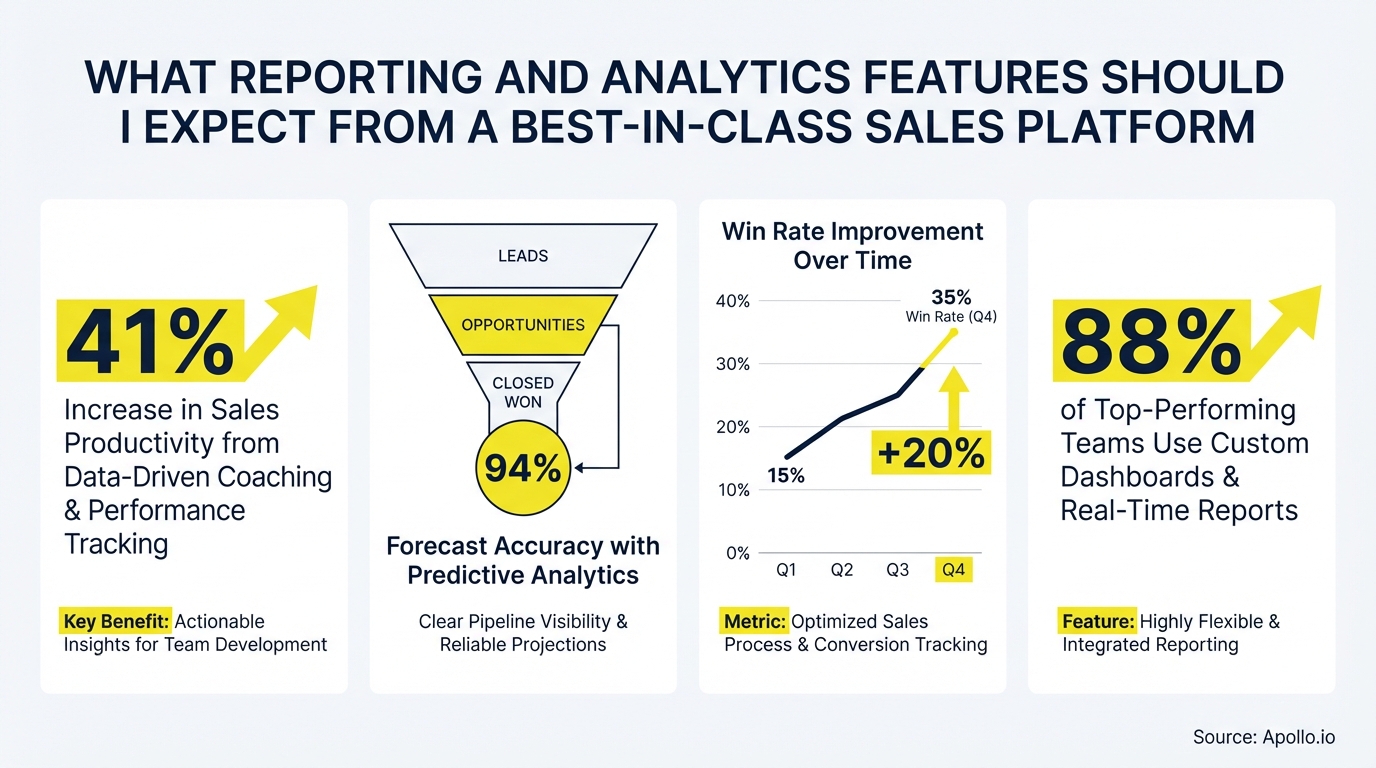
Research from Martal shows AI-driven predictive analytics can improve forecast accuracy by 20 to 30 percent, but that uplift depends entirely on the quality of inputs feeding the model. This reinforces why governed data and agent transparency belong in the same reporting layer. According to Landbase, 92% of sales teams plan to increase their AI investment in 2026, making agent oversight reporting a near-universal need.
Apollo's AI sales automation platform combines engagement execution with transparent reporting so teams know exactly what AI actions are driving pipeline movement.

How Do RevOps Teams Use Unified Reporting to Hit Targets?
RevOps teams use unified reporting to eliminate conflicting metrics across sales, marketing, and customer success by creating one shared view of pipeline, revenue, and engagement performance. Data from Partner2B shows B2B organizations leveraging RevOps are 1.4 times more likely to surpass their revenue targets by 10% or more compared to teams operating in silos.
Unified reporting requires a platform that connects:
- Inbound and outbound lead sources with a consistent attribution model
- CRM opportunity data synced with engagement activity (emails, calls, meetings)
- Enrichment data quality scores so RevOps knows when contact records degrade
- Shared KPI definitions, so pipeline means the same thing in every dashboard
Understanding what revenue operations is and how it drives growth makes clear why a semantic layer, one governed definition per metric, is now a buying criterion for serious RevOps teams, not a feature request. SDRs benefit too: when their activity data feeds the same reporting system as AE deal data, managers can correlate outbound effort with pipeline output in real time.
Turn Funnel Guesswork Into Real Pipeline
Tired of watching marketing leads stall before they ever reach your pipeline? Apollo surfaces in-market buyers and routes quality opportunities to your team automatically. Join 600K+ companies forecasting with confidence.
Start Free with Apollo →What Does a Three-Tier Analytics Maturity Model Look Like?
A three-tier analytics maturity model organizes sales reporting capabilities into Foundation, Advanced, and Expert levels, helping teams assess where they are today and what to build toward.
| Tier | Capabilities | Who It Serves |
|---|---|---|
| Foundation | Pipeline dashboards, activity logs, basic win/loss rates, standard CRM reports | Early-stage teams, individual reps |
| Advanced | Slippage detection, cycle-time analytics, multi-touch attribution, forecast modeling, data quality scoring | Growing sales orgs, RevOps teams |
| Expert | Agent action logs, semantic layer governance, omnichannel signal fusion, AI outcome attribution, compliance dashboards | Enterprise GTM teams, mature RevOps functions |
Most platforms deliver Foundation-tier reporting out of the box. The gap between Advanced and Expert is where sales performance management either scales or stalls. Teams evaluating platforms should verify which tier the vendor's native reporting actually reaches, not what is available only via third-party BI integrations.
Research from JohnnyGrow notes AI is expected to automate approximately one-third of all seller tasks, freeing up teams for more strategic work. Expert-tier analytics is what makes that automation auditable and trustworthy.
How Does Apollo Bring These Features Together in One Platform?
Apollo consolidates prospecting data, engagement execution, pipeline management, and AI-powered reporting into a single workspace, eliminating the fragmented reporting that comes from stitching together multiple tools. As Cyera noted, "Having everything in one system was a game changer."
For SDRs and BDRs, Apollo surfaces activity and sequence performance data alongside contact-level enrichment quality, so reps know which records are reliable before they reach out. For AEs and revenue leaders, Apollo's integrated GTM workflows connect deal management reporting directly to the engagement data that drove each opportunity forward. The result is a single source of truth rather than reconciling exports from three separate systems.
Apollo's approach to analytics also supports the consolidation RevOps teams need. Census reported that switching to Apollo helped them "cut our costs in half" by replacing multiple point solutions with one unified platform.
Predictable Revenue echoed this: "We reduced the complexity of three tools into one."

What Should You Prioritize When Evaluating Sales Platform Reporting?
Prioritize platforms that deliver governed, AI-ready analytics with pipeline execution depth over those that offer only visualization. The features that correlate most with quota attainment and reduced slippage are the ones tied to leading indicators, not lagging summaries.
Use this checklist when evaluating any platform:
- Does the platform define metrics consistently across all dashboards (semantic layer)?
- Can you see deal-level slippage history and stage exit velocity?
- Are AI agent actions logged with outcome attribution?
- Is data quality scoring visible inside the reporting interface?
- Does the platform surface audit logs and access controls natively?
- Can RevOps create unified views without building a separate BI layer?
For teams building toward enterprise-grade sales operations, every item on this checklist should be a hard requirement, not a nice-to-have. Platforms that fail on governance and agent transparency will become liabilities as AI usage scales.
Ready to see analytics, engagement, and pipeline management working together in one place? Start Prospecting with Apollo for free and experience best-in-class reporting without the tech stack complexity.
Prove Pipeline ROI With Apollo
ROI pressure killing your tool budget? Apollo delivers measurable pipeline impact your leadership can see — fast. Leadium 3x'd annual revenue. Start your free trial and show results, not just promises.
Start Your Free Trial →Don't miss these
Sales
Inbound vs Outbound Marketing: Which Strategy Wins?
Sales
What Is a Sales Funnel? The Non-Linear Revenue Framework for 2026
Sales
What Is a Go-to-Market Strategy? The 2026 GTM Playbook
See Apollo in action
We'd love to show how Apollo can help you sell better.
By submitting this form, you will receive information, tips, and promotions from Apollo. To learn more, see our Privacy Statement.
4.7/5 based on 9,690 reviews
