
What Outbound Metrics Should a VP of Sales Track to Manage a 10-Person SDR Team in 2026?
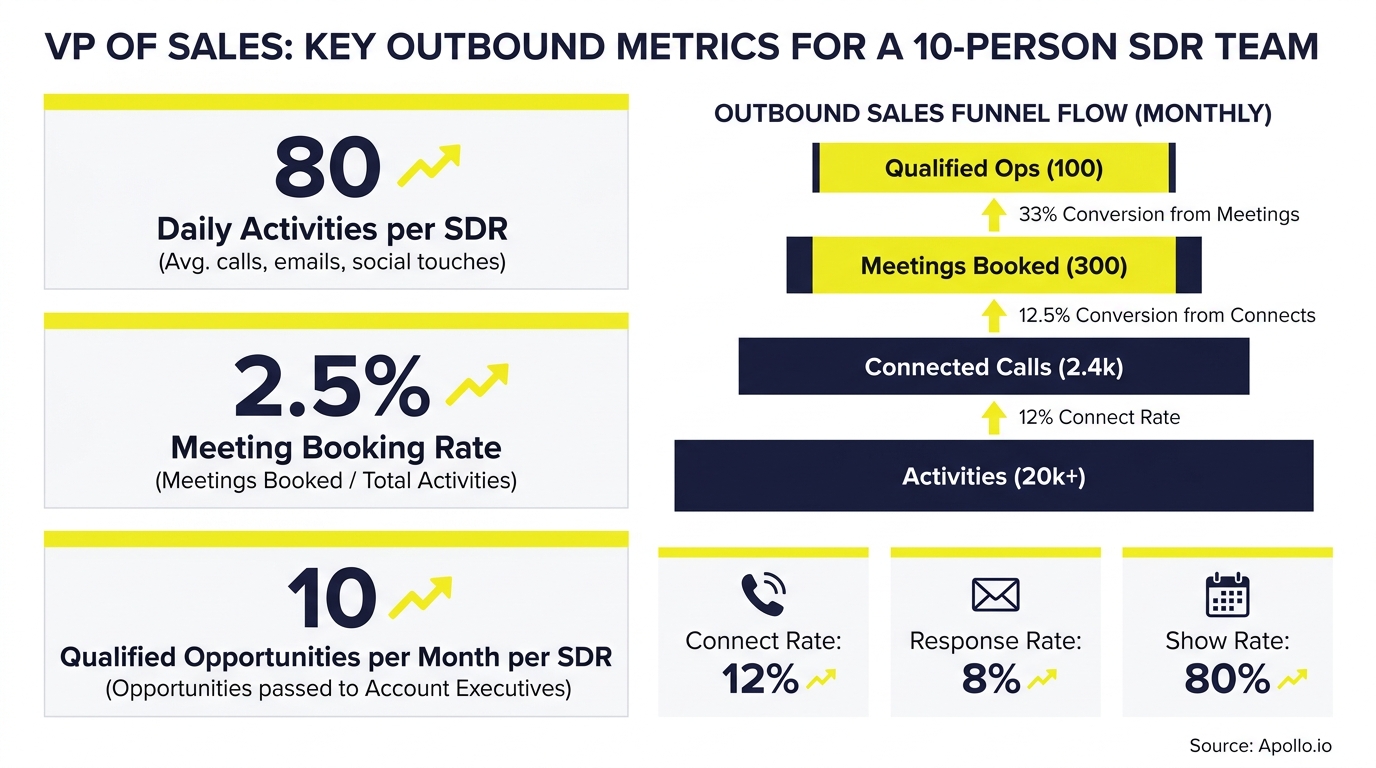
Managing a 10-person SDR team without the right metrics is like running a production line with no output gauges. You see activity everywhere, but you can't tell what's generating pipeline. For VPs of Sales, the shift in 2026 is clear: move from counting touches to measuring conversion quality, sequence efficiency, and data integrity. The right sales KPIs turn your SDR team from a cost center into a predictable revenue engine.
This framework organizes outbound metrics into three layers: reachability, sequence effectiveness, and operational integrity. Each layer answers a distinct question a VP needs to manage performance, coach reps, and report to the board.

Scale Smarter With Apollo's AI Engine
Tired of your reps burning hours on manual research instead of closing deals? Apollo surfaces verified contacts and automates outreach so your team scales without adding headcount. Join 600K+ companies building predictable pipeline.
Start Free with Apollo →Key Takeaways
- Track metrics across three layers: reachability, sequence effectiveness, and data/ops integrity — not just activity volume.
- Qualified meetings and meeting-to-opportunity rate matter more than raw dials or emails sent.
- Multi-threading metrics reveal whether SDRs are building real buying committee access, not just single-contact coverage.
- Data hygiene KPIs (bounce rate, enrichment coverage) directly throttle throughput — they belong on the VP dashboard, not buried in RevOps.
- Standardizing definitions (what counts as a qualified meeting, an SAL, an SQL) is a prerequisite for trustworthy reporting across a 10-person team.
What Are the Core Outbound Metrics for a VP of Sales?
A VP of Sales should track three categories of outbound metrics: activity baselines, funnel conversion rates, and pipeline output per rep. These form the foundation of any SDR performance dashboard.
According to Gradient Works, SDRs typically make 40-50 calls per day, with top quartile performers reaching 70-80. Use these as floor benchmarks, not targets. Activity without conversion insight is noise.
| Metric | Benchmark | What It Tells You |
|---|---|---|
| Calls per Day | 40-50 (top 25%: 70-80) | Effort baseline; not a performance indicator alone |
| Cold Email Reply Rate | ~5.1% | Messaging and list quality signal |
| Meaningful Conversation Rate | ~14.5% | Connect quality, not just connect volume |
| Connect-to-Meeting Rate | 20-40% | Pitch effectiveness after a live connection |
| Meetings Booked per SDR/Month | ~15 | Output benchmark for quota-setting |
| Meeting-to-Opportunity Rate | 20-35% | Meeting quality and AE handoff efficiency |
SalesHive places the average cold B2B email reply rate at around 5.1%. Leads at Scale benchmarks a 14.5% meaningful conversation rate. Outbound Sales Pro puts good connect-to-meeting conversion at 20-40% when messaging is strong.
How Does a 3-Layer SDR Dashboard Work for a VP of Sales?
A 3-layer dashboard separates reachability, sequence effectiveness, and operational integrity into distinct views so VPs can diagnose problems at the right level instead of reacting to surface metrics.
Struggling to get accurate pipeline visibility from your team's outreach? Track real pipeline impact with Apollo's unified GTM platform.

Layer 1: Reachability Metrics
- Connect rate by channel (calls answered, email opens, social replies)
- Email bounce rate (hard bounces above 2% signal list quality issues)
- Domain reputation score (spam complaint rate should stay below 0.1%)
- Phone answer rate by list segment and data source
Layer 2: Sequence Effectiveness Metrics
- Sequence-to-meeting conversion rate by sequence variant
- Steps-to-first-reply (which touch generates the conversation)
- Positive reply rate vs. raw reply rate (automation inflates raw replies)
- Meeting-to-opportunity rate by rep, sequence, and persona
Layer 3: Operational Integrity Metrics
- Enrichment coverage (% of accounts with complete contact data)
- Invalid contact rate per list or ICP segment
- CRM writeback compliance (% of meetings logged with required fields)
- Definition adherence (qualified meeting criteria met before handoff)
How Should VPs Define Key SDR Terms for Trustworthy Reporting?
Standardized definitions are what make dashboards trustworthy. Without them, ten SDRs on one team will report ten different versions of the same number.
Here are the four definitions every VP must lock in before tracking metrics:
- Qualified Meeting: A scheduled conversation with a verified decision-maker or influencer at an in-ICP account, confirmed 24+ hours in advance, with a clear agenda shared.
- SAL (Sales Accepted Lead): A lead reviewed and accepted by the AE after the SDR handoff meets minimum criteria (title, company size, pain confirmed).
- SQL (Sales Qualified Lead): A lead that has passed discovery and shows budget, authority, need, and timeline signals sufficient to move to a formal opportunity.
- Multi-Threading: Active engagement with two or more stakeholders at the same target account within a rolling 30-day window.
For deeper context on how SDR roles and metrics connect to revenue, these definitions should map directly to your CRM stages.
Turn Funnel Guesswork Into Pipeline Clarity
Tired of watching marketing leads stall before they ever reach your pipeline? Apollo surfaces high-intent prospects so your team works real opportunities, not wishful thinking. Nearly 100K paying customers stopped guessing and started closing.
Start Free with Apollo →What Multi-Threading Metrics Should SDRs Track for Buying Committees?
Multi-threading metrics measure whether SDRs are engaging multiple stakeholders per target account, which directly affects whether meetings survive the buying committee stage.
A Gartner survey of 632 B2B buyers (fielded Aug-Sep 2024, published May 2025) found that 74% of B2B buyer teams showed unhealthy conflict during the decision process. Single-contact outbound coverage leaves SDRs exposed when internal stakeholders disagree.
Key multi-threading metrics to add to your dashboard:
- Stakeholders contacted per target account (goal: 2+ per active account)
- Multi-threaded account rate (% of active accounts with 2+ engaged contacts)
- Committee expansion rate (meetings that add a second stakeholder within 14 days)
- Procurement/security stakeholder involvement rate (for enterprise deals)
For enterprise-segment SDR teams, Landbase benchmarks meeting-to-opportunity rates at 5-8% for enterprise and 8-12% for mid-market, reflecting the heavier committee scrutiny at larger companies.
What Data Hygiene KPIs Should RevOps Track Alongside SDR Metrics?
Data hygiene KPIs belong on the VP dashboard because dirty data silently destroys SDR throughput before a single sequence is sent. A Salesforce State of Sales report in 2026 found that 51% of sales leaders with AI say tech silos delay or limit their AI initiatives.
Poor data is the most common silo.
Is your team wasting time on invalid contacts and bad data? Enrich your contact data with Apollo's 230M+ verified business contacts.
| Data Hygiene KPI | Target Threshold | Action If Exceeded |
|---|---|---|
| Hard Bounce Rate | <2% | Audit list source; trigger re-enrichment |
| Spam Complaint Rate | <0.1% | Review sequence copy and send frequency |
| Enrichment Coverage | >85% of accounts | Identify data gaps by segment; enrich before sequencing |
| Invalid Contact Rate | <5% per list | Pause list; re-verify before activating sequences |
| CRM Data Completeness | >90% required fields | Block SAL stage without complete fields |
RevOps leaders should review these weekly alongside a structured revenue operations framework that aligns data standards with SDR workflow rules.
How Do SDRs and VPs Align on Sales Performance Management?
VPs of Sales align with their SDR teams on metrics by building a shared scorecard reviewed weekly, not just in monthly pipeline calls. The scorecard should surface both leading indicators (activities, sequences launched, accounts touched) and lagging indicators (meetings held, SALs created, pipeline generated).
According to Crunchbase, outbound SDRs produce approximately 15 meetings per month. Use this as your team's output anchor, then work backward to set activity targets by channel and sequence type.
For SDRs, a weekly check-in should cover:
- Meetings booked vs. target (with meeting quality flag)
- Active sequences and sequence-to-meeting rate by variant
- Multi-threading coverage on assigned accounts
- Data issues flagged (bounces, bad numbers, missing contacts)
For more on building the performance layer above these metrics, see sales performance management strategy and implementation.
How Do VPs Build a High-Output SDR Dashboard in 2026?
The most effective VP-level outbound dashboard in 2026 tracks efficiency metrics, not just volume. Channels are noisier, buyers prefer self-serve research, and AI-generated outreach is flooding inboxes.
The teams winning are those measuring pipeline per rep, cost per meeting, and positive reply rate — not sends per day.
Use this as your quick-start dashboard checklist for a 10-person team:
- Weekly: Meetings booked, meeting quality pass rate, sequence-to-meeting by variant, active account multi-threading rate
- Bi-weekly: Meeting-to-opportunity rate by rep, SAL acceptance rate, enrichment coverage, bounce rate
- Monthly: Pipeline generated per SDR, cost per meeting, SQL conversion rate, positive reply rate vs. raw reply rate
For guidance on building the sales analytics layer that powers these dashboards, see how sales analytics drives revenue growth. For the outbound tooling that feeds clean data into these dashboards, outbound sales software built for booking more meetings eliminates the manual data entry that breaks reporting integrity.

Start Tracking the Metrics That Actually Build Pipeline
A 10-person SDR team is a significant investment. The metrics above give VPs of Sales the diagnostic precision to coach effectively, forecast confidently, and identify whether underperformance is a rep issue, a sequence issue, or a data issue.
Tracking all three layers — reachability, sequence effectiveness, and operational integrity — is what separates teams that scale from teams that spin their wheels.
Apollo consolidates prospecting, sequencing, enrichment, and pipeline tracking into one platform, so the metrics you need are already connected. As Cyera put it, "Having everything in one system was a game changer." Start a Trial and give your SDR team the unified workspace that makes these metrics measurable from day one.
Prove Pipeline ROI With Apollo
Budget approval stuck on unclear metrics? Apollo delivers measurable pipeline impact from day one — so you walk into every budget review with proof, not promises. Join nearly 100K paying customers closing with confidence.
Start Free with Apollo →Don't miss these
Sales
Inbound vs Outbound Marketing: Which Strategy Wins?
Sales
What Is a Sales Funnel? The Non-Linear Revenue Framework for 2026
Sales
What Is a Go-to-Market Strategy? The 2026 GTM Playbook
See Apollo in action
We'd love to show how Apollo can help you sell better.
By submitting this form, you will receive information, tips, and promotions from Apollo. To learn more, see our Privacy Statement.
4.7/5 based on 9,690 reviews
