
What Is a Sales Strategy? Framework, Components, and 2026 Best Practices
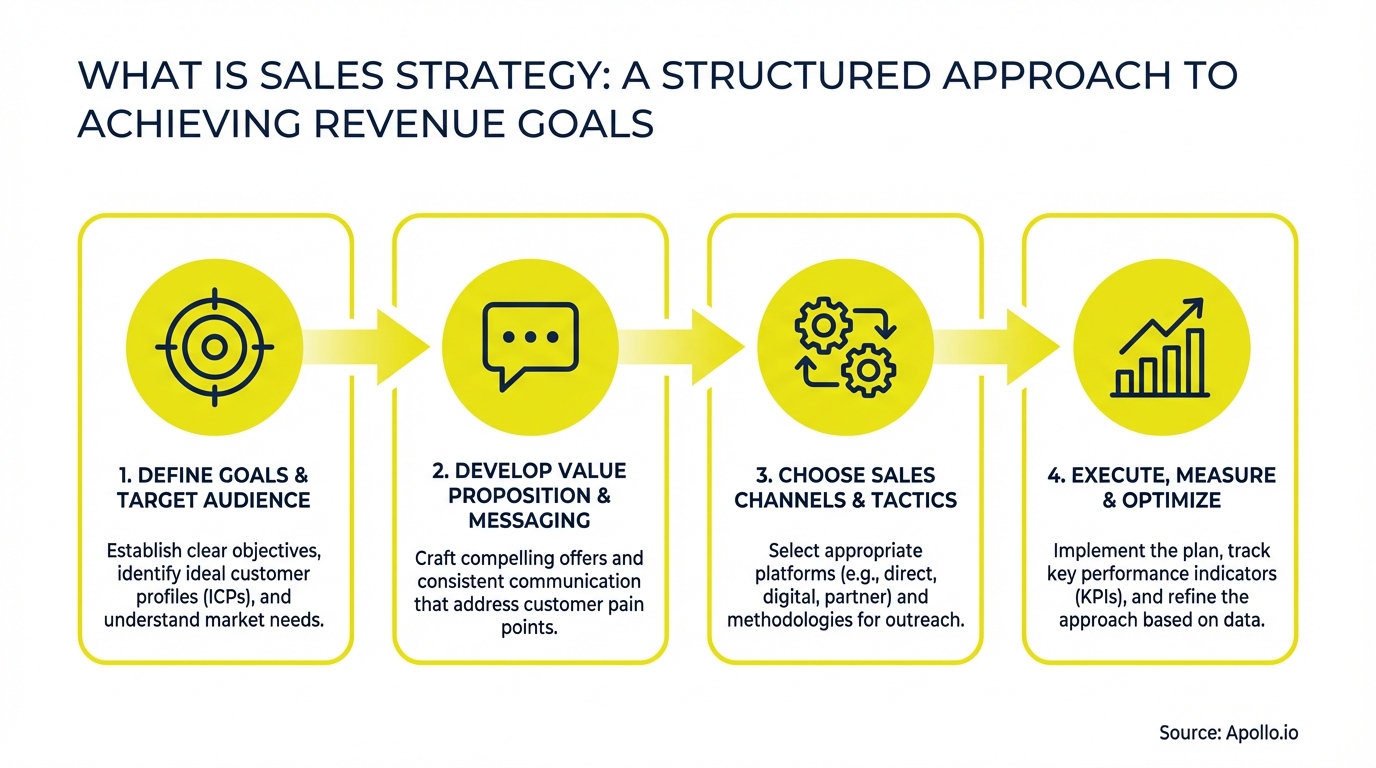
A sales strategy is a documented plan that defines how your team identifies, engages, and converts target buyers into paying customers. It connects your ideal customer profile (ICP) to the tactics, channels, and metrics your team uses every day. Without one, reps work without direction and pipeline becomes unpredictable. If you want to understand how B2B sales works at a structural level, the sales strategy is the starting point.
In 2026, building an effective sales strategy means accounting for buyers who research independently, use AI tools to evaluate vendors, and often prefer to avoid sales reps entirely until they're ready to buy. The old playbook of high-volume cold outreach is losing ground to signal-based, personalized, omnichannel engagement.

Apollo Turns Research Into Revenue
Tired of your reps burning hours on manual lead research instead of selling? Apollo surfaces verified contacts instantly so your team spends time closing, not digging. Join 550K+ companies building pipeline on autopilot.
Start Free with Apollo →Key Takeaways
- A sales strategy defines your ICP, channels, process, and metrics in one connected framework.
- Modern B2B buyers are self-directed: 61% prefer a rep-free buying experience (Gartner, 2025), so your strategy must design for self-serve alongside human touchpoints.
- Relevance beats volume: 73% of buyers actively avoid suppliers who send irrelevant outreach (Gartner, 2025), making ICP precision and intent signals critical.
- AI adoption in sales surged from 39% in 2023 to 81% in 2025, reshaping how teams prospect, personalize, and forecast.
- Sales strategy is now a cross-functional commercial strategy spanning sales, marketing, and customer success with shared KPIs.
What Are the Core Components of a Sales Strategy?
A complete sales strategy covers six interconnected components. Miss one and the others underperform.
| Component | What It Defines |
|---|---|
| ICP | Which companies and buyers you target, by firmographic, technographic, and behavioral criteria |
| Positioning | Why buyers choose you over alternatives, stated in buyer language |
| Channel Mix | Which outbound and inbound channels you use (email, phone, social, partner, self-serve) |
| Sales Process | Stage-by-stage buyer journey with defined exit criteria at each step |
| Enablement | Content, tools, and training that help reps execute the process |
| Metrics | KPIs that measure pipeline health, conversion, and revenue outcomes |
These components link directly to execution. Your sales funnel maps the buyer journey; your strategy defines how you move buyers through it.
Why Does Sales Strategy Matter More in 2026?
Buyers have changed faster than most sales playbooks. According to Clevenio, an estimated 80% of B2B sales interactions between suppliers and buyers are projected to occur through digital channels. Reps who rely on phone-first, high-volume outreach without a supporting strategy are working against buyer behavior, not with it.
Three forces make strategy non-negotiable right now:
- Self-directed buyers: 61% of B2B buyers prefer a rep-free buying experience (Gartner, 2025). Strategy must now design for self-serve touchpoints alongside human ones.
- AI-mediated research: 94% of business buyers report using AI in their buying process (Forrester, 2026). Your content and positioning must be structured for AI-assisted discovery.
- Irrelevance risk: 73% of buyers actively avoid suppliers who send irrelevant outreach (Gartner, 2025). Generic sequences damage pipeline rather than build it.
Tracking the right sales KPIs is what connects strategy to measurable outcomes.
Turn Weak Leads Into Real Pipeline
Tired of marketing leads that never convert to opportunities? Apollo surfaces verified, in-market contacts so your team stops chasing dead ends and starts building predictable pipeline. Join 550K+ companies closing with confidence.
Start Free with Apollo →How Do SDRs and AEs Execute a Sales Strategy Day-to-Day?
Strategy is only useful if it translates into daily rep behavior. Here is how each role operationalizes it:
SDRs and BDRs use the ICP definition to prioritize outreach, rely on intent signals to time their sequences, and follow channel guidance to determine whether to lead with email, phone, or social outreach. A tight ICP definition cuts wasted activity and improves connection rates.
Account Executives use positioning and process to run discovery calls, handle objections consistently, and advance deals through defined stages. For AEs managing complex deals, proven sales techniques and a documented process reduce reliance on individual instinct.
RevOps leaders use the metrics layer to track pipeline health, identify conversion gaps, and flag when the strategy needs updating. KnockKnock reports that AI adoption in sales surged from 39% in 2023 to 81% in 2025, making AI-assisted forecasting and pipeline analysis a standard part of RevOps strategy execution.
Struggling to find qualified leads that match your ICP? Search Apollo's 224M+ contacts with 65+ filters to target the exact accounts your strategy defines.
What Is an Omnichannel Sales Strategy?
An omnichannel sales strategy coordinates multiple channels so buyers receive consistent messaging and can move between touchpoints without friction. This is no longer optional for B2B teams.
According to the McKinsey B2B Pulse 2024, online sales account for 34% of revenue and 71% of B2B companies offer some form of e-commerce.
A practical channel-mix framework for 2026:
- Self-serve (digital): Pricing pages, product demos, ROI calculators, and free trials for buyers who prefer to evaluate independently
- Outbound (rep-led): Signal-triggered sequences via email, phone, and social for accounts showing intent or fitting your ICP
- Inbound (marketing-sourced): Content, ads, and events that bring warm leads into the pipeline
- Human-assisted close: AE involvement reserved for risk reduction, consensus-building, and complex configuration
The key decision rule: deploy human touchpoints where they add value beyond what a buyer can discover independently. Use sales analytics to measure which channel mix produces the shortest cycles and highest win rates for your ICP.

How Do You Handle Stalled Deals in Your Sales Strategy?
Stalled deals are a strategy problem, not just a rep problem. Forrester's State of Business Buying (2024) found that 86% of B2B purchases stall during the buying process.
A sales strategy that doesn't account for deal stalls will consistently underperform on forecast accuracy.
Build these diagnostics into your process:
- Missing champion: No internal advocate driving the deal forward. Re-engage with new value framing or a different contact.
- Consensus gap: Multiple stakeholders with different priorities. Provide tailored content for each persona.
- Risk perception: Buyer fears the switch more than the status quo. Use case studies, implementation guides, and risk-reduction guarantees.
- No urgency: No compelling event tied to a deadline. Create one using business impact data or time-limited terms.
For high-ticket sales especially, a stalled deal framework is not optional. The cost of a stuck deal is too high to leave to improvisation.
How Do Sales Leaders Build and Measure a Sales Strategy?
Sales leaders are responsible for connecting strategy design to execution and outcomes. The build process follows a clear sequence:
- Define ICP: Firmographic, technographic, and behavioral attributes of your best-fit customers
- Set revenue targets: Work backward from quota to determine pipeline coverage requirements
- Map the buyer journey: Identify every stage from awareness to close, including self-serve touchpoints
- Assign channels and tactics: Match outreach type and timing to buyer stage and intent signals
- Establish metrics: Pipeline coverage, stage conversion rates, cycle length, and win rate by segment
- Review cadence: Monthly pipeline reviews and quarterly strategy audits to adjust based on data
Founders building their first outbound motion can reference founder-led sales frameworks to establish the strategy before hiring a full team. For sales performance management, the strategy document becomes the baseline for coaching and accountability.

Spending too much time on manual outreach instead of strategy? Automate your sequences with Apollo's multi-channel platform so reps focus on conversations, not admin.
Build a Sales Strategy That Matches How Buyers Buy in 2026
A sales strategy is the operating system for your revenue team. It defines who you target, how you reach them, what you say, and how you measure success.
In 2026, that system must account for self-directed buyers, AI-assisted research, omnichannel expectations, and the structural risk of deal stalls.
The teams that win are the ones that treat strategy as a living document: updated with data, aligned across sales and marketing, and executed consistently by every rep. Apollo gives sales teams the unified platform to find the right accounts, engage them across channels, and track results in one workspace, consolidating the tools you'd otherwise stitch together separately.
Ready to execute your sales strategy on a single platform? Schedule a Demo and see how Apollo's 2M+ users build pipeline faster.
Prove Pipeline ROI From Day One
Budget approval stuck on metrics you can't quantify? Apollo delivers measurable pipeline impact fast — so your team justifies the investment before the next review. Leadium 3x'd their revenue. You're next.
Start Free with Apollo →Don't miss these
Sales
Inbound vs Outbound Marketing: Which Strategy Wins?
Sales
What Is a Sales Funnel? The Non-Linear Revenue Framework for 2026
Sales
What Is a Go-to-Market Strategy? The 2026 GTM Playbook
See Apollo in action
We'd love to show how Apollo can help you sell better.
By submitting this form, you will receive information, tips, and promotions from Apollo. To learn more, see our Privacy Statement.
4.7/5 based on 9,690 reviews
