
What Sales Techniques Actually Work in 2026?
Modern B2B sales isn't about pushing products anymore. It's about aligning data-driven insights with buyer-first conversations across every channel. According to Gartner, 60% of B2B sales organizations transitioned to data-driven selling by 2025, integrating analytics into every interaction. The question isn't which techniques work, it's how to execute them across digital and human touchpoints without losing trust.
This guide cuts through outdated advice to show you practical sales techniques that adapt to hybrid buying journeys, virtual conversations, and AI-powered workflows.

Apollo Eliminates Hours Of Manual Research
Tired of spending 4+ hours daily hunting for contact info? Apollo delivers 224M+ verified contacts with 96% email accuracy. Join 550K+ companies who replaced manual research with instant prospecting.
Start Free with Apollo →Key Takeaways
- Data-driven selling now outperforms gut-based approaches, with analytics-enabled teams 1.5x more likely to exceed growth targets
- 61% of buyers prefer rep-free experiences, making digital-first engagement critical
- Only 23% of reps feel equally effective selling virtually, highlighting a skill gap
- Six core technique categories cover discovery, trust-building, value framing, objection handling, negotiation, and closing
- Unified platforms like Apollo consolidate prospecting, engagement, and analytics to execute techniques at scale
Why Traditional Sales Techniques Fail in 2026
The buyer journey fragmented. Research by Gartner shows that 80% of B2B interactions now happen in digital channels. Your prospect researches on LinkedIn, downloads a whitepaper, books a demo through your site, then ghosts your follow-up emails.
Traditional techniques assumed linear progression: cold call → meeting → proposal → close. That model is dead.
Today's techniques must work across channels, adapt to buying committee dynamics, and integrate real-time data to stay relevant.
"Apollo could be a third of the cost if you look at the full price of what we were spending on ZoomInfo, Outreach, Salesforce, and admins to make it all work."
The Six Core Categories of Modern Sales Techniques
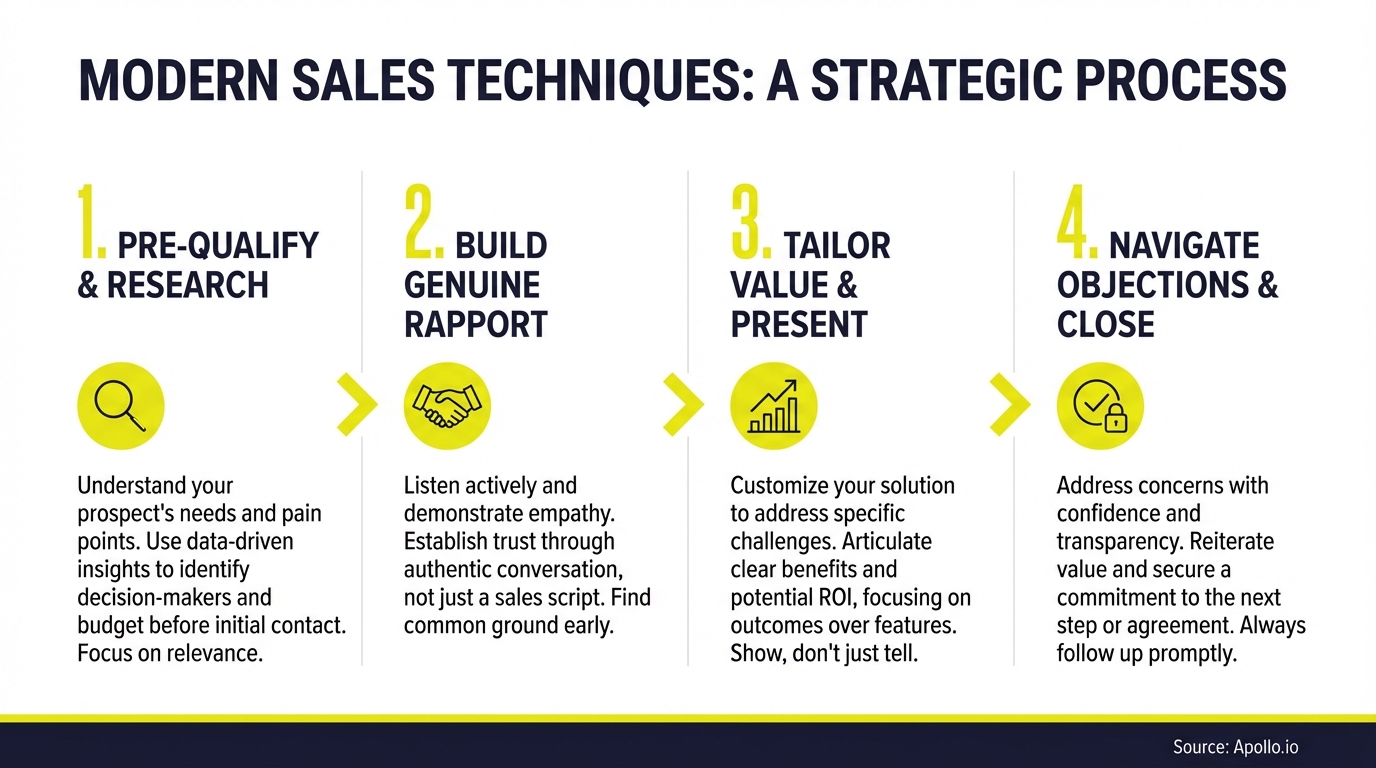
Every effective sales technique falls into one of six buckets. Master these categories and you can adapt to any buyer situation.
| Category | Purpose | Key Techniques |
|---|---|---|
| Discovery & Questioning | Uncover needs and qualify fit | SPIN, BANT, Challenger questioning |
| Trust & Relationship | Build credibility and rapport | Social selling, storytelling, referrals |
| Value Framing | Quantify business impact | ROI modeling, business case building |
| Objection Handling | Address concerns proactively | Feel-felt-found, pre-emption, reframing |
| Negotiation | Align on terms without discounting | Anchoring, bundling, trading concessions |
| Closing Techniques | Secure commitment and next steps | Assumptive close, trial close, urgency creation |
Discovery & Questioning Techniques
SPIN Selling remains effective because it guides prospects to self-discovery. Ask Situation, Problem, Implication, and Need-Payoff questions in sequence. Example: "How many hours does your team spend on manual data entry?" (Situation) → "What happens when that data is outdated?" (Problem) → "How does that impact pipeline accuracy?" (Implication) → "What would it mean if you automated that process?" (Need-Payoff).
BANT (Budget, Authority, Need, Timeline) qualifies deals fast. Don't ask "Do you have budget?" Ask "What budget range are you working within for this initiative?" It's direct but positions you as a partner, not a vendor fishing for information.
Struggling to qualify leads at scale? Search Apollo's 224M+ contacts with 65+ filters to find pre-qualified prospects.

Trust & Relationship Building
Social selling on LinkedIn builds trust before the first conversation. Comment on prospects' posts, share insights relevant to their industry, and establish thought leadership. When you finally reach out, you're not a stranger.
Storytelling with customer examples creates emotional resonance. Instead of listing features, share how a similar company solved the same problem. Use the structure: Challenge → Solution → Result. Keep it under 90 seconds.
"The thing that made me most excited as somebody who's been in sales development a long time was Apollo's integration between sales data and sales engagement and the magic that you can make happen when those two are together on the same platform."
Value Framing Techniques
ROI calculators turn vague benefits into hard numbers. Build a simple spreadsheet: current cost of the problem × frequency × time saved = quantified value. Send it during the proposal stage so champions can justify the purchase internally.
Business case co-creation works for enterprise deals. Schedule a working session with your champion to build the business case together. They know the internal politics and budget constraints better than you do.
How to Execute Sales Techniques Across Hybrid Buying Journeys
Data from McKinsey shows 35% of decision-makers will spend $500K+ through remote or self-service channels. Your techniques must work whether the buyer is on a Zoom call, reading your LinkedIn post, or exploring your pricing page at midnight.
Digital-First Execution
Async video messages bring personality to cold outreach. Record a 30-second Loom addressing the prospect by name, referencing their recent LinkedIn activity, and offering one specific insight. Open rates jump 30-40% versus text-only emails.
Self-service content hubs let buyers explore on their terms. Create interactive ROI calculators, product comparison guides, and case study libraries. Track engagement with tools like sales analytics platforms to identify high-intent prospects.
Virtual Selling Mastery
Turn Forecast Guesswork Into Revenue Certainty
Pipeline forecasting feel like rolling dice? Apollo delivers real-time deal intelligence and intent signals that make every forecast rock-solid. Built-In boosted win rates 10% with Apollo's scoring.
Start Free with Apollo →Only 23% of reps feel equally effective selling virtually, according to Gartner research. Close that gap with structured virtual techniques.
The pre-call brief sets expectations. Send an agenda 24 hours before the meeting with time allocations: "5 min intro, 15 min discovery, 25 min demo, 15 min Q&A." Buyers appreciate structure and it keeps you on track.
Screen share strategically. Don't share your screen until you've completed discovery. Lead with questions, then say "Based on what you shared, let me show you exactly how this solves your X problem." It makes the demo feel custom, not canned.
Spending hours on manual outreach? Automate your sequences with Apollo's unified engagement platform.
Objection Handling Techniques That Actually Work
Pre-emption beats reaction. Address common objections before prospects raise them. During your demo, say "Most teams worry about implementation time. Here's how we get you live in 14 days with zero IT resources." You've neutralized the objection without them having to voice it.
The Feel-Felt-Found framework validates concerns without dismissing them. "I understand how you feel. Other customers felt the same way. What they found was that after the first 30 days, adoption rates exceeded 85%." It's empathetic and data-backed.
Competitive objections require proof. Don't trash competitors. Instead, share a comparison guide with objective criteria, customer testimonials, and third-party validation. Let the data speak.
Negotiation Techniques Without Discounting
Anchoring sets the price expectation. Always present your highest package first, then work down. The contrast makes mid-tier options feel reasonable. Never lead with your cheapest offering.
Trading, not giving. When prospects ask for discounts, respond with "I can explore that if we can expand the scope to include X." Every concession you make should come with a reciprocal commitment from the buyer.
Time-based urgency works when it's genuine. "Our Q1 pricing ends March 31" creates urgency without being pushy. Fake urgency ("This deal expires tomorrow!") destroys trust.

Closing Techniques for Modern Buyers
The assumptive close treats the decision as made. "Let's get you onboarded next week. Does Tuesday or Thursday work better for the kickoff call?" It shifts the conversation from "if" to "when."
Trial closes test readiness throughout the conversation. "If we can solve X, Y, and Z, is there anything else preventing us from moving forward?" It surfaces hidden objections early when they're easier to address.
Multi-threading de-risks the close. Build relationships with 3-5 stakeholders, not just your champion. When your champion goes on vacation or changes roles, you have backup relationships to keep the deal moving. Learn more about strategic sales development.
How to Measure and Optimize Your Sales Techniques
Track technique effectiveness with these metrics:
- Discovery-to-demo conversion rate: Measures qualification accuracy
- Demo-to-proposal conversion rate: Indicates value framing effectiveness
- Proposal-to-close rate: Shows objection handling and closing skill
- Average sales cycle length: Reveals process efficiency
- Win rate by technique category: Identifies your strongest and weakest areas
Use deal management software to tag opportunities by technique used, then analyze performance patterns quarterly.
Execute Sales Techniques at Scale with Apollo
Individual techniques matter, but execution speed determines revenue outcomes. Apollo consolidates prospecting, engagement, and analytics into one workspace so reps can execute techniques without switching between six tools.
Find high-fit prospects with 65+ filters across 224M contacts, personalize outreach with AI-powered messaging, track engagement across email, phone, and LinkedIn, and analyze what's working with built-in sales analytics. It's the difference between knowing a technique and executing it 100 times per week.
Conclusion: From Techniques to Revenue
Sales techniques are tools, not magic tricks. The six categories—discovery, trust, value, objections, negotiation, and closing—form the foundation of every deal.
But in 2026, execution matters more than knowledge.
Master virtual selling, align your messaging across digital channels, and use data to optimize continuously. The reps who win aren't the ones with the most techniques memorized.
They're the ones who execute consistently, measure relentlessly, and adapt quickly.
Ready to execute sales techniques at scale? Start free with Apollo and access 224M+ verified contacts, AI-powered engagement, and unified analytics in one platform.
Prove Apollo's ROI In Your First 30 Days
Budget approval stuck on unclear metrics? Apollo tracks every touchpoint from first contact to closed deal—quantifying time saved, pipeline impact, and win rate improvements. Built-In increased ACV 10% with measurable Apollo insights.
Start Free with Apollo →Don't miss these
Sales
Inbound vs Outbound Marketing: Which Strategy Wins?
Sales
What Is a Sales Funnel? The Non-Linear Revenue Framework for 2026
Sales
What Is a Go-to-Market Strategy? The 2026 GTM Playbook
See Apollo in action
We'd love to show how Apollo can help you sell better.
By submitting this form, you will receive information, tips, and promotions from Apollo. To learn more, see our Privacy Statement.
4.7/5 based on 9,690 reviews
