
What Is Sales Commission? Structures, Rates, and How to Maximize Earnings in 2026
Sales commission is the performance-based pay that rewards reps for closing deals. It's the mechanism that aligns individual effort with company revenue goals and, for most B2B sales professionals, represents a significant portion of total earnings. Understanding how commission works, which structure fits your role, and how quota attainment drives actual pay is no longer optional knowledge.
With companies actively redesigning incentive plans and quota attainment rates under pressure, knowing how to read and optimize your commission plan is a direct competitive advantage, whether you're an SDR, AE, RevOps leader, or sales manager.

Research Less, Pipeline More With Apollo
Tired of hours lost to manual lead research and bounced contact info? Apollo delivers 97% email accuracy so your reps spend time selling, not searching. Nearly 100K paying customers have already made the switch.
Start Free with Apollo →Key Takeaways
- Sales commission is variable pay tied to performance metrics like revenue, margin, or retention, and modern plans often blend multiple metrics.
- Quota attainment is the single biggest driver of actual commission earnings. Low attainment rates industry-wide mean most reps earn below their on-target earnings (OTE).
- SaaS and high-margin industries use tiered structures with accelerators that pay above-rate for exceeding quota.
- For an incentive metric to change rep behavior, it typically needs to represent at least 20% of target variable compensation.
- Plan governance, rollout communication, and dispute resolution processes directly affect rep trust and retention.
What Is Sales Commission?
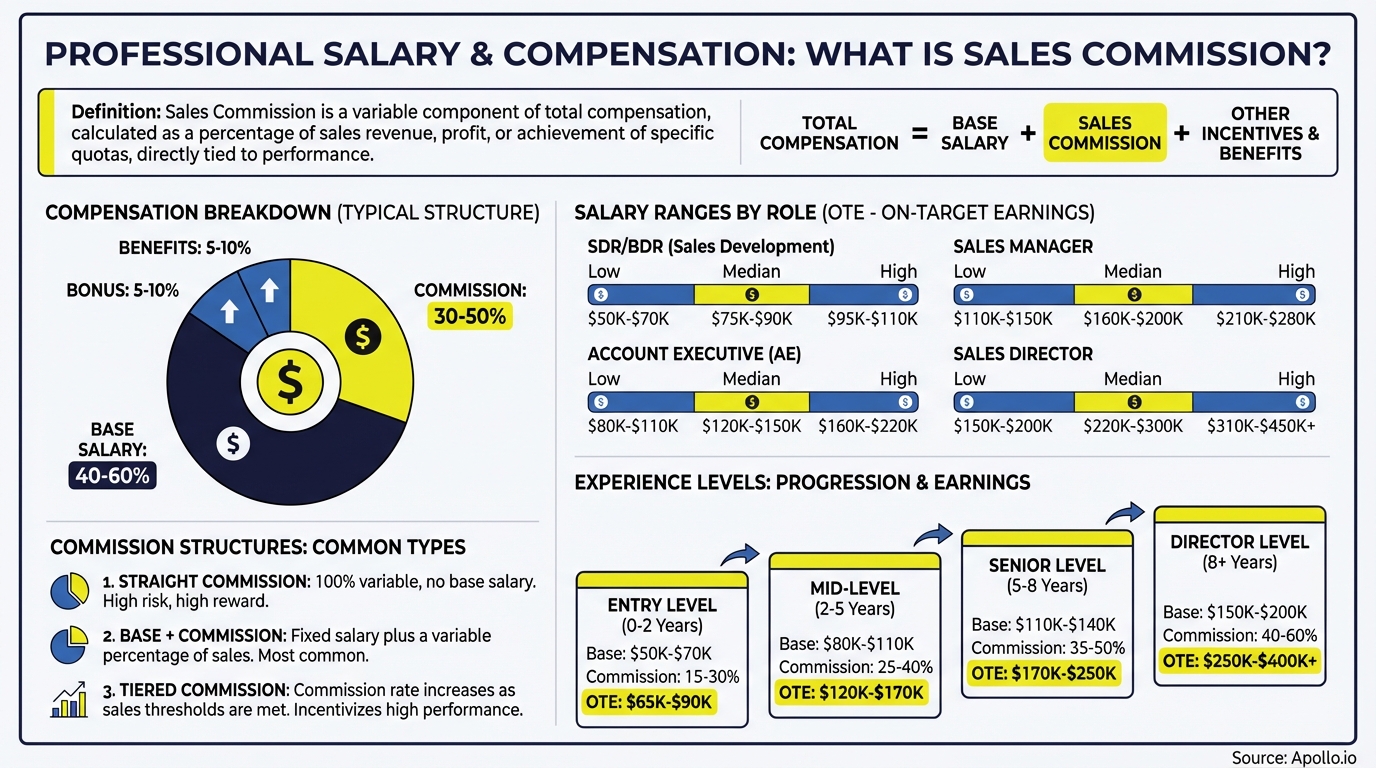
Sales commission is a form of variable compensation paid to salespeople based on the revenue or deals they generate. It is calculated as a percentage of the deal value, gross margin, or another agreed metric.
Commission is separate from base salary and is designed to incentivize specific selling behaviors aligned with company goals.
A standard commission formula looks like this: Commission = Deal Value × Commission Rate. For example, a rep closing a $50,000 deal at a 7% commission rate earns $3,500.
Most plans layer in thresholds (a minimum attainment before commission kicks in) and accelerators (higher rates for exceeding quota) on top of this base calculation.
Commission is not the same as a bonus. Bonuses are typically discretionary and tied to company or team performance. Commission is formulaic, tied directly to individual output, and usually governed by a formal sales contract or compensation agreement.
What Are the Main Types of Sales Commission Structures?
Different structures serve different sales motions. Choosing the wrong one misaligns rep behavior with company goals.
| Structure | How It Works | Best For |
|---|---|---|
| Straight Commission | 100% variable pay, no base salary | High-volume, transactional sales |
| Base + Commission | Fixed base salary plus a percentage of sales | Most B2B sales roles |
| Tiered Commission | Rate increases as attainment thresholds are crossed | SaaS, enterprise, complex deals |
| Gross Margin Commission | Commission on profit, not total revenue | High-discount environments |
| Residual Commission | Ongoing pay for retained accounts | Subscription and recurring revenue models |
| Multi-Metric Commission | Blends revenue, margin, product mix, or retention metrics | Modern enterprise GTM teams |
According to Everstage, SaaS and technology sales often utilize tiered commission structures with accelerators for exceeding quota. This makes sense given the recurring revenue model, where retaining and expanding accounts is as valuable as new logo acquisition.
Turn Weak Leads Into Pipeline With Apollo
Pipeline forecasting a guessing game because quality leads never materialize? Apollo surfaces in-market buyers the moment they're ready, turning funnel gaps into booked meetings. Nearly 100K paying customers stopped guessing and started closing.
Start Free with Apollo →How Does Quota Attainment Affect Commission Earnings?
Quota attainment is the percentage of your sales target you actually hit. It determines which tier of your commission plan you land in and whether accelerators or penalties apply.
Most reps do not earn their full OTE because they do not hit 100% of quota.
Research from TryKondo shows that quota attainment has been historically low, ranging from 16-28% in enterprise studies, a decrease from approximately 50% a decade ago. This is a critical framing point: commission is not a guaranteed supplement to base salary. For most reps, it represents earnings risk as much as earnings opportunity.
This reality makes understanding your plan's thresholds essential. Key attainment milestones to know:
- Below threshold (e.g., under 50%): Zero or reduced commission kicks in
- At quota (100%): Standard OTE commission rate applies
- Above quota (e.g., 120%+): Accelerator rates pay above standard, often 1.5x to 2x the base rate
For AEs and enterprise reps working high-ticket sales, a single deal can push attainment from 60% to 110%, triggering accelerator payouts that substantially increase total compensation.

What Are Multi-Metric Commission Plans and Why Do They Matter?
Multi-metric commission plans weight two or more performance indicators to calculate payout. They are increasingly common because single-metric (revenue-only) plans can drive behaviors that hurt margin, customer retention, or product mix.
A typical multi-metric plan might look like this:
- 60% weight: New revenue (ARR or TCV)
- 20% weight: Gross margin or deal profitability
- 20% weight: Product attachment or customer retention
The 20% threshold matters. For a metric to meaningfully change rep behavior, it needs sufficient financial weight in the plan. Kennect notes that in high-margin industries like SaaS, commissions can be as high as 12% of the deal's value, giving plan designers room to split rates across multiple metrics without reducing the motivating power of each component.
RevOps leaders building or auditing plans should map each metric to the specific behavior they want to drive, then verify the weight is sufficient to make it worth the rep's attention. Tracking the right sales KPIs alongside commission metrics keeps plans grounded in business outcomes.
How Do AEs and SDRs Maximize Commission Earnings?
The commission you earn depends not just on your plan structure but on your ability to build consistent pipeline. Reps who hit quota reliably share one common trait: they control their pipeline inputs, not just their close rates.
For SDRs, commission is often tied to meetings booked or qualified opportunities passed. Maximizing this requires volume and quality, which means spending less time on manual research and more time on outreach. Struggling to build enough pipeline to hit quota? Apollo's AI-powered pipeline builder helps SDRs find, qualify, and engage prospects faster in one unified platform.
For AEs, commission maximization means shortening sales cycles and protecting deal value. Discounting to close kills margin-based commission. The right closing techniques and pre-meeting intelligence reduce the need to discount. Understanding the factors that affect sales performance helps AEs identify and eliminate the variables dragging down attainment before they affect payout.
What Is Commission Plan Governance and Why Does It Reduce Disputes?
Commission governance is the set of processes that define how plans are communicated, administered, and disputed. Poor governance is the leading cause of rep distrust and plan-driven turnover.
A well-governed commission plan includes:
- Written plan documents signed before the period starts, not after
- True-up schedules that reconcile estimated vs. actual payouts on a defined cadence
- Dispute resolution workflow with clear timelines and an escalation path
- Clawback policy with explicit triggers (e.g., customer churn within 90 days)
- Change notification windows giving reps advance notice before plan modifications take effect
Everstage reports that sales compensation is moving toward flexible, data-driven, and personalized incentive models that align seller performance with long-term business objectives. Governance infrastructure is what makes that flexibility manageable without creating confusion or disputes at payout time.
RevOps teams managing commission administration benefit from connecting plan data to revenue operations workflows, ensuring plan changes propagate correctly and payouts reconcile cleanly with CRM data.
Spending too much time reconciling commission data manually? Apollo's sales engagement platform gives revenue teams a single source of truth for activity data, making commission calculations and performance tracking far less error-prone.

What Should Sales Leaders Know About Commission Plan Design in 2026?
Commission plan design is under more scrutiny than ever. Sales leaders need to balance motivating top performers, managing compensation costs, and driving the right mix of behaviors across a diverse team.
Key design principles for 2026:
- Pay mix matters: Most B2B sales roles sit between 50/50 and 70/30 (base/variable). Higher variable ratios work for transactional roles; lower variable suits complex, long-cycle deals.
- Plan simplicity drives adoption: Reps should be able to calculate their commission mentally. Plans with more than three metrics lose motivational power.
- Accelerators retain top performers: Uncapped or high-ceiling accelerators are a key retention tool for reps who consistently exceed quota.
- Ramp periods protect new hires: New reps in months 1-3 typically receive reduced quota or guaranteed minimums to allow fair ramp time.
Sales analytics are essential for validating whether your plan is working as designed. Sales analytics tools can surface attainment distributions, identify plan outliers, and flag when commission costs are diverging from revenue outcomes before the quarter closes.
Conclusion: Build the Pipeline That Makes Commission Achievable
Sales commission is a performance contract between reps and their company. Understanding your structure, attainment thresholds, accelerators, and governance rights turns commission from a passive outcome into an active strategy.
The reps who earn the most are not just the best closers. They build the most consistent pipeline, work their plan deliberately, and know exactly where they stand at every point in the quarter.
Apollo gives B2B GTM teams, from SDRs to enterprise AEs, the prospecting, engagement, and pipeline tools to hit quota consistently. Over 2M users and nearly 100K paying customers use Apollo as their all-in-one platform, consolidating what used to require multiple tools into one workspace. Ready to build the pipeline that turns your commission plan into reliable earnings? Schedule a Demo and see how Apollo helps your team hit quota faster.
Prove Pipeline ROI With Apollo
Budget approval stuck on unclear metrics? Apollo delivers measurable pipeline impact from day one — no lengthy onboarding, no guesswork. Leadium 3x'd annual revenue after making the switch.
Start Free with Apollo →Don't miss these
Sales
Inbound vs Outbound Marketing: Which Strategy Wins?
Sales
What Is a Sales Funnel? The Non-Linear Revenue Framework for 2026
Sales
What Is a Go-to-Market Strategy? The 2026 GTM Playbook
See Apollo in action
We'd love to show how Apollo can help you sell better.
By submitting this form, you will receive information, tips, and promotions from Apollo. To learn more, see our Privacy Statement.
4.7/5 based on 9,690 reviews
