
What Is Account-Based Selling and How Does Sales Automation Support It?
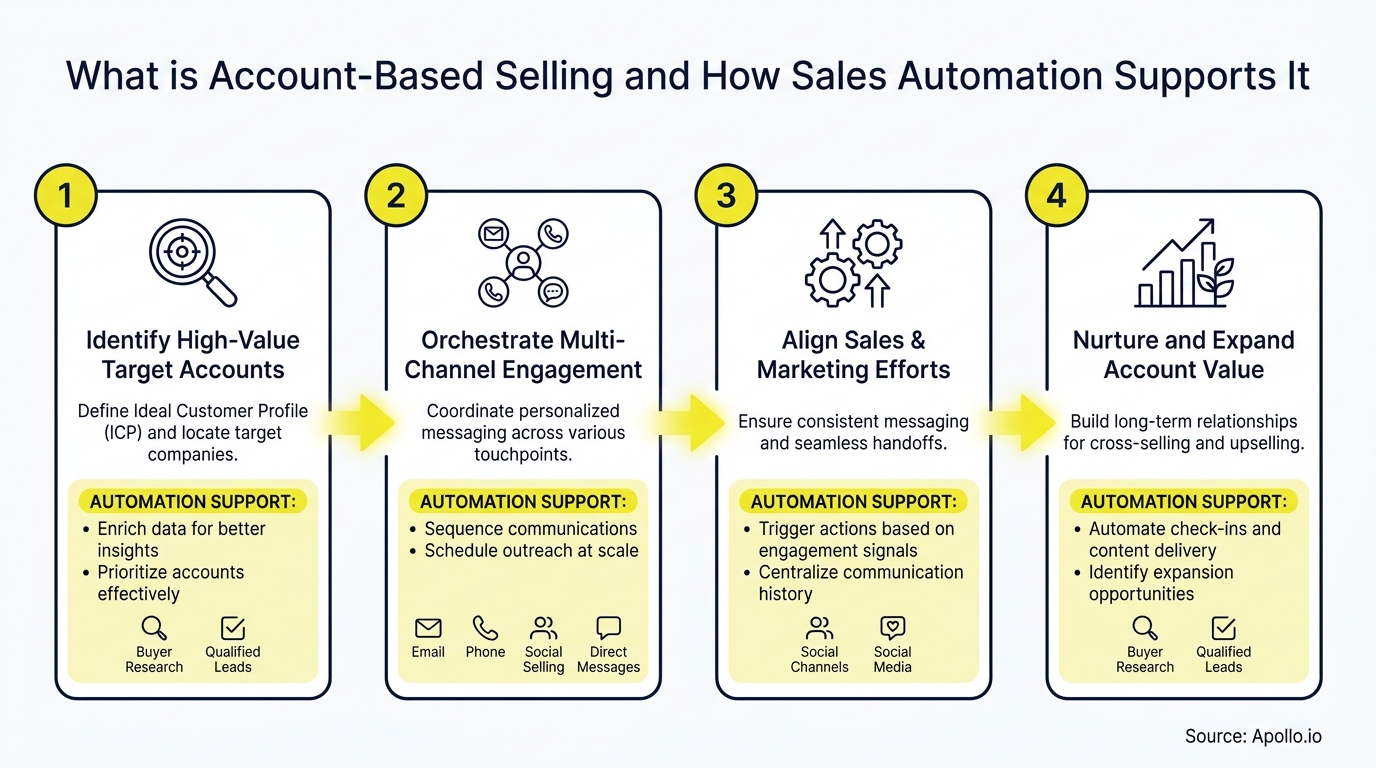
Account-based selling (ABS) is a B2B sales strategy where teams focus resources on a defined set of high-value target accounts rather than chasing individual leads. Instead of casting a wide net, reps identify the buying committee inside each account, personalize outreach by stakeholder role, and coordinate across sales, marketing, and customer success to move the account forward. Sales automation is what makes ABS scalable — handling research, enrichment, and sequencing so reps spend time on conversations, not admin.
McKinsey's 2026 Global B2B Pulse reframes ABS not as a targeting tactic but as a growth operating system, noting that outperformers are redesigning commercial systems around hyperpersonalization, scaled generative AI, and disciplined account-based governance. The shift is already underway — and teams without automation are falling behind.

Research Less, Pipeline More With Apollo
Tired of your reps burning hours on manual lead research instead of selling? Apollo surfaces verified contacts instantly so your team scales outreach without scaling headcount. Join 600K+ companies building predictable pipeline.
Start Free with Apollo →Key Takeaways
- Account-based selling focuses sales effort on named high-value accounts, not individual leads — buying-committee mapping is the foundation.
- Sales automation shifts reps from manual admin to account intelligence and next-best action, directly increasing time spent selling.
- Irrelevant automation actively damages ABS — relevance filters and human approval points are non-negotiable guardrails.
- ABS KPIs differ from lead-based metrics: measure account engagement coverage, pipeline influence per account, and deal velocity by tier.
- A unified GTM platform consolidates account data, engagement, and pipeline tracking — eliminating the fragmentation that kills account plays.
What Is Account-Based Selling and How Is It Different from Lead-Based Selling?
Account-based selling is the sales-side execution of an account-based go-to-market strategy: selecting named accounts, mapping all buying-committee members, and running coordinated, personalized plays across every stakeholder. Lead-based selling, by contrast, treats each inbound or outbound contact as an independent opportunity, regardless of account fit.
| Dimension | Lead-Based Selling | Account-Based Selling |
|---|---|---|
| Unit of focus | Individual lead | Named account + buying committee |
| Outreach | Volume-driven sequences | Personalized plays by stakeholder role |
| Sales/marketing alignment | Hand-off model | Coordinated, account-level coverage |
| Primary KPI | MQL volume, lead conversion rate | Account engagement coverage, pipeline per account |
| Best fit | High-volume, transactional deals | Complex, multi-stakeholder enterprise deals |
ABS vs ABM: ABM (account-based marketing) drives awareness and demand at the account level. ABS is the sales execution that follows — activating conversations, running discovery, and advancing the deal with each buying-committee member. The two work in tandem; ABS without ABM lacks pipeline fuel, and ABM without ABS lacks conversion execution.
Buying-committee mapping checklist:
- Economic buyer (final decision authority)
- Technical evaluator (product/security review)
- Champion (internal advocate)
- End users (day-to-day influencers)
- Legal/procurement (contract approval)
How Does Sales Automation Support Account-Based Selling?
Sales automation supports ABS by removing the manual work — account research, data enrichment, CRM updates, and follow-up sequencing — so reps can focus on the high-judgment conversations that move accounts forward. According to Cirrus Insight, sales professionals spend only 28–30% of their time actively selling, with 70% consumed by administrative tasks, data entry, follow-ups, and internal meetings. Automation reclaims that time and redirects it to account engagement.
Data from Overton Collective shows companies using sales automation see a 14.5% increase in sales productivity and a 12.2% reduction in marketing overhead — meaningful gains when operating at the account level where every touchpoint counts.
| ABS Capability | What Automation Does | Business Outcome |
|---|---|---|
| Account selection | Scores accounts using firmographic, intent, and engagement signals | Reps prioritize the accounts most likely to convert |
| Contact enrichment | Maps and enriches buying-committee contacts automatically | Full committee coverage without manual research |
| Next-best action | Surfaces recommended outreach based on account activity | Timely, relevant engagement at every stage |
| CRM workflow updates | Logs activity, updates stages, triggers alerts automatically | Clean data, faster handoffs, accurate forecasting |
| Measurement | Tracks engagement coverage and pipeline influence per account | Proves ROI, identifies stalled accounts early |
Struggling to identify and enrich your full buying committee? Search Apollo's 230M+ contacts with 65+ filters to map every stakeholder in your target accounts.
Turn Funnel Guesswork Into Closed Deals
Pipeline forecasting a guessing game because quality leads dry up before they reach your AEs? Apollo surfaces verified, in-market contacts so every stage fills with real opportunities. Join 600K+ companies forecasting with confidence.
Start Free with Apollo →What Is the Risk of Irrelevant Automation in ABS?
Irrelevant automation actively undermines account-based selling by eroding trust with exactly the high-value buyers you're trying to win. A Gartner survey of 632 B2B buyers found 73% actively avoid suppliers that send irrelevant outreach, and 69% report inconsistencies between website information and seller-provided information — two failure modes that automation can amplify if left unchecked.
The fix is relevance-first automation with built-in guardrails:
- Relevance filters: Only trigger sequences when an account meets defined engagement or intent thresholds.
- Human approval points: Require rep review before first contact with a new executive or economic buyer.
- Message-channel matching: Align message tone and channel to the stakeholder's role and buying stage.
- Consistency checks: Ensure automated messaging aligns with what's on your website and what AEs say in calls.
This is where sales automation softwaredesign matters: tools that let reps set conditions, review drafts, and approve sends keep automation accountable to the account relationship.

How Do SDRs and AEs Use ABS Automation Together?
SDRs and AEs each have distinct roles in an ABS motion, and automation should support both without creating handoff gaps. SDRs use automation to identify in-market accounts, enrich contacts, and execute the first multi-touch sequences — freeing research time for higher-quality personalization. AEs rely on automation for pre-meeting intelligence, deal-stage alerts, and sales analytics that show which stakeholders are engaged and which are dark.
For RevOps leaders, a unified platform is the prerequisite. Fragmented tools create the data gaps that break account plays mid-cycle. As Cyera noted after consolidating their stack: "Having everything in one system was a game changer." Apollo serves both SDR prospecting and AE deal execution in one workspace, eliminating the handoff friction that stalls account-based deals. See how Apollo's AI sales automation supports full-cycle account-based motions.
What Are the Key ABS KPIs to Track?
ABS KPIs measure account-level progress, not just individual lead activity. Tracking the wrong metrics (MQL volume, email open rates) will misrepresent the health of an account-based program.
- Account engagement coverage: Percentage of buying-committee members with at least one meaningful touchpoint
- Pipeline influence per account: Revenue attributed to account-level marketing and sales activity
- Deal velocity by account tier: Average days from first contact to closed-won, segmented by account tier
- Multi-threading rate: Percentage of active opportunities with 3+ engaged contacts
- Account win rate: Closed-won deals as a percentage of target accounts worked
- Expansion revenue per account: Net revenue retention and upsell from existing ABS accounts
These metrics connect directly to revenue operations reporting — RevOps teams should own the ABS KPI framework and ensure CRM automation captures the right signals at each account stage.
ABS Automation Glossary: Key Terms to Know
These terms appear frequently in ABS and automation discussions. Knowing them helps teams align on strategy and evaluate tools accurately.
- Account scoring: A numerical model ranking target accounts by fit and intent signals to guide rep prioritization.
- Explainable AI (XAI): Account scores presented with the specific reasons behind the ranking, helping reps understand and act on the signal rather than just the number.
- Next-best action (NBA): An automation-surfaced recommendation for what a rep should do next with a specific account or contact, based on engagement data and deal stage.
- Account play: A predefined, coordinated sequence of sales and marketing actions targeting a specific account or account segment.
- Committee mapping: The process of identifying all buying-committee roles within a target account and assigning outreach coverage to each.
- Buyer enablement: Providing buying-committee members with the right content, ROI data, and self-service resources to advance decisions during rep-free stages of the buying journey.

How Do You Get Started with Account-Based Selling and Automation in 2026?
Account-based selling delivers measurable returns when execution is disciplined and automation is relevance-first. According to Powered by Search, 81% of marketers believe ABM delivers a higher ROI than other marketing strategies — and ABS is how sales teams capture that ROI on the execution side.
The practical starting point for most B2B GTM teams in 2026:
- Define your Ideal Customer Profile and build a tiered target account list (Tier 1: high-touch; Tier 2: automated plays; Tier 3: nurture).
- Map the buying committee for every Tier 1 account using enriched contact data.
- Build account plays with relevance triggers — only activate sequences when intent or engagement signals cross a defined threshold.
- Automate CRM updates, next-best action alerts, and handoff triggers so no account falls through the cracks.
- Measure account engagement coverage and pipeline influence weekly, not just MQL counts.
Apollo consolidates account intelligence, contact enrichment, multi-channel sequencing, and pipeline tracking in one platform — the unified workspace that makes ABS executable without a fragmented tech stack. As Census put it: "We cut our costs in half." Explore how Apollo's automation capabilities support every stage of the ABS motion, or start building your target account list today.
Prove Pipeline ROI Before Next QBR
Budget approval stuck on unclear metrics? Apollo delivers measurable pipeline impact your leadership can see — fast. Teams like Leadium 3x'd annual revenue after switching. Start your free trial today.
Start Free with Apollo →Don't miss these
Sales
Inbound vs Outbound Marketing: Which Strategy Wins?
Sales
What Is a Sales Funnel? The Non-Linear Revenue Framework for 2026
Sales
What Is a Go-to-Market Strategy? The 2026 GTM Playbook
See Apollo in action
We'd love to show how Apollo can help you sell better.
By submitting this form, you will receive information, tips, and promotions from Apollo. To learn more, see our Privacy Statement.
4.7/5 based on 9,690 reviews
