
What Does the Transition from a Manual Outbound Motion to an Agentic One Look Like Step by Step?
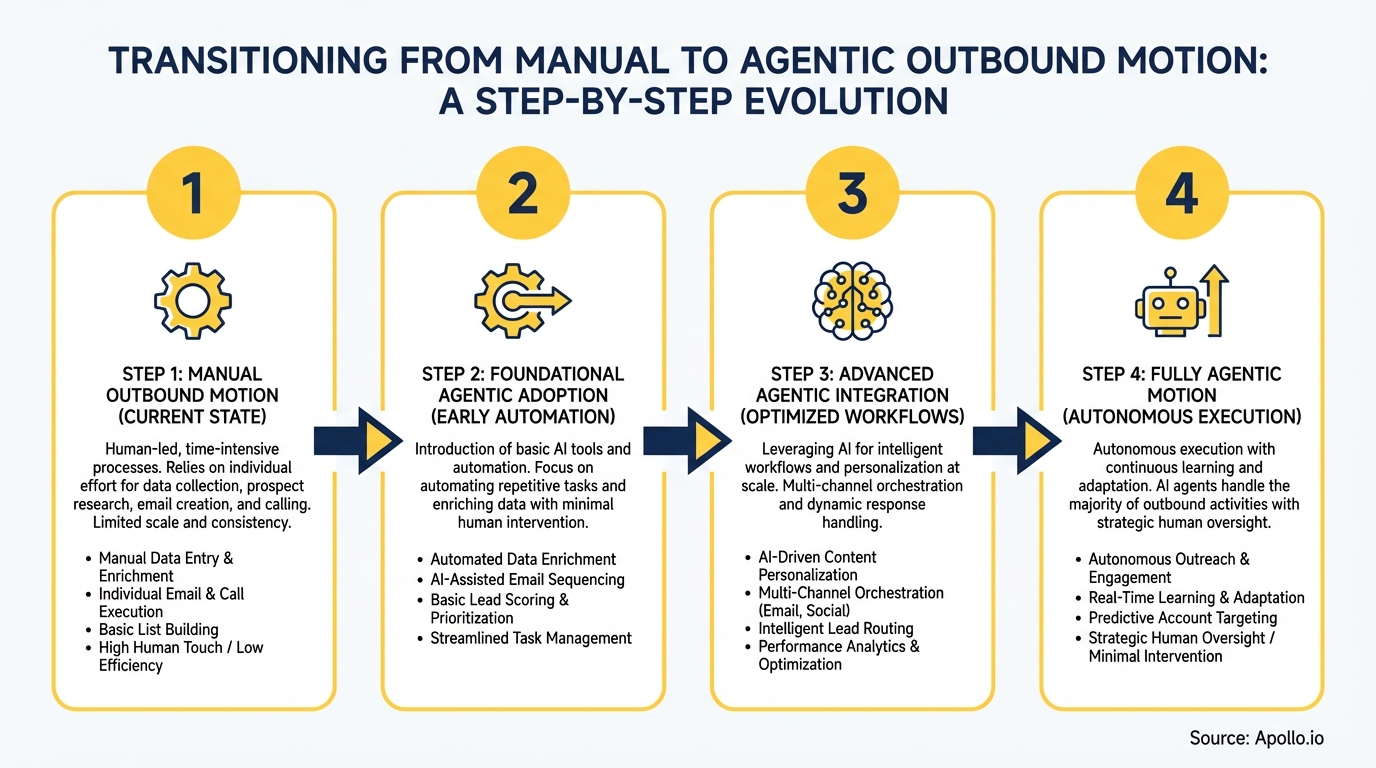
The transition from manual outbound to an agentic motion is a phased shift: you replace rep-driven, task-heavy workflows with AI agents that research, personalize, sequence, and measure outreach autonomously, while humans focus on strategy, approval, and relationship-building. According to MarketBetter.ai, 89% of revenue organizations now use AI in some form, up from 34% in 2023. The teams pulling ahead aren't just using AI tools — they're redesigning their entire outbound motion around agentic workflows.
The challenge is that most teams skip the transition architecture entirely. They bolt an AI writing tool onto an existing sequence and call it agentic.
That's not a transformation — it's a patch. This blueprint gives SDRs, RevOps leaders, and sales managers a stage-gated path from fully manual to fully orchestrated outbound.

Research Less, Pipeline More With Apollo
Tired of burning hours verifying contacts before a single email goes out? Apollo delivers 230M+ business contacts so your reps spend time selling, not searching. Start building pipeline today.
Start Free with Apollo →Key Takeaways
- Agentic outbound replaces manual task execution with AI-driven research, enrichment, messaging, and sequencing — freeing reps for high-value conversations.
- The transition follows five clear phases: Audit, Data Foundation, Agent Deployment, Orchestration, and Governance at Scale.
- Unified data is the single biggest gating factor — agents that lack clean CRM, intent, and firmographic signals hallucinate, spam, or take unsafe actions.
- Multi-agent architectures (specialist agents for research, personalization, follow-up) outperform single "do-it-all SDR bots."
- Each phase has measurable exit criteria — treat this as a maturity model, not a one-time tool purchase.
Why Does Manual Outbound Break Down Before Agentic Takes Over?
Manual outbound breaks down because it depends on rep capacity for tasks that don't require human judgment. Autobound.ai reports that by 2027, Gartner predicts 95% of seller research workflows will begin with AI, up from less than 20% in 2024. The gap between where teams are and where buyers expect them to be is widening fast.
Understanding what's changed in the B2B buyer journey makes this concrete: buyers are further into their decision process before they accept any outreach, which means generic, manually assembled sequences land at the worst possible moment. SDRs spending hours on list-building and copy templating are investing effort in the wrong place. The capacity freed by agentic workflows should redirect into account strategy and conversation quality, not more volume.
What Are the Five Phases of the Manual-to-Agentic Transition?
The transition from manual to agentic outbound follows five sequential phases, each with a clear objective, required inputs, and measurable exit criteria before moving forward.
| Phase | Objective | Key Actions | Exit Criteria |
|---|---|---|---|
| 1. Audit | Map every manual task in your current outbound motion | Document time-per-task, handoffs, error rates; identify highest-effort/lowest-judgment work | Full task inventory with owner and time estimate per rep per week |
| 2. Data Foundation | Create unified, clean data infrastructure agents can trust | Dedupe CRM, define ICP fields, connect intent signals, set consent and routing rules | Single source of truth with 90%+ field completeness on target accounts |
| 3. Agent Deployment | Deploy specialist agents for one workflow at a time | Start with account research agent; add enrichment, then messaging draft agents sequentially | Agent output reviewed and approved by reps with <20% edit rate |
| 4. Orchestration | Connect specialist agents into end-to-end workflows | Chain research → enrichment → personalized sequence → send with human approval gate | Agent-orchestrated sequences running with defined SLA and audit log |
| 5. Governance at Scale | Establish safe autonomy controls before expanding volume | Set approval thresholds, role-based permissions, bias checks, CRM write rules | Governance policy documented; zero unauthorized CRM updates or unsanctioned sends |
Skipping Phase 2 is the most common failure point. Agents running on dirty or incomplete data produce off-target outreach at scale. Treat data readiness as a prerequisite, not a parallel workstream.

How Do SDRs and RevOps Leaders Execute Each Phase Practically?
SDRs execute Phase 1 by logging every prospecting task for one week: list pulls, research tabs open per account, time spent writing first-touch emails, CRM field updates after calls. RevOps leaders use that audit to identify which tasks are pure data manipulation versus genuine judgment calls.
Tasks like firmographic research, contact enrichment, and follow-up scheduling are prime candidates for agent replacement.
For Phase 3, the most effective starting point is a research agent that auto-generates an account intelligence brief before each outreach. Trykondo reports that sales professionals can reclaim 4-7 hours per week by automating prospect research, data entry, and inbox organization. That reclaimed time is where SDRs shift from task execution to conversation strategy. Spending hours on manual outreach? Automate your sequences with Apollo's AI-powered outreach and redirect that capacity toward pipeline-building conversations.
RevOps leaders own Phase 4 and 5. Orchestration requires defining the trigger conditions (e.g., intent signal fires + ICP match + no active opportunity) that initiate an agent workflow. Governance requires setting the constraints: which fields agents can write, what message variants need approval, and how audit logs are reviewed. Understanding how Revenue Operations drives growth is essential context here — agentic outbound only scales safely when RevOps owns the workflow design and guardrails.
What Role Does Unified Data Play in Agentic Outbound Success?
Unified data is the single gating factor for agentic outbound — without it, agents produce irrelevant, repetitive, or unsafe outputs. The minimum data infrastructure for agentic outbound includes CRM data (clean contacts, account hierarchy, activity history), firmographic enrichment (industry, headcount, tech stack), intent signals (topic engagement, category-level buying activity), and consent/routing rules (opt-outs, territory assignments, suppression lists).
A practical 30-day data readiness sprint looks like this:
- Week 1: Audit CRM for duplicate accounts and contacts; establish a deduplication process
- Week 2: Define your ICP framework and map required firmographic fields to your target segments
- Week 3: Connect intent data sources and define signal thresholds that trigger outreach workflows
- Week 4: Document consent rules, suppression lists, and CRM write permissions before any agent is given write access
Struggling to keep your contact data complete and current? Apollo's data enrichment keeps your ICP contacts verified and ready for agentic workflows across 230M+ business contacts with 65+ firmographic filters.
Turn Funnel Gaps Into Pipeline With Apollo
Pipeline forecasting a guessing game because quality leads keep stalling before they convert? Apollo surfaces in-market buyers the moment they're ready, so your team stops chasing cold leads and starts closing. Nearly 100K paying customers trust Apollo to build predictable pipeline.
Schedule a Demo →What Governance Controls Prevent Agentic Outbound from Going Off-Rails?
Governance controls for agentic outbound include approval thresholds, role-based permissions, audit logs, message variant review gates, and CRM write restrictions. These are not optional safety measures — they are the structural requirements that allow volume to scale without brand or compliance risk.
The practical control plane for B2B outbound agents covers four areas:
- Approval gates: All first-touch messages reviewed by a human before send; follow-ups can be auto-sent within approved templates
- CRM write rules: Agents can read all fields but write only to defined activity and status fields; no agent can modify deal stage or contact owner without rep confirmation
- Audit logs: Every agent action logged with timestamp, trigger condition, and output — reviewable by RevOps weekly
- Bias and tone checks: Output reviewed against messaging guidelines before any variant enters a live sequence
Multi-agent architectures reduce governance complexity. Deploying a research agent, a personalization agent, and a scheduling agent separately means each has a narrower scope and is easier to audit than one agent attempting to run the entire outbound sequence end-to-end.
What KPIs Measure Progress Through Each Transition Phase?
Each phase of the transition has distinct KPIs that signal whether teams are ready to advance or need to stabilize before scaling.
| Phase | Primary KPI | Target Benchmark |
|---|---|---|
| Audit | Hours/week per rep on non-selling tasks | Baseline documented |
| Data Foundation | CRM field completeness on ICP accounts | 90%+ completeness |
| Agent Deployment | Rep edit rate on agent-generated content | <20% requiring substantive edits |
| Orchestration | Agent-initiated sequences as % of total | 50%+ of new sequences agent-initiated |
| Governance at Scale | Unauthorized CRM writes or unsanctioned sends | Zero incidents per quarter |
Adoption benchmarks confirm the urgency. According to Cirrus Insight, AI adoption among sales representatives rose from 24% in 2023 to 43% in 2024, nearly doubling in a single year. Teams that have completed Phases 1-3 are already operating at a measurable productivity advantage over those still running fully manual motions. Understanding the full sales acceleration formula helps revenue leaders frame these KPIs in the context of overall pipeline velocity, not just activity metrics.
How Do You Start the Transition Without Disrupting Active Pipeline?
Start the agentic transition on a parallel track: keep existing manual sequences running while piloting one agent workflow on a separate, net-new account segment. This isolates any early agent errors from active pipeline and gives RevOps a clean dataset to measure agent performance against manual baseline.
A low-risk pilot structure for most B2B teams:
- Select a tier-3 account segment with no active opportunities
- Deploy a research agent to generate account briefs for 50 target accounts
- Have SDRs review and rate brief quality before any outreach is sent
- Once brief quality is validated, layer in a personalized first-touch draft agent
- Measure reply rate and meeting rate against your manual motion baseline over 30 days
This approach protects your highest-value buyer leads from early-stage agent errors while building the organizational confidence needed to expand agentic workflows to strategic accounts. For AEs managing enterprise accounts, the pilot also surfaces which agent outputs need the most human refinement — protecting relationship quality at the top of your pipeline.

Start Your Agentic Outbound Transition with Apollo
The transition from manual to agentic outbound is a structured, phase-gated process — not a tool swap. Teams that complete the five phases gain a compounding advantage: agents handle research, enrichment, and sequencing while reps invest their time in conversations that close deals.
The data foundation and governance controls built along the way make scaling safe, not just fast.
Apollo consolidates the intelligence, engagement, and automation layers that agentic outbound requires into one platform. Customers like Cyera report that "having everything in one system was a game changer" — and Predictable Revenue found they "reduced the complexity of three tools into one." For SDRs, RevOps leaders, and sales managers ready to move from manual sequences to orchestrated agentic workflows, Apollo provides the unified data, sales intelligence tools, and AI automation in a single workspace.
Start Free with Apollo and run your first agentic outbound workflow today.
Prove Pipeline ROI With Apollo
ROI pressure killing your next budget approval? Apollo delivers measurable pipeline impact from day one — no guesswork, no waiting. Leadium 3x'd their annual revenue after making the switch.
Start Free with Apollo →Don't miss these
Sales
Inbound vs Outbound Marketing: Which Strategy Wins?
Sales
What Is a Sales Funnel? The Non-Linear Revenue Framework for 2026
Sales
What Is a Go-to-Market Strategy? The 2026 GTM Playbook
See Apollo in action
We'd love to show how Apollo can help you sell better.
By submitting this form, you will receive information, tips, and promotions from Apollo. To learn more, see our Privacy Statement.
4.7/5 based on 9,690 reviews
