
What Does KPI Stand for in Sales? Definition and Key Metrics
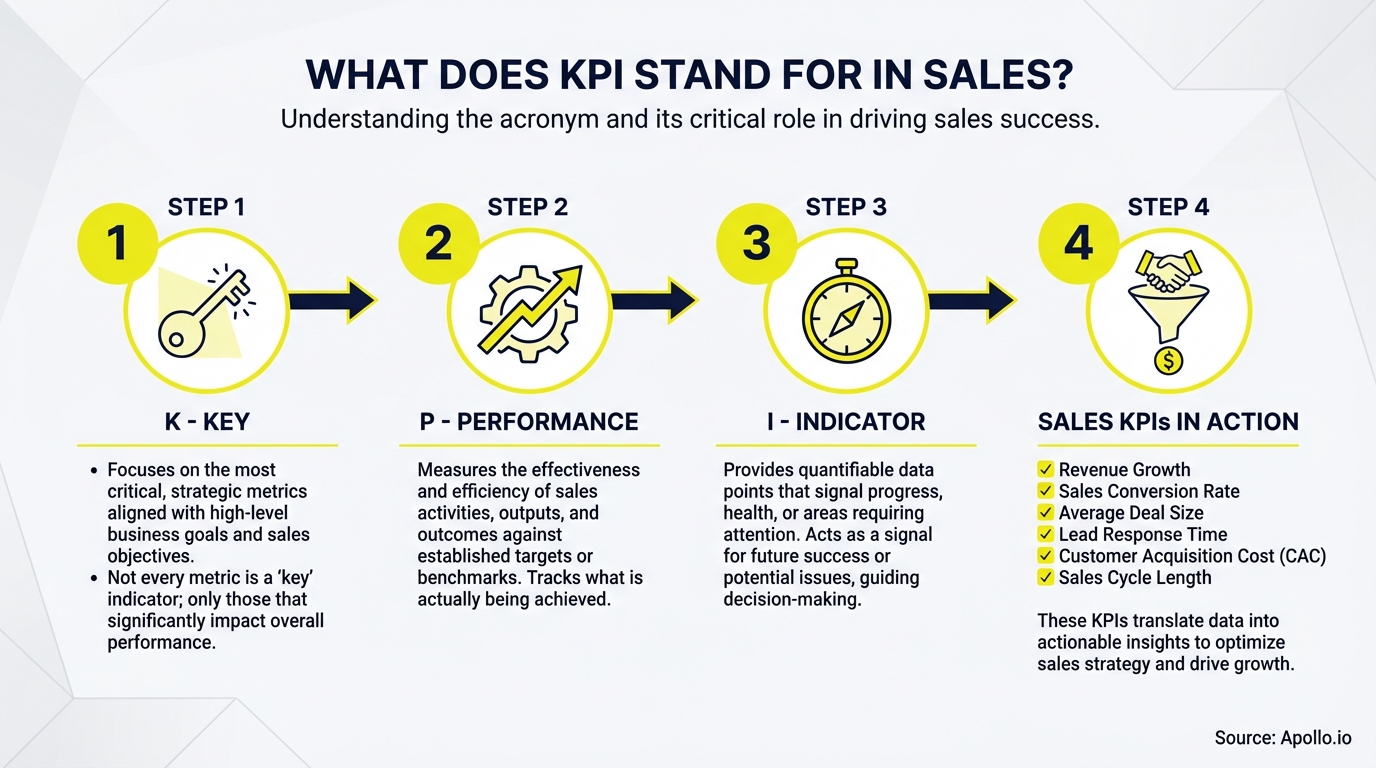
Sales teams in 2026 operate in a data-driven environment where every action needs measurement and optimization. KPI stands for Key Performance Indicator in sales, and these metrics serve as the foundation for tracking progress toward revenue goals, identifying bottlenecks, and making informed decisions. Understanding which KPIs matter for your role and how to track them effectively separates high-performing teams from those struggling to hit quota. Sales KPIs provide the clarity SDRs, AEs, and RevOps leaders need to optimize their workflows and drive predictable revenue.

Scale Quality Lead Gen With Apollo
Generating qualified leads too slow. Apollo automates targeting with 224M+ verified contacts and AI-powered scoring. GTM Ops Agency drove 4x more meetings through automated outbound.
Start Free with Apollo →Key Takeaways
- KPI stands for Key Performance Indicator, a measurable value tracking sales progress toward business objectives
- Different sales roles require different KPIs: SDRs focus on activity metrics, AEs on conversion rates, and RevOps on pipeline health
- Data-driven sales organizations using analytics platforms achieve higher growth rates than competitors relying on intuition
- Modern KPI tracking consolidates data from multiple sources into unified dashboards for real-time visibility
- Cross-functional alignment between marketing and sales teams improves when both track shared KPIs
What Does KPI Stand For in Sales?
KPI stands for Key Performance Indicator, a quantifiable metric that measures how effectively sales teams achieve critical business objectives. In sales, KPIs track everything from prospecting activities to closed revenue, providing visibility into what's working and what needs adjustment. Research by Gartner shows that by 2025, 60% of B2B sales organizations transitioned to data-driven selling approaches, making KPI tracking essential for competitive performance.
Sales KPIs differ from general business metrics because they directly connect individual actions to revenue outcomes. For example, an SDR's email open rate is a KPI that predicts meeting bookings, while an AE's average deal size indicates pricing effectiveness. These indicators create accountability and enable sales performance management at scale.

Why Are Sales KPIs Important in 2026?
Sales KPIs provide the objective measurement framework teams need to navigate increasingly complex buyer journeys. According to Gartner's 2024 survey, 61% of B2B buyers prefer rep-free buying experiences, forcing sales teams to track digital engagement metrics alongside traditional conversation-based KPIs. Without clear indicators, teams can't optimize for self-service channels or know when to intervene in the buying process.
KPIs also drive alignment across GTM teams. When marketing and sales track shared indicators like MQL-to-SQL conversion rates and pipeline velocity, they collaborate more effectively. McKinsey research demonstrates that B2B companies using commercial analytics effectively are 1.5 times more likely to achieve above-average growth rates. For revenue operations teams, KPIs create the single source of truth needed to forecast accurately and allocate resources strategically.
What KPIs Should SDRs Track in 2026?
SDRs and BDRs need activity-based KPIs that measure both quantity and quality of prospecting efforts. The goal is booking qualified meetings, so metrics should track progress toward that outcome.
| KPI Category | Specific Metrics | Why It Matters |
|---|---|---|
| Activity Metrics | Emails sent, calls made, social touches | Measures daily effort and consistency |
| Engagement Metrics | Email open rates, reply rates, call connect rates | Indicates message quality and targeting accuracy |
| Conversion Metrics | Meetings booked, meeting show rate, meetings-to-opportunity rate | Tracks effectiveness at moving prospects through pipeline stages |
| Pipeline Contribution | Pipeline generated, average opportunity value | Connects SDR activity to revenue outcomes |
Struggling to find qualified leads efficiently? Search Apollo's 224M+ contacts with 65+ filters to build targeted lists faster. SDRs using all-in-one prospecting platforms report better KPI performance because they consolidate research, outreach, and tracking in one workspace rather than switching between three separate tools.
See Every Deal In Real-Time With Apollo
Pipeline forecasting a guessing game? Apollo delivers live visibility across every deal stage with verified contact data and intent signals. Built-In increased win rates 10% with Apollo's scoring.
Start Free with Apollo →What KPIs Do Account Executives Need?
Account Executives focus on conversion and revenue KPIs that measure their ability to close deals and expand accounts. Unlike SDRs, AEs track metrics across longer time horizons and larger deal values.
Critical AE KPIs include:
- Win rate: Percentage of opportunities that close as won deals
- Average deal size: Mean contract value across closed deals
- Sales cycle length: Days from opportunity creation to close
- Quota attainment: Percentage of monthly/quarterly revenue target achieved
- Pipeline coverage ratio: Total pipeline value divided by quota (typically 3-5x)
- Activity metrics: Demos delivered, proposals sent, follow-up touchpoints
For Account Executives managing complex B2B sales cycles, tracking these KPIs requires visibility into deal progression and buyer engagement. Modern enterprise sales platforms consolidate CRM data, conversation intelligence, and pipeline analytics into unified dashboards that make KPI tracking effortless.

How Do RevOps Teams Use KPIs?
Revenue Operations leaders monitor system-level KPIs that span marketing, sales, and customer success. Their metrics focus on operational efficiency, data quality, and cross-functional alignment rather than individual performance.
RevOps KPIs typically include:
- Lead-to-customer conversion rate: Percentage of leads that become paying customers
- Customer acquisition cost (CAC): Total GTM spend divided by new customers acquired
- Pipeline velocity: Speed at which deals move through stages
- Forecast accuracy: Variance between predicted and actual closed revenue
- Data completeness: Percentage of contact and account records with required fields populated
- Tech stack ROI: Revenue impact per dollar spent on sales tools
Tired of maintaining multiple tools for prospecting, engagement, and analytics? Apollo's all-in-one GTM platform consolidates your tech stack and cuts costs. RevOps teams at companies like Census report cutting their tool costs in half by moving to unified platforms that track KPIs across the entire revenue cycle.
What KPIs Matter for Sales Leaders?
Sales leaders and executives need high-level KPIs that indicate team health, forecast reliability, and revenue trajectory. These metrics inform strategic decisions about hiring, territory planning, and resource allocation.
| Leadership KPI | What It Measures | Target Benchmark |
|---|---|---|
| Team quota attainment | Percentage of reps hitting quota | 60-80% of team at 100%+ |
| Ramp time | Days for new hires to reach full productivity | 90-120 days for AEs, 30-60 for SDRs |
| Win rate by deal size | Close rates segmented by ACV tiers | Varies by ICP and sales motion |
| Pipeline generation rate | New pipeline created per month/quarter | 3-5x quarterly quota |
| Customer retention rate | Percentage of customers renewing contracts | 90%+ for SaaS |
Sales leaders also track coaching effectiveness metrics like rep skill development scores and the correlation between manager 1:1 frequency and quota attainment. Sales automation platforms surface these insights by connecting activity data with outcomes, enabling leaders to coach based on evidence rather than intuition.
How to Implement KPI Tracking That Actually Works
Start by defining 3-5 core KPIs per role that directly connect to revenue goals. Too many metrics create noise, while too few miss important signals.
Document each KPI's definition, calculation method, data source, and target threshold.
Implementation steps:
- Audit data quality: Ensure your CRM and sales tools capture accurate, complete information
- Build role-specific dashboards: Create views that show relevant KPIs for SDRs, AEs, managers, and executives
- Set review cadences: Daily for activity metrics, weekly for conversion rates, monthly for revenue targets
- Connect KPIs to compensation: Align variable pay with the indicators that matter most
- Train teams on interpretation: Teach reps how to use KPI data to improve their approach
Modern sales teams use platforms that automatically track KPIs across prospecting, engagement, and deal management. Companies like Cyera report that having everything in one system was a game changer for KPI visibility, eliminating the manual reporting work that previously consumed hours each week. Sales funnel analytics become actionable when your tech stack consolidates data from every stage.
Start Tracking Sales KPIs That Drive Revenue
KPI stands for Key Performance Indicator, but in sales, it represents something more fundamental: the measurable connection between daily activities and revenue outcomes. Whether you're an SDR tracking meeting bookings, an AE monitoring win rates, or a RevOps leader optimizing pipeline velocity, the right KPIs provide clarity in an increasingly complex buying environment.
The shift toward data-driven selling makes KPI tracking non-negotiable in 2026. Organizations that effectively use analytics grow faster than competitors, while those relying on gut feel fall behind.
Start with role-appropriate metrics, invest in platforms that automate tracking, and build a culture where teams use KPI data to continuously improve.
Ready to consolidate your sales tools and get complete KPI visibility? Start your free Apollo trial and track prospecting, engagement, and pipeline metrics in one platform.
Prove Apollo's ROI In Your First 30 Days
Budget approval stuck on unclear metrics? Apollo delivers measurable pipeline impact from day one—track time saved, meetings booked, and revenue generated. Customer. io achieved 50% YoY growth with Apollo's automation.
Start Free with Apollo →Don't miss these
Sales
Inbound vs Outbound Marketing: Which Strategy Wins?
Sales
What Is a Sales Funnel? The Non-Linear Revenue Framework for 2026
Sales
What Is a Go-to-Market Strategy? The 2026 GTM Playbook
See Apollo in action
We'd love to show how Apollo can help you sell better.
By submitting this form, you will receive information, tips, and promotions from Apollo. To learn more, see our Privacy Statement.
4.7/5 based on 9,690 reviews
