
What Does a GTM Engineer Do and Why Is the Role Emerging Now in 2026?
A GTM Engineer designs, builds, and governs the revenue systems that turn go-to-market strategy into measurable execution. The role sits at the intersection of sales, marketing, data, and automation — and it's one of the fastest-growing functions in B2B. Job postings for GTM engineering roles grew from roughly 1,400 in mid-2025 to over 3,000 by January 2026, signaling rapid normalization of the function. If you're a RevOps leader, SDR manager, or sales leader trying to understand what a GTM Engineer actually does and why companies are hiring them now, this is the definitive breakdown.

Let Apollo Find Contacts Instantly
Tired of your reps burning hours on manual research instead of selling? Apollo surfaces verified contacts instantly so your team spends time closing, not digging. Join 600K+ companies building pipeline faster.
Start Free with Apollo →Key Takeaways
- A GTM Engineer is a revenue strategist who builds systems — not a tool administrator who stitches APIs together.
- The role is emerging because AI adoption in GTM workflows has accelerated dramatically, and someone needs to govern, implement, and measure these systems.
- GTM Engineers and RevOps serve complementary functions: RevOps owns strategy and process; GTM Engineers build and operationalize the systems.
- The biggest risk in GTM engineering is the "Frankenstack" trap: prioritizing tool complexity over execution velocity.
- The endgame is Agentic GTM — autonomous systems that run research, scoring, messaging, and routing without manual handoffs.
What Does a GTM Engineer Do?
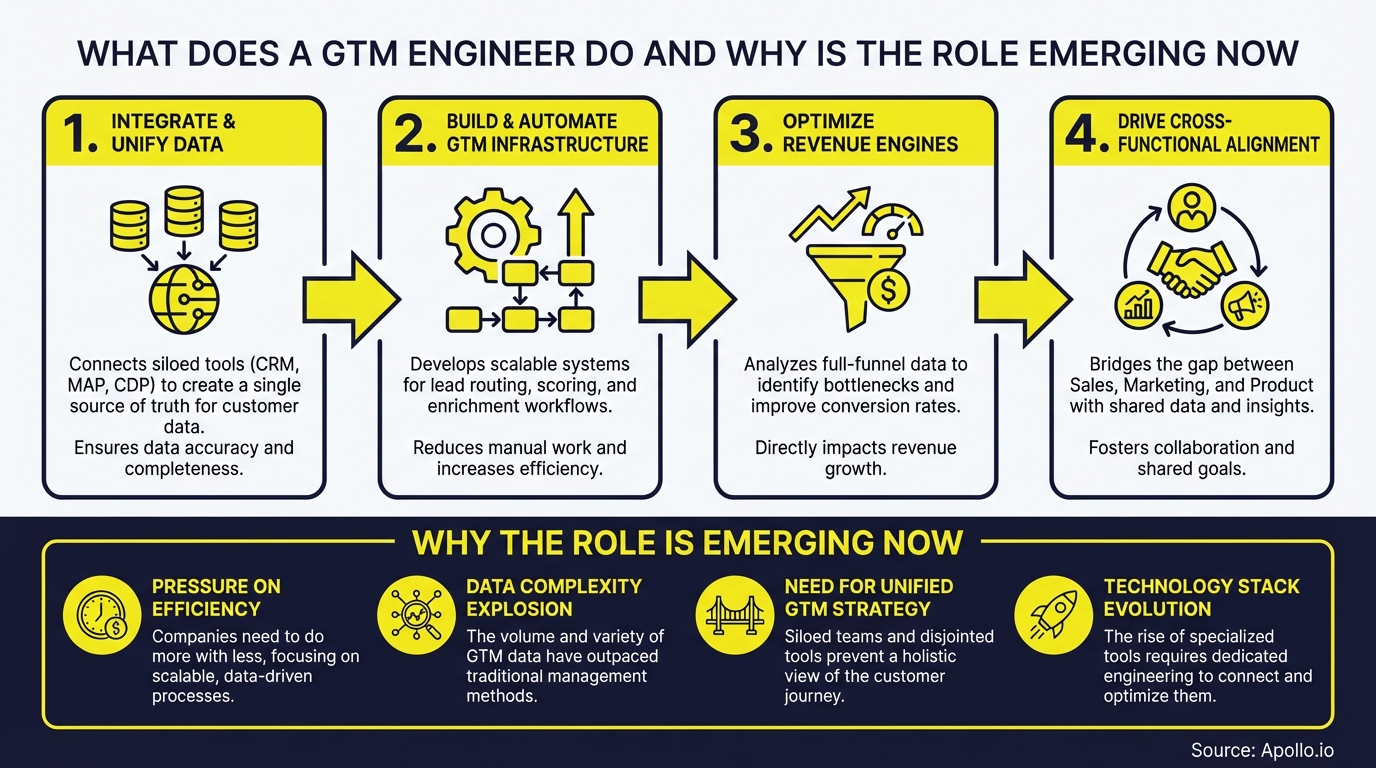
A GTM Engineer architects and automates the systems that drive scalable revenue growth across product, marketing, sales, and operations. According to Metaflow, the role involves "bridging the gap between product, marketing, sales, and operations teams to architect and automate systems that drive scalable revenue growth." This is not a support function — it's a builder role with direct pipeline accountability.
Core GTM Engineer responsibilities include:
- TAM list building: Centralizing the total addressable market into one qualified, segmented source of truth
- Scoring and prioritization: Translating ICP criteria and intent signals into weighted account scores
- Messaging intelligence: Configuring AI prompts that produce research-based, persona-specific outreach at scale
- Data orchestration: Connecting first-party CRM data, enrichment sources, and third-party signals into unified workflows
- Human-in-the-loop (HITL) design: Building review queues so SDRs focus judgment on top accounts while automation handles the rest
- Performance optimization: Tracking which signals correlate with wins and adjusting scoring weights accordingly
As Saleshandy notes, a key GTM Engineer responsibility is "automating GTM workflows: building repeatable systems for lead capture, enrichment, scoring, and routing to accelerate revenue teams." The emphasis on repeatability is critical — GTM Engineers build systems that compound, not campaigns that reset.
Struggling to build a qualified pipeline from your TAM? Search Apollo's 230M+ contacts with 65+ filters to start with verified, segmented data.
Why Is the GTM Engineer Role Emerging Now?
The GTM Engineer role is emerging because AI adoption in revenue workflows has outpaced teams' ability to govern and operationalize it. Three macro forces are converging in 2026:
| Force | What's Happening | Why It Creates Demand for GTM Engineers |
|---|---|---|
| AI-first seller workflows | Gartner projects 95% of seller research will begin with AI by 2027 (up from under 20% in 2024) | Someone must implement, integrate, and govern these AI workflows across the GTM stack |
| Marketing AI adoption | Duke's 2025 CMO Survey found AI/ML now powers 17.2% of marketing activities — a 100% increase since 2022 | Engineering-style build/measure/iterate ownership is required for revenue automations |
| GTM stack proliferation | The number of sales and marketing software tools reached over 15,000 by 2025, per Zylo | Fragmented systems and data silos require a dedicated integrator and optimizer |
The category is also gaining institutional legitimacy. In August 2025, a major funding round in the GTM tools space explicitly positioned GTM Engineering as "an AI-native profession," accelerating adoption beyond early adopters into mainstream revenue teams.
By January 2026, job postings had more than doubled from mid-2025 levels.
How Is a GTM Engineer Different From RevOps?
A GTM Engineer builds systems; RevOps designs the strategy and processes those systems execute. The two roles are complementary, not competing.
Understanding the boundary prevents both duplication and gaps.
| Dimension | RevOps | GTM Engineer |
|---|---|---|
| Primary focus | Process design, pipeline governance, forecasting | System architecture, automation, AI workflow implementation |
| Typical owner of | CRM hygiene, SLA enforcement, reporting | TAM list, scoring models, enrichment workflows, sequencing |
| Output | Process documentation, dashboards, playbooks | Live automated systems, prompt architectures, data pipelines |
| Cadence | Quarterly planning, monthly reviews | Daily system operations, monthly signal tuning |
For a deeper look at the RevOps side of this equation, see What Is Revenue Operations and How Does It Drive Growth? The short answer: RevOps sets the rules; GTM Engineers build the machine that follows them.
Fill Your Funnel Before It Runs Dry
Running out of qualified leads before the quarter ends? Apollo surfaces 230M+ verified contacts matched to your ICP so your pipeline never stalls. Top revenue teams book 46% more meetings — without adding headcount.
Start Free with Apollo →What Skills Does a GTM Engineer Need?
GTM Engineers need a combination of technical depth and revenue strategy fluency. The role is not purely technical — it's not a software engineering job.
It's also not purely strategic — it requires hands-on system building.
According to GoFractional, a core GTM Engineer responsibility is "connecting and managing various sales and marketing tools such as CRM (Salesforce, HubSpot), marketing automation platforms, data enrichment tools, and outreach platforms into a cohesive system." That integration mandate demands both technical and commercial fluency.
Key skill categories:
- Technical: CRM configuration, API integrations, workflow automation (n8n, Make), SQL, Python or JavaScript basics, prompt engineering
- Data: Enrichment pipeline design, signal weighting, data quality governance, attribution modeling
- Revenue strategy: ICP definition, ICP framework and ROI, pipeline metrics, sequencing logic, messaging architecture
- AI operations: Prompt architecture, human-in-the-loop design, QA workflows, agentic workflow governance
Industry compensation for GTM Engineers reflects this hybrid demand, with market salaries typically ranging from $132k to $241k depending on scope and seniority.

How Do SDRs and RevOps Teams Benefit From a GTM Engineer?
SDRs benefit from GTM Engineering by spending less time on research and list-building and more time on conversations that convert. RevOps teams benefit by having someone who translates strategy into running systems — without RevOps having to own the technical build themselves.
A concrete before/after for SDR teams:
- Before: SDR manually researches 15 accounts, writes personalized emails, sends 30 touches by end of day — half the time spent on data entry
- After: System surfaces 50 prioritized accounts with AI-researched context. SDR reviews top 10, approves messages, and 40 go out automatically. By 10am, the SDR is on calls — not building lists
For RevOps leaders, the GTM Engineer solves the perennial problem of strategy dilution. When leadership sets a new targeting priority, the system re-ranks the entire market in hours — no re-briefing of 12 SDRs running different versions of the playbook. For more on the demand generation strategies that GTM systems execute, that resource covers the full funnel.
Spending hours on manual outreach instead of closing? Automate your GTM sequences with Apollo's AI-powered sales automation and let the system handle research and routing.
What Is the GTM Engineer's Biggest Risk?
The biggest risk for a GTM Engineer is the Frankenstack trap: building an elaborate multi-tool workflow and mistaking complexity for sophistication. Many GTM Engineers wear a badge of honor around how many disparate tools they've strung together in n8n and called it a "seamless workflow." The irony is self-defeating — seamless and a 14-tool Frankenstack are an oxymoron by definition.
The best GTM Engineers are revenue strategists, not tool sommeliers. Great strategy demands execution velocity, not integration overhead.
Every additional API dependency is a fragility point. Every additional tool is a contract, a login, a data sync that can break at 2am before a big campaign launch.
The trajectory points toward Agentic GTM: systems that run research, scoring, messaging, and routing autonomously — without a human stitching handoffs between tools. The GTM Engineer who wins long-term deploys the most elegant strategy at the highest velocity, not the most elaborate workflow. Apollo's GTM Engineering (GTME) Program is built around this principle: one platform, one connected workflow, no API babysitting.
For context on how this connects to broader go-to-market strategy, the system a GTM Engineer builds is only as good as the strategy it executes. The role exists to eliminate the gap between the two.

How Do You Get Started With GTM Engineering in 2026?
GTM Engineering is moving from ad-hoc power-user work to an operationalized capability. The GTME Program structures this into a 12-week build: Foundation (TAM + deliverability), Intelligence (scoring + messaging), Orchestration (workflows + data), and Launch (training + live system). The seven-pillar GTME methodology provides the framework any team can adopt regardless of their current stack maturity.
For teams evaluating their current sales and marketing alignment, that's often the first diagnostic: are your marketing signals feeding your sales scoring? If not, a GTM Engineer is the missing link.
The role is real, the demand is accelerating, and the market is still early enough that building this capability now creates a durable competitive advantage. The question isn't whether your team needs GTM engineering — it's whether you build it or fall behind teams that already have.
Ready to build a GTM system that actually executes your strategy? Schedule a Demo with Apollo and see how 2M+ users are collapsing their GTM stack into one end-to-end workflow.
Prove Pipeline ROI Before Next Quarter
ROI pressure killing your tool budget? Apollo delivers measurable pipeline outcomes your exec team can actually see. Leadium 3x'd annual revenue — start your free trial and show the numbers.
Start Free with Apollo →Don't miss these
Revenue Operations
Top Market Intelligence Tools for B2B Teams in 2026
Revenue Operations
Sales Operations Analyst Salary: 2026 Compensation Guide and Benchmarks
Revenue Operations
Sales Compensation Software: How to Automate Commission Management
See Apollo in action
We'd love to show how Apollo can help you sell better.
By submitting this form, you will receive information, tips, and promotions from Apollo. To learn more, see our Privacy Statement.
4.7/5 based on 9,690 reviews
