
Essential Skills for Sales Success in 2026
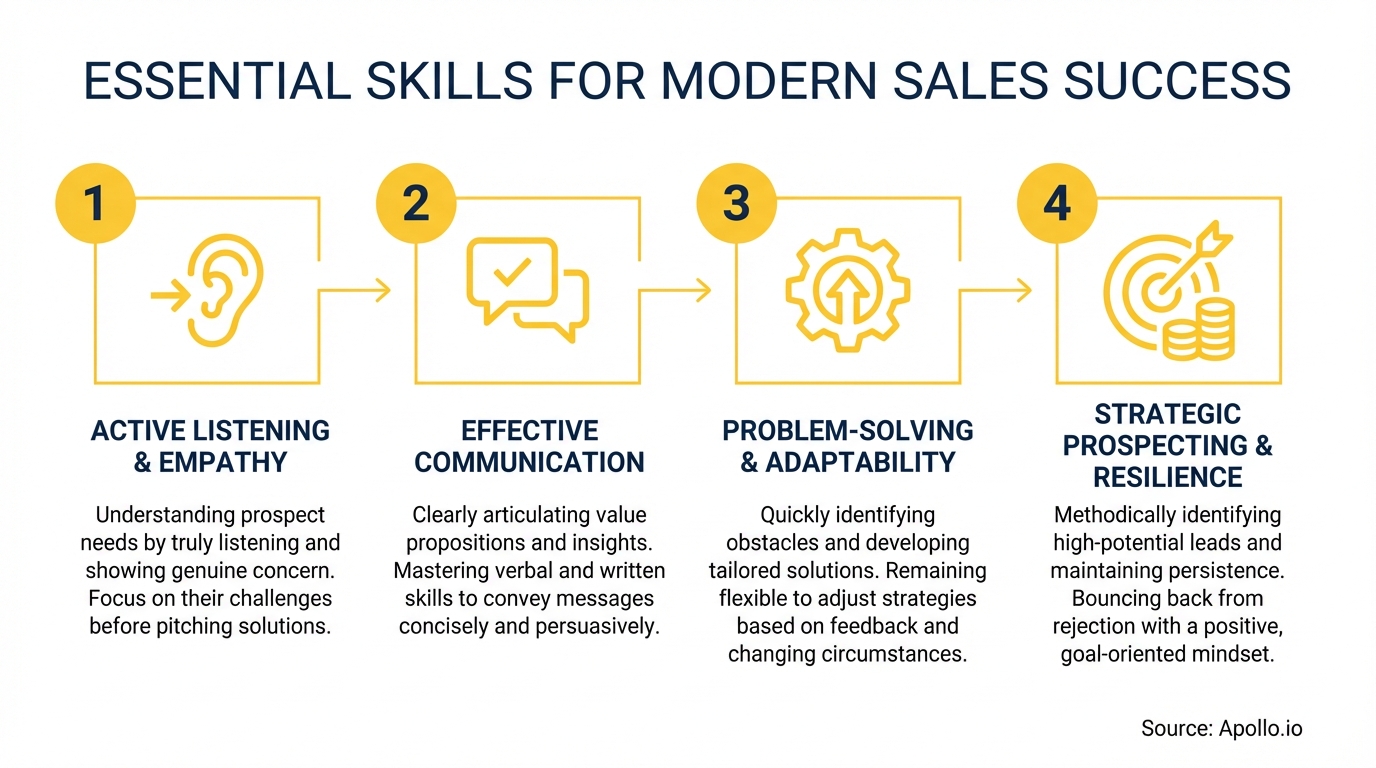
Sales in 2026 demands a hybrid skill set that balances AI fluency with irreplaceable human capabilities. Modern sales professionals must master data-driven prospecting, relevance-first messaging, and technical depth while maintaining emotional intelligence and relationship-building prowess. The stakes are higher: buyers complete 70-90% of their research independently, and 61% prefer a rep-free buying experience. Top-performing sales associates combine foundational sales techniques with emerging competencies like AI workflow management and value-based selling.

Skip Manual Research - Apollo Finds Contacts
Tired of spending 4+ hours daily hunting for contact info? Apollo delivers 224M verified contacts with 96% email accuracy. Join 550K+ companies closing more deals.
Start Free with Apollo →Key Takeaways
- Customer insight and analytical thinking rank as the most crucial sales skill, yet only 27% of professionals feel equipped to deliver actionable insights
- Relational skills and empathy are performance drivers in 2026, essential for building trust in an AI-augmented sales environment
- AI and AI agents are the top growth tactic for 2026, requiring new competencies in workflow design and validation
- Value-based selling focuses on customer outcomes with quantifiable ROI metrics, moving beyond feature discussions
- Tech-savvy professionals who leverage data analytics, AI-driven insights, and unified platforms outperform peers
What Are the Essential Skills for Sales in 2026?
Essential skills for sales in 2026 fall into three categories: foundational relationship skills, analytical competencies, and AI-enabled capabilities. According to Mercuri International's Future State of Sales Skills report, based on a global survey of 591 sales professionals, customer insight and analytical thinking are crucial, yet only 27% of sales professionals feel equipped to deliver actionable insights. This gap between importance and preparedness defines the modern skills challenge.
The foundational layer includes active listening, empathy, and consultative questioning. Research from Sales Dorado shows that only 43% of B2B buyers generally trust salespeople, but 87% trust their regular salesperson with whom they have built a relationship. This underscores why soft skills like honesty, listening, and reliability remain non-negotiable despite technological advances.
The analytical layer requires proficiency in CRM platforms, sales intelligence tools, and data interpretation. Industry research confirms increasing demand for tech-savvy sales professionals who can leverage data analytics, AI-driven insights, and integrated platforms. For SDRs and BDRs, this means using sales analytics to identify high-intent prospects and optimize outreach timing.
How Do SDRs Use AI and Automation Effectively?
SDRs use AI and automation to eliminate manual research, personalize outreach at scale, and focus on high-value conversations. AI agents reduce research time and content creation significantly, allowing SDRs to concentrate on relationship-building and qualification.
The key competency is workflow design: knowing when to use AI for efficiency and when human judgment is required.
Effective SDRs in 2026 master three AI-enabled workflows. First, signal-based prospecting using intent data and buying signals to prioritize accounts. Second, AI-assisted personalization that maintains authenticity while scaling outreach volume. Third, conversation intelligence that surfaces coaching opportunities and refines messaging based on what actually works. Experiments with AI writing tools show these technologies augment rather than replace SDR roles when used strategically.
Struggling to balance prospecting volume with personalization? Automate your research and outreach with Apollo's AI-powered sequences.
Turn Forecast Chaos Into Revenue Certainty
Forecasting feels like guesswork when deal stages aren't visible in real-time. Apollo tracks every prospect interaction automatically, giving you accurate pipeline insights that make quota predictable. Built-In increased win rates 10% with Apollo's scoring.
Start Free with Apollo →Why Are Relational Skills More Important Than Ever?
Relational skills are more important than ever because buyers increasingly distrust generic outreach and prefer human interaction for complex decisions. According to Archetype research, by 2026, relational skills and empathy will be performance drivers, essential for building strong connections and anticipating objections. Gartner predicts that by 2030, 75% of B2B buyers will prefer sales experiences that prioritize human interaction over AI.
This creates a paradox: as AI handles transactional tasks, human skills become the differentiator. Account Executives managing enterprise deals must excel at multi-threading, consensus-building, and navigating procurement complexity.
Sales Leaders need to coach teams on emotional intelligence, active listening, and executive presence. The ability to read buyer signals, adapt communication styles, and build authentic relationships separates top performers from average ones.
For RevOps teams, this means designing systems that free reps from admin work so they can focus on relationship-building. Sales performance management strategies increasingly emphasize coaching quality over activity metrics, recognizing that relationship depth drives revenue more than volume.
What Is Value-Based Selling and How Does It Work?
Value-based selling focuses on customer outcomes and business impact rather than product features. According to The Success Vitamin, in 2026, sales teams must master value-based selling, focusing on customer outcomes and demonstrating value through quantifiable metrics like ROI. This approach requires understanding the prospect's business model, competitive pressures, and success metrics before proposing solutions.
Effective value-based selling follows a structured framework. First, discovery conversations uncover the prospect's current state, desired outcomes, and cost of inaction. Second, solution mapping connects specific capabilities to measurable business results. Third, ROI quantification translates features into financial impact using the prospect's own metrics. Fourth, proof delivery provides case studies and references from similar organizations. The Sales Acceleration Formula provides methodologies for scaling this approach across teams.

AEs and Sales Leaders implementing value-based selling report shorter sales cycles and higher win rates because buyers can justify purchases internally with concrete business cases. This skill is particularly critical when selling to procurement and finance stakeholders who demand quantifiable returns.
How Do Sales Professionals Build Technical Depth?
Sales professionals build technical depth through product certification programs, solution engineering partnerships, and industry specialization. Microsoft's 2025 sales reorganization toward solution engineering roles reflects a market shift: buyers expect credible technical guidance during the sales process, not just post-sale implementation support.
Three paths accelerate technical skill development. First, structured product training with hands-on labs and certification milestones. Second, shadowing solution engineers during technical discovery and proof-of-concept phases. Third, vertical specialization in specific industries to understand technical workflows and integration requirements. Sales leadership books increasingly emphasize technical fluency as a core competency for team development.

For Founders and CEOs building early sales teams, technical depth determines whether reps can navigate complex evaluations independently or require constant engineering support. This directly impacts sales capacity and deal velocity. Modern sales tech stacks should enable reps to access technical documentation, integration specs, and competitive comparisons without leaving their workflow.
What Skills Help Sales Teams Consolidate Their Tech Stack?
Skills that help sales teams consolidate their tech stack include systems thinking, integration management, and vendor evaluation frameworks. Teams at growing startups to mid-market and enterprise organizations struggle with tool sprawl: separate platforms for prospecting, engagement, enrichment, conversation intelligence, and pipeline management create data silos and workflow friction.
Sales Leaders and RevOps professionals need competencies in three areas. First, capability mapping to identify overlapping functionality across tools.
Second, ROI analysis comparing consolidated platforms against point solutions. Third, change management to drive adoption when migrating from familiar tools to unified systems.
As one customer shared, "We reduced the complexity of three tools into one" when consolidating their go-to-market stack.
Need to cut costs while improving team efficiency? Consolidate your prospecting, engagement, and intelligence tools with Apollo's all-in-one platform.
Conclusion: Building Future-Ready Sales Skills in 2026
Building future-ready sales skills in 2026 requires balancing AI fluency with human capabilities that create trust and drive complex decisions. The most successful sales professionals master customer insight and analytical thinking, develop deep relational skills and empathy, embrace value-based selling with quantifiable outcomes, and build technical depth that positions them as credible advisors.
For SDRs, BDRs, and AEs, this means adopting AI for efficiency while investing in the interpersonal skills that differentiate human sellers.
Sales Leaders and Founders should focus enablement efforts on workflow-embedded skill building rather than one-time training events. RevOps teams play a critical role by providing unified platforms that reduce admin burden and surface actionable insights. Sales transformation initiatives succeed when they simplify seller roles while elevating the skills that matter most: understanding customers, building relationships, and delivering measurable value.
Ready to build a high-performing sales team with the right skills and tools? Schedule a Demo to see how Apollo consolidates your sales stack and empowers your team to focus on what they do best: selling.
Show Budget Impact In Days, Not Quarters
Budget approval stuck on unclear metrics? Apollo tracks every touchpoint to pipeline dollar, giving you the ROI proof leadership demands. Built-In increased win rates 10% with visible deal impact.
Start Free with Apollo →Don't miss these
Sales
Inbound vs Outbound Marketing: Which Strategy Wins?
Sales
What Is a Sales Funnel? The Non-Linear Revenue Framework for 2026
Sales
What Is a Go-to-Market Strategy? The 2026 GTM Playbook
See Apollo in action
We'd love to show how Apollo can help you sell better.
By submitting this form, you will receive information, tips, and promotions from Apollo. To learn more, see our Privacy Statement.
4.7/5 based on 9,690 reviews
