
Sales Technology: Definition, Benefits, and Best Practices
Sales teams in 2026 face a defining challenge: buyers now control the journey, AI is reshaping workflows, and tool sprawl drains budgets. According to Research and Markets, the global sales tech market was valued at approximately USD 4.1 billion in 2024 and is projected to reach USD 20.3 billion by 2034, demonstrating a compound annual growth rate (CAGR) of 17.1% from 2025 to 2034. This explosive growth reflects a fundamental shift: sales technology is no longer optional infrastructure but a competitive imperative. Teams that master modern sales tech stacks consolidate tools, automate intelligently, and align to buyer-first journeys are winning. Those clinging to fragmented systems and intuition-based selling are falling behind.

Research Less. Pipeline More With Apollo.
Tired of your reps burning hours on manual research instead of selling? Apollo surfaces verified contacts instantly, so your team scales outreach without scaling headcount. Join 550K+ companies building predictable pipeline.
Start Free with Apollo →Key Takeaways
- Sales technology platforms now consolidate prospecting, engagement, and intelligence into unified workflows, replacing 3-5 separate tools and cutting costs significantly
- AI adoption in sales surged from 24% in 2023 to 43% in 2024, with 92% of organizations planning increased AI investments in 2025
- Buyer behavior has fundamentally shifted: 61% prefer rep-free experiences, and 73% actively avoid suppliers sending irrelevant outreach
- Modern sales tech stacks must support omnichannel engagement, data-driven decision-making, and self-service buyer journeys to remain competitive in 2026
- Teams using consolidated platforms report measurable gains: reduced tool complexity, faster ramp times, and stronger pipeline visibility
What Is Sales Technology in 2026?
Sales technology refers to software platforms and tools that enable sales teams to identify prospects, engage buyers, manage pipelines, and close deals more efficiently. In 2026, sales technology has evolved from standalone point solutions into integrated platforms that combine data intelligence, automation, AI-powered workflows, and analytics in one workspace.
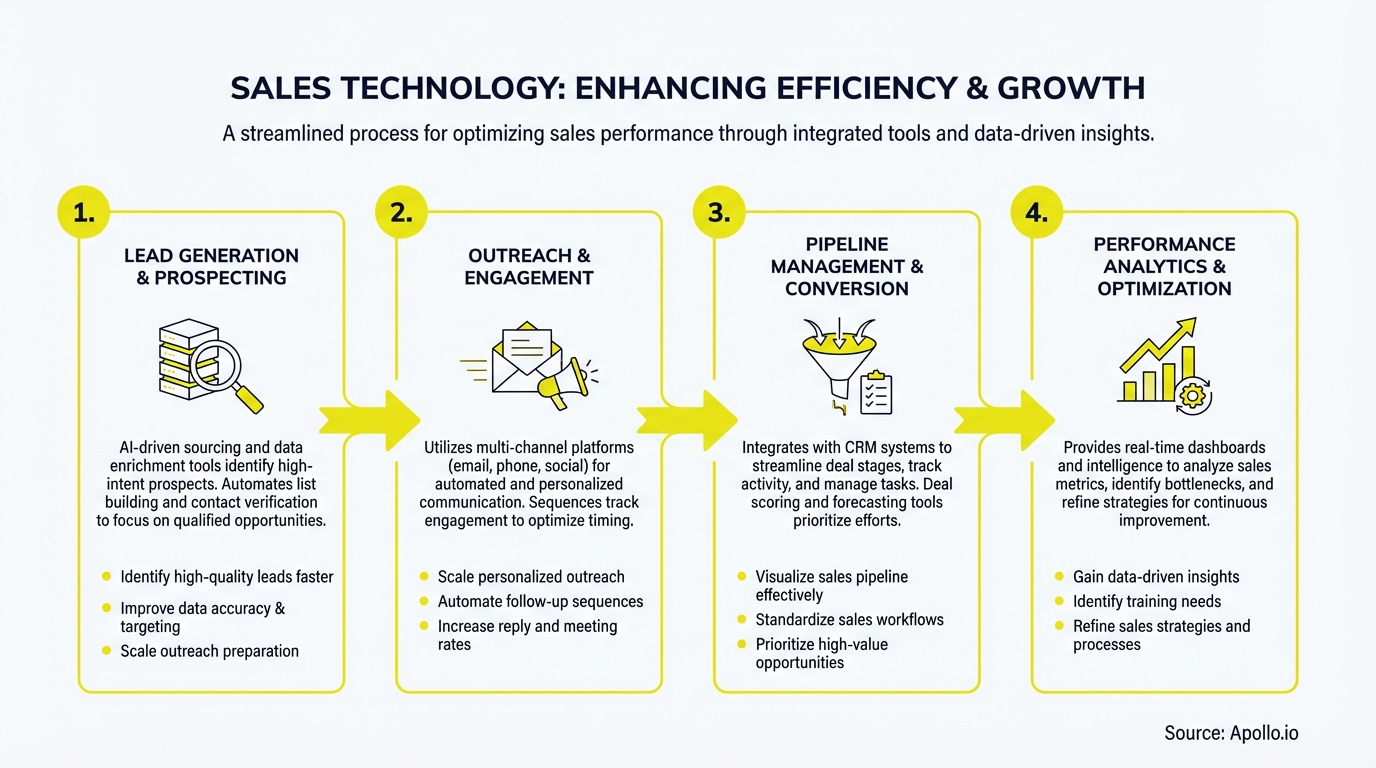
Modern sales tech stacks typically include prospecting and contact discovery, multi-channel engagement and outreach automation, conversation intelligence and call recording, deal and pipeline management, and sales analytics and forecasting. The defining characteristic of 2026 sales technology is consolidation. Teams are moving away from stitching together 5-10 separate tools and toward unified platforms that deliver end-to-end workflows.
Why Is Sales Technology Critical for Revenue Teams?
Sales technology directly impacts revenue outcomes by solving three fundamental problems: data access and accuracy, workflow efficiency and automation, and buyer-seller alignment at scale. Research from HubSpot shows AI adoption in sales has surged from 24% in 2023 to 43% in 2024, enabling teams to automate research, personalize outreach, and prioritize high-intent accounts.
For SDRs and BDRs, sales technology eliminates hours of manual prospecting and data entry. Account Executives gain pre-meeting intelligence and pipeline visibility. Sales Leaders get coaching insights and forecast accuracy. RevOps teams establish a single source of truth across CRM, engagement, and intelligence platforms. Struggling to find qualified leads? Search Apollo's 224M+ contacts with 65+ filters.

What Are the Core Categories of Sales Technology?
The sales technology landscape in 2026 organizes into six functional categories, each addressing specific workflow needs:
| Category | Primary Function | Key Capabilities |
|---|---|---|
| Sales Intelligence & Data | Contact discovery and enrichment | B2B databases, buyer intent signals, account insights, data verification |
| Engagement Platforms | Multi-channel outreach automation | Email sequences, call dialing, task automation, A/B testing |
| Conversation Intelligence | Call recording and analysis | Transcription, coaching insights, sentiment analysis, objection tracking |
| Pipeline & Deal Management | Opportunity tracking and forecasting | Deal stages, win/loss analysis, revenue forecasting, activity tracking |
| Revenue Operations | Cross-functional alignment and analytics | Reporting dashboards, territory management, quota planning, attribution |
| AI & Automation | Workflow optimization and intelligence | Lead scoring, next-best-action, content generation, predictive analytics |
According to Landbase, the overwhelming majority of sales organizations (92%) plan increased investments in AI in 2025. This reflects the category's rapid maturation from experimental to mission-critical. Teams implementing sales automation software report faster deal cycles and higher win rates.
Turn Funnel Gaps Into Pipeline Wins
Pipeline forecasting a guessing game because quality leads dry up before they hit your pipeline? Apollo surfaces in-market buyers the moment they're ready, turning weak top-of-funnel into predictable opportunities. 550K+ companies trust Apollo to forecast with confidence.
Start Free with Apollo →How Do Sales Leaders Build Effective Tech Stacks?
Sales Leaders in 2026 prioritize consolidation over feature accumulation. The most effective tech stacks follow a three-layer architecture: a unified platform for prospecting, engagement, and intelligence (replacing 3-5 point solutions), CRM integration for pipeline and deal management, and specialized tools for conversation intelligence or advanced analytics where needed.
When evaluating platforms, Sales Leaders assess four criteria: data quality and coverage (contact accuracy, refresh frequency, coverage breadth), workflow integration (native CRM sync, API availability, user adoption friction), AI governance and controls (transparency, bias mitigation, human-in-loop workflows), and measurable ROI (time savings, pipeline impact, cost reduction vs. multi-tool stacks). Teams at companies like Predictable Revenue report, "We reduced the complexity of three tools into one" when consolidating onto unified platforms.
How Do SDRs Use Sales Technology to Book More Meetings?
SDRs using modern sales technology follow a data-driven prospecting workflow that eliminates manual research and personalizes outreach at scale. The process starts with account selection using firmographic filters, technographic signals, and buyer intent data.
Next, SDRs build targeted lists with verified contact information and enriched profiles.
Multi-channel sequences combine email, phone, and social touchpoints with AI-generated personalization. Real-time notifications alert SDRs when prospects engage with content or visit pricing pages.
Call recording and conversation intelligence provide coaching insights and objection patterns. Teams report significant time savings and higher connect rates when using consolidated platforms versus stitching together separate tools.
Spending hours on manual outreach? Automate your sequences with Apollo's multi-channel platform.
What Are the Biggest Sales Technology Trends in 2026?
Five macro trends are reshaping sales technology adoption and strategy in 2026:
- Buyer-First Architectures: 61% of B2B buyers prefer rep-free experiences, pushing vendors to invest in self-service content, interactive demos, and digital sales rooms that deliver value without forcing live interactions.
- AI Governance Frameworks: As AI adoption accelerates, organizations implement guardrails around automated outreach, content generation, and predictive scoring to maintain relevance and avoid regulatory risk.
- Platform Consolidation: Teams replace fragmented tool stacks with unified platforms that combine data, engagement, and intelligence. Companies like Census report "We cut our costs in half" by consolidating vendors.
- Omnichannel Consistency: McKinsey's research shows buyers use an average of 10 channels, requiring sales content and messaging to travel seamlessly across email, web, sales rooms, and partner portals.
- Data-Driven Selling: Gartner predicts 65% of B2B sales organizations will shift from intuition-based to data-driven decision-making by 2026, demanding better analytics, revenue operations frameworks, and forecast accuracy.
How Should RevOps Teams Measure Sales Technology ROI?
RevOps teams justify sales technology investments by tracking four metric categories: efficiency metrics (time saved per rep, manual tasks eliminated, ramp time reduction), pipeline impact (lead volume, conversion rates by stage, velocity improvements), revenue outcomes (win rates, deal size, quota attainment), and cost metrics (cost per tool vs. consolidated platform, seat utilization, integration maintenance burden).
The most compelling ROI narratives compare consolidated platforms against multi-tool stacks. For example, a team using separate tools for data enrichment, engagement, and dialing might spend $200+ per seat monthly across vendors, plus integration costs and context-switching friction.
Consolidated platforms eliminate those expenses while improving data consistency and workflow adoption. Cyera's team noted, "Having everything in one system was a game changer" when evaluating platform consolidation.
Start Building Your 2026 Sales Tech Stack
Sales technology in 2026 rewards teams that prioritize consolidation, AI governance, and buyer-first workflows. The market is projected to grow from USD 4.1 billion in 2024 to USD 20.3 billion by 2034, driven by AI adoption, omnichannel buyer expectations, and the shift to data-driven selling.
Teams still managing fragmented tool stacks face rising costs, data inconsistencies, and slower ramp times.
The path forward is clear: evaluate platforms that combine prospecting, engagement, and intelligence in one workspace. Implement AI governance frameworks to maintain relevance and avoid buyer fatigue.
Measure ROI against efficiency gains, pipeline impact, and tool consolidation savings. For Sales Leaders, RevOps professionals, and Founders building outbound motions, the question is no longer whether to invest in sales technology but which architecture delivers measurable outcomes at the lowest total cost of ownership.
Ready to consolidate your sales tech stack? Start free with Apollo and access 224M+ verified contacts, multi-channel sequences, AI-powered automation, and deal management in one unified platform. Join 2M+ users who have replaced multiple tools with a single workspace designed for modern revenue teams.
Prove Pipeline ROI Before Next QBR
Budget approval stuck on unclear metrics? Apollo delivers measurable pipeline impact from day one — so you walk into every QBR with numbers that justify the investment. Leadium 3x'd their revenue. You're next.
Start Free with Apollo →Don't miss these
Sales
Inbound vs Outbound Marketing: Which Strategy Wins?
Sales
What Is a Sales Funnel? The Non-Linear Revenue Framework for 2026
Sales
What Is a Go-to-Market Strategy? The 2026 GTM Playbook
See Apollo in action
We'd love to show how Apollo can help you sell better.
By submitting this form, you will receive information, tips, and promotions from Apollo. To learn more, see our Privacy Statement.
4.7/5 based on 9,690 reviews
