
What Are Sales Projections and How Do You Build Accurate Ones in 2026?
Sales projections are forward-looking revenue estimates built from historical data, pipeline activity, and market assumptions. They tell leadership where revenue is headed, drive quota-setting, and inform hiring and budget decisions. Yet Clari Labs research in early 2026 found that 87% of enterprises missed their 2025 revenue targets, despite record AI investment. The problem isn't the tools. It's the operating model behind the forecast. This guide gives you a practical framework to build projections that actually hold.
If you want projections that connect to real pipeline data, start with how sales analytics drives revenue growth — the foundation every reliable forecast depends on.

Research Less, Pipeline More With Apollo
Tired of your reps burning hours verifying contacts instead of closing deals? Apollo surfaces accurate, ready-to-reach prospects so your team sells from minute one. Join 550K+ companies building pipeline faster.
Start Free with Apollo →Key Takeaways
- Sales projections are estimates of future revenue based on pipeline, historical performance, and market signals — not guesses.
- 87% of enterprises missed 2025 revenue targets; the root cause is operating-model failure, not lack of AI tools.
- Accurate projections require scenario planning (base, upside, downside) tied to specific market segments.
- RevOps leaders and sales leaders must align on a single source of truth — fragmented data is the top forecast killer.
- Signal-based forecasting (intent data, call signals, product usage) is replacing simple CRM-stage rollups in 2026.
What Are Sales Projections?
Sales projections are quantified estimates of future revenue over a defined period — typically monthly, quarterly, or annually. They differ from sales forecasts in scope: a forecast reflects likely outcomes from current pipeline, while a projection models revenue under different assumptions and scenarios.
Projections answer questions like: What revenue can we expect if win rates hold? What happens if deal cycles lengthen by 20%? They are inputs into board presentations, hiring plans, and budget allocation. Tracking the right sales KPIs is essential to making those projections defensible.
What Methods Are Used to Build Sales Projections?
There is no single correct method. The best approach combines multiple inputs for triangulation.
| Method | Best For | Key Input |
|---|---|---|
| Historical trend analysis | Mature, stable businesses | Past revenue by period |
| Pipeline-based forecasting | Deal-driven sales teams | Weighted CRM opportunities |
| Top-down market sizing | New markets or product launches | TAM, market share assumptions |
| Signal-based forecasting | High-velocity or complex sales | Intent data, call signals, product usage |
| Scenario planning | Uncertain or volatile markets | Multiple assumption sets |
Signal-based forecasting is gaining traction in 2026. Teams blend CRM stage data with buyer intent signals, product usage, and conversation intelligence to explain why a number is moving, not just report that it moved.
According to Landbase, the global B2B e-commerce market is projected to reach $32.11 trillion in 2025 and grow to $36.16 trillion by 2026 — context that makes macro-informed scenario inputs increasingly important for any B2B projection model.
Turn Funnel Guesswork Into Real Pipeline
Forecasts feel like fiction when quality leads stall before they ever become opportunities. Apollo surfaces in-market buyers at the right moment, so your pipeline reflects reality. Join 550K+ companies forecasting with confidence.
Start Free with Apollo →How Do RevOps Leaders Build a Reliable Projection Framework?
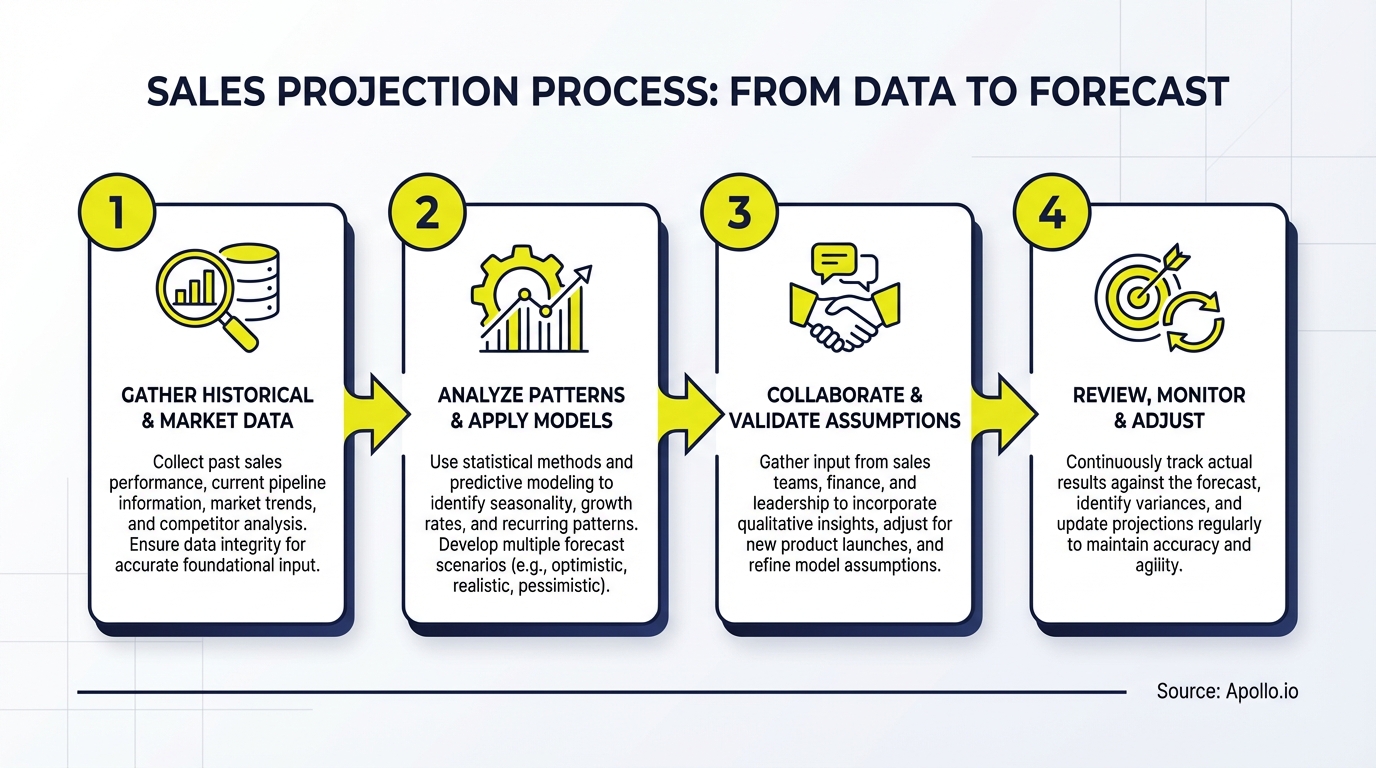
RevOps leaders are the architects of forecast accuracy. A reliable framework has five components:
- Single source of truth: All pipeline data flows through one CRM. Conflicting spreadsheets are the fastest way to destroy forecast credibility.
- Defined stages with exit criteria: Every pipeline stage needs objective criteria. Vague stages produce vague projections.
- Weighted probability model: Assign close probabilities by stage, deal size, and rep history — not gut feel.
- Scenario planning: Run three versions — base, upside, and downside — tied to specific pipeline coverage ratios and market assumptions.
- Governance cadence: Weekly pipeline reviews with Sales, monthly reconciliation with Finance, and quarterly reforecast cycles.
Struggling to get clean pipeline data into one place? Apollo's AI-powered pipeline builder gives RevOps teams a unified view of pipeline health, activity, and coverage — without stitching together five tools.
For a deeper look at the infrastructure behind this, see what a revenue operations framework looks like in practice.
How Do Sales Leaders and AEs Use Scenario Planning?
For sales leaders, scenario planning converts a single-number forecast into a range of outcomes with defined drivers. For Account Executives managing large deals, it surfaces which opportunities are truly load-bearing for the quarter.
A practical three-scenario model:
- Base case: Current pipeline closes at historical win rates. No new inbound surprises, no major slippage.
- Upside case: Two or three at-risk deals close. Late-stage pipeline converts above trend.
- Downside case: One large deal slips a quarter. Win rates drop by 10-15 points due to competitive pressure or budget freezes.
Sales leaders should tie each scenario to specific pipeline coverage thresholds. If the team needs 3x pipeline coverage to hit base case, the downside scenario starts when coverage drops below 2.5x. For enterprise AEs managing complex, multi-stakeholder deals, these enterprise sales strategies can directly improve the quality of pipeline feeding into projections.
Digital buying is also reshaping the inputs. According to Forrester's B2B predictions, over half of large B2B transactions of $1 million or greater are now processed through digital self-serve channels, influenced by Millennial and Gen Z buyers. This compresses deal cycles and changes the timing assumptions built into projection models.
What Are the Most Common Sales Projection Mistakes?
Most forecast misses trace back to a small set of recurring errors:
- Sandbagging: Reps underreport to manage expectations. Projections consistently run below actual performance.
- Optimism bias: Leaders over-weight late-stage deals without validating buyer engagement signals.
- Single-number forecasts: Presenting one number to the board without a range creates false precision.
- Stale data: Projections built on CRM data that hasn't been updated in weeks are projections built on fiction.
- Ignoring churn: Gross revenue projections that omit contraction and churn overstate net revenue growth.
- No data governance: Multiple people entering pipeline data with different conventions produces noise, not signal.
The Clari Labs finding — 87% of enterprises missed 2025 targets — frames these errors not as individual rep failures but as operating-model failures. Standardized data, governed AI models, and cross-functional alignment (Sales + RevOps + Finance + CIO) are the structural fixes.

How Do SDRs and BDRs Contribute to Better Sales Projections?
SDRs and BDRs are the top-of-funnel inputs that make or break long-range projections. If pipeline coverage is thin, no amount of weighted forecasting saves the quarter.
SDRs contribute to projection accuracy by:
- Consistently entering contact and activity data into CRM so conversion rates are calculable
- Qualifying opportunities against defined ICP criteria before passing to AEs
- Flagging early-stage deal characteristics (company size, budget signals, urgency) that improve probability weighting
The structural challenge is that B2B buying has shifted heavily digital. Research from SuperAGI highlights that 80% of B2B sales interactions between suppliers and buyers are expected to occur through digital channels. SDRs and BDRs who master multi-channel outreach — email, phone, and social — create higher-quality pipeline that produces more predictable downstream projections.
Need to build more qualified pipeline to feed your projections? Search Apollo's 224M+ verified contacts with 65+ filters to find exactly the prospects that match your ICP and coverage targets.
What Tools and Data Sources Improve Sales Projection Accuracy?
Projection quality is a direct function of data quality. The tools that matter most:
| Tool Category | Function in Projections |
|---|---|
| CRM | Pipeline stage tracking, deal history, win/loss data |
| Revenue intelligence | Call signals, engagement scoring, deal risk alerts |
| Data enrichment | Keeps contact and company data current so pipeline records are reliable |
| Sales engagement | Activity tracking that shows real buyer engagement, not just rep activity |
| Deal management | Multi-stakeholder visibility, next-step accountability |
Tool sprawl degrades projection accuracy because data lives in silos. Cyera noted that "having everything in one system was a game changer" after consolidating their stack. Apollo's deal management software connects pipeline data, contact intelligence, and engagement history in one workspace — giving sales leaders the unified view they need to build projections without manual data reconciliation.
For a broader view of how to build a tech stack that supports scalable forecasting, see how to build a sales tech stack that scales revenue.
How Do You Turn Sales Projections Into an Actionable Revenue Plan?
A projection that sits in a spreadsheet is an analysis. A projection connected to execution is a plan. The bridge is a clear set of actions tied to each scenario:
- If tracking to base: Maintain current activity levels. Monitor at-risk deals weekly.
- If tracking to downside: Accelerate top-of-funnel. Pull in deals from next quarter's pipeline. Review pricing and deal terms on stalled opportunities.
- If tracking to upside: Prepare capacity — make sure implementation, onboarding, and customer success can absorb accelerated closed-won volume.
Projections should feed directly into revenue operations strategy, not exist as a separate finance exercise. The teams that hit their numbers treat projections as a living operational tool, not a quarterly reporting ritual.

Build Sales Projections That Actually Hold in 2026
Accurate sales projections require three things working together: clean pipeline data, a disciplined operating model, and scenario-based thinking that accounts for market uncertainty. The 87% miss rate in 2025 was not a forecasting problem.
It was a data governance and cross-functional alignment problem.
Start with pipeline quality. Projections are only as good as the opportunities feeding them.
Apollo gives SDRs, AEs, RevOps leaders, and founders a unified platform to prospect, engage, and manage deals — so the data powering your projections reflects reality.
Get Leads Now and start building a pipeline that makes your 2026 sales projections defensible.
Apollo Turns Pipeline Into Proof
ROI pressure killing your next budget approval? Apollo gives sales teams measurable pipeline impact from day one. Leadium 3x'd their annual revenue — see what Apollo delivers for yours.
Start Free with Apollo →Don't miss these
Sales
Inbound vs Outbound Marketing: Which Strategy Wins?
Sales
What Is a Sales Funnel? The Non-Linear Revenue Framework for 2026
Sales
What Is a Go-to-Market Strategy? The 2026 GTM Playbook
See Apollo in action
We'd love to show how Apollo can help you sell better.
By submitting this form, you will receive information, tips, and promotions from Apollo. To learn more, see our Privacy Statement.
4.7/5 based on 9,690 reviews
