
What Is a Sales Pitch Presentation? Structure, Examples, and Best Practices for 2026
A sales pitch presentation is a structured, visual narrative that communicates your value proposition, proof, and next steps to a prospect or buying group. Done well, it moves buyers from awareness to decision. Done poorly, it gets forwarded around an organization until it quietly dies in someone's inbox. The stakes are high: according to BookYourData, the average B2B sales win rate was just 21% in 2023. Your pitch deck is one of the few levers you can actually control. Start with Apollo's sales pitch fundamentals to ground your approach before building your deck.

Research Less, Close More With Apollo
Tired of your reps burning hours verifying contact info instead of selling? Apollo delivers 96% email accuracy across 224M contacts so your team hits the phones, not dead ends. Start building real pipeline today.
Start Free with Apollo →Key Takeaways
- Modern buyers self-educate before talking to reps — your pitch must work without you in the room.
- Personalization is the primary differentiator: 86% of business buyers are more likely to buy when sellers understand their goals.
- Structure matters more than design: lead with an executive summary, follow with proof, and end with procurement-ready materials.
- Top performers spend most of their time on relationship-building, not pitching — the deck supports the conversation, not replaces it.
- Modular, evidence-driven pitch systems outperform one-size-fits-all decks in multi-stakeholder deals.
What Is a Sales Pitch Presentation?
A sales pitch presentation is a structured document or slide deck used to communicate a solution's value to a prospect. It combines problem framing, proof, ROI logic, and a clear call to action.
Historically called a "pitch deck," the format has evolved from a live presentation aid into a self-serve decision document that circulates across buying committees.
The key distinction: a pitch deck is the artifact; a pitch presentation is the live or async delivery of that artifact.
In 2026, the most effective teams build for both modes simultaneously.
Explore Apollo's sales presentation ROI template for a ready-to-use framework.
Why Do Most Sales Pitch Presentations Fail?
Most decks fail because they are built for the seller, not the buyer. They lead with company history, feature lists, and awards — none of which answer the buyer's core question: "What does this mean for me, specifically?"
Research from Extu shows that 86% of business buyers are more likely to purchase when companies understand their goals, yet 59% say most sales reps don't take the time to understand them. That gap is where deals die. Additional failure modes include:
- No exec summary: Decks that bury the value prop on slide 8 lose internal champions who forward it.
- Generic proof: Logos without metrics don't move skeptical stakeholders.
- No procurement layer: Security, compliance, and vendor risk questions go unanswered, stalling legal review.
- Single-mode design: Decks built only for live delivery collapse when shared asynchronously.
How Should You Structure a Sales Pitch Presentation?
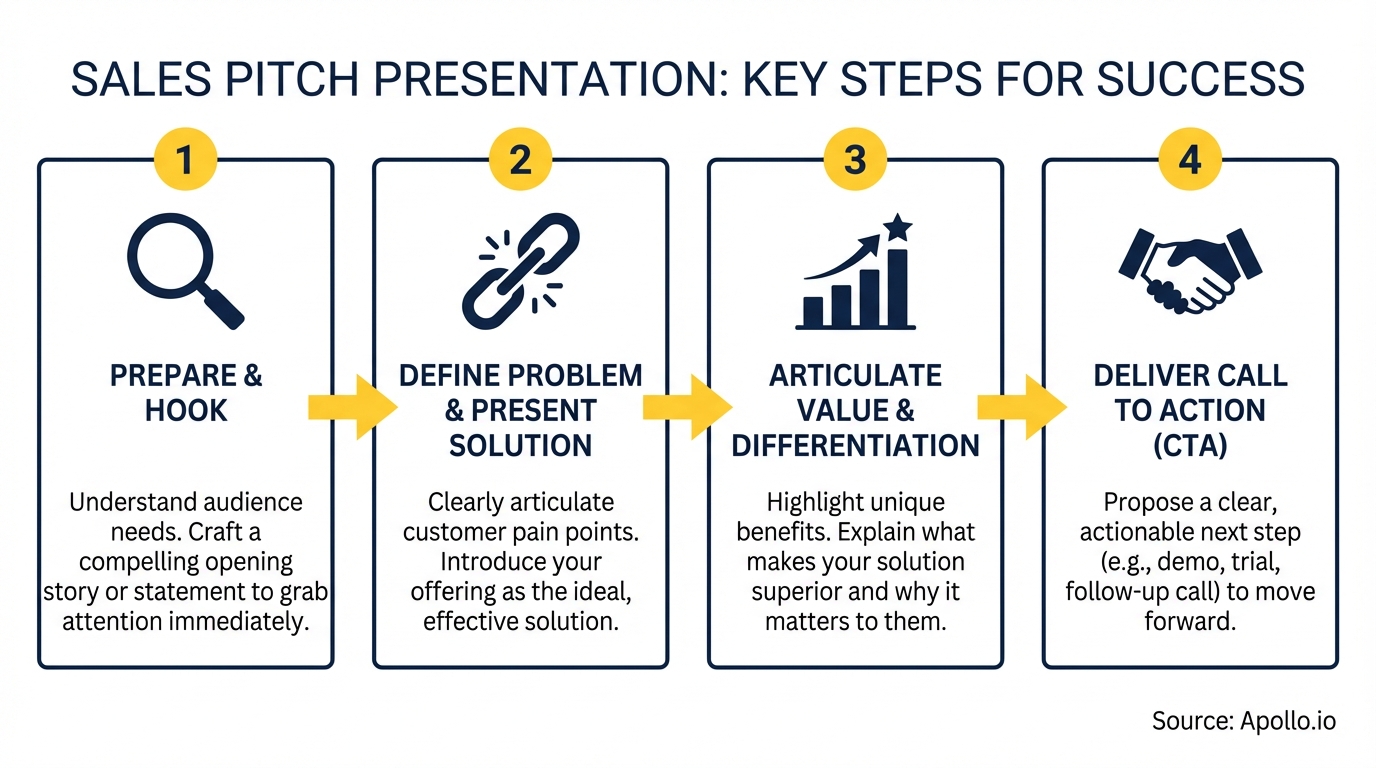
A high-converting sales pitch presentation follows a modular structure that works for live delivery, async review, and internal forwarding. Use this sequence:
| Section | Purpose | Length |
|---|---|---|
| Executive Summary | One-slide value prop + top-line ROI | 1-2 slides |
| Problem Framing | Mirror the buyer's pain with specificity | 2-3 slides |
| Solution + Differentiators | How you solve it, not just what you do | 3-4 slides |
| ROI / TCO Estimate | Realistic cost, time-to-value, risk flags | 1-2 slides |
| Evidence Annex | Case studies with quantified results | 2-4 slides |
| Procurement Appendix | Security, compliance, vendor risk Q&A | 1-2 slides |
| Next Steps | Clear, low-friction ask | 1 slide |
The executive summary slide must stand alone. Buyers forward decks internally before you ever meet the decision-maker. If slide one doesn't answer "why us, why now," the rest of the deck won't get read. For enterprise deals with multiple stakeholders, add an internal forwarding kit: a condensed two-page PDF that links back to the full deck.
Turn Funnel Guesswork Into Pipeline Clarity
Tired of watching quality leads stall before they ever become real opportunities? Apollo surfaces in-market buyers with precision so your forecast reflects reality, not hope. Join 550K+ companies building pipeline they can actually predict.
Schedule a Demo →How Do AEs and SDRs Use Pitch Presentations Differently?
Account Executives use pitch presentations as closing tools — structured around ROI, risk mitigation, and procurement readiness. SDRs and BDRs use shorter, sharper versions as conversation starters, often a single-slide leave-behind or a three-slide email attachment designed to earn a next meeting.
According to RingCentral, 82% of top-performing salespeople say they "always" perform research before reaching out to prospects, compared to just 49% for other sellers. For SDRs, this means your pitch asset should be pre-personalized by segment or persona — not a single generic deck blasted to every contact. Need to find and research the right contacts before you pitch? Search Apollo's 224M+ verified contacts with 65+ filters to build targeted prospect lists before you build your deck.
For RevOps leaders, the pitch presentation is also a data asset. Tracking which slides get the most time, which annexes get downloaded, and which deals stall at procurement informs coaching and process improvement. Connect pitch performance to sales analytics to close the feedback loop.

What Makes a Sales Pitch Presentation Persuasive in 2026?
Persuasion in 2026 is built on specificity and proof, not feature lists. Data from SalesLion shows that top-performing reps use conversational selling and "pitch" their offer only 7% of the time, focusing the rest on building relationships. The deck is a support tool, not the sales motion itself.
The elements that consistently drive persuasion:
- Buyer-specific problem framing: Use the buyer's exact language from discovery calls.
- Quantified case studies: Logos without metrics are decorative. Include revenue impact, time saved, or churn reduced.
- Pre-empted objections: Embed answers to common objections in the deck so internal champions can defend the recommendation without you. Research from Development Corporate found top performers are 843% more likely to overcome objections effectively, largely because they anticipate them during discovery.
- ROI transparency: Show realistic time-to-value, not best-case projections.
- Procurement-ready appendix: Include a security one-pager and vendor risk FAQ to unblock legal and IT review.
Struggling to keep deals moving after you send the deck? Track every deal stage and stakeholder interaction with Apollo's deal management tools so nothing stalls in silence.
How Do You Personalize a Sales Pitch Presentation at Scale?
Personalization at scale requires a modular library, not a custom deck for every prospect. Build core slide modules by industry, company size, pain point, and persona.
Then assemble the right combination per deal rather than starting from scratch each time.
Practical steps for modular personalization:
- Tag all slides by segment, pain point, and buying stage in your asset library.
- Create industry-specific proof slides (fintech, healthcare, SaaS, etc.) that swap in as needed.
- Use a cover slide and executive summary that reference the prospect's company name, role, and specific challenge.
- Include a "relevant customers like you" slide filtered by industry or company size.
This approach also connects to proven sales pitch techniques that close more deals by meeting buyers where they are, not where you want them to be. For high-value accounts, pair modular decks with a deeper high-ticket sales strategy that includes executive access and multi-threading.
How Do You Measure Whether Your Sales Pitch Presentation Is Working?
A pitch deck is a testable asset. Track these signals to know whether your presentation is doing its job:
- Deck engagement rate: What percentage of prospects open and scroll through the deck?
- Slide drop-off: Which slide causes most viewers to stop reading?
- Annex downloads: Are procurement or ROI annexes being accessed (signals serious evaluation)?
- Time-to-next-meeting: Does sending the deck accelerate or slow down the follow-up?
- Win rate by deck version: A/B test different structures or proof combinations.
Connect pitch analytics to your core sales KPIs to understand whether deck quality correlates with pipeline velocity and win rates. Sales leaders and RevOps teams who instrument pitch performance gain a coaching advantage that compounds over time.
Build Better Pitch Presentations with Apollo
A great sales pitch presentation is a system, not a slide deck. It requires accurate prospect intelligence to personalize, a modular evidence library to scale, and deal tracking to follow through after you hit send.
Apollo gives SDRs, AEs, and sales leaders a unified platform to find the right contacts, understand their context, run multi-channel outreach, and manage every deal stage in one workspace. As Cyera's team put it: "Having everything in one system was a game changer." Explore the sales tech stack playbook to see how Apollo consolidates the tools you need to build, deliver, and follow up on every pitch.
Ready to pitch smarter? Request a Demo and see how Apollo's all-in-one GTM platform helps your team close more deals with less tool complexity.
Prove Pipeline ROI With Apollo
Budget approval stuck on unclear metrics? Apollo gives sales teams measurable pipeline impact from day one. Leadium 3x'd their annual revenue — see your ROI before you commit.
Schedule a Demo →Don't miss these
Sales
Inbound vs Outbound Marketing: Which Strategy Wins?
Sales
What Is a Sales Funnel? The Non-Linear Revenue Framework for 2026
Sales
What Is a Go-to-Market Strategy? The 2026 GTM Playbook
See Apollo in action
We'd love to show how Apollo can help you sell better.
By submitting this form, you will receive information, tips, and promotions from Apollo. To learn more, see our Privacy Statement.
4.7/5 based on 9,690 reviews
