
What Is a Sales Pitch and How Do You Deliver One That Wins?
Your sales pitch is no longer just a presentation you deliver. By 2025, 80% of B2B sales interactions between suppliers and buyers are expected to occur through digital channels. Modern buyers research, compare, and often decide before they ever speak with a sales rep. Your pitch must work across email, video, web content, and live conversations to meet buyers where they are.
A sales pitch is a strategic communication that explains how your solution solves a specific buyer problem. It combines research, storytelling, and proof to guide prospects toward a decision.
The best pitches feel like helpful conversations, not scripted presentations.

Apollo Eliminates 4+ Hours Of Daily Research
Tired of spending 4+ hours daily hunting for contact info? Apollo delivers 224M verified contacts with 96% email accuracy instantly. Join 550K+ companies closing deals faster.
Start Free with Apollo →Key Takeaways
- Modern sales pitches must work across digital channels (email, video, web) and adapt to self-serve buyer journeys
- Effective pitches prioritize buyer problems and outcomes over product features
- Relevance and personalization directly impact whether buyers engage or ignore your outreach
- Structured frameworks (SPIN, PAS, BAB) help sales teams deliver consistent, repeatable messages
- AI tools and sales intelligence platforms enable faster research and better targeting at scale
What Makes a Sales Pitch Effective in 2026?
A sales pitch is a concise, persuasive message that articulates the value your solution delivers to a specific buyer. Unlike generic marketing, an effective pitch addresses the prospect's current situation, challenges, and desired outcomes with tailored insights.
The shift to digital buying has fundamentally changed pitch requirements. Buyers now control the conversation timeline and prefer to research independently before engaging sales.
Your pitch must provide self-serve value (clear ROI models, proof points, use cases) while remaining flexible for live interactions.
"Apollo gets us the people we need to speak to. Without that, there's no business."
Core Elements Every Pitch Needs
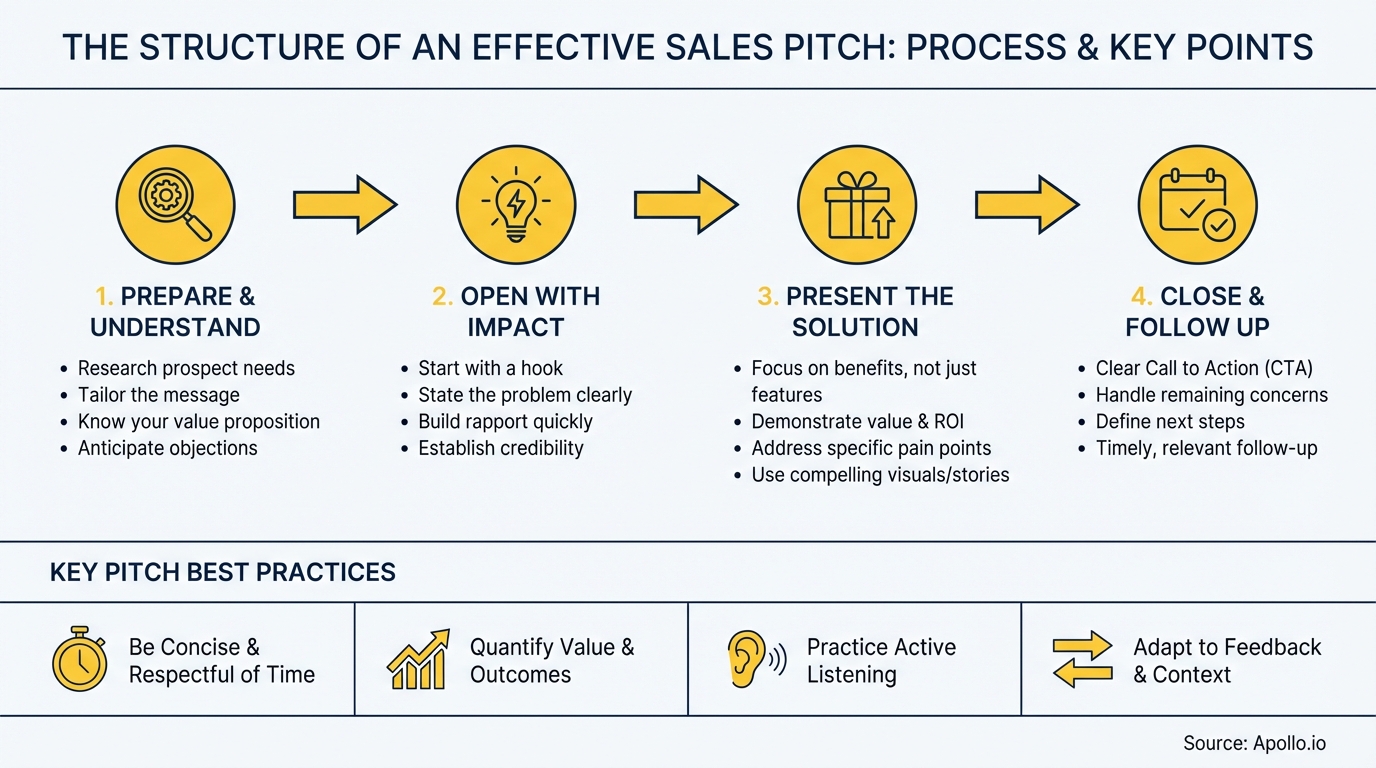
Regardless of format, winning pitches share four components:
- Problem clarity: Name the specific challenge your buyer faces (not generic pain points)
- Outcome focus: Show the measurable result they'll achieve (revenue growth, time savings, cost reduction)
- Proof and credibility: Use customer examples, data, and case studies that match the buyer's context
- Clear next action: Tell the buyer exactly what to do next (book a demo, review a proposal, start a trial)
How Do You Structure a Sales Pitch That Converts?
Structure determines whether your pitch gets heard or ignored. Three proven frameworks guide most B2B pitches:
| Framework | Structure | Best For |
|---|---|---|
| SPIN | Situation → Problem → Implication → Need-Payoff | Discovery calls, consultative selling, complex solutions |
| PAS | Problem → Agitate → Solve | Email outreach, short demos, transactional sales |
| BAB | Before → After → Bridge | Case studies, ROI discussions, transformation stories |
The SPIN framework works for longer sales cycles where you need to uncover hidden problems. Start with situational questions about their current process, identify problems they're experiencing, explore the implications of not solving those problems, and guide them to articulate the value of fixing it.
Problem-Agitate-Solution (PAS) condenses the pitch into three beats. State the problem your buyer faces, agitate it by showing the cost of inaction, then position your solution as the answer. This works well in email sequences and outbound campaigns where attention is limited.
Before-After-Bridge (BAB) tells a transformation story.
Paint the "before" picture (current state), describe the "after" vision (desired outcome), then bridge the gap by showing how your solution delivers that transformation.
This framework excels in formal presentations and ROI-focused conversations.
See Every Deal In Real Time With Apollo
Pipeline forecasting a guessing game? Apollo delivers real-time deal visibility and accurate forecasts so you hit your number. Built-In boosted win rates 10% with Apollo's signals.
Start Free with Apollo →What Are the Four Types of Sales Pitches?
Your pitch format must match the channel and buyer context. The four primary types serve different stages of the sales process:
1. Elevator Pitch (30-60 Seconds)
A verbal snapshot that explains who you help, what problem you solve, and why it matters. Use this at networking events, cold calls, or any first interaction where you have minimal time to create interest.
Focus on outcomes, not features.
2. Email Pitch (75-150 Words)
Written outreach that earns a reply by demonstrating relevance. Lead with a specific insight about their business, connect it to a problem you solve, and end with a single clear ask.
Personalization is non-negotiable.
Generic templates get ignored or deleted.
3. Phone Pitch (2-5 Minutes)
A discovery-focused conversation that qualifies the prospect while building interest. Ask situational questions first, listen for problems, then tailor your pitch to what you've learned.
The goal is a next meeting, not closing on the call.
4. Presentation Pitch (15-45 Minutes)
A structured demo or slide deck for qualified opportunities. Organize around the buyer's use cases, not your product roadmap.
Include customer proof, ROI models, and interactive elements that invite questions.
Why Do Most Sales Pitches Fail?
Pitch failure stems from four predictable mistakes:
Generic messaging: Buyers ignore pitches that feel mass-produced. If your email could be sent to any company in any industry, it lacks the specificity needed to earn attention. Research the prospect's business before you reach out.
Feature dumping: Listing product capabilities without connecting them to buyer outcomes wastes time. Buyers care about results (faster sales cycles, higher conversion rates, reduced costs), not technical specifications.
Ignoring buyer context: A pitch that works for startups fails with enterprises. A message for CFOs confuses CMOs. Segment your approach by industry, company size, role, and buying stage. One-size-fits-all pitches don't work.
Weak proof: Claims without evidence get dismissed. Use specific customer examples, quantified results, and case studies that match your prospect's profile. Vague statements like "we help companies grow" lack credibility.
"We reduced the complexity of three tools into one. We're getting higher reply rates, open rates are doubled, meetings are up, and speed to booking a meeting is cut in half."
How Do You Personalize a Sales Pitch at Scale?
Personalization separates winning pitches from ignored outreach. Start with research: review the prospect's website, recent news, funding announcements, and social activity.
Identify triggers (new hire, product launch, expansion) that signal buying intent.
Use sales intelligence platforms to automate research and enrichment. Tools like Apollo provide verified contact data, firmographics, and intent signals that help you understand buyer context before you reach out. This cuts manual research from hours to minutes.
Segment your pitch by role and industry. A CRO cares about revenue growth and pipeline velocity.
A VP of Sales Development focuses on SDR productivity and meeting conversion rates. Tailor your messaging to the problems each persona actually owns.
Create modular pitch templates with customizable sections.
Build a library of industry-specific examples, role-based pain points, and outcome statements you can mix and match.
This enables personalization without starting from scratch each time.
According to recent research, over 80% of sales teams using AI reported increased revenue. AI-powered tools help reps personalize outreach faster by suggesting relevant talking points based on buyer data.

What Metrics Should You Track for Pitch Performance?
Measure what matters. Track these KPIs to understand pitch effectiveness:
- Email response rate: Percentage of prospects who reply to your outreach (benchmark: 8-15% for well-targeted campaigns)
- Meeting conversion rate: Percentage of pitches that result in a scheduled meeting (benchmark: 15-25% for qualified leads)
- Demo-to-opportunity rate: Percentage of demos that advance to formal opportunities (benchmark: 30-40%)
- Win rate by pitch type: Close rate segmented by pitch format, industry, and buyer role
Run A/B tests on pitch variables: subject lines, opening hooks, proof points, and CTAs. Test one element at a time to isolate what drives performance. Use sales analytics tools to track results and identify patterns.
Research from Marketing LTB shows the average B2B sales cycle has increased to 4.9 months, up from 4.3 months in 2022. Longer cycles mean your pitch must sustain engagement across multiple touchpoints.
How Do Digital Channels Change Your Pitch Strategy?
Digital and self-serve buying demand pitch content that works without a live rep. Create a pitch ecosystem: web pages, video explainers, ROI calculators, case studies, and comparison guides that buyers can consume independently.
Video pitches scale personal communication. Record 1-2 minute videos that address specific buyer scenarios.
Use them in email sequences, landing pages, and follow-up messages. Video humanizes your outreach and increases engagement.
Interactive demos let buyers explore your product on their own timeline. Build self-serve tours that highlight key use cases and outcomes.
Gate advanced features behind a meeting request to generate qualified leads.
Web content as pitch infrastructure: publish buyer enablement resources (implementation guides, ROI models, security documentation) that answer common questions before prospects ask. This accelerates deals by removing friction from the research phase.
What Role Does AI Play in Modern Sales Pitches?
AI transforms pitch preparation and delivery. Use AI research tools to summarize company news, identify buying signals, and suggest relevant talking points.
This cuts prep time and improves message relevance.
AI writing assistants help reps draft personalized emails faster. They suggest openers based on prospect data, recommend proof points from your case study library, and optimize messaging for higher response rates.
Conversation intelligence platforms analyze your calls and demos to identify what works. They surface successful pitch patterns, flag areas where you lost the buyer's attention, and provide coaching feedback based on top performer benchmarks.
Generative AI creates pitch variations for different segments. Input your core value proposition, target persona, and desired outcome.
The AI generates tailored versions for different industries, company sizes, and buyer roles. This enables mass personalization without manual effort.

How Can You Continuously Improve Your Pitch?
Pitch optimization is ongoing. Record your calls and demos, then review them to identify improvement areas.
Listen for moments where the buyer disengaged or had objections. Adjust your pitch to address those friction points earlier.
Collect feedback from prospects (won and lost deals). Ask: "What made you choose us?" or "What could we have explained better?" Use their answers to refine your messaging and proof points.
Shadow top performers. Listen to how your best reps structure their pitches, handle objections, and guide conversations. Document their patterns and train the rest of your team on those techniques.
Build a pitch playbook with proven templates, frameworks, and examples.
Make it easy for new reps to ramp quickly and maintain consistency across your team.
Update the playbook quarterly based on performance data and market changes.
Organizations with Revenue Operations (RevOps) grow revenue nearly three times faster than non-adopters, according to a Forrester-commissioned study. Align your pitch strategy with broader go-to-market operations for maximum impact. Learn more about revenue operations strategies.
Start Building Pitches That Convert
Effective sales pitches combine research, structure, and personalization to meet buyers where they are. Focus on outcomes over features, use proven frameworks to guide your message, and adapt your approach to digital buying behaviors.
The best pitches feel like conversations, not presentations. They demonstrate understanding of the buyer's world and provide clear paths to measurable results.
Invest in the research and preparation that make relevance possible.
Modern sales teams need platforms that consolidate prospecting, engagement, and intelligence into one workspace. Schedule a demo with Apollo to see how unified sales tools accelerate your pitch-to-close process.
Prove Apollo's ROI In Your First 30 Days
Budget approval stuck on unclear metrics? Apollo delivers measurable pipeline impact from day one—46% more meetings, 10% higher win rates. Built-In justified their investment in weeks.
Start Free with Apollo →Don't miss these
Sales
Inbound vs Outbound Marketing: Which Strategy Wins?
Sales
What Is a Sales Funnel? The Non-Linear Revenue Framework for 2026
Sales
What Is a Go-to-Market Strategy? The 2026 GTM Playbook
See Apollo in action
We'd love to show how Apollo can help you sell better.
By submitting this form, you will receive information, tips, and promotions from Apollo. To learn more, see our Privacy Statement.
4.7/5 based on 9,690 reviews
