
Sales Pitch Deck: How to Create Presentations That Close Deals
Your sales pitch deck can make or break your deal before you even open your mouth. In 2026, buyers research vendors extensively before engaging with sales teams, and your deck often serves as the first impression. A well-crafted sales pitch deck tells a compelling story, addresses buyer concerns, and provides the evidence needed to move deals forward.
According to Museum of Entrepreneurship, research indicates that 94% of first impressions are design-driven, highlighting the importance of a clean and elegant layout in pitch decks. With buying cycles stretching longer and budgets under scrutiny, your deck needs to deliver immediate value and prove ROI from slide one.

Apollo Finds Contacts While You Close Deals
Tired of spending 4+ hours daily hunting for contact info? Apollo delivers 224M verified contacts with 96% email accuracy. Join 550K+ companies who stopped researching and started selling.
Start Free with Apollo →Key Takeaways
- A sales pitch deck is a visual presentation that communicates your value proposition and guides prospects through your solution
- Effective decks should be limited to 10-15 slides to maintain attention and clarity
- Design matters: 94% of first impressions are design-driven in pitch presentations
- Modern decks must prove ROI and include measurable business outcomes
- AI-powered tools now enable faster deck creation while maintaining brand consistency
What Is a Sales Pitch Deck?
A sales pitch deck is a visual presentation designed to communicate your solution's value proposition, demonstrate how it solves specific business problems, and persuade prospects to take action. The deck serves as a structured narrative that guides conversations with potential customers through discovery, solution presentation, and closing stages.
Sales pitch decks differ from marketing presentations by focusing on buyer-specific pain points and business outcomes. According to GoHub VC, key components include the problem, solution, market opportunity, unique value proposition, traction and metrics, business model, financial projections, vision, mission, goals, and team.
Account Executives use pitch decks during discovery calls, product demonstrations, and executive presentations to maintain message consistency across stakeholders. The deck provides a framework for proven sales pitch techniques that address objections and move deals forward.
Why Are Sales Pitch Decks Critical in 2026?
Buyers make decisions earlier in the purchase journey than ever before. With budgets tightening and stakeholders demanding ROI proof upfront, your pitch deck often influences vendor selection before the first sales conversation.
Research from Overnight Design shows that our brains process visual information approximately 60,000 times faster than text, making visual storytelling essential for complex B2B solutions. Sales professionals spend only 28-34% of their time on actual selling activities according to Landbase, with the rest consumed by administrative tasks, meetings, and non-revenue-generating work.
For Sales Leaders managing distributed teams, standardized pitch decks ensure message consistency across regions and segments. RevOps teams use deck performance data to identify which narratives resonate with specific buyer personas, enabling continuous optimization of the sales motion.

What Should Be Included in a Sales Pitch Deck?
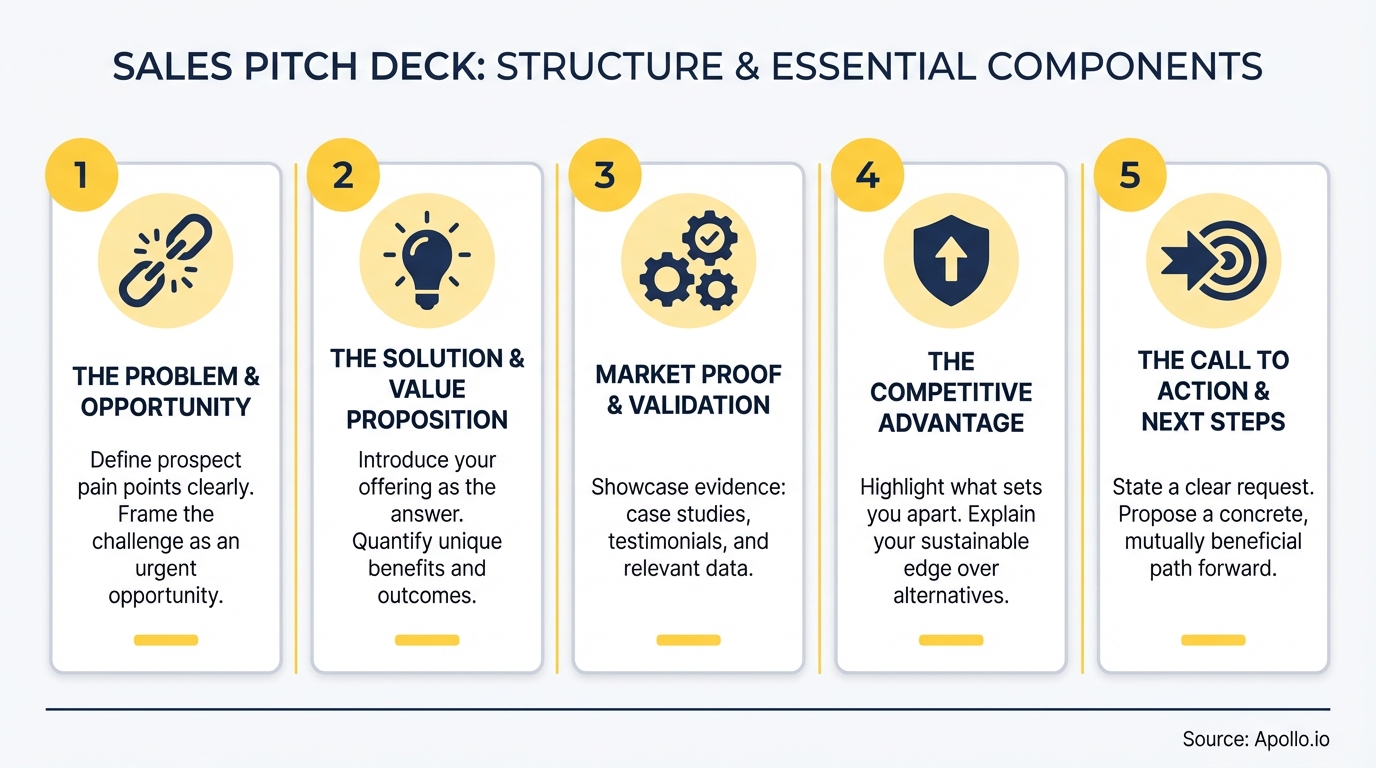
According to Qubit Capital, effective pitch decks generally should be limited to 10-15 slides maximum to allow investors to absorb information adequately. Here are the essential components:
| Slide Component | Purpose | Key Elements |
|---|---|---|
| Problem Statement | Establish relevance and urgency | Specific pain points, cost of inaction, market context |
| Solution Overview | Present your unique approach | Key capabilities, differentiation, why now |
| Value Proposition | Quantify business impact | ROI metrics, time savings, efficiency gains |
| Social Proof | Build credibility and trust | Customer logos, case studies, testimonials |
| Implementation | Address adoption concerns | Timeline, resources needed, support model |
| Pricing & Next Steps | Clear path to purchase | Investment options, ROI calculator, CTA |
SDRs use simplified versions of the full deck for initial outreach, focusing on problem identification and early-stage qualification. BDRs leverage specific slides to address objections during follow-up conversations, customizing content based on prospect research.
Struggling to personalize outreach at scale? Automate your sequences with Apollo's multi-channel platform to deliver the right message at the right time.
Turn Forecast Chaos Into Revenue Certainty
Pipeline forecasting a guessing game? Apollo surfaces buying signals and tracks deal progress in real-time so you can predict revenue with confidence. Built-In boosted win rates 10% with Apollo's scoring.
Start Free with Apollo →How Do You Create a Winning Sales Pitch Deck?
Start with buyer research to understand specific pain points and decision criteria. Use sales analytics to identify which messages resonate with different segments, then structure your narrative around those insights.
Follow this proven framework:
- Hook with relevance: Open with a data point or scenario that mirrors your prospect's current challenge
- Quantify the problem: Show the business impact of the status quo with specific metrics
- Present your solution: Focus on outcomes, not features. How does it solve their specific problem?
- Prove it works: Use case studies from similar companies in their industry
- Make it actionable: Clear next steps with timeline and expected outcomes
Modern teams use AI tools to maintain brand consistency while enabling customization. Microsoft's Copilot integration in PowerPoint now allows teams to pull approved enterprise brand assets automatically during slide creation, ensuring on-brand presentations at scale.
For enterprise sales cycles, create modular deck sections that can be assembled based on stakeholder role. CFOs need financial impact slides, while technical buyers require integration and security details.
How Do Sales Leaders Use Pitch Decks to Drive Revenue?
Sales Leaders treat pitch decks as strategic assets that scale their team's effectiveness. By standardizing core narratives while allowing tactical customization, leaders ensure consistent messaging across the organization.
Top-performing sales organizations integrate their pitch deck strategy with their sales pipeline management process, tracking which deck versions correlate with higher win rates. They use deal management software to monitor deck usage across opportunities and identify coaching opportunities.
Founders and CEOs use pitch decks to establish category positioning and communicate vision to both prospects and internal teams. These executive-level decks focus on market opportunity, competitive differentiation, and strategic roadmap rather than tactical product details.
RevOps teams analyze deck performance data to optimize content, measuring metrics like:
- Time spent on each slide
- Sections that prospects revisit
- Pages shared internally with buying committee
- Correlation between deck engagement and deal velocity
This data-driven approach transforms pitch decks from static presentations into dynamic revenue drivers. Teams that instrument their decks can iterate based on actual buyer behavior rather than assumptions.
What Are Common Sales Pitch Deck Mistakes?
Many teams create decks that focus on their product rather than the buyer's problems. This inside-out approach fails to establish relevance and loses attention quickly.
Avoid these critical mistakes:
- Too many slides: Decks over 15 slides lose audience attention and dilute key messages
- Feature dumping: Listing capabilities without connecting to business outcomes
- Weak social proof: Generic testimonials instead of specific, quantified results
- Missing ROI: Failing to quantify the business impact of your solution
- Poor design: Cluttered slides, inconsistent branding, hard-to-read fonts
- No clear CTA: Prospects don't know what action to take next
Another common error is using the same deck for all prospects. Top performers customize decks based on industry, company size, and specific use cases.
They reference the prospect's competitors, cite relevant case studies, and address industry-specific challenges.
Sales teams also fail to update decks regularly, letting content become stale with outdated metrics, old customer logos, or deprecated product screenshots. Establish a quarterly review process to refresh content and incorporate new proof points.
How Can You Measure Sales Pitch Deck Effectiveness?
Track deck performance using both quantitative metrics and qualitative feedback. Modern sales engagement platforms provide analytics on deck views, time spent per slide, and share rates among buying committee members.
Key metrics to monitor include:
| Metric | What It Reveals | Target Benchmark |
|---|---|---|
| Deck Open Rate | Initial interest level | 60%+ for sent decks |
| Completion Rate | Content engagement | 75%+ view all slides |
| Internal Shares | Champion advocacy | 2+ forwards per deal |
| Win Rate Correlation | Deck impact on outcomes | Track by deck version |
| Time to Next Stage | Deal velocity impact | Compare with/without deck |
Qualitative feedback matters equally. After presentations, ask prospects which slides resonated most and what questions remain unanswered.
Use this input to refine your narrative and address common objections proactively.
A/B test different deck versions to identify winning elements. Try variations in slide order, value proposition framing, or case study selection.
Track which versions correlate with higher conversion rates at each pipeline stage.
Integrate deck analytics with your sales KPIs to understand the full impact on revenue outcomes. This data-driven approach enables continuous optimization based on real buyer behavior.
Start Building Revenue-Driving Pitch Decks
Your sales pitch deck is a strategic asset that influences buyer decisions throughout the purchase journey. By focusing on buyer problems, quantifying business impact, and maintaining design excellence, you create presentations that move deals forward.
The most effective sales organizations treat pitch decks as living documents that evolve based on market feedback and performance data. They empower their teams with standardized narratives while enabling customization for specific buyer contexts.
In 2026, successful pitch decks combine compelling storytelling with measurable business outcomes. They serve as tools for sales productivity, enabling teams to communicate value consistently across all customer interactions.
Ready to accelerate your sales motion? Start Your Free Trial with Apollo to build pipeline, engage prospects, and close deals faster with the all-in-one sales platform trusted by 550K+ companies.
Prove ROI In 30 Days, Not 90
Budget approval stuck on unclear metrics? Apollo delivers measurable pipeline impact from day one—track time saved, meetings booked, and revenue influenced. Customer. io achieved 50% YoY growth with Apollo's automation.
Start Free with Apollo →Don't miss these
Sales
Inbound vs Outbound Marketing: Which Strategy Wins?
Sales
What Is a Sales Funnel? The Non-Linear Revenue Framework for 2026
Sales
What Is a Go-to-Market Strategy? The 2026 GTM Playbook
See Apollo in action
We'd love to show how Apollo can help you sell better.
By submitting this form, you will receive information, tips, and promotions from Apollo. To learn more, see our Privacy Statement.
4.7/5 based on 9,690 reviews
