
What Is a Sales Company? Definition, Types, and How They Drive Revenue
Modern B2B sales teams face mounting pressure to close deals faster while buyers complete most of their research before ever speaking with a seller. According to Heinz Marketing, B2B buyers are completing nearly 70% of their purchasing process before engaging with sellers. This shift demands that sales companies rethink their entire go-to-market approach, from content strategy to tech stack architecture.
Sales companies that win in 2026 master three capabilities: governance-backed content operations, consolidated sales technology, and revenue intelligence systems that enable rep-free buying experiences. Whether you're an SDR prospecting into new accounts or a RevOps leader optimizing pipeline conversion, understanding how modern sales companies operate is essential for hitting quota.

Apollo Eliminates 4+ Hours Of Daily Research
Tired of spending 4+ hours daily hunting for contact info? Apollo delivers 224M verified contacts instantly so your team sells instead of searches. Join 550K+ companies closing more deals.
Start Free with Apollo →Key Takeaways
- Sales companies consolidate tools to cut costs and improve team efficiency across prospecting, engagement, and deal management
- B2B buyers complete 70% of purchase decisions before contacting sales, requiring pre-engagement content assets and self-serve resources
- Modern sales operations prioritize data governance, CRM hygiene, and AI integration to enable accurate forecasting and faster cycles
- Account Executives and SDRs need unified platforms that eliminate context-switching between prospecting, outreach, and deal tracking systems
- Revenue Operations teams drive growth by implementing scalable processes, measurement frameworks, and tech stack consolidation strategies
What Is a Sales Company in 2026?
A sales company is an organization structured to generate revenue through direct selling of products or services to business customers or consumers. In 2026, successful sales companies operate as data-driven revenue engines that combine verified contact intelligence, multi-channel engagement automation, and deal management systems into unified workflows.
Unlike traditional sales organizations that relied on manual prospecting and disconnected tools, modern sales companies integrate their entire go-to-market stack. This includes contact databases, engagement platforms, conversation intelligence, and pipeline management in one system. Research from BookYourData shows that by 2025, 80% of B2B buyer-seller interactions are expected to occur through digital channels, making platform consolidation critical for competitive advantage.
Core Functions of Modern Sales Organizations
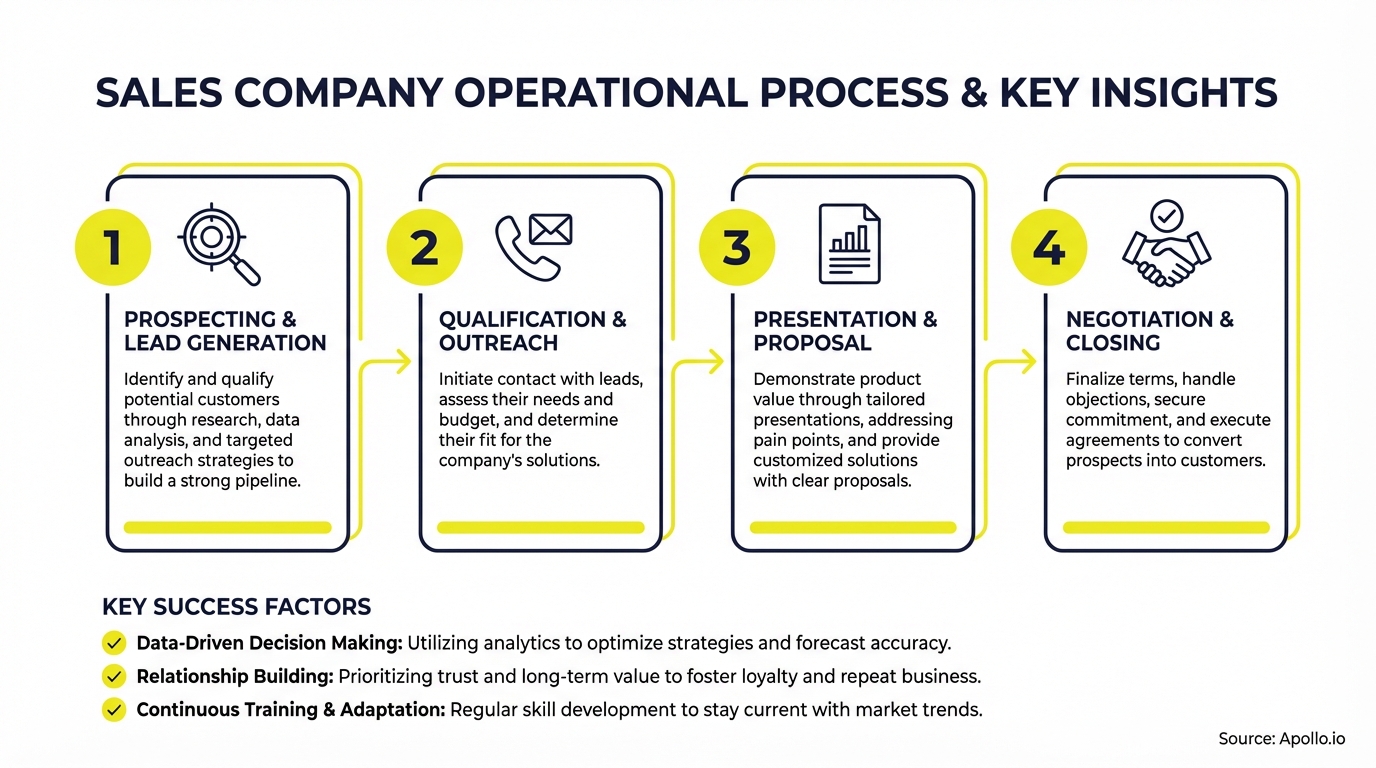
- Prospecting & Lead Generation: Identifying and qualifying potential customers using verified contact data and intent signals
- Sales Engagement: Multi-channel outreach across email, phone, and social channels with personalized messaging sequences
- Deal Management: Pipeline tracking, forecasting, and opportunity progression through defined sales stages
- Revenue Operations: Process optimization, data governance, tech stack management, and performance analytics
- Customer Success: Retention, expansion, and advocacy programs that drive recurring revenue growth
How Do Sales Companies Generate Revenue?
Sales companies generate revenue through systematic processes that move prospects from initial awareness to closed deals. The revenue generation model depends on average contract value, sales cycle length, and buyer complexity. Companies with an average contract value (ACV) of $50-$100K reported in 2024 that it takes nearly 9 months to close a deal, according to Norwest's 2024 Sales and Marketing Benchmark Report.
Modern sales companies compress these cycles by implementing revenue operations frameworks that eliminate friction points. RevOps leaders focus on data quality, process standardization, and technology integration to accelerate pipeline velocity.
Revenue Generation Models
| Model | Typical ACV | Sales Cycle | Primary Channel |
|---|---|---|---|
| Transactional | $1K-$10K | 7-30 days | Self-serve, inside sales |
| Mid-Market | $10K-$100K | 3-9 months | SDR-to-AE handoff |
| Enterprise | $100K+ | 6-18 months | Strategic account teams |
Struggling to find qualified leads across segments? Search Apollo's 224M+ contacts with 65+ filters to build targeted prospect lists in minutes.
How Do SDRs Build Pipeline in Modern Sales Companies?
SDRs in 2026 build pipeline by combining verified contact data, personalized outreach sequences, and intent signals to book qualified meetings. The traditional cold call-only approach no longer works when buyers prefer digital-first interactions.
SDRs need unified platforms that integrate prospecting, engagement, and activity tracking without context-switching between five different tools.
Top-performing SDRs use sales automation to scale their outreach while maintaining personalization. They build sequences that combine email, phone, and social touchpoints based on buyer behavior and engagement signals. The key differentiator is data quality paired with workflow efficiency.

SDR Daily Workflow Components
- Account Research: Review firmographics, technographics, and recent company news for context
- Contact Discovery: Find decision-makers with verified email addresses and direct dial numbers
- Sequence Enrollment: Add prospects to personalized multi-channel cadences based on persona and buying stage
- Activity Execution: Make calls, send emails, and engage on social channels with tracking and logging
- Meeting Qualification: Vet interest, confirm fit criteria, and schedule handoff to Account Executives
What Sales Technology Do High-Performing Companies Use?
High-performing sales companies consolidate their tech stacks around unified platforms that combine prospecting, engagement, and intelligence capabilities. The average sales team historically used 10+ disconnected tools, creating data silos, integration headaches, and wasted budget.
In 2026, winning teams prioritize consolidation over point solutions.
Platform consolidation delivers measurable benefits beyond cost savings. Sales teams report improved data accuracy, faster rep onboarding, and better cross-functional visibility when working from a single source of truth.
As one customer noted, "We reduced the complexity of three tools into one," while another shared, "We cut our costs in half."
Essential Sales Technology Categories
| Category | Core Capability | Impact on Revenue |
|---|---|---|
| Contact Data | Verified emails, phone numbers, job changes | Higher connect rates, reduced bounce rates |
| Engagement | Multi-channel sequences, templates, tracking | Increased touchpoint volume, better response rates |
| Intelligence | Buying signals, conversation insights, forecasting | Shorter cycles, improved win rates |
| Pipeline Management | Deal tracking, stage progression, reporting | Forecast accuracy, rep accountability |
Spending hours on manual outreach across disconnected tools? Automate your sequences with Apollo's unified platform that combines prospecting, engagement, and tracking.
Turn Forecast Guesswork Into Revenue Certainty
Pipeline forecasting a guessing game? Apollo delivers real-time deal visibility and buying signals so you predict revenue with confidence. Built-In boosted win rates 10% with Apollo's intelligence.
Start Free with Apollo →How Do Account Executives Close Deals Faster?
Account Executives close deals faster by entering conversations with comprehensive account intelligence, maintaining deal momentum through structured processes, and leveraging conversation insights to refine their approach. The key shift in 2026 is that AEs can no longer rely solely on relationship-building skills when buyers have already completed most of their evaluation before first contact.
Successful AEs implement disciplined deal management practices that include multi-threading across buyer committees, documenting next steps with clear owners and deadlines, and using proven pitch techniques tailored to specific stakeholder concerns. They also leverage conversation intelligence to identify objection patterns and refine messaging based on what actually works in closed-won deals.
Deal Velocity Accelerators
- Pre-Call Research: Review previous conversations, tech stack, competitive intel before every meeting
- Multi-Threading: Build relationships across 3-5 stakeholders to reduce single-point-of-failure risk
- Mutual Action Plans: Co-create timelines with buyers that include their internal approval steps
- Proof Points: Share relevant case studies and ROI calculators specific to buyer's industry and use case
- Champion Development: Equip internal advocates with materials and talking points for selling internally
How Do RevOps Teams Drive Predictable Revenue?
Revenue Operations teams drive predictable revenue by establishing data governance frameworks, optimizing cross-functional processes, and implementing measurement systems that connect activity to outcomes. RevOps emerged as a critical function because siloed sales, marketing, and customer success operations created inconsistent experiences and inaccurate forecasting.
In 2026, RevOps leaders focus on three priorities: tech stack consolidation to eliminate data fragmentation, process standardization to ensure consistent execution, and analytics frameworks that surface leading indicators of pipeline health. They also own CRM hygiene, field definitions, and stage criteria to ensure forecasts reflect reality.
RevOps Ownership Areas
- Data Management: Contact data quality, deduplication rules, enrichment workflows, field standardization
- Process Design: Lead routing, stage definitions, handoff criteria, approval workflows
- Technology Stack: Tool evaluation, integration architecture, vendor management, user enablement
- Performance Metrics: Pipeline coverage ratios, conversion rates, cycle times, win rates by segment
- Forecasting: Methodology definition, deal inspection cadences, risk identification, commit accuracy
What Metrics Define Sales Company Success?
Sales company success is defined by pipeline generation rates, win rates, average contract values, sales cycle length, and customer acquisition costs. However, research from Rachel Krug reveals that in 2024, up to 70% of B2B sales representatives missed their annual quota, meaning only 30% hit their target. This underscores the importance of tracking leading indicators that predict quota attainment rather than just lagging results.
Modern sales leaders implement comprehensive KPI frameworks that measure both activity metrics and outcome metrics. They establish thresholds for activities like outreach volume, connect rates, and meeting set rates while also tracking progression metrics like stage conversion rates and average deal size. The goal is early identification of performance gaps before quarter-end surprises.
Critical Sales Metrics by Role
| Role | Key Metrics | Target Benchmark |
|---|---|---|
| SDR | Meetings set, connect rate, response rate | 15-20 meetings/month, 20-30% connect rate |
| AE | Win rate, cycle time, average deal size | 20-30% win rate, 90-180 day cycle |
| Sales Leader | Pipeline coverage, forecast accuracy, quota attainment | 3-4x coverage, 90%+ accuracy, 80%+ attainment |
Start Building Your Modern Sales Company
Building a modern sales company requires consolidating your tech stack, implementing data governance, and enabling your teams with unified workflows. The companies winning in 2026 eliminated tool sprawl, established single sources of truth for customer data, and empowered reps to execute without context-switching between five different platforms.
Start by auditing your current tech stack and identifying overlapping capabilities. Look for opportunities to consolidate prospecting, engagement, and intelligence into one system.
Then establish clear data standards, stage definitions, and process documentation to ensure consistent execution across your team. Finally, implement measurement frameworks that surface leading indicators of pipeline health.
Ready to consolidate your sales stack and drive predictable revenue? Start Your Free Trial and see how Apollo's all-in-one platform helps 90K+ sales companies prospect, engage, and close deals faster.
Prove Apollo's ROI In Your First 30 Days
Budget approval stuck on unclear metrics? Apollo tracks every activity to pipeline dollar so you justify spend with hard numbers. Customer. io achieved 50% YoY growth with measurable automation impact.
Start Free with Apollo →Don't miss these
Sales
Inbound vs Outbound Marketing: Which Strategy Wins?
Sales
What Is a Sales Funnel? The Non-Linear Revenue Framework for 2026
Sales
What Is a Go-to-Market Strategy? The 2026 GTM Playbook
See Apollo in action
We'd love to show how Apollo can help you sell better.
By submitting this form, you will receive information, tips, and promotions from Apollo. To learn more, see our Privacy Statement.
4.7/5 based on 9,690 reviews
