
What Is a Sales AI Assistant? How It Works, Key Benefits, and 2026 Playbook
A sales AI assistant is software that automates research, drafts outreach, summarizes calls, and surfaces insights so reps spend more time selling.
According to Cirrus Insight, 56% of sales professionals now use AI daily, and those users are twice as likely to exceed their sales targets.
That gap is widening fast.
If your team still relies on manual research and generic templates, you're competing at a structural disadvantage.
This article covers exactly how a modern AI sales tool works, what ROI looks like by role, and how to roll one out without chaos.

Research Less, Close More With Apollo
Tired of burning hours tracking down contact info that turns out to be wrong? Apollo delivers 97% accurate emails and verified numbers so your team sells instead of searches. Join 600K+ companies building pipeline on autopilot.
Start Free with Apollo →Key Takeaways
- A sales AI assistant handles research, drafting, call summaries, and follow-ups so reps focus on conversations that close deals.
- The AI in sales market was valued at USD 31.2 billion in 2024 and is projected to grow at a 28.8% CAGR through 2034.
- SDRs and AEs see the fastest ROI: fewer hours on manual tasks means more outreach volume and more booked meetings.
- Governance matters. The best deployments pair AI generation with approved messaging libraries and human review loops.
- Apollo consolidates prospecting, AI outreach, call intelligence, and pipeline management into one workspace, cutting your tech stack significantly.
What Is a Sales AI Assistant?
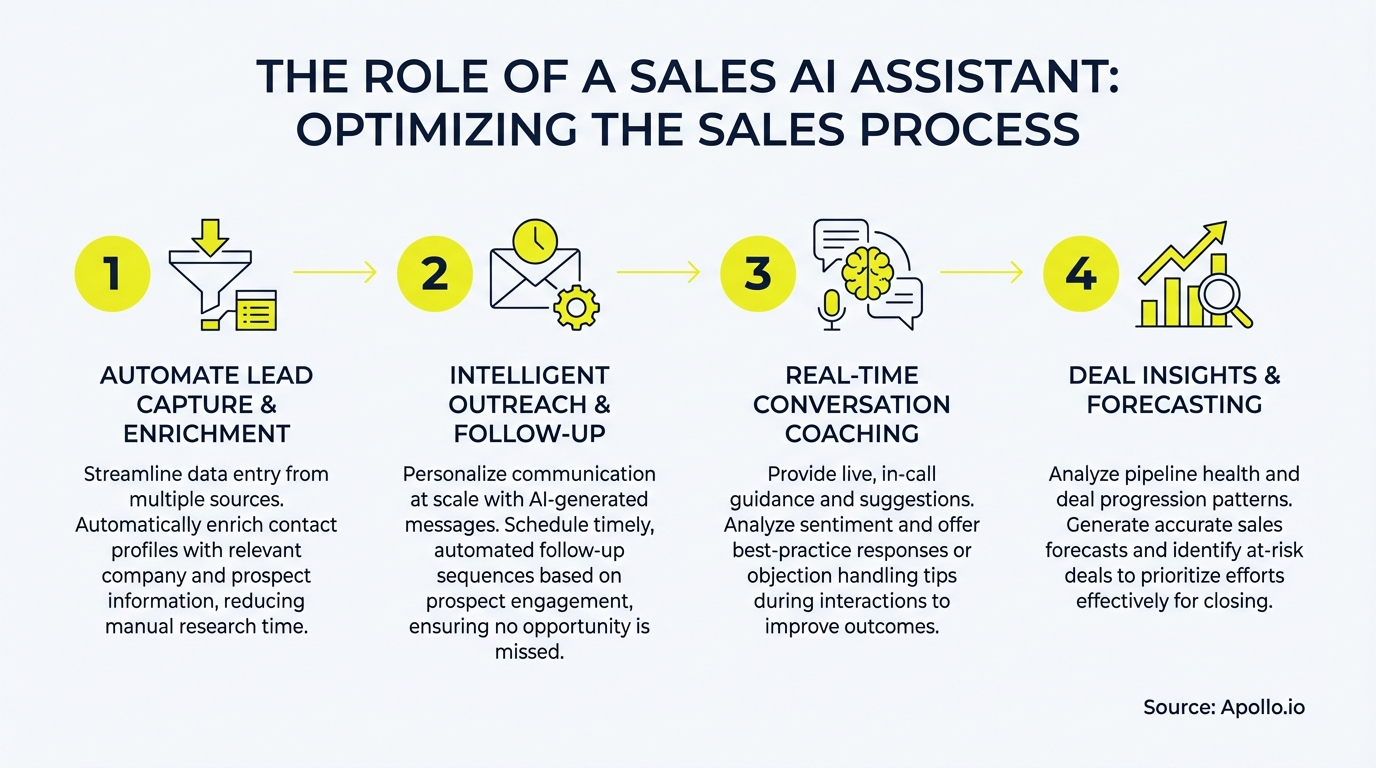
A sales AI assistant is an AI-powered tool embedded in a sales workflow that handles time-intensive tasks: account research, personalized email drafting, call transcription, objection coaching, and CRM data entry. It is not a chatbot for website visitors, a marketing content tool, or a standalone CRM.
The distinction matters because sales AI assistants are purpose-built for revenue workflows, pulling context from CRM records, contact data, and real-time buying signals to generate outputs reps can act on immediately.
The category has shifted from "copilot" (suggestions) to "agent" (execution). Modern assistants complete multi-step tasks: find a prospect, research their company, draft a personalized sequence, and log the activity, all without manual input at each step. Check out how sales automation tools fit into this broader workflow.
Why Is Adoption Accelerating in 2026?
Market momentum is undeniable. Data from GM Insights shows the global AI in sales market was valued at USD 31.2 billion in 2024 and is projected to reach USD 39.4 billion in 2025, growing at a 28.8% CAGR through 2034. Separately, Optif AI reports that according to Gartner's 2025 Sales Technology Report, 89% of revenue organizations now use AI-powered tools, up from 34% in 2023.
The driver is straightforward: content demand doubled between 2023 and 2024, and headcount didn't. AI assistants act as capacity multipliers, letting the same team produce more personalized outreach, faster follow-ups, and better-prepared calls without adding headcount.
How Do SDRs and AEs Use a Sales AI Assistant Day-to-Day?
The ROI differs by role, and understanding that split helps prioritize where to deploy first.
| Role | Primary Use Cases | Key Outcome |
|---|---|---|
| SDRs / BDRs | AI-drafted first-touch emails, prospect research briefs, sequence personalization | More outreach volume, higher reply rates |
| Account Executives | Pre-call account summaries, objection handling suggestions, follow-up drafts | Shorter sales cycles, stronger multi-threading |
| RevOps | CRM hygiene automation, pipeline health signals, sales KPI tracking | Cleaner data, single source of truth |
| Sales Leaders | Call coaching summaries, rep performance trends, forecast inputs | Coach at scale without listening to every call |
SDRs using AI assistants report measurable time savings on research that gets redirected into personalization and follow-up volume. For Account Executives managing complex deals, deal management tools paired with AI summaries reduce the cognitive load of juggling multiple stakeholders.
Spending hours on manual outreach? Automate your sequences with Apollo's multi-channel platform and let AI handle the first draft every time.

What Core Capabilities Should a Sales AI Assistant Have?
Not all AI assistants are equal. Evaluate tools against these six capabilities before committing:
- Prospect research: Auto-generates account briefs from company news, funding events, job changes, and intent signals, not just static firmographics.
- Personalized outreach drafting: Produces email and call scripts tailored to role, industry, and context, pulling from approved messaging blocks.
- Call intelligence: Transcribes, summarizes, and extracts next steps from calls automatically. Apollo's AI call assistant handles this natively so reps stay present in the conversation.
- CRM sync: Logs activities, updates contact records, and flags stale opportunities without manual entry.
- Governance controls: Approved prompt libraries, role-based permissions, and human review loops. This is non-negotiable for enterprise rollouts.
- Pipeline signals: Surfaces at-risk deals and recommends next actions based on engagement data and sales analytics.
Turn Funnel Gaps Into Predictable Pipeline
Pipeline forecasting a guessing game because quality leads never convert? Apollo surfaces in-market buyers at the right moment, so your funnel fills with opportunities — not dead ends. Nearly 100K paying customers trust Apollo to call their shot.
Schedule a Demo →How Do You Build a Governance Framework for AI Sales Content?
Ungoverned AI creates brand risk, inconsistent messaging, and compliance exposure. A governance framework prevents all three. Structure it in three layers:
- Approved messaging library: Marketing-vetted value propositions, persona-specific talk tracks, and approved subject lines stored as reusable blocks. Reps pull from these rather than generating from scratch every time.
- Human review loops: High-stakes outputs (executive outreach, renewal narratives, pricing discussions) require a review step before sending. Lower-stakes outputs (cold email variations) can run with lighter oversight.
- Audit and iteration: Track which AI-generated messages convert and which don't. Feed winners back into the library. This creates a self-improving content system rather than a one-off generation tool.
Governance is what separates teams that get sustainable ROI from teams that generate noise. For a broader view of how this fits your stack, see our sales tech stack playbook.
How Does Apollo Work as a Sales AI Assistant?
Apollo combines a 230M+ contact database, AI-powered outreach, call intelligence, and pipeline management in one platform. For B2B GTM teams under ROI pressure, that consolidation matters. "Having everything in one system was a game changer," noted the team at Cyera. "We cut our costs in half," said Census.
Instead of stitching together a prospecting tool, a sequencing platform, a call recorder, and a CRM enrichment layer, Apollo handles all of it. The AI Research Agent surfaces account insights before outreach. AI-powered messaging drafts and personalizes sequences. The call assistant captures and summarizes every conversation. Sales productivity improves because reps operate from one workspace instead of switching between five tools. Apollo has seen 500% year-over-year AI platform growth and 46% more meetings booked when teams use the AI Research Agent.

What Is the ROI of a Sales AI Assistant?
ROI depends on team size, use case, and current baseline, but the framework is consistent. Time saved on research and drafting converts directly into more outreach attempts and more conversations.
More conversations, with better personalization, convert into more pipeline. Governance ensures the quality stays high as volume scales.
According to data cited by Jeeva AI, 92% of executives plan to increase AI budgets over the next three years, with 55% expecting at least a 10% budget increase. The ROI narrative has moved from innovation framing to cost-and-throughput framing. Sales leaders are now expected to show measurable pipeline impact from AI investment, not just adoption metrics. Tracking the right revenue operations inputs makes that case easier to build.
How Do You Get Started with a Sales AI Assistant in 2026?
A phased rollout reduces friction and builds internal proof points before full deployment:
- Week 1-2: Audit current stack. Identify which tools overlap with AI assistant capabilities. Define the consolidation opportunity.
- Week 3-4: Build your messaging library. Pull approved copy from marketing. Define persona rules and tone guidelines.
- Month 2: Pilot with a 3-5 rep cohort (ideally SDRs first). Measure reply rates, meeting booking rates, and time-on-task.
- Month 3+: Expand based on pilot results. Establish governance checkpoints and a feedback loop for content improvement.
Champions matter. Identify one rep per team who becomes the internal advocate. Their results become the social proof that drives broader adoption without top-down mandates.
Start Selling Smarter with Apollo's Sales AI Assistant
A sales AI assistant is no longer a competitive advantage. It's the baseline.
Teams that deploy one with proper governance, approved messaging libraries, and integrated pipeline data outperform those that don't, on volume, personalization, and conversion.
Apollo gives SDRs, AEs, RevOps leaders, and sales managers everything they need in one platform: AI-powered prospecting, multi-channel sequences, call intelligence, and deal management. No stitching together five tools.
No switching between windows. "We reduced the complexity of three tools into one," said Collin Stewart at Predictable Revenue.
Ready to see what a unified sales AI assistant looks like in practice? Schedule a Demo and see how Apollo's AI platform drives more meetings, better pipeline, and a leaner tech stack.
Prove Pipeline ROI With Apollo
ROI pressure killing your tool budget before it even starts? Apollo delivers measurable pipeline impact fast — Leadium 3x'd annual revenue using Apollo's automation. Start your free trial today.
Start Free with Apollo →Don't miss these
Sales
Inbound vs Outbound Marketing: Which Strategy Wins?
Sales
What Is a Sales Funnel? The Non-Linear Revenue Framework for 2026
Sales
What Is a Go-to-Market Strategy? The 2026 GTM Playbook
See Apollo in action
We'd love to show how Apollo can help you sell better.
By submitting this form, you will receive information, tips, and promotions from Apollo. To learn more, see our Privacy Statement.
4.7/5 based on 9,690 reviews
