
Sales Accelerator: How to Speed Up Your Sales Cycle and Close More Deals
Sales teams face mounting pressure to close deals faster while buyers increasingly prefer self-serve research over traditional sales calls. A sales accelerator bridges this gap by streamlining workflows, automating repetitive tasks, and delivering actionable insights at every stage of the sales cycle. According to SalesStar, by 2025, Gartner predicts that 80% of B2B sales interactions between suppliers and buyers will occur in digital channels. This shift demands tools that enable reps to engage prospects across multiple touchpoints while maintaining consistent, relevant messaging. Sales productivity depends on technology that eliminates friction and accelerates pipeline velocity.

Find Verified Contacts In Seconds With Apollo
Tired of spending hours hunting for accurate contact info? Apollo delivers 224M+ verified contacts with 96% email accuracy. Join 550K+ companies closing more deals.
Start Free with Apollo →Key Takeaways
- Sales accelerators automate prospecting, outreach, and follow-up to shorten sales cycles and increase deal velocity
- Modern buyers complete most research independently, requiring tools that support rep-free buying journeys while enabling strategic human touchpoints
- Unified platforms consolidate data enrichment, engagement automation, and pipeline tracking to cut tech stack complexity and costs
- AI-powered features like conversation intelligence and predictive scoring help SDRs and AEs prioritize high-value opportunities
- Effective sales acceleration requires alignment across prospecting, engagement, deal management, and analytics capabilities
What Is a Sales Accelerator?
A sales accelerator is a platform or set of tools that speeds up the sales process by automating manual tasks, organizing prospect data, and guiding reps through prioritized workflows. It consolidates prospecting, outreach automation, meeting scheduling, and pipeline tracking into one workspace.
Sales accelerators eliminate context-switching between tools, giving SDRs and Account Executives a clear view of what to do next.
These platforms integrate with CRMs to enrich contact records, trigger multi-channel sequences, and surface buying signals. The goal is to reduce time spent on administrative work and increase time spent selling.
For founders and sales leaders managing lean teams, a sales accelerator replaces point solutions like data providers, email automation tools, and dialer software with a unified system.
Why Do Sales Teams Need Sales Accelerators in 2026?
Buyer behavior has fundamentally changed. Research from Gartner projects that by 2026, B2B sales organizations using Generative AI-embedded sales technologies will reduce the amount of time spent on prospecting and customer meeting preparation by over 50%. Reps need tools that adapt to this reality by automating research and enabling instant personalization at scale.
Sales accelerators address three critical challenges:
- Data fragmentation: Contact information, engagement history, and deal context scattered across multiple systems slow down decision-making
- Manual prospecting: Reps spend hours researching accounts and building lists instead of having conversations
- Inconsistent follow-up: Deals stall when reps lack automated reminders and structured outreach sequences
RevOps leaders implementing sales accelerators report cleaner data pipelines, better forecast accuracy, and reduced tool sprawl. Instead of managing integrations between five separate vendors, teams operate from one platform.
As one customer shared: "We reduced the complexity of three tools into one" (Predictable Revenue).
How Does a Sales Accelerator Work?
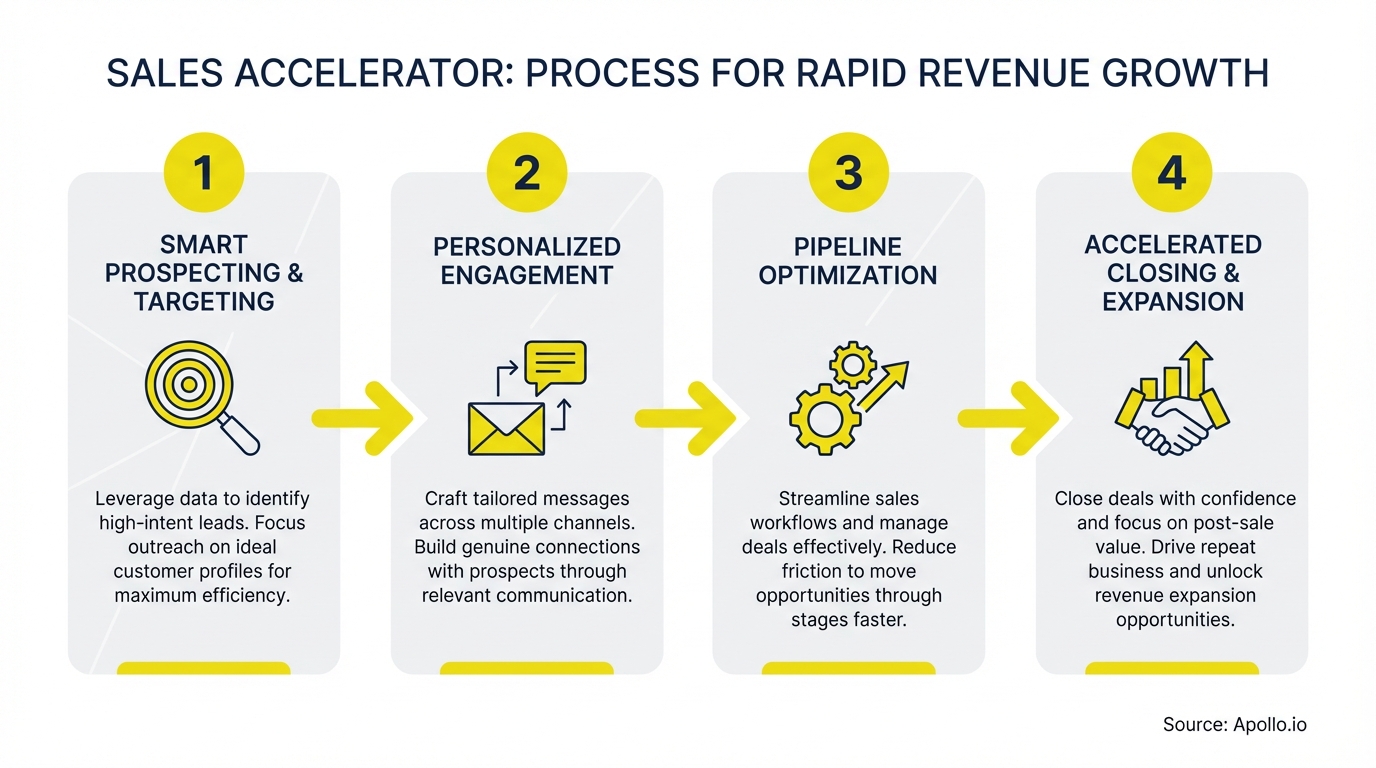
Sales accelerators combine four core capabilities: data intelligence, workflow automation, multi-channel engagement, and performance analytics. Each component works together to move prospects through the pipeline faster.
What Role Does Data Intelligence Play?
Data intelligence starts with access to verified business contacts and company information. Sales accelerators provide searchable databases with filters for industry, company size, technology stack, and job title.
Reps build targeted lists in minutes instead of hours. The platform enriches CRM records automatically, filling gaps in contact details and firmographic data.
Struggling to find qualified leads? Search Apollo's 224M+ contacts with 65+ filters.
How Does Workflow Automation Accelerate Sales Cycles?
Automation handles repetitive tasks like email sequences, task creation, and meeting scheduling. SDRs set up cadences that combine email, phone calls, and social touchpoints.
The system tracks engagement, logs activity in the CRM, and surfaces the next action. When a prospect opens an email or visits the pricing page, the platform alerts the rep in real time.
Sales automation software eliminates manual data entry and ensures consistent follow-up. For Account Executives managing multiple deals, automated reminders prevent opportunities from going cold. The platform queues the next call, drafts follow-up emails using AI, and updates deal stages based on activity.
What Multi-Channel Engagement Features Matter Most?
Modern buyers engage across email, phone, social selling platforms, and professional networks. Sales accelerators enable coordinated outreach across all channels from one interface.
Reps launch sequences that alternate between touchpoints based on prospect behavior. If someone doesn't respond to email, the system schedules a call or social message.
The platform tracks which channels drive the best response rates for different segments. Sales leaders use this data to refine messaging and channel mix. Social selling strategies integrate directly into multi-channel workflows, allowing reps to engage prospects where they're most active.
Spot Ready Buyers Before Your Competitors Do
Missing in-market prospects while competitors close your deals? Apollo's intent signals reveal buyers actively researching solutions. Built-In increased win rates 10% with buying signal intelligence.
Start Free with Apollo →How Do SDRs Use Sales Accelerators to Book More Meetings?
SDRs and BDRs face quota pressure to book qualified meetings while managing high-volume prospecting. Sales accelerators give them the tools to scale outreach without sacrificing personalization.
The workflow starts with building a targeted list using advanced search filters (industry, revenue, headcount, technology signals).

Once the list is ready, SDRs enroll contacts in multi-touch sequences. The platform suggests optimal send times, A/B tests subject lines, and tracks open rates.
When a prospect engages, the system prioritizes them in the rep's task queue. SDRs spend less time deciding who to contact next and more time having conversations.
AI features analyze past successful emails to suggest messaging improvements. For new reps ramping up, this accelerates learning and helps them hit quota faster.
The platform also surfaces buying signals like job changes, funding announcements, or technology adoptions that indicate purchase intent. SDRs using these insights report higher connection rates and more qualified pipeline.
What Features Should Sales Leaders Prioritize?
Sales leaders evaluating accelerators should focus on capabilities that drive measurable pipeline impact and team efficiency. The platform must consolidate prospecting, engagement, and analytics to reduce tech stack complexity.
Key features include:
| Feature Category | Core Capabilities | Business Impact |
|---|---|---|
| Prospecting & Data | Contact database, enrichment, intent signals | Reduces research time, improves targeting accuracy |
| Engagement Automation | Multi-channel sequences, AI email generation, dialer | Increases outreach volume, maintains consistency |
| Deal Management | Pipeline tracking, automated task creation, forecasting | Prevents deals from stalling, improves forecast accuracy |
| Analytics & Insights | Activity tracking, conversion metrics, rep performance | Identifies coaching opportunities, optimizes workflows |
| Integrations | Native CRM sync, calendar tools, communication platforms | Eliminates data silos, reduces manual entry |
Spending hours on manual outreach? Automate your sequences with Apollo's multi-channel platform.

Platforms that unify these capabilities into one workspace deliver the strongest ROI. Teams using consolidated sales tech stacks eliminate redundant subscriptions and integration maintenance. As one customer reported: "We cut our costs in half" (Census).
How Do Sales Accelerators Support Revenue Operations?
RevOps teams rely on sales accelerators to maintain data hygiene, enforce process consistency, and measure go-to-market effectiveness. The platform serves as the single source of truth for prospect and customer data.
Automated enrichment keeps records current without manual updates.
Sales accelerators provide visibility into rep activity, pipeline health, and conversion rates at every stage. RevOps leaders use these insights to identify bottlenecks and optimize resource allocation. Tracking the right sales KPIs becomes straightforward when all activity flows through one system.
The platform also enforces governance around outreach volume, message compliance, and territory management. RevOps can set guardrails that prevent reps from over-contacting prospects or sending off-brand messaging.
This balance between automation and control protects brand reputation while scaling outbound motion.
What Results Can Teams Expect from Sales Accelerators?
Teams implementing sales accelerators report faster ramp times for new hires, increased pipeline generation, and shorter sales cycles. SDRs book more meetings because they spend less time on list building and more time on conversations.
Account Executives close deals faster with automated follow-up and real-time deal insights.
Sales leaders gain predictable forecasting through better pipeline visibility and activity tracking. They can identify which reps need coaching, which sequences perform best, and where deals typically stall. Sales analytics embedded in the platform eliminate the need for manual reporting.
Organizations also see cost savings from consolidating multiple tools into one platform. Instead of paying for separate data providers, engagement tools, and dialers, teams operate from a unified workspace.
This consolidation reduces integration complexity and support overhead. As one RevOps leader noted: "Having everything in one system was a game changer" (Cyera).
Accelerate Your Sales Motion in 2026
Sales accelerators have evolved from nice-to-have productivity tools to essential infrastructure for modern go-to-market teams. They enable rep-free buyer journeys while empowering reps to focus on high-value conversations.
The right platform consolidates data, automates workflows, and provides the insights needed to hit revenue targets consistently.
For SDRs looking to book more meetings, AEs closing complex deals, and RevOps leaders optimizing the sales engine, a unified sales accelerator eliminates tool sprawl and drives measurable results. Teams that embrace these platforms gain competitive advantages in speed, efficiency, and buyer experience.
Ready to accelerate your sales motion? Get leads now with Apollo's all-in-one sales intelligence platform.
Prove Pipeline ROI In Days, Not Quarters
Budget stuck on unclear metrics? Apollo tracks every touchpoint from prospect to close—quantifying exactly how your outreach drives revenue. Customer. io achieved 50% YoY growth with measurable pipeline impact.
Start Free with Apollo →Don't miss these
Sales
Inbound vs Outbound Marketing: Which Strategy Wins?
Sales
What Is a Sales Funnel? The Non-Linear Revenue Framework for 2026
Sales
What Is a Go-to-Market Strategy? The 2026 GTM Playbook
See Apollo in action
We'd love to show how Apollo can help you sell better.
By submitting this form, you will receive information, tips, and promotions from Apollo. To learn more, see our Privacy Statement.
4.7/5 based on 9,690 reviews
