
Psychology of Sales: How Buyers Make Decisions in 2026
B2B buying has fundamentally shifted. Buyers now complete most of their journey before ever speaking to a sales rep, making every piece of content, every data point, and every digital touchpoint a psychological trigger that either builds trust or creates doubt. Understanding the psychology of sales in 2026 means mastering the mental frameworks that drive self-serve buyers, committee decisions, and early vendor shortlisting. According to Marketing Automation, approximately 75% of B2B buyers prefer a sales experience without direct interaction with sales representatives. This makes psychological insight the foundation of modern sales analytics and revenue strategy.

Apollo Eliminates Hours Of Manual Research
Tired of spending 4+ hours daily hunting for contact info? Apollo delivers 224M verified contacts with 96% email accuracy. Join 550K+ companies who turned research time into selling time.
Start Free with Apollo →Key Takeaways
- Modern buyers decide before contact: vendors win by earning Day One shortlist position through content and proof
- Credibility beats likability: buyers prioritize verifiable expertise over relationship-building tactics
- Self-serve psychology demands consistency: message alignment across channels prevents buyer mistrust
- Committee buying amplifies risk aversion: multiple stakeholders require defensible decisions and shared mental models
- AI-era personalization creates noise: insight and specificity differentiate where generic relevance fails
What Is the Psychology of Sales?
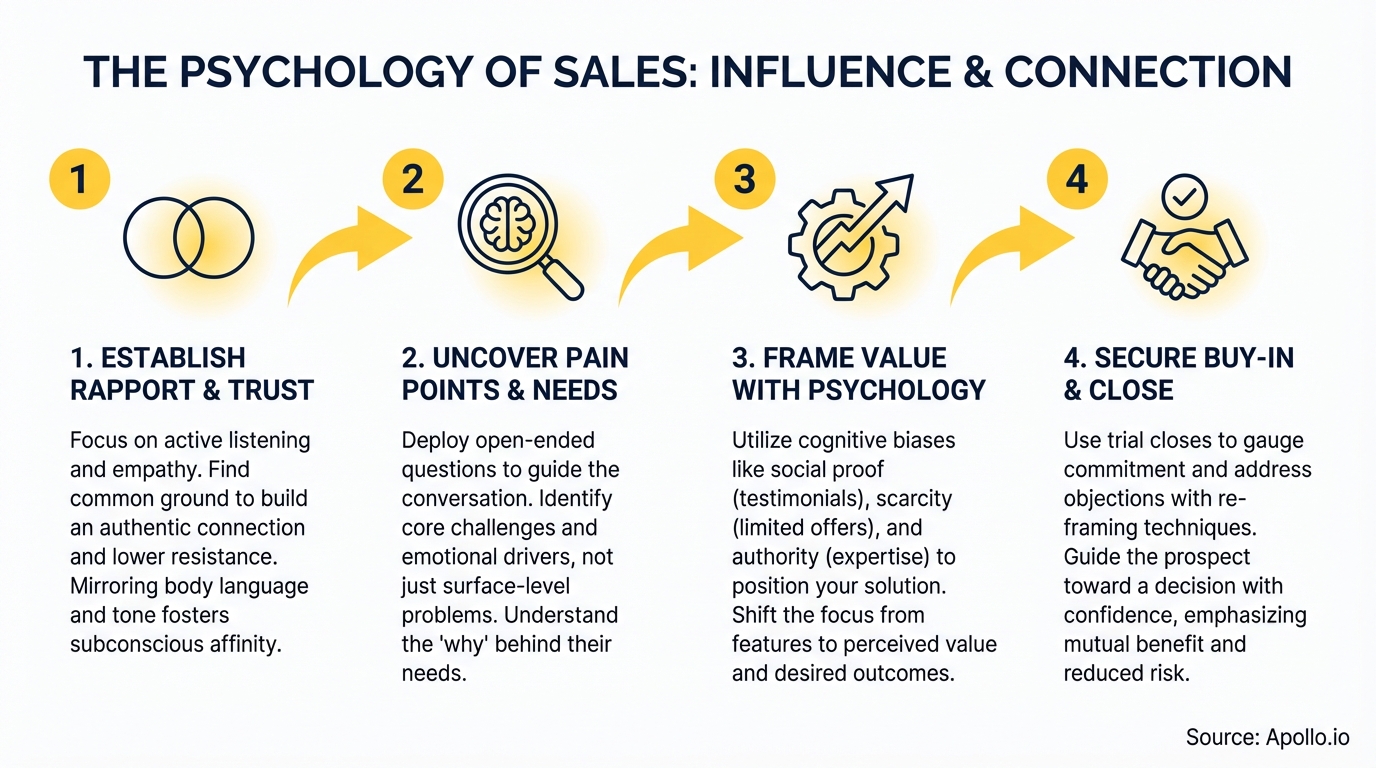
The psychology of sales is the study of mental triggers, decision-making patterns, and behavioral drivers that influence how buyers evaluate vendors, process information, and commit to purchases. It encompasses cognitive biases (anchoring, social proof, loss aversion), emotional states (trust, anxiety, confidence), and structural decision frameworks (committee consensus, risk management, ROI justification).
In 2026, sales psychology focuses less on persuasion tactics during conversations and more on designing buyer experiences that reduce friction, build credibility, and create psychological safety throughout self-serve journeys.
This shift reflects a fundamental change in B2B buying behavior. Research from 6sense shows that in 2025, buyers are contacting sellers earlier in their journey, with the point of first contact shifting from about 69% of the way through the buying journey in 2023-2024 to 61% in 2025, which translates to roughly 6 to 7 weeks sooner. However, by the time that contact happens, vendor preferences are already established. Sales psychology now operates primarily through content, data, and digital experiences rather than live interactions.
Why Does Buyer Psychology Matter More in 2026?
Buyer psychology has become the primary competitive battleground because purchasing decisions are made before sales conversations begin. The rise of self-serve buying, AI-powered research, and expanded buying committees means vendors must understand and influence psychological states they cannot directly observe.
Three forces make psychology critical: rep-free preference, pre-contact vendor selection, and trust erosion from AI-generated noise.
The data is clear. According to BookYourData, by 2025, 80% of B2B sales interactions between suppliers and buyers occur through digital channels. Buyers research independently, validate through peer networks, and form vendor preferences through content consumption rather than sales pitches. A study by Sales Growth found that 82% of buyers prioritize credibility over likability, with 54% stating they don't need to like the salesperson to do business with them. This credibility-first psychology requires different content strategies, proof hierarchies, and objection handling approaches than traditional relationship-selling models.

What Psychological Triggers Drive Self-Serve Buyers?
Self-serve buyers operate under distinct psychological constraints: time scarcity, information overload, and decision anxiety without expert guidance. They seek three outcomes: rapid pattern matching (category fit), risk reduction (proof and validation), and cognitive efficiency (clear comparisons and ROI clarity).
Vendors who structure content to deliver these outcomes win early shortlist position.
Key psychological triggers for self-serve buyers include:
- Category anchoring: Buyers form mental models of "what this type of solution does" within seconds of discovery. Clear positioning and differentiation prevent miscategorization.
- Social proof hierarchy: Peer reviews, customer logos, and third-party validation reduce perceived risk more effectively than vendor claims.
- Consistency verification: Buyers cross-reference website content, sales materials, and review sites. Message inconsistency triggers mistrust and vendor elimination.
- ROI defensibility: Self-serve buyers need ammunition to justify decisions internally. Calculators, benchmarks, and CFO-ready narratives enable committee consensus.
Struggling to reach self-serve buyers doing independent research? Build targeted contact lists with Apollo's 224M+ verified business contacts and 65+ search filters.
Apollo Turns Weak Leads Into Pipeline Fast
Marketing leads stalling at the top of the funnel. Apollo scores and routes qualified prospects automatically with 96% email accuracy. Built-In boosted win rates 10% using Apollo's signals.
Start Free with Apollo →How Do SDRs Use Psychology to Book More Meetings?
SDRs in 2026 succeed by understanding that buyers want relevance, not relationship-building. The psychology shift from "rapport first" to "insight first" means outreach must immediately demonstrate understanding of the buyer's context, challenges, and priorities. Generic personalization creates noise; specific insight creates curiosity. SDRs who master trigger events, pain point diagnosis, and value articulation book meetings at higher rates.
Effective psychological strategies for SDRs:
- Trigger-based timing: Reach out when buyers experience change (hiring, funding, tech stack shifts) that creates psychological receptiveness.
- Problem-first messaging: Lead with the specific problem you solve, not your product. Buyers engage when you demonstrate understanding.
- Peer proof integration: Reference similar companies or roles that achieved outcomes. Social proof reduces skepticism.
- Low-friction asks: Request small commitments (5-minute call, specific question answered) rather than full demos. Reduces decision anxiety.
For more on building effective outreach strategies, explore social selling techniques that prioritize insight over volume.
What Psychology Drives Committee Buying Decisions?
Committee buying introduces complex group psychology: consensus requirements, political dynamics, and distributed risk aversion. Each stakeholder brings different priorities, fears, and success criteria.
Winning requires creating shared mental models that allow diverse buyers to align around a defensible decision. The larger the committee, the more critical psychological safety and decision defensibility become.
Committee psychology operates on several levels. Individual stakeholders need role-specific value (CFO wants ROI, IT wants security, end-users want usability).
The group needs consensus mechanisms: shared business cases, mutual action plans, and internal champion enablement. According to research, B2B purchases now involve expanding buying groups, with generative AI purchases doubling stakeholder counts.
This amplifies the psychological need for audit trails, risk mitigation documentation, and change management narratives that reduce individual accountability fears.
Account Executives managing complex deals use tools that track stakeholder engagement and map buying committee relationships. Platforms that consolidate contact intelligence, engagement history, and deal progression visibility help AEs navigate committee psychology by identifying champions, blockers, and unengaged stakeholders who create risk.
How Does AI Change Sales Psychology in 2026?
AI creates both opportunity and psychological challenges. On one hand, AI tools enable hyper-personalization, predictive insights, and efficiency gains.
On the other, AI-generated outreach creates "personalization inflation" where tailored messages become noise, and buyers develop skepticism toward AI-written content. The psychology shifts toward trust signals that AI cannot fake: verifiable expertise, transparent processes, and human accountability at critical moments.
The trust paradox is real. While AI adoption accelerates (over 80% of sales teams using AI report increased revenue according to industry research), buyer preference for human interaction at key decision points is rising. Gartner predicts that by 2030, 75% of B2B buyers will prefer sales experiences that prioritize human interaction over AI. This suggests successful teams use AI for efficiency (research, data enrichment, workflow automation) while reserving human engagement for trust-building, negotiation, and change management conversations where psychological safety matters most.

What Content Formats Match Buyer Psychology?
Different buying stages and buyer types require format-specific content that matches their psychological state and information-processing preferences. Early-stage buyers seek pattern matching and category education (short-form content, comparison tables, explainer videos).
Mid-stage buyers need validation and risk reduction (case studies, ROI calculators, peer reviews).
Late-stage buyers require consensus tools and implementation confidence (business case templates, mutual action plans, security documentation).
Format psychology in 2026:
| Buyer Stage | Psychological Need | Effective Formats |
|---|---|---|
| Discovery | Category understanding, quick pattern matching | Short videos, comparison charts, positioning statements |
| Evaluation | Risk reduction, peer validation, ROI clarity | Case studies, customer reviews, ROI calculators |
| Decision | Consensus building, implementation confidence | Business case templates, security docs, onboarding previews |
| Advocacy | Internal selling, stakeholder alignment | Executive summaries, stakeholder-specific one-pagers |
For deeper insights on building effective content strategies, review revenue operations frameworks that align content production with buyer journey stages.
Conclusion: Master Buyer Psychology to Win in 2026
The psychology of sales has shifted from persuasion tactics to buyer enablement. Vendors win by understanding self-serve decision patterns, committee dynamics, and trust-building mechanisms that operate before sales conversations begin.
Success requires content governance (message consistency), proof hierarchies (credible validation), and format strategies that match psychological states across the buying journey. Teams that master these elements earn Day One shortlist position and reduce sales cycle friction.
The data confirms this shift. With buyers contacting sellers earlier but deciding independently, with credibility outweighing likability, and with AI creating both efficiency and noise, sales psychology becomes the foundation of go-to-market strategy. RevOps leaders building scalable systems recognize that psychological insight drives every metric that matters: conversion rates, sales velocity, deal size, and customer retention.
Ready to build a sales motion that aligns with modern buyer psychology? Start a trial and consolidate your prospecting, engagement, and intelligence tools into one platform that helps your team understand and influence buyer decisions at every stage.
Prove Pipeline ROI In Days, Not Quarters
Budget approval stuck on unclear metrics? Apollo tracks every touchpoint to pipeline with built-in attribution. Customer. io achieved 50% YoY growth with measurable ROI.
Start Free with Apollo →Don't miss these
Sales
Inbound vs Outbound Marketing: Which Strategy Wins?
Sales
What Is a Sales Funnel? The Non-Linear Revenue Framework for 2026
Sales
What Is a Go-to-Market Strategy? The 2026 GTM Playbook
See Apollo in action
We'd love to show how Apollo can help you sell better.
By submitting this form, you will receive information, tips, and promotions from Apollo. To learn more, see our Privacy Statement.
4.7/5 based on 9,690 reviews
