
Insurance Agent Leads: How to Find and Convert More Prospects
Insurance agent leads are only valuable if they turn into bound policies. In 2025, roughly 100 million U.S. adults said they needed life insurance or more coverage, yet only 9.4 million individual life policies were sold in 2024, according to LIMRA. That gap means the real problem isn't finding more names, it's qualifying, routing, and following up on the leads you already have.
This playbook gives you a lead-quality scorecard, a funnel math model, a line-of-business routing matrix, and a compliance checklist you can use before you buy your next batch of leads. For teams building outbound lists alongside purchased leads, finding B2B leads by title, industry, or company can supplement paid sources with a controllable, owned pipeline.
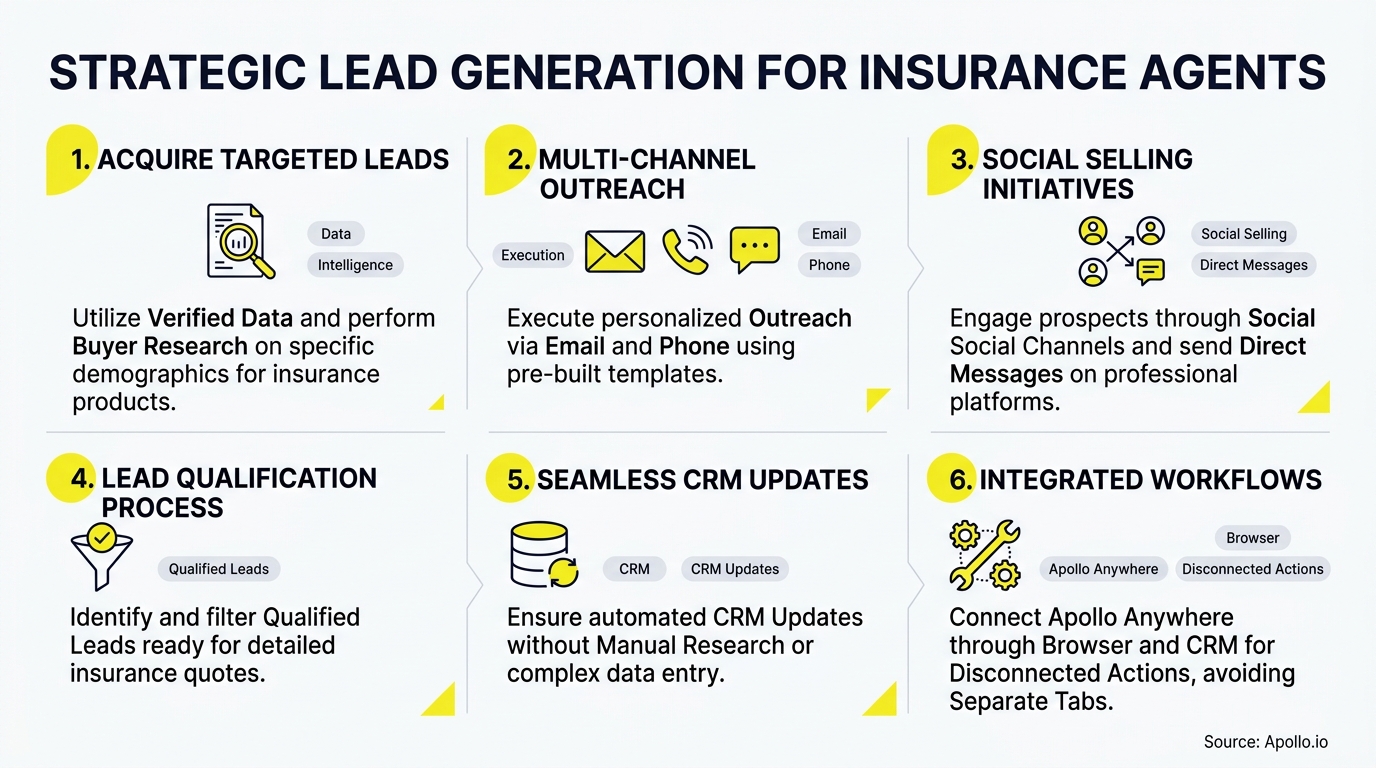

Apollo Ends Manual Lead Research For Good
Still burning hours chasing down emails and phone numbers that go nowhere? Apollo hands your team verified contact data instantly, at 98% email accuracy, so reps sell instead of digging. Build your pipeline on data you can trust.
Start Free with Apollo →Key Takeaways
- Lead volume doesn't equal revenue: most insurance shoppers need education before they buy, so scoring for readiness matters more than raw contact counts.
- Speed-to-lead is a proven conversion lever, but it only works when paired with accurate carrier-fit and consent data.
- Regulatory scrutiny on consent and data provenance is rising, making vendor due-diligence a growth requirement, not just a legal formality.
- Digital shopping behavior varies sharply by line of business, so your routing and follow-up cadence should too.
- Agencies that combine purchased leads with owned outbound and referral pipelines reduce dependency on rising acquisition costs.
What Are Insurance Agent Leads?
Insurance agent leads are contact records of consumers or businesses who have shown some level of interest in purchasing or renewing an insurance policy, typically captured through a quote form, call, referral, or aggregator site. They range from cold, unverified data to exclusive, consent-documented prospects actively comparing carriers.
Not all leads are created equal: a shared lead sold to five agents behaves very differently from an exclusive lead captured minutes ago with a verified consent timestamp.
The distinction matters because J.D. Power found that auto insurance shoppers now obtain a record average of 3.5 quotes per shopping session, with 48% of new policies purchased digitally. Your lead is competing against several other agents and carriers in real time, so its quality and your response speed both determine whether it converts.
How Do You Score Insurance Lead Quality Before You Buy?
Score insurance lead quality using six criteria: consent documentation, timestamp freshness, exclusivity, eligibility match, carrier appetite, and buyer readiness. Run every vendor and lead batch through this scorecard before committing budget.
| Criterion | What to Verify | Red Flag |
|---|---|---|
| Consent documentation | Written proof of opt-in, source URL, and timestamp | Vendor can't produce a consent record on request |
| Timestamp freshness | Minutes or hours old, not days | Lead is older than 24-48 hours with no re-verification |
| Exclusivity | Sold to one agent vs. shared across multiple buyers | Vendor won't disclose how many times a lead is resold |
| Eligibility match | State licensing, coverage type, and household fit | High rate of leads outside your licensed states |
| Carrier appetite | Risk profile matches carriers you write for | Leads consistently decline or rate outside appetite |
| Buyer readiness | Active shopping signal, not passive content download | Lead can't recall requesting a quote when contacted |
Ask every vendor these due-diligence questions before signing a contract: Where does the consent originate, and can you produce a record? Is this lead exclusive or shared, and how many buyers receive it? What's your average lead age at delivery? Do you have any FTC or state regulatory actions on file? This last question matters more than ever: in August 2025, the FTC settled with Assurance IQ and MediaAlpha for $145 million over allegations tied to deceptive marketing and lead-generation practices, with MediaAlpha reportedly selling around 119 million consumer leads in 2024 alone. Consent provenance is now a core part of lead scoring, not an afterthought.
Struggling to find qualified leads that meet this bar? Search Apollo's 240M+ contacts with 65+ filters to build owned business-insurance prospect lists alongside your purchased consumer leads.
How Do You Calculate the ROI of Insurance Agent Leads?
Calculate insurance lead ROI by tracking cost per lead through five stages: contact rate, quote rate, bind rate, retention, and lifetime value. A lead that costs less upfront but converts poorly at any stage can cost more per bound policy than a pricier, better-qualified lead.
Use this formula to model true acquisition cost:
- Cost per contact = Lead cost ÷ contact rate
- Cost per quote = Cost per contact ÷ quote rate
- Cost per bind = Cost per quote ÷ bind rate
- True acquisition cost = Cost per bind, adjusted for average retention period and lifetime value
For context on broader acquisition benchmarks, Digital Applied projects the median B2B cost per lead will reach $213 in 2026, up from $198 in 2025, a useful reference point when negotiating vendor rates. Commercial lines agents should also watch loss-cost trends: Fall Line Specialty reports average commercial premiums declined 1.2% in Q1 2026, the first quarterly drop since 2017, which can compress commission-based ROI even when bind rates hold steady.
Retention drives lifetime value more than any single lead source. Agents who nurture leads with structured follow-up, not just a single quote call, see stronger multi-year retention. Review proven prospect nurturing strategies for converting hesitant, not-yet-ready buyers into long-term policyholders.
Apollo Turns Cold Leads Into Ready Buyers
Watching sales-ready opportunities stall because marketing handoffs miss the moment? Apollo surfaces buying signals so reps engage prospects exactly when they're ready to talk. Built-In saw a 10% win rate lift using Apollo's scoring.
Schedule a Demo →Are Insurance Leads Worth It?
Insurance leads are worth it when your contact-to-bind funnel is fast, licensed for the lead's state and line, and paired with a documented consent trail. They are not worth it when leads sit unworked for hours, get routed to the wrong producer, or come from vendors who can't verify consent.
Speed matters more than most agencies assume. According to AllCalls, connecting with a lead within 60 seconds of inquiry increases closing probability by 391% compared to slower response times. If your team can't hit that window consistently, the lead's cost-effectiveness drops regardless of source quality.
Independent agents still command significant market share, which supports continued lead investment for the right buyer profile. Insurance Journal reports independent agents placed 62.1% of all U.S. P&C premiums in 2025. That distribution advantage only holds if agencies convert inbound interest before a competitor or a direct-to-consumer channel does.
How Do You Route Leads by Line of Business?
Route leads based on how each insurance line is actually shopped: auto and home leads need fast, digital-first response, while life and commercial leads need consultative, advisor-led follow-up.
| Line of Business | Buyer Behavior | Recommended Response SLA | Routing Priority |
|---|---|---|---|
| Auto | Digital-first; compares multiple quotes fast | Under 5 minutes, call + text | Route to fastest available producer |
| Home | Often bundled with auto shopping | Under 15 minutes | Pair with auto quote when possible |
| Life | Researches online, still wants human advice | Same business day, education-first outreach | Route to advisor-style producer, not fastest available |
| Commercial | Longer cycle, appetite-dependent | Within 24 hours, needs underwriting fit check | Route by industry specialization |
This split matters because 53% of first-time auto insurance buyers start through digital channels versus 29% through agents, according to research from J.D. Power. Life insurance behaves differently: most consumers still want to talk to a person before buying, even after researching online. Routing life leads to your fastest available rep instead of your most consultative one wastes the lead.

How Can Producers and Agency Owners Cut Response Time Without Adding Headcount?
Producers and agency owners cut response time by consolidating lead intake, enrichment, and outreach into one workflow instead of manually checking multiple lead vendor dashboards and CRMs. For Sales Professionals and Account Executives managing a book of both personal and commercial lines, that consolidation directly compresses the contact-to-quote window.
Manual research between lead delivery and first call is where most speed-to-lead advantage gets lost. Spending hours cross-referencing lead data before you dial? Automate your sequences with Apollo's multi-channel platform so calls, emails, and follow-up tasks trigger the moment a lead lands, without juggling separate tools.
Collin Stewart of Predictable Revenue put it simply: "We reduced the complexity of three tools into one." For agency owners running lead generation, CRM, and outreach as separate subscriptions, that kind of consolidation reduces both cost and the operational drag of switching between systems mid-follow-up.
AI adoption is accelerating fast among agencies too. Agent for the Future found 65% of insurance agents used AI for work in 2026, up sharply from 37% in 2025, signaling that manual, spreadsheet-driven lead tracking is becoming a competitive disadvantage.
What Compliance Rules Apply to Insurance Lead Generation in 2026?
Insurance lead generation compliance in 2026 centers on TCPA consent, Do Not Call registry checks, and documented consent provenance, even after a January 2025 court ruling narrowed one specific FCC requirement. The Eleventh Circuit vacated the FCC's planned one-to-one seller-consent rule for automated marketing calls and texts, but this did not eliminate broader TCPA or Do Not Call obligations, according to the court's published opinion.
Maintain a compliance records checklist for every lead source:
- Written consent record with timestamp and source URL
- Do Not Call registry scrub before first outreach attempt
- Documentation of how many parties received the same lead
- Records retention policy aligned with your state's insurance department requirements
- Vendor attestation of no pending FTC or state regulatory actions
Health-insurance and ACA-adjacent lead buyers face additional scrutiny. CMS announced a moratorium on new Marketplace broker registrations in September 2026 amid a fraud crackdown, reporting cancellation of enrollments covering more than 760,000 people and termination of over 200 noncompliant agents since January, per CMS. Agencies with clean, auditable enrollment workflows are better positioned to keep operating through this kind of enforcement wave.
How Do Growing Agencies Reduce Dependence on Purchased Leads?
Growing agencies reduce lead-vendor dependence by building owned outbound and referral pipelines alongside purchased leads, giving them a acquisition channel they control directly. Best Practices agencies, the top-tier performers tracked in the Reagan Consulting and Big "I" study, posted 10.7% organic growth in 2025 compared to a 7.8% industry median, according to Fall Line Specialty. Organic growth like this typically comes from referral programs, commercial-lines prospecting, and retention-focused outreach, not just lead-vendor spend.
For commercial-lines producers and RevOps teams supporting them, building an owned list of business prospects reduces reliance on shared consumer lead pools. Outbound prospecting strategies for finding and winning B2B leads apply directly to commercial insurance producers targeting specific industries or company sizes.
Tired of stitching together a lead vendor, a separate CRM, and a third outreach tool? Start free with Apollo's 240M+ verified business contacts to build and work commercial-lines prospect lists in the same workspace where you track follow-up and quotes.

Conclusion: Build a Lead System, Not Just a Lead Budget
Insurance agent leads only generate revenue when paired with fast response, accurate routing by line of business, and clean compliance records. The scorecard, funnel math, and routing matrix above give you a repeatable system to evaluate any vendor and any lead batch before you spend another dollar.
The agencies pulling ahead in 2026 aren't necessarily buying more leads. They're converting a higher share of the leads they already have by cutting response time, matching producers to buyer readiness, and keeping consent documentation audit-ready.
Pairing purchased leads with an owned outbound and referral pipeline gives you a growth lever that doesn't depend on rising vendor costs.
Ready to stop losing leads to slow follow-up and scattered spreadsheets? Start Free with Apollo and give your producers one workspace to enrich prospects, route by line of business, and log every touch for compliance review.
Scale Your Team Without Slowing Down
Ramping new reps taking forever while pipeline sits untouched? Apollo standardizes prospecting workflows so every rep hits full speed fast, no tribal knowledge required. Leadium tripled annual revenue by automating the process instead of the headcount.
Start Free with Apollo →Don't miss these
Sales
Inbound vs Outbound Marketing: Which Strategy Wins?
Sales
What Is a Sales Funnel? The Non-Linear Revenue Framework for 2026
Sales
What Is a Go-to-Market Strategy? The 2026 GTM Playbook
See Apollo in action
We'd love to show how Apollo can help you sell better.
By submitting this form, you will receive information, tips, and promotions from Apollo. To learn more, see our Privacy Statement.
4.7/5 based on 9,690 reviews
