
How to Increase Website Sales in 2026: A Rep-Free Revenue Framework
Your website is now your primary sales floor. According to marketingltb.com, 93% of B2B buying processes begin with online research, regardless of the final purchase method. Yet most B2B websites are still built around generating form fills for a rep to follow up, not enabling buyers to make decisions independently. That gap costs you revenue every day. Understanding how sales analytics drives revenue growth starts with recognizing that the website itself is a sales asset, not just a lead capture tool.

Verified Contacts. Less Research. More Deals.
Tired of burning hours hunting down emails that bounce and numbers that go nowhere? Apollo delivers 97% email accuracy across 230M+ contacts so your team spends time selling, not searching. Start building real pipeline today.
Start Free with Apollo →Key Takeaways
- B2B buyers overwhelmingly prefer self-serve journeys: build your site to close deals, not just capture leads.
- Content inconsistency between your website and your sales team actively destroys buyer trust and kills conversions.
- Reducing friction (ungating content, simplifying navigation, adding ROI tools) directly increases pipeline.
- Role-based information architecture guides buyers to the right content without overwhelming them.
- Tracking the right sales KPIs lets you measure exactly which website changes move revenue.
Why Is the Rep-Free Buying Shift So Important in 2026?
A Gartner survey of 632 B2B buyers found that 61% prefer a rep-free buying experience overall. Simultaneously, 73% of those same buyers actively avoid suppliers who send irrelevant outreach. If your website cannot answer buyer questions completely and accurately, you lose deals before a rep ever enters the picture.
The market scale makes this urgent. Coveo reports that U.S. B2B e-commerce sales reached $2.43 trillion in 2024, a 17% jump year-over-year. Teams that optimize for self-serve conversion capture a growing share of this spend. Those that don't cede it to competitors whose websites do the selling for them.
What Is a Rep-Free Revenue Framework?
A Rep-Free Revenue framework turns your website into a structured sales system that guides buyers from awareness to decision without requiring a rep touchpoint. It has four core components:
| Component | What It Does | Example |
|---|---|---|
| Information Architecture (IA) | Organizes content into role-based paths | Separate pages for SDRs, RevOps, and AEs |
| Single Source of Truth | Aligns website copy with sales messaging | Shared pricing, feature, and proof language |
| Buyer Enablement Tools | Lets buyers self-qualify and calculate value | ROI calculators, comparison templates |
| Progressive Profiling | Unlocks deeper content based on intent signals | Ungated top content, gated late-stage assets |
The Gartner survey cited above also found that 69% of B2B buyers report inconsistencies between a supplier's website and what sellers say. A single source of truth governance model eliminates that trust-breaking gap.
Turn Weak Leads Into Pipeline Wins
Pipeline forecasting a guessing game because marketing leads never convert? Apollo's intent signals surface prospects already in buying mode — so your team stops chasing and starts closing. Join 600K+ companies building predictable revenue.
Schedule a Demo →How Should SDRs and AEs Use the Website as a Sales Tool?
SDRs and Account Executives often treat the website as a brochure. High-performing teams use it as a live sales asset. Here is how each role benefits from a Rep-Free Revenue approach:
- SDRs: Share specific role-based landing pages in outreach rather than generic homepages. Prospects self-educate before the first call, shortening discovery.
- AEs: Point late-stage buyers to ROI calculators and implementation guides to accelerate internal champion buy-in. This reduces stalled deals caused by internal committee friction.
- RevOps leaders: Use sales KPI tracking to measure which website pages correlate with closed-won opportunities, then feed that data back into content prioritization.
- Marketing leaders: Align content production with buyer intent stages. The Demand Gen Report's 2024 Content Preferences Benchmark Survey found 51% of buyers say content is too generic, up from 38% in 2023.
Struggling to build pipeline from website visitors who never convert? Build and qualify pipeline faster with Apollo's AI-powered pipeline tools.

How Does Information Architecture Reduce Friction and Increase Conversions?
Content overwhelm is a conversion killer. The same Demand Gen Report survey found 56% of buyers cite an overwhelming amount of available content, and 51% say there are too many steps to access what they need (up from 30% in 2023).
A well-structured IA solves both problems.
Practical IA changes that increase website sales:
- Role-based entry points: Homepage navigation segmented by job title or use case (e.g., "For Sales Teams", "For RevOps", "For Founders").
- Start-here pages: A single recommended path for each buyer persona that surfaces the three to five most relevant assets.
- Decision-tree asset catalog: Interactive content hubs that ask two or three qualifying questions and return a curated reading list.
- Ungated early-stage content: Remove forms from awareness and consideration assets. Reserve progressive profiling for late-stage items like pricing guides and implementation templates.
Review how to build a sales tech stack that scales revenue for a practical look at how information architecture decisions connect to tool selection and process design.
What Buyer Enablement Tools Actually Increase Website Sales?
Buyer enablement tools are self-service assets that help prospects make a purchase decision without needing a rep. They are the highest-leverage content investment for late-stage conversion.
- ROI and TCO calculators: Let buyers input their own numbers to generate a personalized business case. These reduce the internal approval barrier for champions.
- Vendor comparison templates: Pre-built evaluation frameworks that position your product favorably while saving the buyer research time.
- Implementation guides: Show buyers exactly what onboarding looks like. Fear of complexity is a common late-stage objection; a detailed guide removes it. See what effective sales onboarding looks like for a model to adapt.
- Case studies with metrics: Specific, measurable outcomes from named customers carry more weight than generic testimonials. Apollo customers like Cyera report that "having everything in one system was a game changer."
Spending too much time manually following up on website leads? Automate multi-channel follow-up sequences with Apollo's sales engagement platform.
How Do You Measure the Revenue Impact of Website Changes?
Measuring website impact on revenue requires connecting content engagement data to pipeline and closed-won outcomes. Most teams track pageviews. High-performing teams track pipeline influence.
Key metrics to connect website activity to revenue:
- Content-influenced pipeline: Deals where a prospect engaged with a specific page or asset before closing.
- Self-serve conversion rate: Percentage of visitors who complete a purchase or book a demo without outbound rep contact.
- Content-to-meeting attribution: Which ungated assets correlate most strongly with meeting bookings in the following 7 to 14 days.
- Page accuracy audits: Quarterly cross-checks between website claims and current sales deck language to eliminate the inconsistency gap Gartner identified.
Tracking revenue operations metrics across the full funnel reveals which website investments generate the highest return and where to cut or redirect budget.

How to Increase Website Sales in 2026: A Summary
The shift is clear. Bookyourdata reports that the share of U.S. B2B companies' revenue from digital channels rose from 34% in 2021 to 45% in 2023, projected to reach 56% by 2025. Your website is not a marketing expense; it is a revenue engine that operates around the clock.
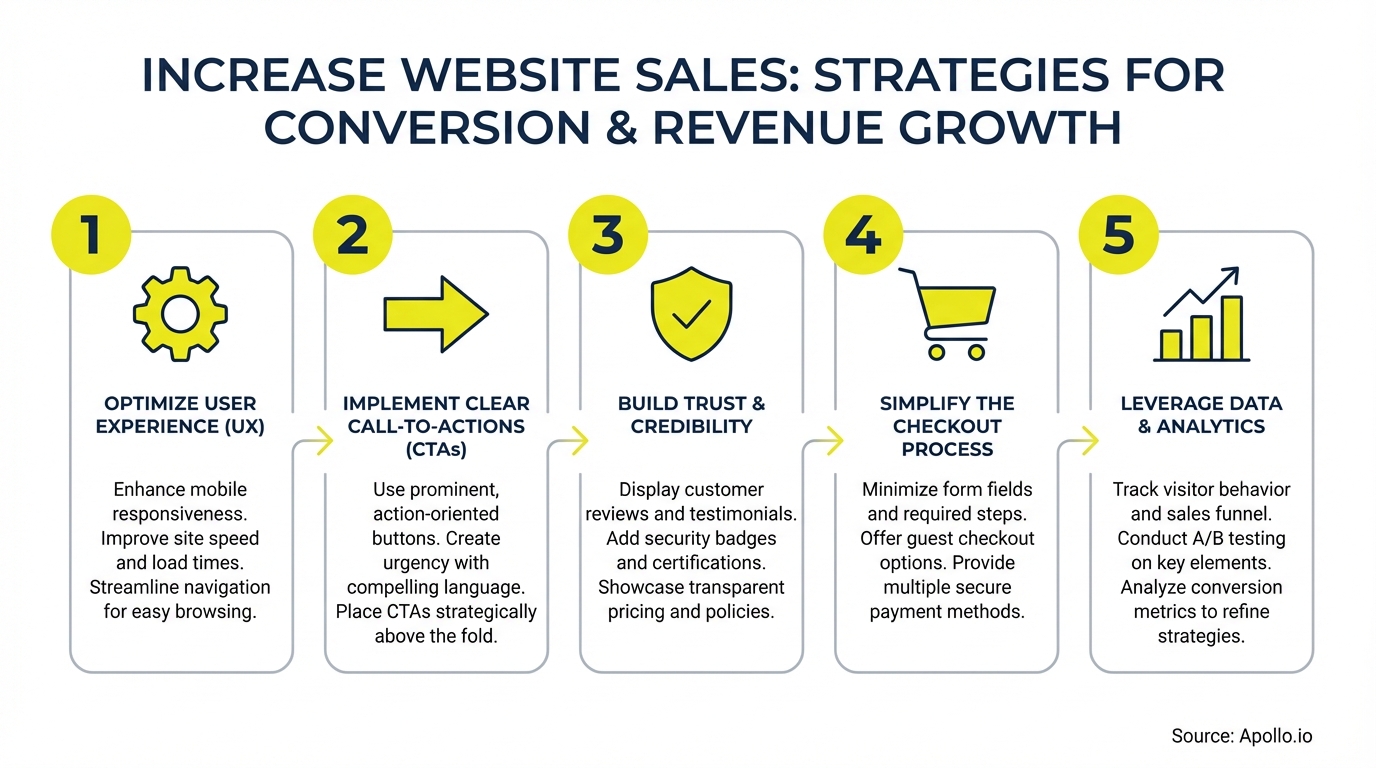
To increase website sales in 2026, implement these five actions:
- Redesign your IA around buyer roles, not product features.
- Establish a single source of truth that aligns web copy and sales messaging.
- Deploy ROI calculators and implementation guides as ungated late-stage assets.
- Replace hard gates on top-of-funnel content with progressive profiling.
- Measure content-influenced pipeline monthly and adjust based on closed-won data.
Apollo gives B2B GTM teams a unified platform to connect website intent signals to outbound action, enriched contact data, and multi-channel sequences in one workspace. Customers like Predictable Revenue report "we reduced the complexity of three tools into one." Ready to turn more website visitors into closed deals? Start Prospecting with Apollo for free.
Prove Pipeline ROI Before Next Quarter
ROI pressure killing your tool budget before it even starts? Apollo delivers measurable pipeline impact fast — Leadium 3x'd annual revenue and GTM Ops drives 4x more meetings. Start free and show results immediately.
Start Free with Apollo →Don't miss these
Sales
Inbound vs Outbound Marketing: Which Strategy Wins?
Sales
What Is a Sales Funnel? The Non-Linear Revenue Framework for 2026
Sales
What Is a Go-to-Market Strategy? The 2026 GTM Playbook
See Apollo in action
We'd love to show how Apollo can help you sell better.
By submitting this form, you will receive information, tips, and promotions from Apollo. To learn more, see our Privacy Statement.
4.7/5 based on 9,690 reviews
